
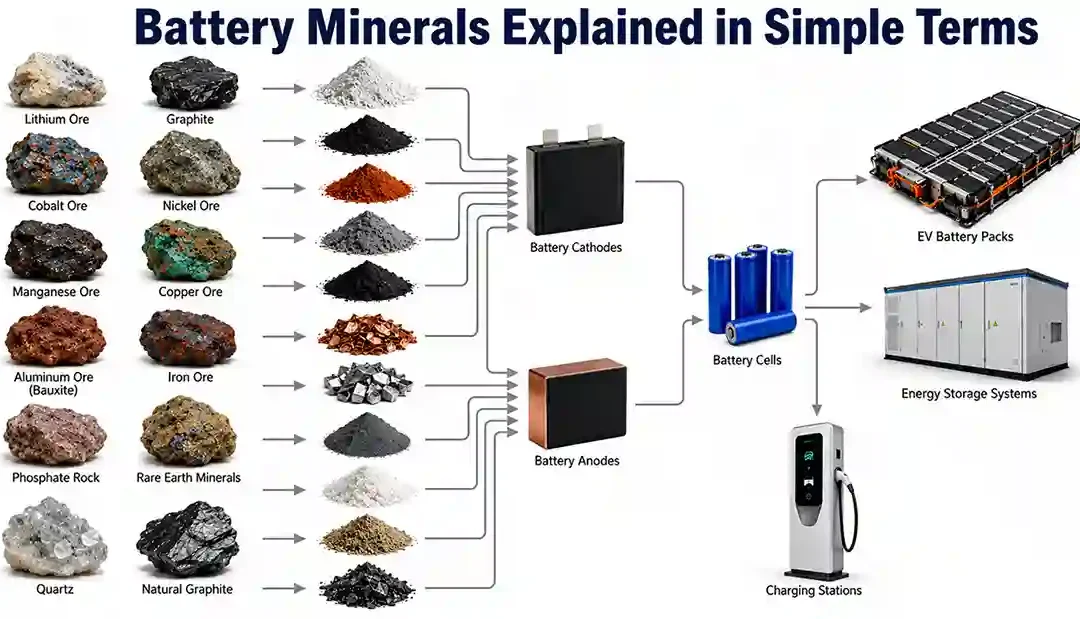
Rechargeable batteries have become one of the most important technologies in modern society. They power smartphones, laptops, electric vehicles (EVs), renewable energy storage systems, and countless portable electronic devices. Behind every battery is a group of naturally occurring minerals extracted from the Earth's crust.
Battery minerals are the raw materials used to manufacture battery electrodes, electrolytes, current collectors, and structural components. Each mineral contributes unique chemical and physical properties that determine battery capacity, charging speed, lifespan, and safety.
Understanding battery minerals helps explain the strong connection between geology, mining, chemistry, materials science, and the global transition to clean energy.
This topic should be studied together with Minerals in Paint, Mineralogy, Minerals in Electronics, Minerals in Smartphones, and Minerals in Agriculture.
Why Batteries Depend on Minerals
Battery technologies require minerals because they provide:
- Energy storage
- Electrical conductivity
- Chemical stability
- Fast charging capability
- High energy density
- Long battery life
- Thermal stability
- Structural strength
Without these minerals, modern rechargeable batteries would not function efficiently.
Major Battery Minerals
Lithium
Common uses:
- Lithium-ion batteries
- Electric vehicles
- Grid-scale energy storage
Importance:
Lithium is the primary element used for storing electrical energy in rechargeable batteries.
Graphite
Common uses:
- Battery anodes
- Lithium-ion batteries
Importance:
Graphite forms the anode in most lithium-ion batteries and enables efficient charging and discharging.
Cobalt
Common uses:
- Battery cathodes
- Electric vehicle batteries
Importance:
Cobalt improves battery stability, safety, and lifespan.
Nickel
Common uses:
- High-energy battery cathodes
- Electric vehicles
Importance:
Nickel increases battery energy density and extends driving range.
Manganese
Common uses:
- Battery cathodes
- Rechargeable batteries
Importance:
Manganese improves battery safety, durability, and performance.
Copper
Common uses:
- Battery current collectors
- Electrical connections
Importance:
Copper efficiently transfers electrical current inside battery cells.
Aluminum (Bauxite)
Common uses:
- Battery casings
- Cathode current collectors
Importance:
Aluminum is lightweight, corrosion-resistant, and helps dissipate heat.
Iron
Common uses:
- Lithium Iron Phosphate (LFP) batteries
Importance:
Iron provides excellent thermal stability and long battery life.
Phosphate Rock
Common uses:
- Lithium Iron Phosphate (LFP) cathodes
Importance:
Phosphate improves battery safety and chemical stability.
Rare Earth Elements
Common uses:
- Battery technologies
- Electric motors associated with EV systems
Importance:
Rare earth elements support advanced energy technologies and high-performance electric systems.
Quartz (Silica)
Common uses:
- Battery manufacturing equipment
- Electronic components
Importance:
High-purity silica supports semiconductor and battery manufacturing processes.
Natural Graphite
Common uses:
- Battery anodes
Importance:
Natural graphite remains one of the most critical minerals for lithium-ion batteries.
Battery Minerals by Application
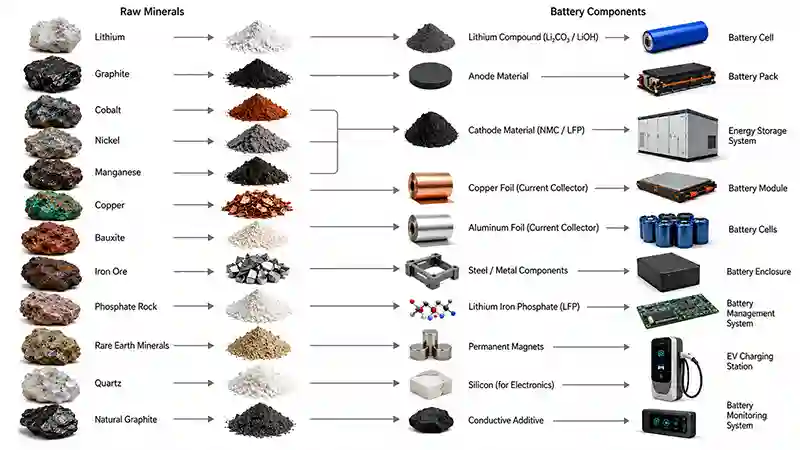
| Battery Component | Major Minerals |
|---|---|
| Anode | Graphite |
| Cathode | Lithium, Nickel, Cobalt, Manganese, Iron, Phosphate |
| Current Collectors | Copper, Aluminum |
| Battery Case | Aluminum, Steel |
| Battery Management Electronics | Copper, Quartz, Gold |
| Energy Storage Systems | Lithium, Graphite, Nickel |
| Electric Vehicle Batteries | Lithium, Graphite, Nickel, Cobalt, Manganese |
From Mine to Battery
Battery minerals pass through several stages before becoming rechargeable batteries.
- Minerals are extracted from mines.
- Ores are refined into high-purity materials.
- Battery-grade chemicals are produced.
- Electrodes and battery cells are manufactured.
- Battery packs are assembled.
- Batteries are installed in electric vehicles, electronics, and energy storage systems.
- Used batteries are collected and recycled.
This process connects geology directly to modern energy storage.
How Battery Minerals Support Energy Storage
Different minerals perform different functions.
Energy Storage
- Lithium
Battery Anodes
- Graphite
Battery Cathodes
- Nickel
- Cobalt
- Manganese
- Iron
- Phosphate
Electrical Conductors
- Copper
- Aluminum
Supporting Materials
- Quartz
- Rare Earth Elements
Together, these minerals make modern rechargeable batteries possible.
Geological Importance
Economic geologists study mineral deposits that supply the battery industry.
Research includes:
- Critical mineral exploration
- Ore deposit geology
- Sustainable mining
- Resource assessment
- Mineral processing
These studies help secure long-term supplies of essential battery minerals.
Laboratory Investigation
Battery minerals are analyzed using:
- X-Ray Fluorescence (XRF)
- X-Ray Diffraction (XRD)
- ICP-MS
- ICP-OES
- Atomic Absorption Spectroscopy (AAS)
- Scanning Electron Microscopy (SEM)
These techniques determine mineral composition, purity, and suitability for battery manufacturing.
Applications
Battery minerals are essential for:
- Electric vehicles
- Smartphones
- Laptops
- Tablets
- Grid-scale energy storage
- Solar battery systems
- Wind energy storage
- Portable electronics
- Backup power systems
- Industrial batteries
Advantages of Studying Battery Minerals
Understanding battery minerals helps:
- Support clean energy technologies
- Improve battery performance
- Strengthen critical mineral supply chains
- Promote sustainable resource management
- Advance electric transportation
- Improve energy security
Limitations
Despite their importance, battery minerals present several challenges.
- Mining can affect ecosystems.
- Demand is increasing rapidly.
- Supply chains are concentrated in a limited number of countries.
- Battery-grade processing requires advanced technology.
- Recycling infrastructure continues to expand.
For a broader understanding, study this topic together with:
- Economic Geology
- Mineralogy
- Materials Science
- Electrochemistry
- Energy Resources
- Mining Engineering
- Environmental Geology
- Sustainability
Comparison Table
| Mineral | Primary Battery Use | Main Benefit |
| Lithium | Energy Storage | High Energy Density |
| Graphite | Anode | Efficient Charging |
| Cobalt | Cathode | Stability |
| Nickel | Cathode | Higher Capacity |
| Manganese | Cathode | Safety |
| Copper | Current Collector | Electrical Conductivity |
| Aluminum | Battery Case & Cathode Collector | Lightweight |
| Iron | LFP Batteries | Long Lifespan |
| Phosphate | LFP Cathodes | Thermal Stability |
| Quartz | Manufacturing | High Purity Materials |
Summary Table
| Feature | Battery Minerals |
| Main Purpose | Rechargeable Battery Manufacturing |
| Major Minerals | Lithium, Graphite, Nickel, Cobalt |
| Key Applications | EVs, Energy Storage, Electronics |
| Study Methods | XRF, XRD, ICP-MS, SEM |
| Geological Importance | Economic Geology and Critical Minerals |
Battery minerals are naturally occurring minerals used to manufacture rechargeable batteries for electric vehicles, consumer electronics, and renewable energy storage systems.
Lithium is one of the most important battery minerals because it enables high energy density and efficient rechargeable battery performance.
Graphite forms the anode in most lithium-ion batteries, allowing lithium ions to move efficiently during charging and discharging.
Nickel increases battery capacity, while cobalt improves stability, safety, and battery lifespan.
Battery minerals are considered critical because they are essential for electric vehicles, renewable energy storage, and the global transition to clean energy.
Final Thoughts
Battery minerals are the foundation of modern energy storage technologies. Lithium, graphite, nickel, cobalt, manganese, copper, aluminum, iron, and phosphate each play specialized roles in rechargeable batteries used in electric vehicles, renewable energy systems, and consumer electronics. These geological resources enable cleaner transportation, reliable electricity storage, and the continued growth of advanced technologies.
As demand for batteries continues to rise, responsible mining, improved recycling, and sustainable management of critical minerals will become increasingly important. Understanding battery minerals provides valuable insight into the connection between geology, energy, and the future of sustainable technology.
Continue Learning
Continue exploring related topics: