
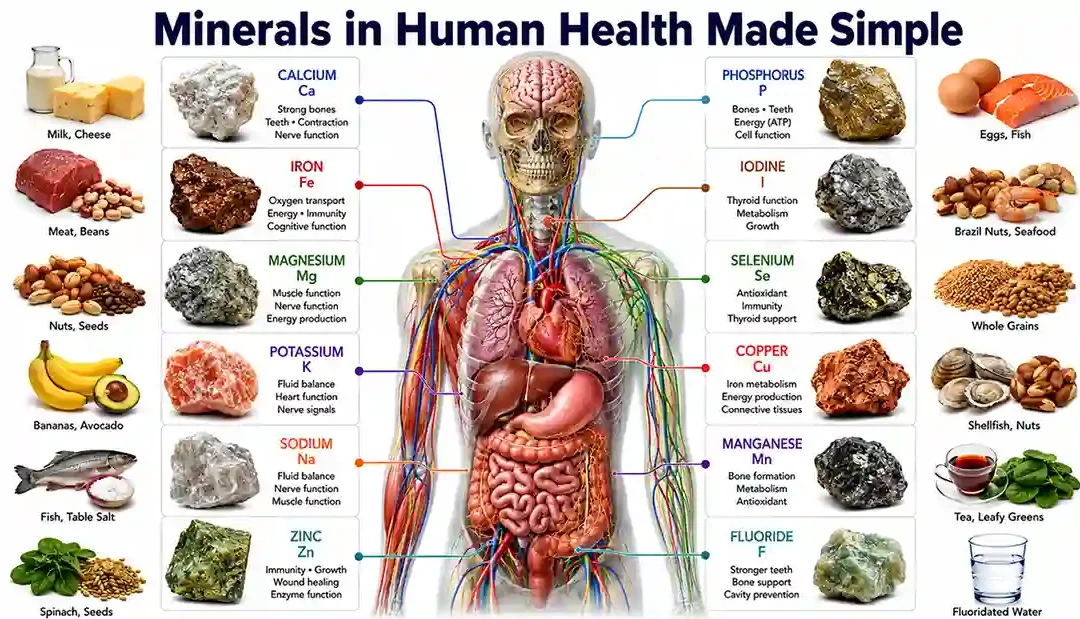
Minerals are essential inorganic nutrients that the human body requires for normal growth, development, and survival. Unlike vitamins, proteins, carbohydrates, and fats, minerals originate from rocks and soils before entering the food chain through plants, animals, and water.
Minerals in human health regulate thousands of biological processes, including bone formation, oxygen transport, nerve communication, muscle contraction, hormone production, enzyme activity, immune defense, and cellular metabolism. Although the body requires only small quantities of many minerals, deficiencies or excessive intake can significantly affect health.
Understanding the role of minerals in human health demonstrates the close relationship between geology, nutrition, medicine, agriculture, and environmental science.
This topic should be studied together with Minerals in Food, Mineralogy, and Geochemistry.
Why Human Health Depends on Minerals
Every cell in the human body requires minerals to function properly.
Essential minerals help:
- Build bones and teeth
- Carry oxygen throughout the body
- Support muscle movement
- Regulate nerve signals
- Produce hormones
- Activate enzymes
- Maintain fluid balance
- Strengthen the immune system
Without adequate mineral intake, many body systems cannot function efficiently.
Major Minerals Essential for Human Health
Calcium
Main food sources:
- Milk
- Cheese
- Yogurt
- Leafy green vegetables
Functions:
- Bone formation
- Tooth development
- Muscle contraction
- Blood clotting
Importance:
Nearly 99% of the body's calcium is stored in bones and teeth.
Phosphorus
Main food sources:
- Fish
- Meat
- Dairy
- Eggs
Functions:
- Bone mineralization
- DNA synthesis
- Energy production
Importance:
Phosphorus works together with calcium to maintain strong bones.
Iron
Main food sources:
- Red meat
- Beans
- Spinach
- Lentils
Functions:
- Hemoglobin production
- Oxygen transport
Importance:
Iron deficiency is one of the world's most common nutritional deficiencies.
Magnesium
Main food sources:
- Nuts
- Seeds
- Whole grains
- Green vegetables
Functions:
- Enzyme activation
- Muscle function
- Heart rhythm
- Bone health
Importance:
Magnesium participates in more than 300 biochemical reactions.
Potassium
Main food sources:
- Bananas
- Potatoes
- Tomatoes
- Avocados
Functions:
- Muscle contraction
- Nerve transmission
- Blood pressure regulation
Importance:
Potassium supports cardiovascular health.
Sodium
Main food sources:
- Table salt
- Seafood
- Processed foods
Functions:
- Fluid balance
- Nerve impulses
- Muscle function
Importance:
Both deficiency and excess sodium intake can affect health.
Zinc
Main food sources:
- Seafood
- Beef
- Pumpkin seeds
- Legumes
Functions:
- Immune function
- Cell growth
- Wound healing
Importance:
Zinc is essential for normal growth and tissue repair.
Iodine
Main food sources:
- Seaweed
- Seafood
- Iodized salt
Functions:
- Thyroid hormone production
Importance:
Iodine regulates metabolism and supports brain development.
Selenium
Main food sources:
- Brazil nuts
- Fish
- Eggs
Functions:
- Antioxidant defense
- Thyroid function
Importance:
Selenium protects cells from oxidative stress.
Copper
Main food sources:
- Nuts
- Shellfish
- Whole grains
Functions:
- Iron metabolism
- Connective tissue formation
- Nervous system function
Importance:
Copper supports healthy blood vessels and red blood cell formation.
Manganese
Main food sources:
- Whole grains
- Tea
- Nuts
Functions:
- Bone formation
- Enzyme activation
- Metabolism
Importance:
Manganese contributes to healthy skeletal development.
Fluoride
Main food sources:
- Drinking water
- Tea
- Seafood
Functions:
- Tooth enamel protection
- Bone health
Importance:
Fluoride helps reduce tooth decay.
Minerals by Body System
| Body System | Essential Minerals |
|---|---|
| Skeletal System | Calcium, Phosphorus, Magnesium, Fluoride |
| Muscular System | Potassium, Calcium, Magnesium, Sodium |
| Nervous System | Sodium, Potassium, Magnesium |
| Blood | Iron, Copper |
| Immune System | Zinc, Selenium |
| Thyroid | Iodine, Selenium |
| Cardiovascular System | Potassium, Magnesium |
| Teeth | Calcium, Fluoride, Phosphorus |
Major and Trace Minerals
Major Minerals
Required in relatively large amounts.
Include:
- Calcium
- Phosphorus
- Potassium
- Sodium
- Magnesium
- Chloride
- Sulfur
Trace Minerals
Needed in much smaller amounts.
Include:
- Iron
- Zinc
- Copper
- Selenium
- Iodine
- Manganese
- Fluoride
- Chromium
- Molybdenum
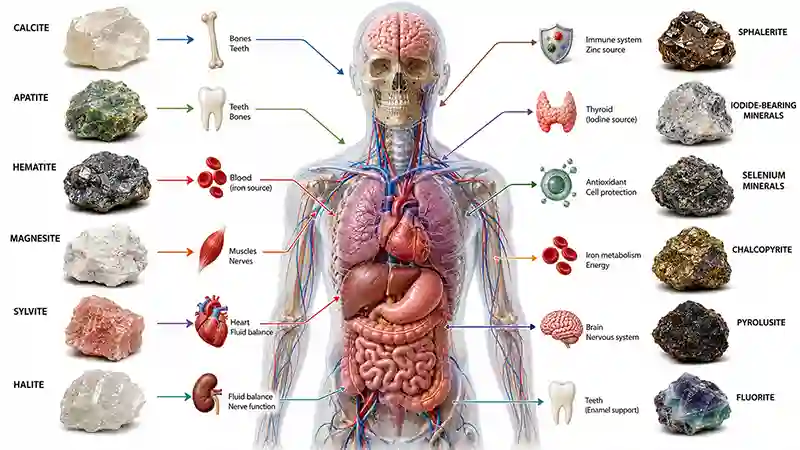
From Rocks to Human Health
Essential minerals follow a natural geological pathway before reaching the human body.
- Rocks weather into soils.
- Minerals dissolve into soil and groundwater.
- Plants absorb mineral nutrients.
- Animals consume plants.
- Humans eat plants, animals, and drink water.
- Minerals support human growth and health.
This natural cycle demonstrates the connection between Earth's geology and human biology.
Mineral Deficiencies and Health
Insufficient mineral intake may lead to various health problems.
Examples include:
| Mineral | Possible Deficiency |
| Iron | Iron-deficiency anemia |
| Calcium | Weak bones, osteoporosis |
| Iodine | Goiter, thyroid disorders |
| Zinc | Poor immunity |
| Magnesium | Muscle cramps |
| Potassium | Muscle weakness |
| Fluoride | Increased tooth decay |
A balanced diet usually provides adequate mineral intake for healthy individuals.
Geological Importance
Medical geologists and geochemists study how Earth's mineral resources influence human health.
They investigate:
- Soil mineral composition
- Drinking water quality
- Trace element distribution
- Agricultural nutrient availability
- Environmental exposure to minerals
Their research supports healthier communities and sustainable food systems.
Laboratory Investigation
Minerals involved in human health are analyzed using:
- ICP-MS
- Atomic Absorption Spectroscopy (AAS)
- ICP-OES
- X-Ray Fluorescence (XRF)
- Ion Chromatography
- Clinical blood and urine mineral testing
These methods help evaluate mineral nutrition and diagnose deficiencies.
Applications
Understanding minerals in human health supports:
- Clinical nutrition
- Public health
- Preventive medicine
- Medical research
- Sports nutrition
- Food fortification
- Agriculture
- Environmental health
Advantages of Studying Minerals in Human Health
Understanding essential minerals helps:
- Prevent nutrient deficiencies
- Improve bone health
- Support cardiovascular function
- Strengthen immunity
- Improve child development
- Promote healthy aging
Limitations
Despite their importance, minerals present several nutritional challenges.
- Mineral deficiencies remain common worldwide.
- Excess mineral intake may cause toxicity.
- Soil quality influences food mineral content.
- Certain minerals compete for absorption.
- Dietary habits affect mineral availability.
For a broader understanding, study this topic together with:
- Medical Geology
- Nutrition
- Food Science
- Geochemistry
- Human Physiology
- Environmental Geology
- Agricultural Science
- Mineralogy
Comparison Table
| Mineral | Primary Function | Main Food Sources |
| Calcium | Bones & Teeth | Dairy |
| Iron | Oxygen Transport | Red Meat |
| Magnesium | Enzyme Activity | Nuts |
| Potassium | Muscle Function | Bananas |
| Phosphorus | Energy & Bones | Fish |
| Zinc | Immunity | Seafood |
| Iodine | Thyroid Hormones | Seaweed |
| Selenium | Antioxidant | Brazil Nuts |
| Copper | Iron Metabolism | Nuts |
| Fluoride | Tooth Protection | Drinking Water |
Summary Table
| Feature | Minerals in Human Health |
| Main Purpose | Growth, Metabolism, and Disease Prevention |
| Major Minerals | Calcium, Magnesium, Potassium, Phosphorus |
| Trace Minerals | Iron, Zinc, Selenium, Iodine |
| Study Methods | ICP-MS, AAS, ICP-OES, XRF |
| Geological Importance | Medical Geology and Human Nutrition |
Minerals in human health are inorganic nutrients that support normal body functions, including bone development, oxygen transport, nerve signaling, immune function, and metabolism.
Calcium, phosphorus, potassium, magnesium, iron, zinc, iodine, selenium, sodium, and copper are among the most important essential minerals.
Mineral deficiencies can lead to anemia, weak bones, thyroid disorders, muscle weakness, impaired immunity, poor growth, and other health problems depending on the missing mineral.
Yes. Excessive intake of minerals such as sodium, iron, fluoride, or selenium may cause adverse health effects, so maintaining a balanced intake is important.
Minerals originate from rocks and soils, are absorbed by plants, transferred through the food chain, and finally enter the human body through food and drinking water.
Final Thoughts
Minerals are fundamental to human health, supporting every major body system from bones and muscles to the brain, heart, and immune system. These essential nutrients begin their journey in Earth's rocks and soils before moving through plants, animals, and food into the human body. Calcium strengthens bones, iron carries oxygen, potassium regulates muscles, iodine supports the thyroid, and zinc strengthens immunity.
Understanding the connection between geology, agriculture, nutrition, and medicine highlights why sustainable soil management, balanced diets, and responsible use of natural resources are essential for maintaining healthy populations. Minerals truly form the invisible link between Earth's geology and human well-being.
Continue Learning
Continue exploring related topics: