
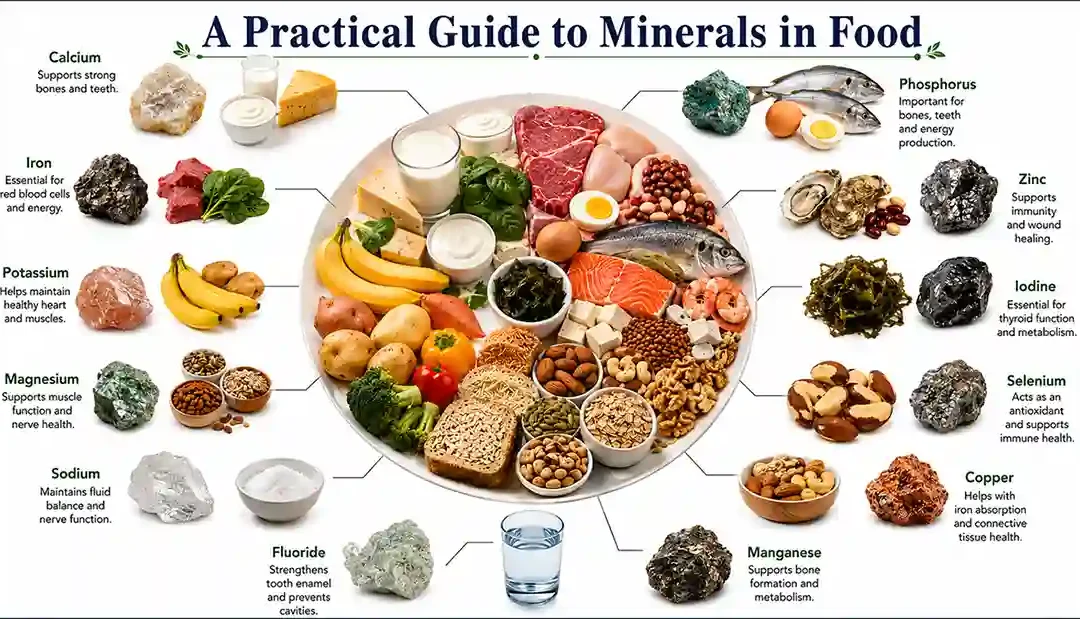
Minerals are essential nutrients that the human body requires to grow, function, and remain healthy. Unlike carbohydrates, proteins, and fats, minerals are inorganic elements naturally found in rocks, soils, and water before entering the food chain through plants and animals.
Minerals in food support hundreds of biological processes, including bone formation, oxygen transport, muscle contraction, nerve signaling, hormone production, enzyme activity, and immune function. Although only small amounts are needed, mineral deficiencies or excesses can significantly affect human health.
Understanding food minerals demonstrates the close relationship between geology, agriculture, nutrition, and medicine.
This topic should be studied together with Mineralogy, Geochemistry, and Evaporite in Minerals.
Why Food Depends on Minerals
Humans cannot produce minerals naturally.
Instead, they obtain them through food and drinking water.
Dietary minerals are responsible for:
- Building bones and teeth
- Carrying oxygen
- Supporting muscles
- Regulating nerves
- Producing hormones
- Maintaining fluid balance
- Strengthening immunity
- Activating enzymes
A balanced diet provides the minerals needed for lifelong health.
Major Minerals Found in Food
Calcium
Main food sources:
- Milk
- Cheese
- Yogurt
- Leafy vegetables
Functions:
- Bone formation
- Teeth development
- Muscle contraction
- Blood clotting
Importance:
Calcium is the most abundant mineral in the human body.
Iron
Main food sources:
- Red meat
- Spinach
- Beans
- Lentils
Functions:
- Hemoglobin production
- Oxygen transport
Importance:
Iron prevents anemia and supports energy production.
Potassium
Main food sources:
- Bananas
- Potatoes
- Tomatoes
- Beans
Functions:
- Nerve signaling
- Muscle contraction
- Blood pressure regulation
Importance:
Potassium supports cardiovascular health.
Magnesium
Main food sources:
- Nuts
- Seeds
- Whole grains
- Green vegetables
Functions:
- Enzyme activation
- Muscle function
- Bone health
Importance:
Magnesium participates in hundreds of biochemical reactions.
Phosphorus
Main food sources:
- Fish
- Meat
- Eggs
- Dairy products
Functions:
- Bone formation
- DNA production
- Energy metabolism
Importance:
Phosphorus works closely with calcium.
Zinc
Main food sources:
- Seafood
- Beef
- Pumpkin seeds
- Legumes
Functions:
- Immune function
- Wound healing
- Cell growth
Importance:
Zinc supports healthy growth and immune defense.
Sodium
Main food sources:
- Table salt
- Processed foods
- Seafood
Functions:
- Fluid balance
- Nerve function
- Muscle contraction
Importance:
Although essential, excessive sodium intake may contribute to high blood pressure.
Iodine
Main food sources:
- Seaweed
- Seafood
- Iodized salt
Functions:
- Thyroid hormone production
Importance:
Iodine supports normal metabolism and brain development.
Selenium
Main food sources:
- Brazil nuts
- Fish
- Eggs
Functions:
- Antioxidant defense
- Thyroid function
Importance:
Selenium protects cells from oxidative damage.
Copper
Main food sources:
- Nuts
- Shellfish
- Whole grains
Functions:
- Iron metabolism
- Connective tissue formation
Importance:
Copper supports healthy blood vessels and nerves.
Manganese
Main food sources:
- Whole grains
- Tea
- Nuts
Functions:
- Bone development
- Enzyme activity
Importance:
Manganese contributes to normal metabolism.
Fluoride
Main food sources:
- Drinking water
- Tea
- Seafood
Functions:
- Tooth enamel protection
Importance:
Fluoride helps prevent tooth decay.
Minerals by Food Group
| Food Group | Major Minerals |
|---|---|
| Dairy | Calcium, Phosphorus |
| Meat | Iron, Zinc, Phosphorus |
| Fish | Iodine, Selenium, Phosphorus |
| Fruits | Potassium |
| Vegetables | Magnesium, Iron, Calcium |
| Whole Grains | Magnesium, Manganese |
| Nuts & Seeds | Magnesium, Zinc, Copper |
| Seaweed | Iodine |
Major and Trace Minerals
Major Minerals
Required in relatively large amounts.
Include:
- Calcium
- Phosphorus
- Potassium
- Sodium
- Magnesium
- Chloride
- Sulfur
Trace Minerals
Needed in much smaller amounts.
Include:
- Iron
- Zinc
- Copper
- Selenium
- Iodine
- Manganese
- Fluoride
- Chromium
- Molybdenum
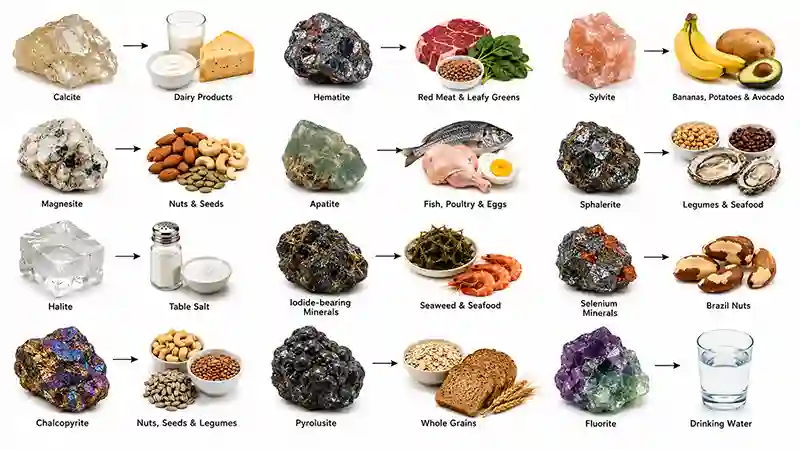
From Rocks to Food
Food minerals enter the human diet through a natural geological cycle.
- Weathering releases minerals from rocks.
- Minerals enter soils and groundwater.
- Plants absorb dissolved nutrients.
- Animals consume plants.
- Humans consume plants and animals.
- Minerals support human health.
This process connects geology directly to nutrition.
Environmental Challenges
Food mineral availability depends on environmental conditions.
Challenges include:
- Soil depletion
- Water contamination
- Climate change
- Agricultural practices
- Mineral-deficient soils
Sustainable farming helps maintain mineral-rich foods.
Mineral Fortification
Some foods are fortified with additional minerals.
Examples include:
- Iodized salt
- Iron-fortified cereals
- Calcium-fortified milk alternatives
- Zinc-enriched foods
Fortification helps reduce nutritional deficiencies.
Geological Importance
Geologists help society by studying:
- Soil mineral composition
- Agricultural geochemistry
- Groundwater quality
- Trace element distribution
- Natural nutrient cycles
Their work supports food security and public health.
Laboratory Investigation
Food minerals are analyzed using:
- ICP-MS
- Atomic Absorption Spectroscopy (AAS)
- X-Ray Fluorescence (XRF)
- Ion Chromatography
- Inductively Coupled Plasma Optical Emission Spectroscopy (ICP-OES)
These methods measure mineral concentrations and food quality.
Applications
Food minerals are essential for:
- Human nutrition
- Infant development
- Sports nutrition
- Public health
- Food fortification
- Agriculture
- Clinical nutrition
- Preventive medicine
Advantages of Studying Food Minerals
Understanding food minerals helps scientists and health professionals:
- Prevent nutrient deficiencies
- Improve food quality
- Support healthy growth
- Enhance agricultural productivity
- Develop fortified foods
- Promote public health
Limitations
Despite their importance, food minerals present several challenges.
- Mineral content varies with soil composition.
- Food processing may reduce mineral levels.
- Some minerals compete for absorption.
- Excess intake of certain minerals may be harmful.
- Global nutrient deficiencies remain a public health concern.
For a broader understanding, study this topic together with:
- Mineralogy
- Geochemistry
- Food Science
- Human Nutrition
- Agricultural Geology
- Environmental Geology
- Medical Geology
- Soil Science
Comparison Table
| Mineral | Main Function | Common Food Sources |
| Calcium | Bones & Teeth | Dairy |
| Iron | Oxygen Transport | Red Meat, Beans |
| Potassium | Muscle Function | Bananas |
| Magnesium | Enzyme Activity | Nuts |
| Phosphorus | Energy & Bones | Fish |
| Zinc | Immunity | Seafood |
| Iodine | Thyroid Function | Seaweed |
| Selenium | Antioxidant | Brazil Nuts |
| Copper | Iron Metabolism | Nuts |
| Manganese | Enzyme Function | Whole Grains |
Summary Table
| Feature | Minerals in Food |
| Main Purpose | Human Nutrition |
| Major Minerals | Calcium, Potassium, Magnesium, Phosphorus |
| Trace Minerals | Iron, Zinc, Iodine, Selenium |
| Study Methods | ICP-MS, AAS, XRF, ICP-OES |
| Geological Importance | Soil Minerals and Nutrient Cycles |
Minerals in food are naturally occurring inorganic nutrients that the body needs for normal growth, metabolism, and overall health.
Calcium, together with phosphorus and magnesium, plays a major role in maintaining healthy bones and teeth.
Iron helps produce hemoglobin, allowing red blood cells to transport oxygen throughout the body.
Bananas, potatoes, tomatoes, beans, avocados, and leafy vegetables are excellent dietary sources of potassium.
Yes. Deficiencies in minerals such as iron, iodine, calcium, or zinc can lead to anemia, thyroid disorders, weakened bones, impaired immunity, and other health problems.
Final Thoughts
Minerals are indispensable nutrients that connect Earth's geology with human health. Weathering releases essential elements from rocks into soils, plants absorb them, animals incorporate them into tissues, and humans obtain them through a balanced diet. Calcium strengthens bones, iron transports oxygen, potassium supports muscles, iodine regulates thyroid function, and many other minerals keep the body functioning normally.
As global populations continue to grow, sustainable agriculture, healthy soils, responsible food fortification, and nutritional education will remain essential for ensuring adequate mineral intake. Understanding the geological origin of dietary minerals highlights the remarkable journey of nutrients from Earth's crust to our dinner plates.
Continue Learning
Continue exploring related topics: