
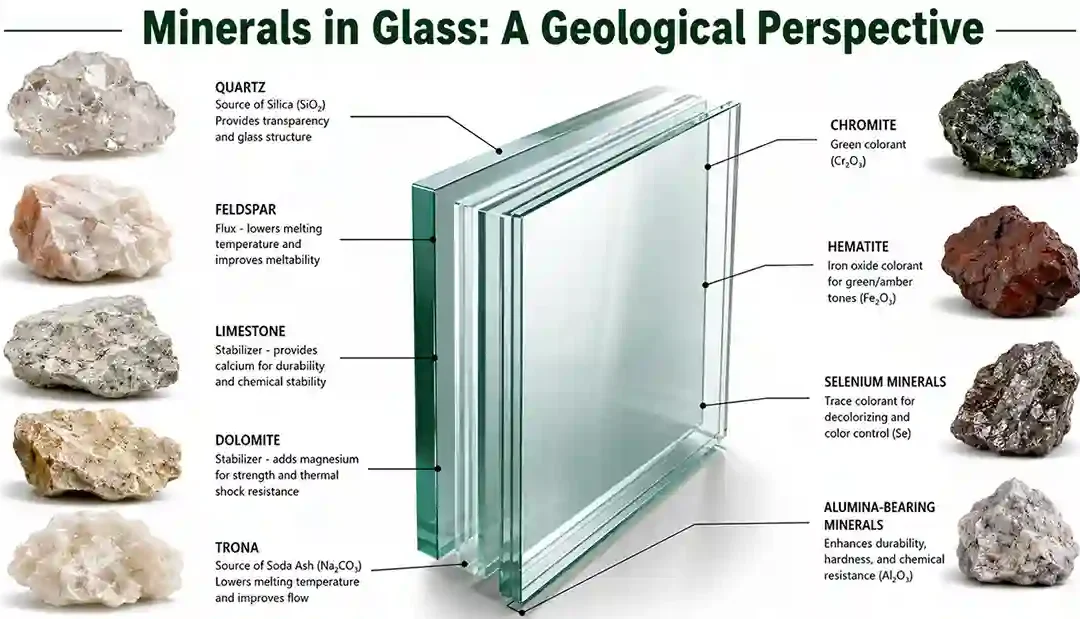
Glass is one of the most versatile materials used by modern society. It is found in windows, bottles, laboratory equipment, smartphones, optical fibers, solar panels, automobiles, and countless electronic devices. Although it appears simple, glass is produced from a carefully controlled mixture of naturally occurring minerals extracted from the Earth's crust.
Minerals in glass provide transparency, strength, chemical resistance, thermal stability, and optical properties. Quartz supplies silica, feldspar improves melting, limestone and dolomite stabilize the glass structure, while several trace minerals create the colors and specialized properties used in decorative and industrial glass.
Understanding these minerals reveals the close relationship between geology, materials science, and modern manufacturing.
This topic should be studied together with Industrial Minerals, Quartz, and Mineralogy.
Why Glass Depends on Minerals
Glass requires minerals with carefully balanced chemical compositions.
These minerals provide:
- Transparency
- Chemical stability
- Mechanical strength
- Heat resistance
- Optical clarity
- Durability
- Color control
Without these minerals, modern glass manufacturing would not be possible.
Major Minerals Used in Glass
Quartz
Main mineral:
- Quartz
Uses:
- Primary silica source
- Window glass
- Optical glass
- Fiberglass
Importance:
Quartz supplies silica (SiO₂), which forms the main structural framework of glass.
Feldspar
Uses:
- Flux
- Glass manufacturing
- Specialty glass
Importance:
Feldspar lowers melting temperatures and improves manufacturing efficiency.
Limestone
Main mineral:
- Calcite
Uses:
- Soda-lime glass
- Container glass
- Flat glass
Importance:
Limestone supplies calcium oxide, improving durability and chemical stability.
Dolomite
Uses:
- Float glass
- Architectural glass
- Automotive glass
Importance:
Dolomite provides magnesium oxide, increasing hardness and resistance to weathering.
Trona
Main mineral:
- Trona
Uses:
- Soda ash production
Importance:
Trona is processed into soda ash, which reduces the melting temperature of silica during glass production.
Kaolin Clay
Uses:
- High-quality specialty glass
- Fiberglass
- Ceramic glass
Importance:
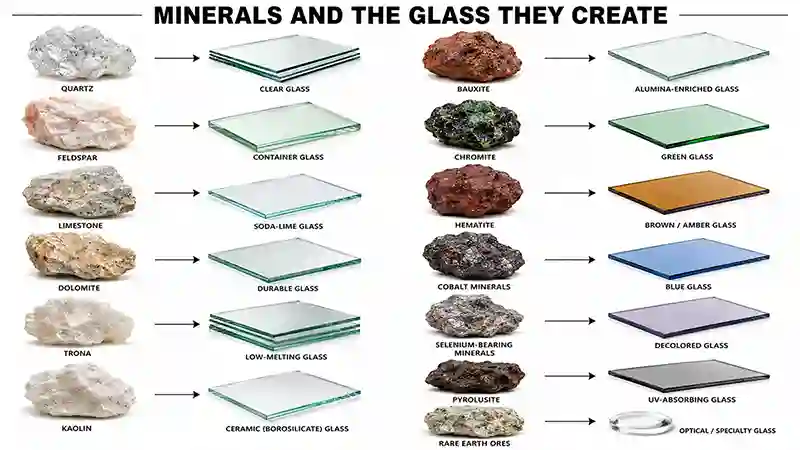
Provides alumina, improving strength and chemical resistance.
Bauxite
Uses:
- Alumina-rich specialty glass
Importance:
Increases hardness and thermal resistance.
Chromite
Uses:
- Green-colored glass
Importance:
Chromium compounds create emerald-green colors used in bottles and decorative glass.
Hematite
Uses:
- Brown, amber, and red glass
Importance:
Iron compounds control color and improve UV protection.
Selenium Minerals
Uses:
- Colorless glass
- Red decorative glass
Importance:
Selenium neutralizes unwanted green tints or creates vibrant red glass.
Cobalt Minerals
Uses:
- Blue glass
Importance:
Cobalt produces intense blue coloration even in very small amounts.
Manganese Minerals
Common source:
- Pyrolusite
Uses:
- Color correction
- Purple decorative glass
Importance:
Manganese removes green coloration caused by iron impurities.
Rare Earth Elements
Common elements:
- Cerium
- Lanthanum
Uses:
- Optical glass
- Camera lenses
- Precision instruments
Importance:
Rare earth elements improve optical performance and UV absorption.
Minerals by Glass Product
| Glass Product | Main Minerals |
|---|---|
| Window Glass | Quartz, Limestone, Dolomite, Trona |
| Bottle Glass | Quartz, Limestone, Soda Ash |
| Fiberglass | Quartz, Kaolin, Limestone |
| Optical Glass | Quartz, Rare Earth Elements |
| Smartphone Glass | Quartz, Alumina, Feldspar |
| Laboratory Glass | Quartz, Boron Compounds, Feldspar |
| Colored Glass | Chromite, Cobalt, Selenium, Hematite |
Types of Glass and Their Mineral Composition
Soda-Lime Glass
Main minerals:
- Quartz
- Limestone
- Trona
Most common type of commercial glass.
Borosilicate Glass
Main ingredients:
- Quartz
- Boron compounds
- Feldspar
Highly resistant to heat and chemicals.
Lead Glass
Main ingredients:
- Quartz
- Lead oxide
Used in crystal glass and radiation shielding.
Aluminosilicate Glass
Main ingredients:
- Quartz
- Alumina
- Feldspar
Used in smartphone screens and aerospace applications.
Optical Glass
Main ingredients:
- Quartz
- Rare earth elements
Used for cameras, microscopes, and telescopes.
From Mine to Glass Product
Glass minerals undergo several production stages.
- Geological exploration
- Mining and quarrying
- Mineral processing
- Batch mixing
- Furnace melting
- Forming and shaping
- Annealing
- Finishing
- Recycling
Each stage transforms natural minerals into finished glass products.
Environmental Challenges
Glass production faces several environmental challenges.
These include:
- High-temperature furnaces
- Carbon emissions
- Mining impacts
- Energy consumption
- Raw material extraction
Modern manufacturing increasingly incorporates recycled glass to reduce these impacts.
Recycling Glass Minerals
Glass is one of the most recyclable industrial materials.
Benefits include:
- Reduced mining
- Lower energy consumption
- Reduced landfill waste
- Lower carbon emissions
- Conservation of mineral resources
Recycled glass (cullet) can replace a significant portion of raw materials.
Geological Importance
Glass manufacturing depends heavily on high-purity industrial minerals.
Geologists help:
- Locate silica sand deposits
- Evaluate limestone quality
- Identify feldspar resources
- Assess industrial mineral reserves
- Improve sustainable resource management
Laboratory Investigation
Glass-making minerals are studied using:
- X-Ray Diffraction (XRD)
- X-Ray Fluorescence (XRF)
- Scanning Electron Microscopy (SEM)
- Petrographic Microscopy
- ICP-MS
- Thermal analysis
These methods determine mineral purity, composition, and suitability for industrial glass production.
Applications
Glass minerals are essential in:
- Buildings
- Automobiles
- Smartphones
- Fiber-optic cables
- Solar panels
- Medical equipment
- Laboratory instruments
- Food packaging
- Consumer electronics
Advantages of Studying Glass Minerals
Understanding glass minerals helps scientists and engineers:
- Improve glass quality
- Develop stronger materials
- Increase recycling efficiency
- Enhance optical performance
- Reduce manufacturing costs
- Support sustainable industrial development
Limitations
Despite their importance, glass minerals present several challenges.
- High-purity silica deposits are limited in some regions.
- Glass manufacturing requires large amounts of energy.
- Mining activities may affect landscapes and ecosystems.
- Some specialty glass compositions depend on scarce minerals.
- Maintaining consistent raw material quality is essential for producing high-performance glass.
For a broader understanding, study this topic together with:
- Industrial Minerals
- Economic Minerals
- Quartz
- Engineering Geology
- Materials Science
- Glass Recycling
- Sustainable Manufacturing
- Mineralogy
Comparison Table
| Mineral | Main Glass Function | Example Product |
| Quartz | Silica framework | Window Glass |
| Feldspar | Flux | Flat Glass |
| Limestone | Stabilizer | Bottle Glass |
| Dolomite | Hardness | Automotive Glass |
| Trona | Soda Ash | Soda-Lime Glass |
| Kaolin | Alumina Source | Fiberglass |
| Chromite | Green Color | Beverage Bottles |
| Cobalt Minerals | Blue Color | Decorative Glass |
| Selenium Minerals | Color Control | Clear and Red Glass |
| Rare Earth Elements | Optical Properties | Camera Lenses |
Summary Table
| Feature | Minerals in Glass |
| Main Purpose | Glass Manufacturing |
| Key Minerals | Quartz, Feldspar, Limestone, Dolomite |
| Specialty Minerals | Chromite, Cobalt, Selenium, Rare Earth Elements |
| Study Methods | XRD, XRF, SEM, Petrography |
| Geological Importance | Industrial Mineral Resources and Glass Production |
Quartz is the most important mineral because it provides silica, the primary component of nearly all commercial glass.
Limestone supplies calcium oxide, which strengthens the glass and improves its resistance to water and chemicals.
Chromium produces green glass, cobalt creates blue glass, selenium creates red glass or removes green tints, while iron compounds produce amber and brown colors.
Yes. Glass can be recycled repeatedly without significant loss of quality, reducing energy use and conserving natural mineral resources.
Impurities can affect the color, transparency, strength, and overall quality of finished glass products.
Final Thoughts
Glass manufacturing depends on a carefully balanced mixture of industrial minerals that provide strength, clarity, durability, and specialized optical properties. Quartz forms the structural framework, while feldspar, limestone, dolomite, and trona improve melting behavior and long-term performance. Additional minerals such as chromium, cobalt, selenium, and rare earth elements create the colors and advanced characteristics required for modern technology.
As demand for high-performance glass continues to grow in construction, electronics, renewable energy, and transportation, sustainable mineral extraction and glass recycling will play an increasingly important role in conserving resources and supporting future innovation.
Continue Learning
Continue exploring related topics: