
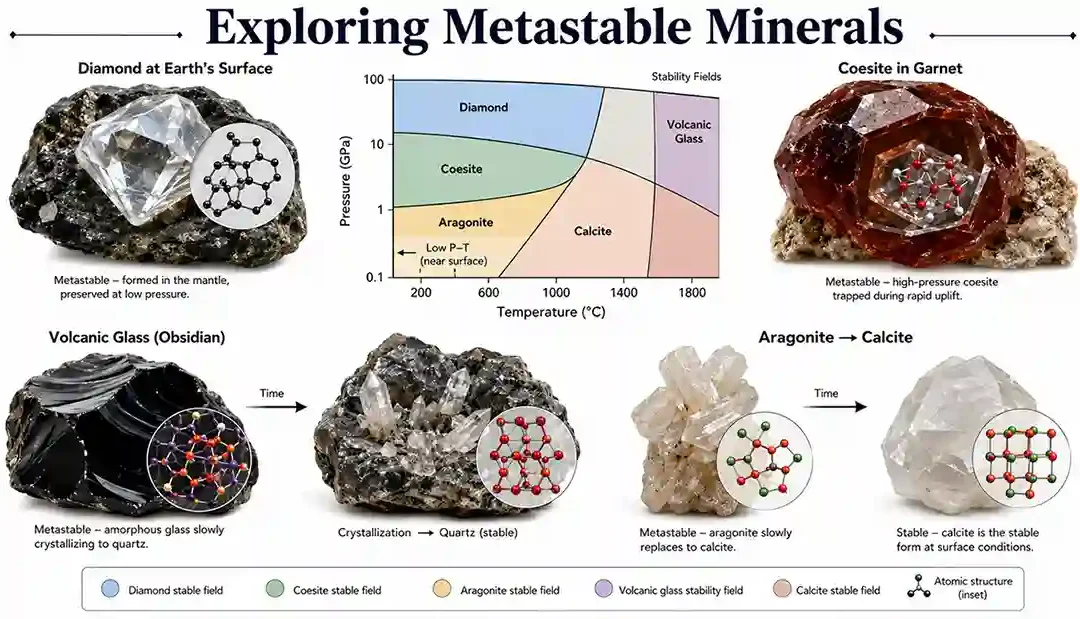
Many minerals continue to exist even after the environmental conditions under which they formed have changed. Although they are no longer the most stable phase, they remain preserved because their transformation into a more stable mineral is extremely slow. These minerals are known as metastable minerals.
Metastability is common in Earth's crust and mantle. Diamonds remain stable for millions of years at Earth's surface despite graphite being the thermodynamically stable form of carbon. Likewise, minerals formed under extreme pressure may survive long after they are brought to the surface.
Understanding metastable minerals helps geologists interpret Earth's history, reconstruct metamorphic conditions, study deep-Earth processes, and understand mineral phase transitions.
This topic should be studied together with Mineral Phase Changes, Mineral Stability, Mineral Polymorphism, and Crystal Structure of Minerals.
What Are Metastable Minerals?
Metastable minerals are minerals that persist outside their equilibrium stability field because the transformation to a more stable phase is extremely slow or requires high activation energy.
Although they are not the most stable minerals under present conditions, they may remain unchanged for thousands or even millions of years.
Stable vs Metastable Minerals
A stable mineral has the lowest free energy under existing environmental conditions.
A metastable mineral has a higher free energy but remains preserved because transformation is kinetically inhibited.
| Stable Minerals | Metastable Minerals |
|---|---|
| Lowest energy state | Higher energy state |
| Naturally favored | Temporarily preserved |
| Stable under current conditions | Formed under different conditions |
| Little tendency to transform | May eventually transform |
Why Do Minerals Become Metastable?
Minerals become metastable because atomic rearrangement often requires:
- Breaking strong chemical bonds
- Large atomic movements
- High activation energy
- Sufficient temperature
- Long periods of time
Without enough energy, transformation proceeds very slowly.
How Metastable Minerals Form
Metastable minerals commonly form when geological conditions change faster than minerals can respond.
Typical situations include:
- Rapid uplift
- Sudden cooling
- Volcanic eruptions
- Meteorite impacts
- High-pressure metamorphism
- Rapid decompression
These events preserve minerals outside their normal stability fields.
Factors Controlling Metastability
Temperature
- Higher temperatures increase atomic mobility and accelerate transformations.
- Lower temperatures often preserve metastable minerals.
Pressure
- Changes in pressure may move minerals outside their equilibrium stability range.
Activation Energy
- Large activation energies slow crystal transformations.
- This is the primary reason many metastable minerals survive.
Grain Size
- Fine-grained minerals usually transform faster because they contain more grain boundaries.
Water
- Water enhances atomic diffusion and often accelerates mineral reactions.
Common Examples of Metastable Minerals
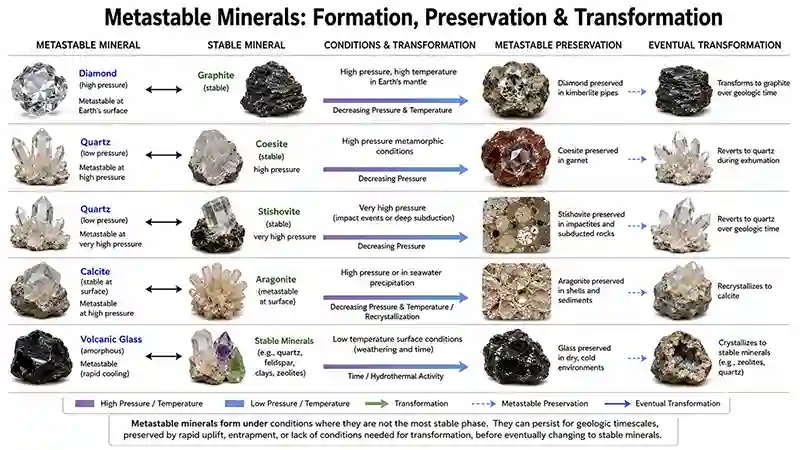
Diamond
- Stable at very high pressure
- Metastable at Earth's surface
- Eventually transforms into graphite, but extremely slowly
Coesite
- High-pressure form of quartz
- Preserved inside garnet or eclogite
- Indicates ultra-high-pressure metamorphism
Stishovite
- Extremely high-pressure silica polymorph
- Common in meteorite impact structures
- Metastable after pressure is released
Aragonite
- Higher-pressure polymorph of calcium carbonate
- Often preserved in marine shells
- Slowly transforms into calcite
Volcanic Glass (Obsidian)
- Metastable amorphous material
- Gradually crystallizes into stable minerals over geological time
Wadsleyite and Ringwoodite
- Stable in Earth's mantle
- May become metastable if rapidly transported toward the surface
Metastability in Earth's Interior
Metastable minerals are especially important in subduction zones.
Cold oceanic plates may transport minerals deep into the mantle before they transform.
These delayed transformations affect:
- Earthquakes
- Mantle convection
- Seismic wave velocities
- Plate tectonics
Geological Importance
Metastable minerals help geologists:
- Identify ancient pressure conditions
- Reconstruct metamorphic history
- Recognize impact events
- Understand mantle processes
- Study tectonic evolution
Their presence often records geological environments that no longer exist.
Laboratory Investigation
Scientists investigate metastable minerals using:
- Diamond Anvil Cells
- High-Pressure Experiments
- X-Ray Diffraction (XRD)
- Raman Spectroscopy
- Electron Microprobe Analysis
- Transmission Electron Microscopy (TEM)
- Differential Scanning Calorimetry (DSC)
These techniques measure crystal structures, transformation rates, and stability limits.
Applications
Understanding metastable minerals is important in:
- Mineralogy
- Petrology
- Metamorphic Geology
- Geophysics
- Planetary Science
- Materials Science
- Gemology
- High-Pressure Physics
Advantages of Studying Metastable Minerals
Studying metastable minerals helps scientists:
- Reconstruct ancient geological conditions
- Understand mineral transformation rates
- Interpret subduction processes
- Explain deep-focus earthquakes
- Discover high-pressure minerals
- Improve advanced ceramic and industrial materials
Limitations
Metastable minerals can be challenging to interpret because:
- They may transform during sample preparation.
- Some occur only as microscopic inclusions.
- Transformation rates vary widely with temperature and water content.
- Laboratory experiments may not perfectly reproduce natural geological timescales.
For a broader understanding, study this topic together with:
- Mineral Phase Changes
- Mineral Stability
- Mineral Polymorphism
- Crystal Structure of Minerals
- Metamorphism and Minerals
- High-Pressure Mineralogy
- Earth's Interior
- Petrology
Comparison Table
| Mineral | Stable Conditions | Metastable Environment |
| Diamond | High Pressure Mantle | Earth's Surface |
| Coesite | Ultra-High Pressure | Metamorphic Rocks |
| Stishovite | Extreme Pressure | Impact Structures |
| Aragonite | High Pressure | Marine Sediments |
| Obsidian | Rapid Cooling | Gradually Crystallizes |
| Ringwoodite | Mantle Transition Zone | Rapid Uplift |
Summary Table
| Feature | Metastable Minerals |
| Definition | Minerals Existing Outside Their Equilibrium Stability Field |
| Main Cause | High Activation Energy |
| Key Controls | Temperature, Pressure, Water, Time |
| Common Examples | Diamond, Coesite, Aragonite, Obsidian |
| Geological Importance | Metamorphism, Mantle Processes, Mineral Stability |
Metastable minerals are minerals that remain preserved outside their equilibrium stability conditions because their transformation into a more stable phase is extremely slow.
Diamond is stable at high pressures deep within Earth's mantle. At Earth's surface, graphite is the stable form of carbon, but diamond remains because the transformation requires a large amount of activation energy.
They are preserved when environmental conditions change faster than the mineral can transform or when the energy required for atomic rearrangement is too high.
They are found in metamorphic rocks, subduction zones, impact structures, volcanic rocks, and some sedimentary environments.
Scientists use X-ray diffraction, Raman spectroscopy, electron microscopy, high-pressure experiments, and geochemical analyses to identify metastable phases and determine their stability.
Final Thoughts
Metastable minerals demonstrate that mineral stability depends not only on pressure and temperature but also on the rate at which atoms can reorganize into new crystal structures. Their persistence provides valuable evidence of past geological environments, deep-Earth processes, and rapid tectonic events. From diamonds preserved at Earth's surface to coesite trapped within metamorphic rocks, metastable minerals serve as natural records of conditions that once existed deep inside our planet.
By studying metastability alongside mineral phase changes, crystal structures, and high-pressure mineralogy, geologists gain deeper insight into Earth's dynamic evolution and the remarkable ability of minerals to preserve geological history over immense spans of time.
Continue Learning
Continue exploring mineral transformations with these related guides: