
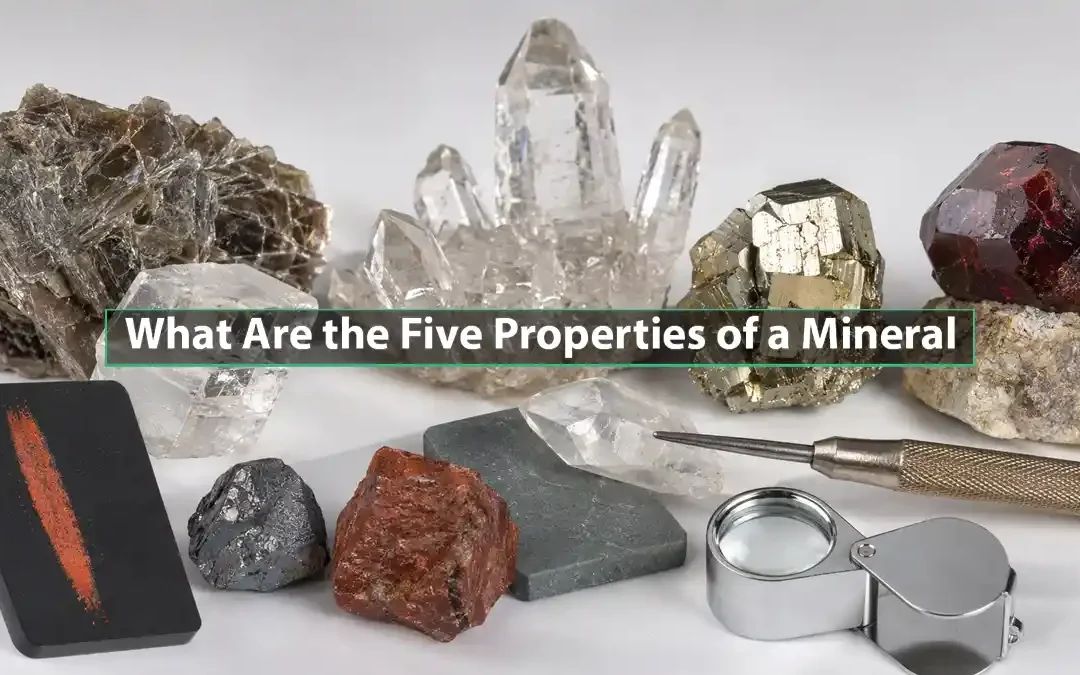
Minerals are everywhere around us—from the quartz in a wristwatch to the graphite in a pencil. Yet when geologists pick up a mineral sample, they do not identify it based on color alone. Instead, they look at a set of physical properties that reveal what the mineral really is.
If you've ever wondered how scientists can tell the difference between two similar-looking minerals, the answer lies in five important characteristics. These properties act like a mineral's fingerprint, helping geologists identify and classify minerals accurately.
In this guide, you'll learn what the five properties of a mineral are, why they matter, and how they are used in real-world geology.
Why Mineral Properties Matter
Minerals often look similar at first glance. A shiny metallic mineral might resemble another completely different mineral. Color can even change because of impurities.
That is why geologists rely on measurable physical properties rather than appearance alone.
These properties help scientists:
- Identify unknown minerals
- Classify mineral groups
- Understand rock formation
- Explore ore deposits
- Study Earth's geological history
The Five Main Properties of a Mineral
The five most commonly used properties for mineral identification are:
- Hardness
- Luster
- Streak
- Cleavage and Fracture
- Crystal Form (Crystal Habit)
Together, these characteristics provide enough information to identify many common minerals.
1. Hardness: How Resistant Is a Mineral to Scratching?
Hardness measures a mineral's resistance to being scratched.
In 1812, Friedrich Mohs developed the famous Mohs Hardness Scale, which ranks minerals from 1 to 10.
Mohs Hardness Scale
| Mineral | Hardness |
|---|---|
| Talc | 1 |
| Gypsum | 2 |
| Calcite | 3 |
| Fluorite | 4 |
| Apatite | 5 |
| Feldspar | 6 |
| Quartz | 7 |
| Topaz | 8 |
| Corundum | 9 |
| Diamond | 10 |
For example:
- A fingernail has a hardness of about 2.5
- A copper coin is around 3
- Glass is approximately 5.5
If a mineral scratches glass, it is likely harder than 5.5.
One interesting observation is that many beginners assume heavier minerals are harder. In reality, weight and hardness are unrelated.
See our guide mohs-hardness-scale
2. Luster: How Does a Mineral Reflect Light?
Luster describes how light reflects from a mineral's surface.
Geologists usually divide luster into two broad categories:
Metallic Luster
Minerals appear shiny like metal.
Examples:
- Pyrite
- Galena
- Magnetite
Nonmetallic Luster
Minerals do not resemble polished metal.
Common types include:
| Luster Type | Example |
|---|---|
| Glassy (Vitreous) | Quartz |
| Pearly | Muscovite |
| Silky | Gypsum |
| Resinous | Sulfur |
| Dull | Kaolinite |
Luster is often one of the first things geologists notice when examining a specimen.
Learn more mineral-luster-explained
3. Streak: The Mineral's True Color
Many minerals change color due to impurities, weathering, or chemical changes.
Streak reveals the mineral's actual powdered color by rubbing it across an unglazed porcelain plate.
Examples
| Mineral | Visible Color | Streak Color |
|---|---|---|
| Hematite | Silver or Black | Red-Brown |
| Pyrite | Gold | Greenish Black |
| Magnetite | Black | Black |
This simple test often solves identification problems that color alone cannot.
A famous example is hematite. It may look metallic silver but always leaves a reddish-brown streak.
See our guide mineral-color-and-streak
4. Cleavage and Fracture: How a Mineral Breaks
When minerals break, they follow predictable patterns based on their internal atomic structure.
Cleavage
Cleavage occurs when a mineral breaks along flat, smooth planes.
Examples:
- Mica splits into thin sheets
- Halite breaks into cubes
- Calcite forms rhombohedral fragments
Fracture
When minerals do not break along cleavage planes, they fracture.
Common fracture types include:
- Conchoidal fracture (Quartz)
- Uneven fracture
- Fibrous fracture
Quartz is famous for its shell-like conchoidal fracture, which resembles broken glass.
Understanding cleavage often provides clues about a mineral's crystal structure.
Learn more mineral-cleavage-vs-fracture
5. Crystal Form (Crystal Habit): The Mineral's Natural Shape
Crystal form refers to the geometric shape minerals develop during growth.
Minerals grow according to their atomic arrangement, producing characteristic crystal shapes.
Examples
| Mineral | Crystal Habit |
|---|---|
| Quartz | Hexagonal Prisms |
| Pyrite | Cubes |
| Garnet | Dodecahedrons |
| Kyanite | Bladed Crystals |
| Gypsum | Tabular Crystals |
Not every mineral specimen displays perfect crystals, but when they do, crystal habit becomes a powerful identification tool.
You can explore crystal-systems-explained
Comparison Table: The Five Properties at a Glance
| Property | What It Measures | Example |
|---|---|---|
| Hardness | Resistance to scratching | Quartz = 7 |
| Luster | Light reflection | Pyrite = Metallic |
| Streak | Powdered color | Hematite = Red-Brown |
| Cleavage | Breakage pattern | Mica = Sheets |
| Crystal Form | Natural crystal shape | Quartz = Hexagonal |
This combination of tests allows geologists to identify many minerals without advanced laboratory equipment.
Real-World Example: Identifying Quartz
Suppose you find a transparent mineral specimen.
You test it and discover:
- Hardness = 7
- Glassy luster
- White streak
- No cleavage
- Hexagonal crystal shape
These characteristics strongly indicate quartz.
This is exactly how field geologists narrow down mineral identification in places such as Grand Canyon, Iceland volcanic fields, and mountain ranges worldwide.
How Geologists Use These Properties Today
Modern laboratories use advanced techniques such as:
- X-ray diffraction (XRD)
- Electron microscopy
- Spectroscopy
However, the five traditional mineral properties remain essential because they allow quick field identification before laboratory testing.
Even professional geologists still carry hand lenses, streak plates, and hardness tools during fieldwork.
Common Mistakes When Identifying Minerals
Relying Only on Color
Color can vary widely because of impurities.
Ignoring Streak
Streak is often more reliable than surface color.
Confusing Hardness with Density
A dense mineral is not necessarily hard.
Overlooking Crystal Habit
Crystal shape frequently provides important identification clues.
These mistakes are common among beginners and can lead to incorrect identification.
Frequently Asked Questions
The five main properties are hardness, luster, streak, cleavage (or fracture), and crystal form. Geologists use these characteristics to identify minerals.
Hardness is one of the most useful properties because it can be measured easily using the Mohs Hardness Scale.
Color can vary due to impurities, making it less reliable than hardness, streak, or crystal structure.
Streak reveals a mineral's true powdered color and is often more reliable than surface color.
No. Some minerals, such as quartz, do not exhibit cleavage and instead break through fracture patterns.
Conclusion
The five properties of a mineral—hardness, luster, streak, cleavage, and crystal form—serve as the foundation of mineral identification. While advanced laboratory methods exist today, these classic physical properties remain some of the most effective tools for understanding minerals in the field.
The next time you pick up a mineral specimen, try looking beyond its color. A simple scratch test, a streak plate, or a closer look at its crystal shape can reveal a surprising amount about its identity and geological history.