
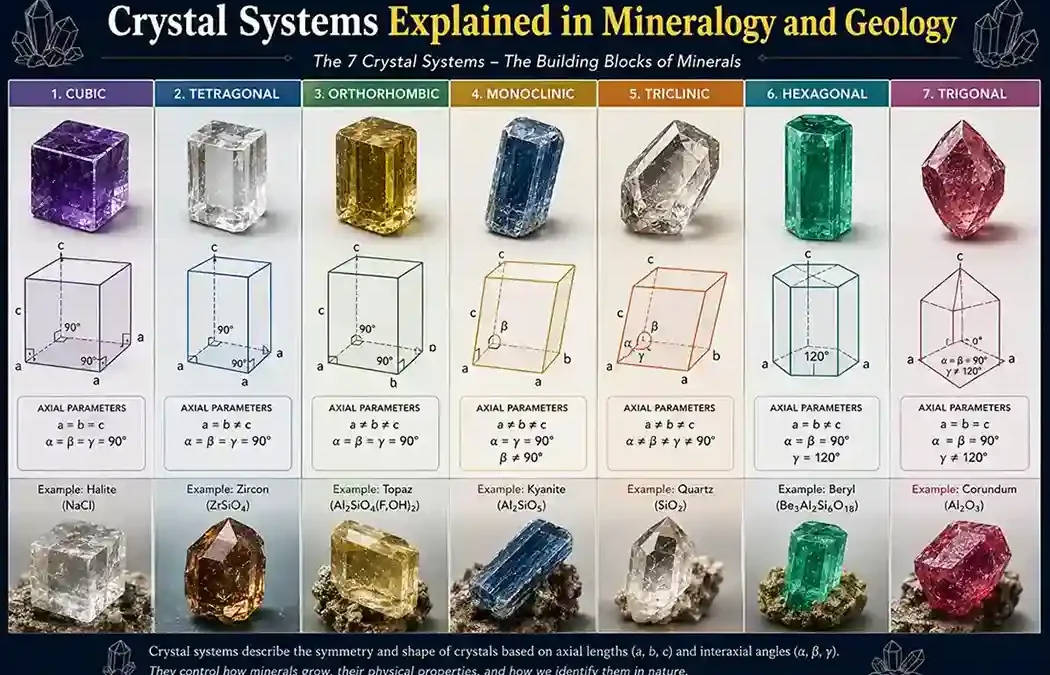
Every mineral crystal grows according to a specific geometric pattern. These patterns are grouped into seven crystal systems, which form the foundation of crystallography and mineral classification.
Crystal systems describe:
- crystal symmetry
- axis lengths
- crystal angles
- atomic arrangement
Geologists use crystal systems to:
- identify minerals
- classify crystal structures
- understand mineral formation
- study crystal growth patterns
Although thousands of minerals exist, all mineral crystals belong to one of seven basic crystal systems.
Learn more → crystal structure in minerals
The Seven Crystal Systems
| Crystal System | Example Mineral |
|---|---|
| Cubic | Halite |
| Tetragonal | Zircon |
| Orthorhombic | Olivine |
| Monoclinic | Gypsum |
| Triclinic | Albite |
| Hexagonal | Quartz |
| Trigonal | Calcite |
What Is a Crystal System?
A crystal system is a method of classifying crystals based on symmetry.
Scientists classify crystals by examining:
- crystal axes
- axis lengths
- intersection angles
- crystal symmetry
Different crystal systems produce different crystal shapes.
Why Crystal Systems Matter
Crystal systems help scientists:
- classify minerals
- understand atomic structure
- predict crystal growth
- identify unknown specimens
They provide a direct connection between internal crystal structure and external crystal shape.
Cubic Crystal System
Characteristics
- Three equal crystal axes
- All angles are 90°
Common Minerals
- Halite
- Pyrite
- Galena
- Diamond
The cubic system produces highly symmetrical cube-shaped crystals.
Tetragonal Crystal System
Characteristics
- Two equal axes
- One longer or shorter axis
- All angles 90°
Common Minerals
- Zircon
- Rutile
Tetragonal crystals often appear elongated compared to cubic crystals.
Orthorhombic Crystal System
Characteristics
- Three unequal axes
- All angles 90°
Common Minerals
- Olivine
- Sulfur
- Topaz
Orthorhombic crystals often form blocky or elongated shapes.
Monoclinic Crystal System
Characteristics
- Three unequal axes
- One angle differs from 90°
Common Minerals
- Gypsum
- Orthoclase Feldspar
- Muscovite
This system is common among many rock-forming minerals.
Triclinic Crystal System
Characteristics
- Three unequal axes
- No angles equal 90°
Common Minerals
- Albite
- Kyanite
- Microcline
Triclinic crystals show the lowest symmetry among the seven systems.
Hexagonal Crystal System
Characteristics
- Four crystal axes
- Six-fold symmetry
Common Minerals
- Quartz
- Beryl
Hexagonal crystals often form six-sided prisms.
Trigonal Crystal System
Characteristics
- Three-fold rotational symmetry
- Closely related to the hexagonal system
Common Minerals
- Calcite
- Hematite
- Corundum
Many important minerals belong to the trigonal system.
Crystal System Comparison
| System | Axis Lengths | Angles |
|---|---|---|
| Cubic | Equal | 90° |
| Tetragonal | Two equal | 90° |
| Orthorhombic | Unequal | 90° |
| Monoclinic | Unequal | One not 90° |
| Triclinic | Unequal | None 90° |
| Hexagonal | Special arrangement | 120° symmetry |
| Trigonal | Three-fold symmetry | Variable |
Crystal Systems and Mineral Identification
Crystal systems help geologists:
- identify minerals
- classify crystal habits
- understand mineral formation
Crystal shape often provides valuable clues before laboratory testing.
Learn more → mineral habit explained
Relative Abundance of Crystal Systems
| Crystal System | Relative Occurrence |
|---|---|
| Monoclinic | Very Common |
| Orthorhombic | Common |
| Hexagonal | Common |
| Trigonal | Common |
| Cubic | Moderate |
| Tetragonal | Less Common |
| Triclinic | Less Common |
Crystal Systems and Crystal Structure
Crystal systems are directly related to crystal structure.
The internal arrangement of atoms determines:
- crystal symmetry
- growth direction
- external crystal form
Understanding crystal systems helps explain why minerals grow into different shapes.
Learn more → crystal structure in minerals
There are seven crystal systems used in mineralogy and crystallography.
Quartz belongs to the hexagonal crystal system.
The cubic crystal system has the highest symmetry.
They help scientists classify minerals and understand crystal growth.
Calcite is one of the best-known trigonal minerals.
Final Thoughts
Crystal systems provide the framework for understanding how minerals grow and why they develop specific crystal shapes. By classifying crystals into seven systems, geologists can identify minerals, study crystal symmetry, and better understand Earth's geological processes.
Crystal systems connect the microscopic world of atomic structures with the visible shapes seen in mineral specimens, making them one of the most important concepts in mineralogy.