
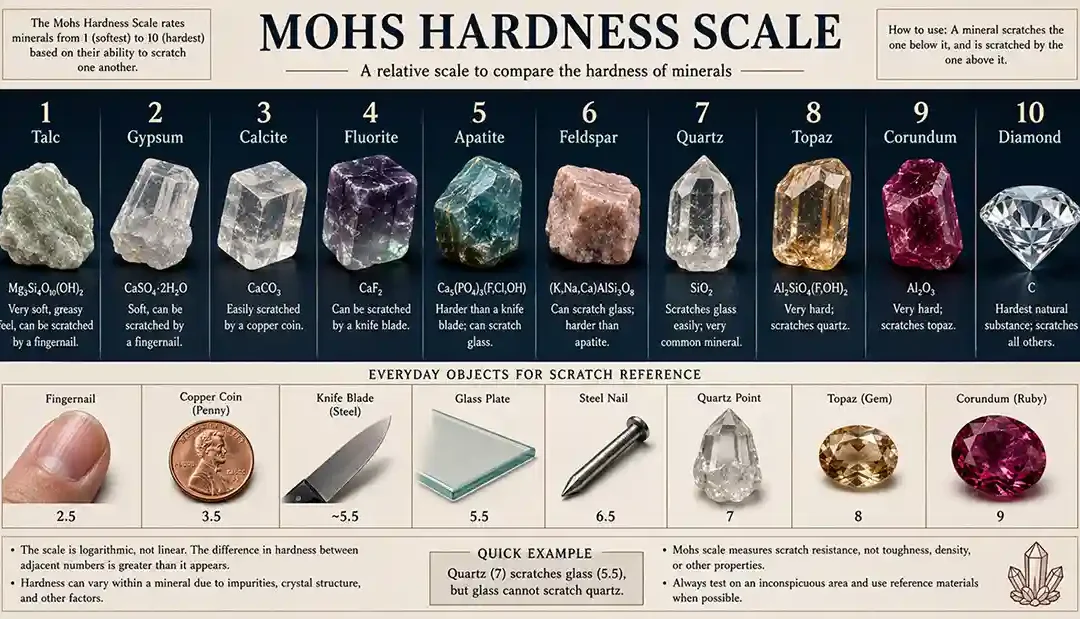
The Mohs Hardness Scale is one of the most widely used systems for identifying minerals. Developed by German mineralogist Friedrich Mohs in 1812, the scale measures a mineral's resistance to scratching.
Instead of using complicated laboratory equipment, geologists can compare minerals using a simple scratch test. The scale ranks ten reference minerals from the softest mineral, talc, to the hardest naturally occurring mineral, diamond.
Today, the Mohs Hardness Scale remains an essential tool in:
- geology
- mineralogy
- mining
- gemology
- Earth science education
Learn more → hardness of minerals
What Is the Mohs Hardness Scale?
The Mohs Hardness Scale is a relative scale used to measure mineral hardness. A harder mineral can scratch a softer mineral.
For example:
- Quartz scratches calcite
- Diamond scratches quartz
The scale contains ten standard minerals arranged from softest to hardest.
The Complete Mohs Hardness Scale
| Hardness | Mineral |
|---|---|
| 1 | Talc |
| 2 | Gypsum |
| 3 | Calcite |
| 4 | Fluorite |
| 5 | Apatite |
| 6 | Orthoclase Feldspar |
| 7 | Quartz |
| 8 | Topaz |
| 9 | Corundum |
| 10 | Diamond |
Visualizing the Mohs Scale
The hardness sequence can be represented as:
1<2<3<4<5<6<7<8<9<10
Each mineral can scratch those below it but cannot scratch those above it.
Hardness 1: Talc
Talc Characteristics
- Softest mineral on the scale
- Easily scratched by a fingernail
- Smooth, greasy feel
Common Uses
- Cosmetics
- Ceramics
- Industrial powders
Hardness 2: Gypsum
Gypsum Characteristics
- Very soft
- Can be scratched by a fingernail
- Common evaporite mineral
Common Uses
- Plaster
- Drywall
- Construction materials
Hardness 3: Calcite
Calcite Characteristics
- Main mineral in limestone
- Reacts with acid
- Softer than glass
Common Uses
- Cement production
- Building stone
- Soil treatment
Learn more → chemical properties of minerals
Hardness 4–6: Intermediate Minerals
| Hardness | Mineral |
|---|---|
| 4 | Fluorite |
| 5 | Apatite |
| 6 | Orthoclase Feldspar |
These minerals are commonly found in:
- igneous rocks
- metamorphic rocks
- hydrothermal deposits
They represent the middle of the hardness scale.
Hardness 7: Quartz
Quartz is one of the most important minerals in geology.
Characteristics
- Hardness of 7
- Scratches glass easily
- Common in many rock types
Quartz is highly resistant to weathering and remains abundant in sediments.
Hardness 8: Topaz
Topaz Characteristics
- Hard gemstone mineral
- Resistant to scratching
- Common in pegmatites and hydrothermal deposits
Topaz is widely used in jewelry because of its durability.
Hardness 9: Corundum
Corundum Characteristics
- Extremely hard
- Second hardest natural mineral
Gemstone Varieties
- Ruby
- Sapphire
Corundum is also used as an industrial abrasive.
Hardness 10: Diamond
Diamond is the hardest naturally occurring mineral.
Characteristics
- Hardness of 10
- Exceptional scratch resistance
- Strong atomic bonding
Uses
- Jewelry
- Cutting tools
- Industrial drilling
Diamond's hardness comes from its extremely strong crystal structure.
Learn more → crystal structure in minerals
Mohs Scale and Everyday Objects
| Object | Approximate Hardness |
|---|---|
| Fingernail | 2.5 |
| Copper Coin | 3 |
| Knife Blade | 5–5.5 |
| Glass | 5.5 |
| Steel File | 6.5 |
These objects can help perform quick field hardness tests.
How Geologists Use the Mohs Scale
Geologists:
- Select a reference mineral or object.
- Attempt a scratch test.
- Compare results with known hardness values.
This method helps identify unknown mineral samples quickly.
Relative Hardness Comparison
HDiamond=10>HCorundum=9>HTopaz=8>HQuartz=7>HFeldspar=6>HCalcite=3>HTalc=1
This comparison shows the relative order of minerals on the Mohs scale.
Limitations of the Mohs Scale
Although useful, the Mohs scale is:
- relative rather than absolute
- not linear
- best suited for field identification
For example:
- Diamond is much harder than corundum
- Yet they differ by only one number
Scientists often use advanced laboratory tests for precise hardness measurements.
Why the Mohs Scale Matters
The Mohs Hardness Scale helps:
- identify minerals
- classify geological materials
- assess gemstone durability
- study weathering resistance
It remains one of the simplest and most effective tools in mineralogy.
Learn more → mineral identification guide
A scale used to rank minerals according to their resistance to scratching.
German mineralogist Friedrich Mohs in 1812.
Talc, with a hardness of 1.
Diamond, with a hardness of 10.
No. It is a relative ranking system rather than a linear measurement scale.
Final Thoughts
The Mohs Hardness Scale is one of the most important tools in mineral identification and geology. By ranking minerals from talc to diamond, it provides a simple and reliable method for comparing scratch resistance.
Whether used in classrooms, geology labs, or fieldwork, the Mohs Scale remains a fundamental part of understanding minerals and their physical properties.