
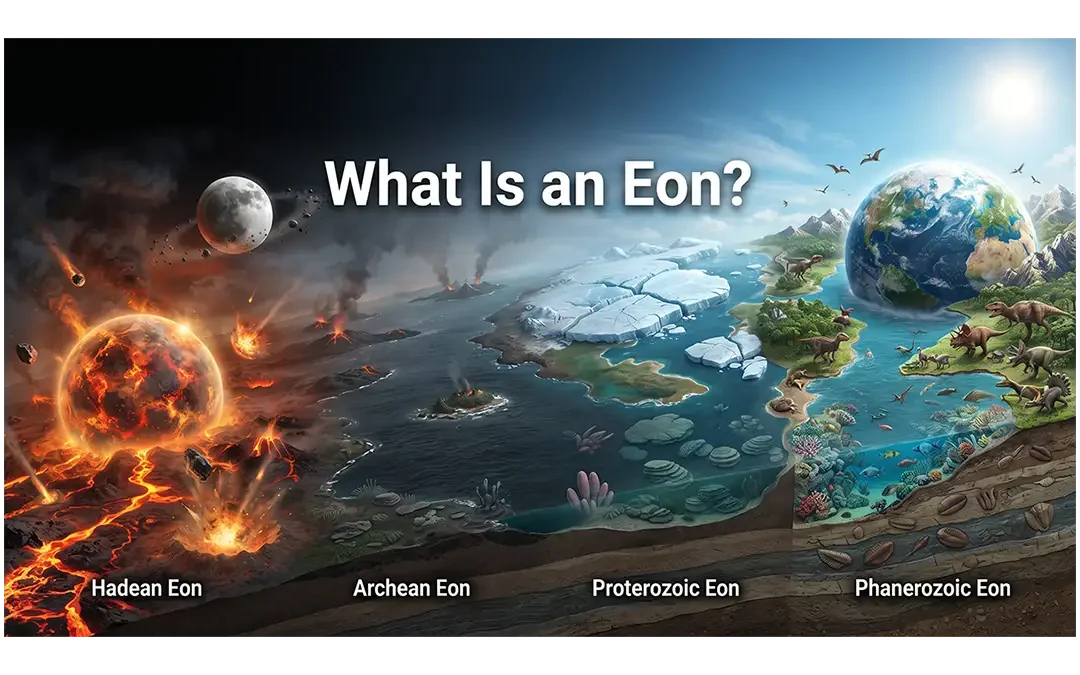
Earth is about 4.6 billion years old. During this enormous span of time, the planet has changed again and again. Continents have formed and moved, oceans have appeared and disappeared, mountains have risen, climates have shifted, and life has evolved from simple organisms into the diverse forms we see today.
To understand this immense history, geologists divide Earth's past into different units of time. The largest formal division of the geologic time scale is called an eon. An eon covers an extremely long period and provides a broad view of major changes in Earth's history.
What Is an Eon?
In geology and geochronology, an eon is the primary, largest formal interval of time on the Geologic Time Scale. Formally defined and maintained by the International Commission on Stratigraphy (ICS), eons categorize the fundamental physical and biological transformations of Earth into broad stages.
An eon is the largest formal unit of geological time used in the geologic time scale. It covers a very long period, usually hundreds of millions to billions of years.
Geologists use eons to organize Earth's history into broad intervals. Each eon contains major changes in the planet's geology, atmosphere, oceans, and life. Eons are further divided into smaller units called eras, which are then divided into periods, and periods are divided into epochs.
A simple way to understand the hierarchy is:
Eon → Era → Period → Epoch
For example, the Phanerozoic Eon contains the Paleozoic, Mesozoic, and Cenozoic eras. These eras are further divided into periods and epochs.
Because an eon covers such a large amount of time, it is useful when scientists want to describe major stages in Earth's long history rather than focus on a relatively short geological interval.
How Long Is an Eon?
In astronomy and informal conversation, the word "eon" (sometimes spelled aeon) is often used casually to describe an indefinite, impossibly long period. In geology, however, an eon has a precise scientific meaning, though it does not have a fixed, standardized number of years.
Instead, an eon's duration is defined by the occurrence of major planetary events. Consequently, the length of Earth's eons varies substantially:
- The Hadean Eon: Lasted approximately 540 million years.
- The Archean Eon: Lasted 1,500 million years.
- The Proterozoic Eon: Lasted nearly 2,000 million years.
- The Phanerozoic Eon: Has lasted 538.8 million years so far.
The first three eons—the Hadean, Archean, and Proterozoic—are collectively known as the Precambrian. Together, they represent roughly 88% of Earth's entire existence.
Eons of Earth's History
Earth's history is officially divided into four distinct eons, arranged here in chronological order from the birth of the planet to modern day:
- Hadean Eon (4.54 Ga - 4.0 Ga)
- Archean Eon (4.0 Ga - 2.5 Ga)
- Proterozoic Eon (2.5 Ga - 538.8 Ma)
- Phanerozoic Eon (538.8 Ma - Present)
These dates are approximate in simplified descriptions. The formal geologic time scale is updated as scientists improve their understanding of Earth's history. The USGS 2024 chart provides the current numerical framework used in its publication.
Hadean Eon
The Hadean Eon (4.54 to 4.0 billion years ago) marks the violent birth of the Solar System and the initial cooling of planet Earth. Named after Hades, the Greek god of the underworld, this interval reflects the hellish, extreme conditions that characterized our early world. It began with the formation of Earth about 4.6 billion years ago and extends to roughly 4.0 billion years ago.
During the Hadean, Earth formed via the gravitational accretion of dust, gas, and planetesimals within the early solar nebula. Key developments included:
- Planetary Differentiation: Dense molten iron and nickel sank to the center to forge Earth's metallic core, creating our protective geomagnetic field, while lighter silicate minerals floated upward to create a primitive mantle.
- The Giant Moon-Forming Impact: A Mars-sized protoplanet called Theia collided with the young Earth, ejecting debris into orbit that condensed to form the Moon.
- Intense Bombardment: Continuous asteroid and comet impacts churned the molten surface, while early volcanic outgassing released water vapor, carbon dioxide, methane, and ammonia, forming Earth's first primordial atmosphere.
Much of the evidence from this early interval has been altered, destroyed, or recycled by later geological processes. Scientists study rare ancient minerals, especially very old zircon crystals, to learn about conditions on the early Earth. These minerals provide clues about the presence of an early crust and liquid water.
The Hadean therefore represents the beginning of Earth's geological story and sets the stage for the development of the early crust, oceans, atmosphere, and eventually life.
Archean Eon
The Archean Eon (4.0 to 2.5 billion years ago) is the era when stable continental foundations formed and the first living organisms appeared. The name derives from the ancient Greek word Arkhē, meaning "beginning" or "origin."
During the Archean:
- Formation of Continental Cratons: Heat flow from Earth's mantle was roughly double to triple what it is today. Rapid mantle convection and primitive plate tectonic cycles drove the growth of the first stable continental cores, known as cratons or continental shields.
- Anoxic Oceans and Atmospheres: Earth possessed vast, deep oceans rich in dissolved iron, but the atmosphere remained almost entirely devoid of free oxygen (O2). The skies would have appeared orange-tinted due to high atmospheric methane levels.
- The Origin of Life: The oldest direct evidence of life dates to the Archean (3.7 to 3.5 billion years ago). These earliest organisms were simple, single-celled, anaerobic prokaryotes (bacteria and archaea). Microscopic cyanobacteria formed large, layered bio-sedimentary structures called stromatolites in shallow coastal waters, initiating the first biological oxygen production via photosynthesis.
Proterozoic Eon
The Proterozoic Eon (2.5 billion to 538.8 million years ago) is the longest single eon in Earth's history, spanning nearly two billion years. Its name translates from Greek to mean "earlier life."
This eon bridged the gap between a primitive microbial world and an oxygen-rich planet teeming with complex organisms:
- The Great Oxidation Event (GOE): Around 2.4 to 2.1 billion years ago, oxygen produced by photosynthetic cyanobacteria overwhelmed oceanic iron sinks (depositing widespread Banded Iron Formations) and accumulated directly into the atmosphere. This triggered the mass extinction of many obligate anaerobic microbes and spurred the development of Earth's ozone layer.
- Snowball Earth Glaciations: As methane was oxidized into weaker greenhouse gases, the planet cooled drastically, plunging Earth into global, ice-covered states known as "Snowball Earth" events (notably the Huronian, Sturtian, and Marinoan glaciations).
- Evolution of Complex Life: The Proterozoic saw the development of eukaryotes (cells with a nucleus and organelles), the rise of sexual reproduction, and the emergence of the first multicellular organisms. By the late Proterozoic (the Ediacaran Period), soft-bodied, multi-tissued marine creatures (the Ediacaran Biota) populated seafloors worldwide.
Phanerozoic Eon
The Phanerozoic Eon (538.8 million years ago to the present) is the current eon in which we live. The term means "visible life," reflecting the abundant, hard-shelled fossils preserved within rock strata from this interval onward.
Though representing only about 12% of geological history, the Phanerozoic features the greatest diversification of complex life and ecosystems:
- The Cambrian Explosion: At the start of the Phanerozoic, life rapidly diversified in marine ecosystems, giving rise to all major modern animal body plans, including trilobites, mollusks, arthropods, and early chordates.
- Colonization of Land: Plants, fungi, arthropods, and amphibians transitioned from oceans to dry land, establishing terrestrial forests, river basins, and soil profiles.
- Evolutionary Dynasties and Extinctions: The Phanerozoic is divided into three major eras—the Paleozoic (Age of Invertebrates & Fish), the Mesozoic (Age of Reptiles & Dinosaurs), and the Cenozoic (Age of Mammals & Birds). It is punctuated by "The Big Five" mass extinction events, including the end-Permian extinction (the largest extinction in Earth's history) and the end-Cretaceous asteroid impact that wiped out non-avian dinosaurs.
Eon vs. Era, Period, and Epoch
To classify Earth's deep time accurately, geologists employ a structured nesting system. An eon is divided into smaller, more granular sub-units of time:
Eon → Era → Period → Epoch → Age
- Eon: The largest category, spanning hundreds of millions to billions of years (e.g., Phanerozoic).
- Era: A major subdivision of an eon defined by broad evolutionary and tectonic regimes, spanning tens to hundreds of millions of years (e.g., Mesozoic Era).
- Period: A subdivision of an era characterized by specific rock systems and distinct fossil assemblages, spanning millions to tens of millions of years (e.g., Jurassic Period).
- Epoch: A finer breakdown of a period, spanning several million years (e.g., Pleistocene Epoch).
- Age: The smallest formal geochronologic unit, spanning thousands to millions of years (e.g., Holocene Stage/Age).
| Time Unit | Typical Span | Example |
| Eon | Hundreds of millions to billions of years | Phanerozoic Eon |
| Era | Tens to hundreds of millions of years | Cenozoic Era |
| Period | Millions to tens of millions of years | Quaternary Period |
| Epoch | Hundreds of thousands to millions of years | Holocene Epoch |
| Age | Thousands to millions of years | Meghalayan Age |
Eon vs. Age: Are They the Same?
An eon and an age are not the same thing.
An eon represents an extremely large division of geological time. An age is a much smaller interval used at a lower level of the geologic time scale.
The word "age" is also sometimes used informally when people describe a broad period of Earth's history, such as the "Age of Dinosaurs." However, this informal use should not be confused with a formal rank in the geologic time scale.
Therefore, when discussing formal geological divisions, an eon is much larger than an age.
How Do Scientists Determine Eon Boundaries?
Scientists do not choose geological boundaries randomly. They use evidence preserved in rocks and minerals.
Several types of evidence help scientists understand geological time, including:
- Fossils
- Rock layers
- Mineral composition
- Chemical changes
- Isotopic evidence
- Major biological changes
- Changes in Earth's atmosphere
- Evidence of major climatic events
- Radiometric dating
Fossils are particularly useful for many parts of the geologic time scale because the appearance and disappearance of organisms can help identify important boundaries. The USGS explains that geological time was gradually developed using evidence from rocks and fossils, with Earth's history divided into eons, eras, periods, and epochs.
Radiometric dating also plays an important role. By studying radioactive isotopes in minerals, scientists can estimate when rocks formed or when geological events occurred.
Together, these methods allow scientists to construct and refine the geologic time scale.
Why Are Eons Important in Geology?
Eons are important because Earth's history is too long and complex to understand as one continuous timeline. Imagine trying to describe everything that happened during more than 4.5 billion years in a single paragraph. It would be extremely difficult to organize the information. Eons provide a broad framework.
They allow scientists and students to identify major stages in Earth's development. For example, the Hadean helps describe Earth's earliest formation, the Archean provides a framework for studying early crust and life, the Proterozoic covers major changes in oxygen and biological complexity, and the Phanerozoic contains the abundant fossil record of complex life.
This organization also makes it easier to compare geological events from different parts of Earth's history.
How Eons Help Us Understand Earth's History
An eon provides a useful big-picture view of geological history.
For example, instead of studying billions of years as one continuous period, scientists can look at four major stages:
Hadean: Earth formed and began to develop.
Archean: Early crust, oceans, and microbial life became established.
Proterozoic: Oxygen levels increased and more complex life developed.
Phanerozoic: Complex life became abundant and diversified.
This simple framework makes it easier to understand how geological and biological changes occurred over extremely long periods.
There are four major eons commonly recognized in Earth's geological history: the Hadean, Archean, Proterozoic, and Phanerozoic.
We are currently living in the Phanerozoic Eon. It began about 538.8 million years ago and continues to the present.
The Hadean Eon is the earliest major eon in Earth's history. It began with the formation of Earth about 4.6 billion years ago.
The Proterozoic Eon lasted roughly 2 billion years, making it the longest of the four major eons when using the current approximate boundaries.
An eon is divided into smaller units called eras. The sequence is eon, era, period, and epoch.
Conclusion
An eon represents the ultimate benchmark of deep time on Earth. Spanning billions of years, these four grand chapters—the molten crucible of the Hadean, the microbial cradle of the Archean, the oxygenating expansion of the Proterozoic, and the complex biological tapestry of the Phanerozoic—document our planet's transformation from a hostile ball of magma into a living world.
By classifying Earth's history into structured eons, geoscientists can decode the ancient forces that shaped our crust, track the co-evolution of life and atmosphere, and place human existence into its proper perspective along the planet's 4.54-billion-year timeline.