
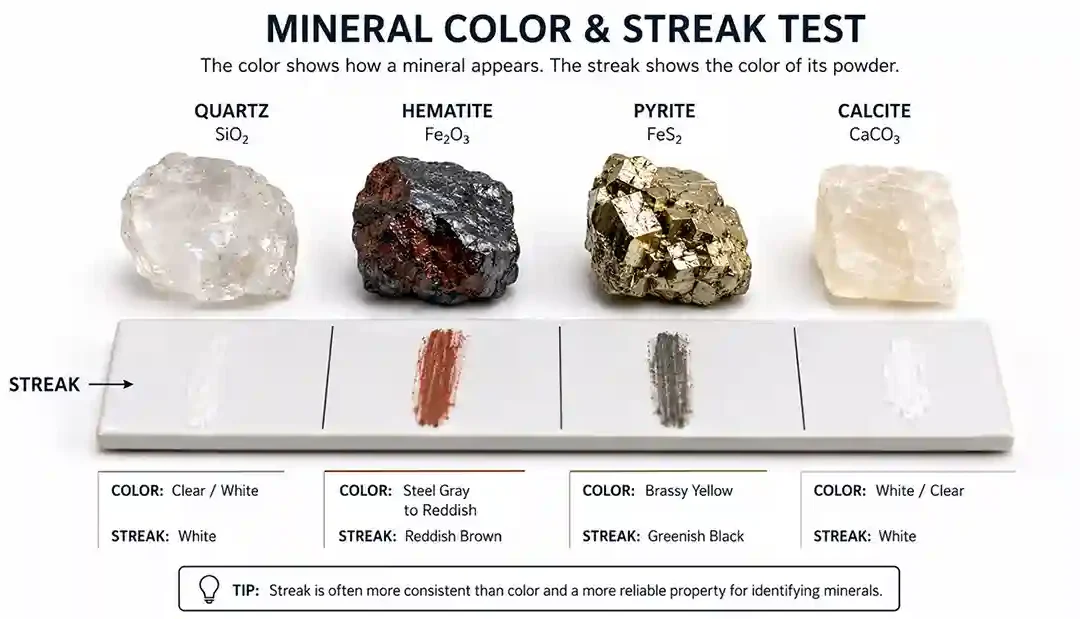
Color is often the first characteristic people notice when examining a mineral. However, color alone is not always reliable because impurities can change a mineral's appearance.
To improve identification accuracy, geologists use another important property called streak. Streak is the color of a mineral in powdered form and often remains consistent even when the mineral's surface color varies.
By comparing color and streak, scientists can:
- identify unknown minerals
- distinguish similar-looking specimens
- improve field and laboratory analysis
These two properties are among the most commonly used tools in mineral identification.
Learn more → mineral-identification-guide
Importance of Color vs Streak
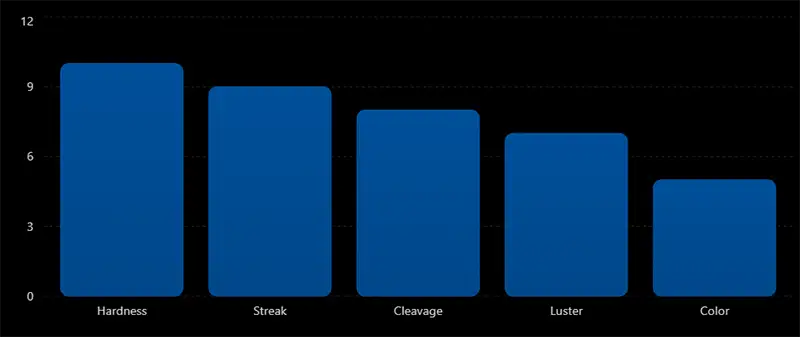
Reliability of Mineral Identification Properties
Streak is often more reliable than color when identifying minerals.
| Property | Reliability |
|---|---|
| Color | 5 |
| Streak | 9 |
| Hardness | 10 |
| Cleavage | 8 |
| Luster | 7 |
What Is Mineral Color?
Mineral color refers to the visible color of a mineral specimen. Colors can result from:
- chemical composition
- impurities
- crystal defects
- weathering
Examples
- Quartz can be clear, purple, pink, or smoky
- Calcite may appear white, yellow, gray, or brown
- Fluorite occurs in many different colors
Because color can vary greatly, it should not be used as the only identification method.
Why Mineral Color Can Be Misleading
Many minerals share similar colors.
For example:
- Quartz and calcite may both appear white
- Pyrite and gold may both appear yellow
- Hematite can appear red, gray, or black
Impurities often influence surface color without changing the mineral itself. This is why geologists rely on additional tests.
What Is Mineral Streak?
Streak is the color of a mineral in powdered form. Scientists determine streak by rubbing a mineral against an unglazed porcelain streak plate. The resulting powder color helps identify the mineral. Unlike surface color, streak is usually more consistent.
How the Streak Test Works
Step-by-Step Process
- Obtain a streak plate.
- Rub the mineral firmly across the plate.
- Observe the color of the powder left behind.
- Compare the streak color with known mineral data.
This simple test can quickly eliminate many identification possibilities.
Mineral Color vs Streak
| Property | Color | Streak |
|---|---|---|
| What It Shows | Surface appearance | Powder color |
| Reliability | Moderate | High |
| Affected by Impurities | Often | Rarely |
| Used for Identification | Yes | Yes |
Streak is usually a more dependable property than color.
Common Mineral Streak Colors
| Mineral | Surface Color | Streak Color |
|---|---|---|
| Hematite | Gray to black | Reddish-brown |
| Pyrite | Brass yellow | Greenish-black |
| Magnetite | Black | Black |
| Galena | Silver-gray | Gray-black |
| Calcite | Various colors | White |
These differences help geologists distinguish minerals that may look similar.
Hematite: A Classic Streak Example
Hematite is one of the best examples of streak testing.
Although hematite may appear:
- silver-gray
- black
- metallic
Its streak remains reddish-brown. This distinctive streak makes hematite easy to identify.
Minerals That Do Not Produce Clear Streaks
Some minerals are harder than the streak plate.
Examples
- Quartz
- Topaz
- Corundum
- Diamond
These minerals may:
- scratch the plate
- leave little or no powder
In such cases, geologists rely on:
- hardness
- crystal form
- cleavage
- density
Learn more → characteristics-of-minerals
Factors Affecting Mineral Color
Several factors influence mineral color:
Common Causes
- trace elements
- chemical impurities
- radiation exposure
- crystal defects
- weathering
Example
Pure quartz is colorless, but trace impurities can create:
- amethyst (purple)
- rose quartz (pink)
- smoky quartz (gray)
Color and Streak in Mineral Identification
Identification Value of Mineral Properties
Color and streak are important but work best when combined with other tests.
Why Geologists Use Multiple Tests
Professional mineral identification rarely depends on one property.
Geologists usually combine:
- color
- streak
- hardness
- luster
- cleavage
- crystal habit
Using multiple properties produces more accurate results.
Learn more → mineral-habit-explained
Mineral color is the visible appearance of a mineral's surface.
Streak is the color of a mineral in powdered form.
Because streak usually remains consistent even when surface color changes due to impurities.
Hematite is well known for its reddish-brown streak.
Final Thoughts
Mineral color and streak are two of the most useful properties in mineral identification. While color provides a quick visual clue, streak often offers a more reliable way to distinguish minerals.
By combining color, streak, hardness, and other physical properties, geologists can accurately identify minerals and better understand Earth's geological materials.