
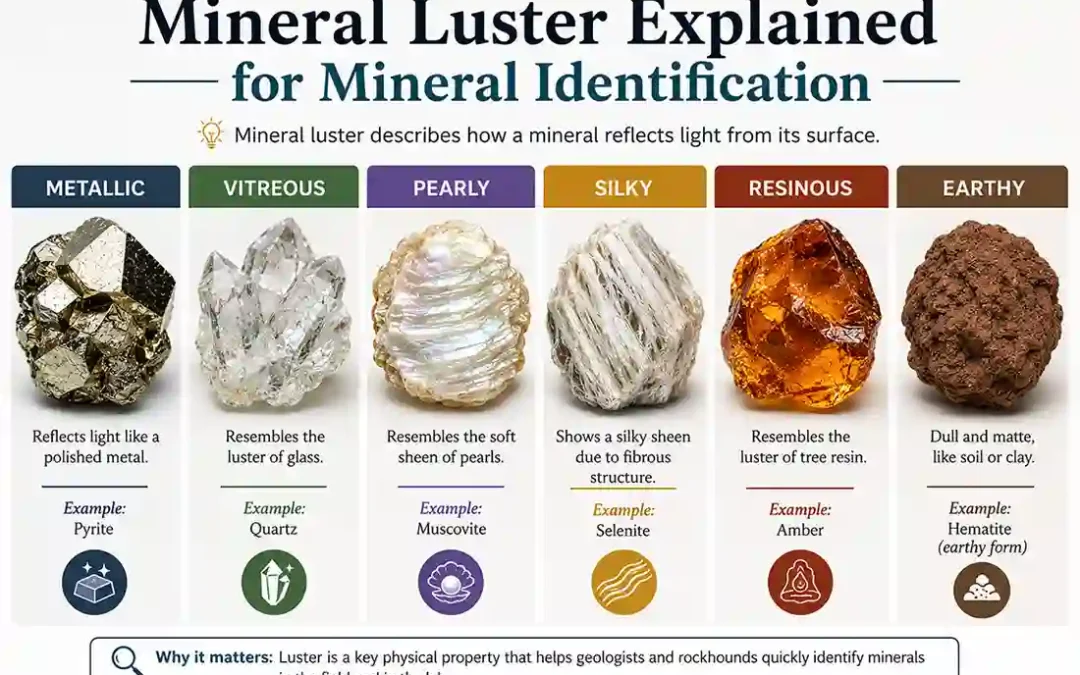
Luster is one of the most useful physical properties used in mineral identification. It describes how light reflects from a mineral’s surface and often provides a quick clue about a mineral’s composition and structure.
When geologists examine a mineral, they frequently evaluate luster before performing other tests. Some minerals appear bright and metallic, while others look glassy, silky, or dull.
Understanding mineral luster helps scientists:
- identify minerals
- classify mineral groups
- distinguish similar specimens
- interpret mineral formation conditions
Because luster is easy to observe, it is commonly used in both fieldwork and laboratory studies.
Learn more → mineral-identification-guide
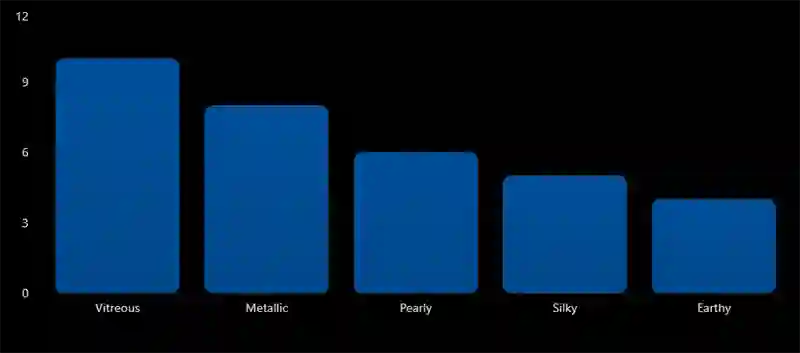
Common Types of Mineral Luster
Common Mineral Luster Types
Major luster categories used in mineral identification.
What Is Mineral Luster?
Mineral luster is the way a mineral reflects light
It describes the appearance of a mineral surface when viewed under normal lighting.
Luster depends on:
- crystal structure
- chemical composition
- surface texture
- light reflection
Geologists often divide luster into two major categories:
- metallic
- nonmetallic
Metallic Luster
Minerals with metallic luster reflect light like polished metal.
Characteristics
- bright reflective surface
- opaque appearance
- metal-like shine
Common Examples
- Pyrite
- Galena
- Magnetite
- Chalcopyrite
Metallic luster is often found in ore minerals.
Nonmetallic Luster
Most minerals display nonmetallic luster
These minerals do not resemble metal and can appear:
- glassy
- pearly
- silky
- resinous
- dull
Nonmetallic luster is common in:
- silicate minerals
- carbonate minerals
- sulfate minerals
Vitreous (Glassy) Luster
Vitreous means glass-like appearance.
Characteristics
- bright reflection
- smooth surface
- resembles broken glass
Common Examples
- Quartz
- Calcite
- Topaz
Vitreous luster is one of the most common mineral lusters.
Metallic vs Nonmetallic Luster
| Property | Metallic | Nonmetallic |
|---|---|---|
| Appearance | Metal-like | Glassy or dull |
| Transparency | Usually opaque | May be transparent |
| Common Minerals | Pyrite, Galena | Quartz, Calcite |
| Reflectivity | Very high | Moderate |
Pearly Luster
Pearly luster resembles the surface of a pearl
Characteristics
- soft glow
- layered appearance
- delicate reflections
Common Examples
- Muscovite mica
- Talc
- Some gypsum varieties
Silky Luster
Silky luster appears similar to silk fabric.
Characteristics
- soft reflective sheen
- fibrous texture
- parallel crystal growth
Common Examples
- Satin spar gypsum
- Chrysotile
Silky luster often occurs in fibrous minerals.
Resinous Luster
Resinous luster resembles tree resin or amber
Common Examples
- Sphalerite
- Amber
These minerals often appear:
- slightly translucent
- glossy
- yellow to brown
Earthy or Dull Luster
Earthy luster appears dull and non-reflective.
Common Examples
- Kaolinite
- Bauxite
- Some hematite varieties
Earthy minerals often look:
- rough
- powdery
- weathered
Common Minerals and Their Luster
| Mineral | Typical Luster |
|---|---|
| Quartz | Vitreous |
| Pyrite | Metallic |
| Mica | Pearly |
| Gypsum | Silky |
| Hematite | Metallic to Earthy |
Many minerals can display more than one luster type.
Factors That Affect Luster
Several factors influence how a mineral reflects light:
Important Factors
- crystal structure
- chemical composition
- grain size
- weathering
- surface condition
Weathered minerals may appear duller than fresh samples.
Luster and Mineral Identification
Luster is most useful when combined with:
- hardness
- streak
- cleavage
- crystal habit
- color
Professional mineral identification rarely relies on a single property.
Learn more → mineral-color-and-streak
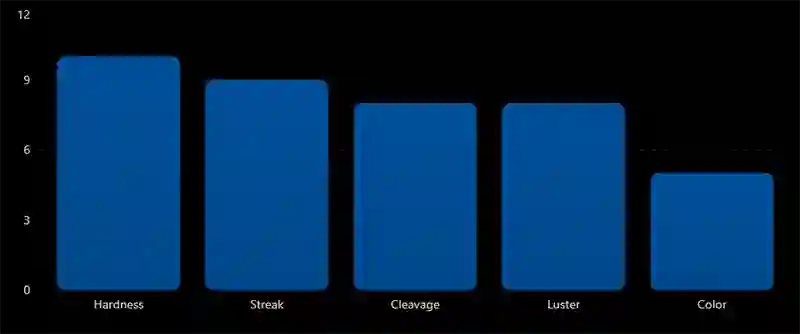
Identification Value of Mineral Properties
Identification Value of Common Mineral Properties
Luster is an important property but works best alongside other tests.
Mineral luster describes how light reflects from a mineral’s surface.
Metallic and nonmetallic luster.
Pyrite is a classic example of metallic luster.
A glass-like appearance commonly seen in quartz and calcite.
Final Thoughts
Mineral luster is one of the easiest and most useful properties for identifying minerals. Whether a mineral appears metallic, glassy, silky, pearly, or dull, its luster provides important clues about its composition and structure.
By combining luster with hardness, streak, crystal habit, and other physical properties, geologists can accurately identify minerals and better understand Earth's geological materials.