
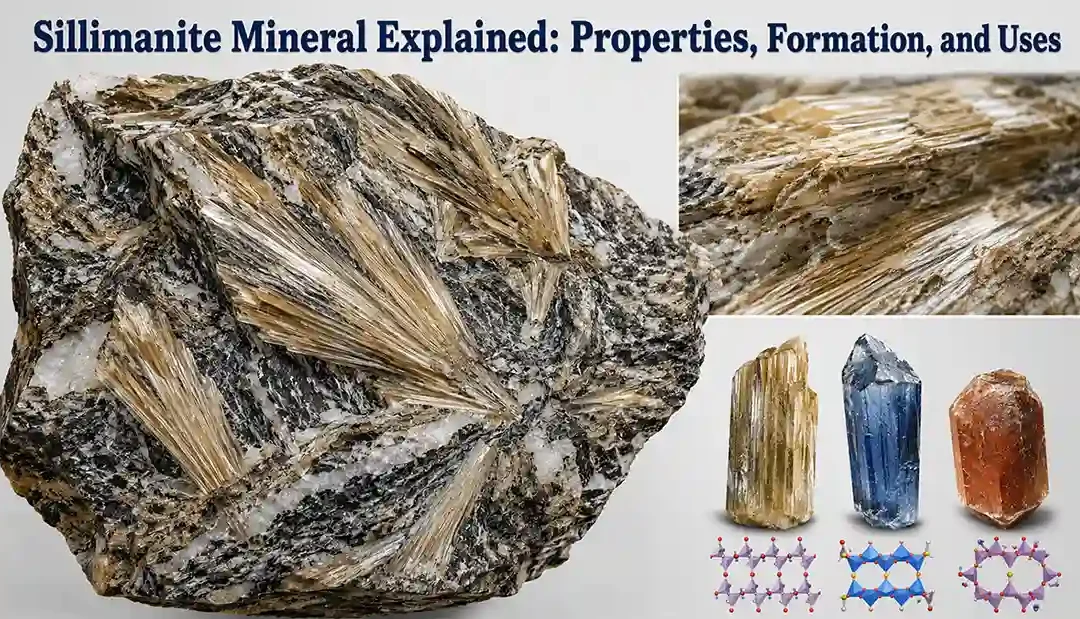
Sillimanite is an aluminum silicate mineral that forms under high-temperature metamorphic conditions. It is one of the three important aluminum silicate polymorphs, alongside kyanite and andalusite, and serves as a key indicator mineral for determining metamorphic grade.
Sillimanite is commonly found in:
- high-grade metamorphic rocks
- gneiss
- schist
- granulite
- contact metamorphic environments
Its presence indicates that rocks have experienced intense heat during metamorphism, making it one of the most valuable minerals for interpreting geological history.
Learn more → kyanite mineral explained
What Is Sillimanite?
Sillimanite is an aluminum silicate mineral. Its chemical formula is: . Sillimanite belongs to the aluminum silicate polymorph group, which includes:
- Andalusite
- Kyanite
- Sillimanite
Although these minerals share the same chemical composition, they form under different pressure-temperature conditions.
Basic Properties of Sillimanite
| Property | Value |
|---|---|
| Chemical Formula | Al₂SiO₅ |
| Mineral Group | Nesosilicate |
| Crystal System | Orthorhombic |
| Hardness | 6.5–7.5 |
| Streak | White |
| Luster | Vitreous to Silky |
What Is Fibrolite?
One of the most common forms of sillimanite is fibrolite.
Fibrolite consists of:
- fine fibrous crystals
- needle-like aggregates
- silky mineral masses
This variety is common in high-grade metamorphic rocks and is often easier to recognize than large sillimanite crystals.
Crystal Structure of Sillimanite
Sillimanite contains:
- aluminum atoms
- silicon tetrahedra
- oxygen atoms
Its crystal structure forms:
- slender prisms
- fibrous aggregates
- needle-like crystals
The crystal arrangement allows sillimanite to remain stable at very high temperatures.
Learn more → crystal structure in minerals
Crystal System of Sillimanite
Crystal Classification
Sillimanite belongs to the orthorhombic crystal system. Its crystallographic relationship is:
Common crystal habits include:
- fibrous crystals
- slender prisms
- radiating aggregates
Learn more → orthorhombic crystal system
Physical Properties of Sillimanite
| Property | Description |
|---|---|
| Color | White, gray, brown, green |
| Streak | White |
| Luster | Vitreous to silky |
| Hardness | 6.5–7.5 |
| Cleavage | Poor |
| Transparency | Transparent to translucent |
| Specific Gravity | 3.2–3.3 |
How Sillimanite Forms
High-Temperature Metamorphism
Sillimanite develops under elevated temperatures.
Regional Metamorphism
Forms during deep crustal metamorphism.
Contact Metamorphism
Occurs near igneous intrusions where temperatures are high.
Mountain Building
Develops in tectonically active regions undergoing intense metamorphism.
Sillimanite as an Index Mineral
Sillimanite is one of the most important metamorphic index minerals.
Its presence typically indicates:
- high temperatures
- moderate to high metamorphic grade
- advanced metamorphic conditions
Geologists use sillimanite to identify rocks that have experienced significant thermal metamorphism.
Learn more → garnet mineral explained
Andalusite, Kyanite, and Sillimanite
These minerals share the same chemical formula:
However, they form under different conditions.
| Mineral | Pressure | Temperature |
|---|---|---|
| Andalusite | Low | Moderate |
| Kyanite | High | Moderate |
| Sillimanite | High Temperature | High |
This relationship makes them powerful indicators of metamorphic environments.
Learn more → andalusite mineral explained
Common Rocks Containing Sillimanite
Sillimanite commonly occurs in:
- gneiss
- schist
- granulite
- hornfels
- metamorphosed shale
These rocks are generally associated with high-grade metamorphic conditions.
Geological Importance of Sillimanite
Sillimanite helps geologists determine:
- metamorphic temperature
- tectonic history
- crustal evolution
- mountain-building processes
Its occurrence provides evidence of deep crustal heating and intense metamorphism.
Industrial Uses of Sillimanite
Refractory Materials
Used in high-temperature furnaces and kilns.
Ceramics
Improves heat resistance and durability.
Glass Manufacturing
Used in specialty industrial products.
Metallurgical Industry
Applied in high-temperature processing systems.
Major Uses of Sillimanite
| Industry | Application |
|---|---|
| Refractories | Furnace linings |
| Ceramics | Heat-resistant products |
| Glass | Industrial materials |
| Metallurgy | High-temperature processes |
Sillimanite in Mineral Identification
Geologists identify sillimanite using:
- fibrous habit
- needle-like crystals
- hardness of 6.5–7.5
- silky luster
- occurrence in high-grade metamorphic rocks
Fibrolite aggregates are often the easiest field indicator.
Learn more → mineral identification guide
Sillimanite Identification Summary
| Property | Sillimanite |
|---|---|
| Formula | Al₂SiO₅ |
| Hardness | 6.5–7.5 |
| Crystal System | Orthorhombic |
| Color | White to Brown |
| Luster | Vitreous to Silky |
| Mineral Group | Nesosilicate |
Sillimanite is an aluminum silicate mineral with the formula Al₂SiO₅.
It is an index mineral that indicates high-temperature metamorphic conditions.
Fibrolite is the fibrous variety of sillimanite commonly found in metamorphic rocks.
Sillimanite belongs to the orthorhombic crystal system.
Sillimanite occurs in gneiss, schist, granulite, and other high-grade metamorphic rocks.
Final Thoughts
Sillimanite is one of the most important metamorphic index minerals and a critical indicator of high-temperature metamorphism. Its fibrous crystal habits, association with high-grade rocks, and relationship with kyanite and andalusite make it essential for understanding metamorphic processes and crustal evolution.
From deep crustal environments to industrial refractory applications, sillimanite demonstrates how mineral stability reflects the extreme conditions inside Earth's crust.