
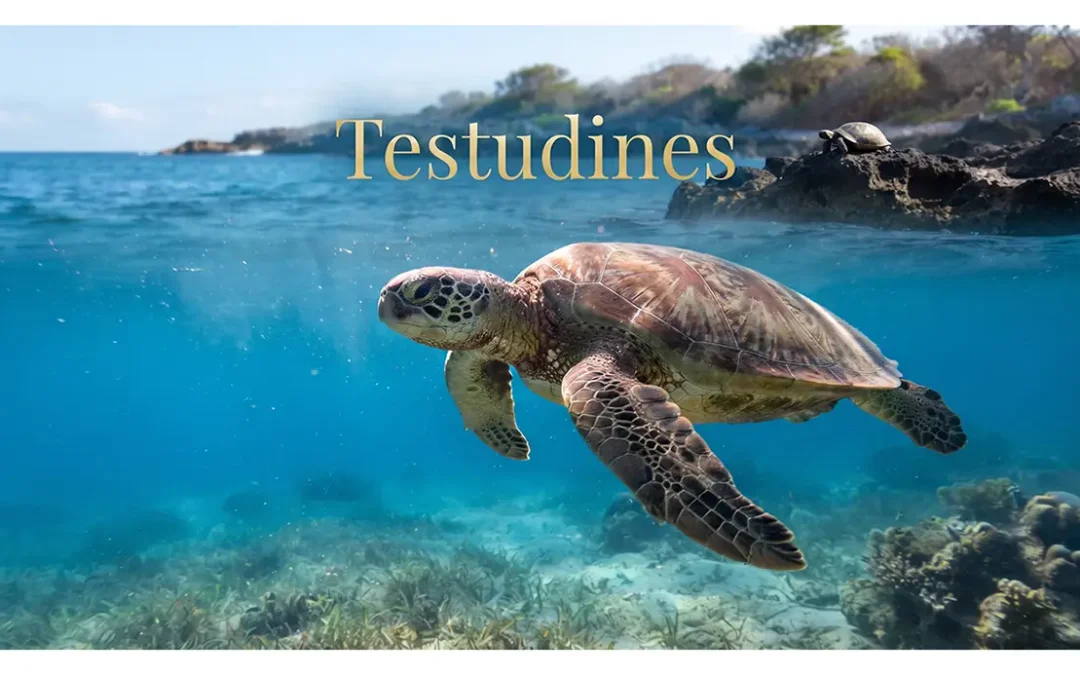
Turtles are among the most distinctive reptiles on Earth. Their protective shells, specialized skeletons, and diverse lifestyles distinguish them from other vertebrates. From ocean-dwelling sea turtles to freshwater terrapins and land-dwelling tortoises, these animals occupy a wide range of environments and perform important ecological roles.
All living turtles belong to the order Testudines, a group with an evolutionary history extending back more than 200 million years. Their ancestors developed a unique body structure that includes a shell integrated with the skeleton. Over millions of years, different lineages adapted to terrestrial, freshwater, and marine environments, producing the variety of forms seen today.
Although turtles share several fundamental anatomical features, they differ considerably in body size, diet, movement, reproduction, and habitat preferences. Some species spend most of their lives in water, while others depend on dry land. Their feeding strategies range from plant consumption to hunting fish, insects, mollusks, and other animals.
Despite their long evolutionary history, many turtle species now face serious threats from habitat destruction, pollution, accidental capture in fishing gear, illegal wildlife trade, and climate change. Understanding their biology and ecological needs is essential for protecting these remarkable reptiles.
What Are Testudines?
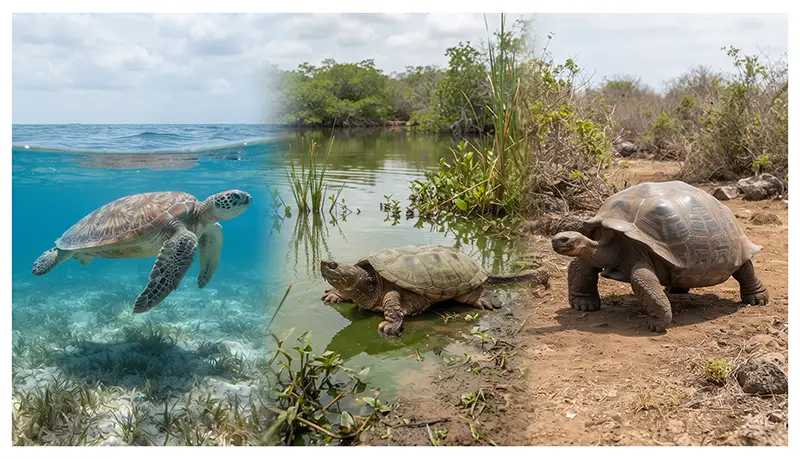
Testudines is the scientific name of the reptilian order that includes all living turtles, tortoises, and terrapins, together with their extinct relatives. Members of this group are commonly called chelonians, a term derived from the Greek word for tortoise or turtle.
The defining characteristic of Testudines is their specialized body structure, particularly the shell formed from modified skeletal elements and associated tissues. Unlike the external armor of an armadillo, a turtle's shell is integrated with its skeleton and cannot simply be separated from the body.
Turtles belong to the class Reptilia. They are vertebrates, meaning they possess a backbone, and they breathe air using lungs. Even species that live almost entirely in water must surface periodically to breathe, although some aquatic turtles can absorb limited amounts of oxygen through specialized tissues while submerged.
The words turtle, tortoise, and terrapin are common names rather than universally consistent scientific divisions. Their usage varies by region and language.
In general, sea turtles are adapted to marine environments, tortoises are primarily terrestrial, and terrapins commonly refers to certain freshwater or brackish-water turtles in some regions. These distinctions are useful in everyday communication, but they do not represent three separate taxonomic orders.
Testudines includes animals with very different lifestyles. Sea turtles possess streamlined bodies and flipper-like limbs, whereas many tortoises have sturdy legs and feet adapted for walking across land.
Freshwater species often combine webbed feet with shells and body shapes suited to swimming, walking along pond bottoms, or moving between aquatic and terrestrial habitats. Despite these differences, all turtles share the fundamental anatomical organization that defines the group.
Evolutionary History and Fossil Origins
The evolutionary history of turtles extends deep into the Mesozoic Era and possibly beyond the earliest appearance of recognizable turtle fossils. Paleontologists use fossil skeletons, geological dating, and comparisons with living reptiles to investigate how the modern turtle body plan developed.
Some of the most important early evidence comes from the Late Triassic and Early Jurassic. These fossils show that turtle anatomy developed gradually rather than appearing fully formed in a single evolutionary step.
Early relatives of turtles
Eunotosaurus, which lived during the Permian Period approximately 260 million years ago, possessed broad, elongated ribs and other features that have been discussed in studies of early turtle evolution. It did not possess the complete shell found in modern turtles, and its exact position within the evolutionary history of the group has been investigated through anatomical comparisons.
Other important fossils include Pappochelys, from the Middle Triassic, and Odontochelys, from the Late Triassic. These animals preserve combinations of features that help researchers understand the development of the turtle skeleton and shell.
Odontochelys had a well-developed plastron, the lower part of the shell, but its upper shell was less complete than that of modern turtles. Its anatomy supports the interpretation that the turtle shell developed through a sequence of structural changes.
The Early Jurassic turtle Proganochelys possessed a more complete shell and many features associated with the established turtle body plan. However, it also retained characteristics absent from most living turtles, including extensive bony armor and a tail that could not be withdrawn in the modern manner.
Together, these fossils demonstrate that important turtle characteristics evolved over an extended period. Researchers continue to investigate the precise relationships among early forms and the order in which particular anatomical features appeared.
How turtles became diverse
As turtle lineages evolved, different groups developed adaptations for living in freshwater, marine, and terrestrial environments. Some lineages acquired streamlined bodies and powerful swimming limbs.
Others evolved stronger feet and sturdy limbs suited to walking on land. Changes in skull structure, feeding mechanisms, and shell shape allowed species to exploit different resources and habitats.
The fossil record also reveals that turtles once included species and body forms that no longer exist. Fossil comparisons help researchers reconstruct these extinct lineages and determine how modern groups are related.
Turtle evolution did not follow a simple progression from primitive to advanced forms. Instead, multiple lineages evolved different solutions to environmental challenges, and many ancient branches eventually disappeared.
Turtle Anatomy and the Structure of the Shell
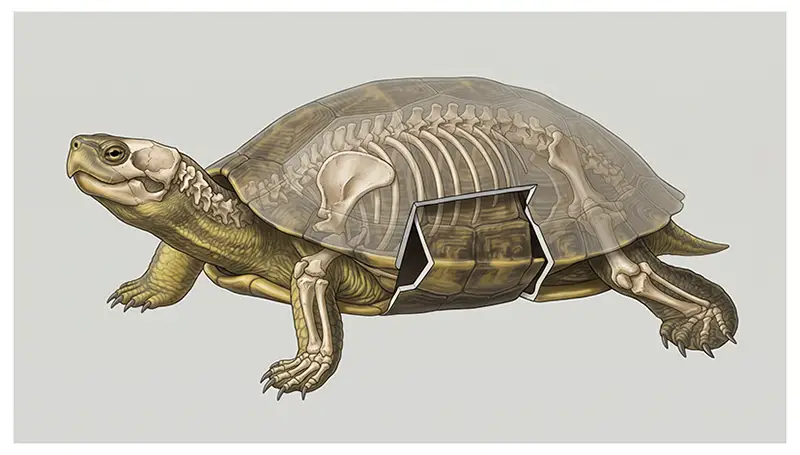
The turtle body plan is unusual among vertebrates because the ribs and other skeletal elements are incorporated into a protective shell. This structure provides defense while also influencing movement, breathing, and the arrangement of internal organs.
The carapace and plastron
A turtle's shell has two principal components. The carapace is the upper section that covers the back and sides of the body. It contains modified skeletal elements, including ribs and vertebral structures, together with associated bone. The plastron forms the lower section of the shell. Its bones provide protection for the underside of the animal.
The two sections connect along the sides of the body, forming a protective enclosure around much of the trunk. In many species, the outer shell bears keratinous scutes, which are hard plates made of the same general structural protein found in reptilian scales, claws, and bird feathers. Some turtles, including the leatherback sea turtle, have a different outer covering and do not possess the typical arrangement of large hard scutes.
The shell is living tissue, not a lifeless external container. It contains nerves and blood vessels, and injuries can damage underlying bone and other tissues. A turtle cannot leave its shell, because the structure is part of its body.
The skeleton and limbs
Turtles have a backbone and a skull, as well as a distinctive arrangement of ribs and limb bones. Their shoulder girdle lies inside the rib cage, an unusual arrangement compared with most other vertebrates.
The limbs vary according to lifestyle. Land tortoises typically have sturdy legs that support their weight during walking. Freshwater turtles often possess webbed feet that assist swimming, while sea turtles have long, flattened flippers that generate thrust through the water.
These differences illustrate how the same basic skeletal plan can support several types of movement.
The head, jaws, and senses
Modern turtles lack teeth. Instead, they possess a hard, keratin-covered beak whose shape varies with feeding habits. Some species have broad jaws suited to crushing plant material, while others possess sharp-edged beaks that help them capture prey or cut food into manageable pieces.
Turtles use vision, smell, touch, and other sensory abilities to find food, recognize their surroundings, and respond to threats. Aquatic species may also detect vibrations and water movements that provide information about nearby animals.
How turtles breathe
Turtles breathe air through lungs, but their rigid shells prevent them from expanding the chest in the same way that many mammals do. Instead, turtles use specialized muscles and movements of the body wall and internal organs to ventilate their lungs. The exact mechanism varies among species and reflects their unusual skeletal structure.
Some aquatic turtles can remain submerged for long periods by reducing their metabolic activity and, in certain species, absorbing limited amounts of oxygen through tissues associated with the throat or cloaca. These mechanisms do not replace lung breathing under ordinary conditions.
Classification and Major Groups of Testudines
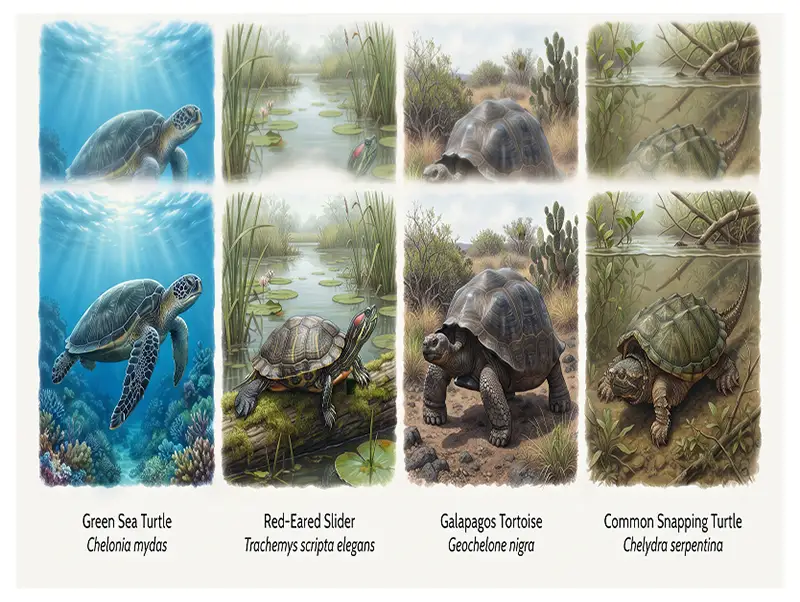
Scientists classify turtles according to shared anatomical features, genetic evidence, evolutionary relationships, and fossil information. Modern classifications recognize two major living branches of turtles: Cryptodira and Pleurodira.
Cryptodira: hidden-neck turtles
Cryptodira is the larger of the two major living turtle lineages. Many members withdraw the head by bending the neck into an S-shaped curve, pulling it backward between the shoulder structures.
This group includes sea turtles, tortoises, snapping turtles, softshell turtles, and many familiar freshwater species.
Sea turtles belong to a marine lineage that includes animals such as the green sea turtle (Chelonia mydas) and the loggerhead sea turtle (Caretta caretta). Their limbs are modified into flippers, and their body shapes support efficient swimming.
Tortoises belong to the family Testudinidae. They are adapted primarily to terrestrial life and often have sturdy limbs, strong feet, and shells suited to their environments. However, body shape varies considerably among species, and not every tortoise has a high-domed shell.
Other cryptodires include snapping turtles, which possess powerful jaws, and softshell turtles, which have flattened bodies and flexible, leathery shell coverings.
Pleurodira: side-neck turtles
Pleurodira includes turtles that bend the neck sideways beneath the edge of the shell rather than withdrawing it straight backward.
This group contains several freshwater lineages distributed mainly in the Southern Hemisphere, including parts of South America, Africa, and Australia.
Side-neck turtles display considerable diversity in shell shape, feeding behavior, and habitat use. Many live in rivers, lakes, wetlands, and other freshwater environments.
Their neck-retraction mechanism distinguishes them anatomically from cryptodires and provides an important feature for understanding turtle evolutionary relationships.
Why classification matters
Classification helps scientists organize the diversity of Testudines and investigate how different species evolved.
It also prevents confusion between ecological categories and evolutionary groups. For example, tortoises are a recognizable group of land-dwelling turtles within Cryptodira, whereas the term terrapin has different meanings in different regions and does not define a single universal taxonomic group.
Scientists continue to revise classifications as new genetic analyses and fossil discoveries improve our understanding of turtle relationships.
Habitat and Global Distribution
Turtles occupy a wide range of habitats on every continent except Antarctica. Their distribution reflects millions of years of evolutionary history, geographical change, and adaptation to local environmental conditions.
Terrestrial habitats
Tortoises and some other land-dwelling turtles inhabit forests, grasslands, scrublands, and dry regions. Their ability to survive in particular environments depends on temperature, moisture, vegetation, shelter, and the availability of suitable nesting sites.
Desert tortoises can survive in arid habitats by using burrows and other shelters to avoid extreme temperatures. Some species also store water and reduce activity during unfavorable conditions.
Forest-dwelling tortoises may depend on humid microhabitats, leaf litter, and shaded areas. Their habitat requirements differ from those of species adapted to open, dry landscapes.
Freshwater habitats
Freshwater turtles live in rivers, streams, ponds, lakes, swamps, and wetlands. Many species require access to basking sites, submerged refuges, and suitable places to lay eggs.
Some spend much of their time in water, while others regularly move onto land. Their distribution may depend on water depth, current speed, vegetation, temperature, and the availability of prey.
Changes to river systems, wetland drainage, dams, and pollution can fragment populations or remove essential habitat features.
Marine habitats
Sea turtles inhabit tropical, subtropical, and, in some cases, temperate marine environments. Depending on the species and life stage, they use coastal waters, coral reefs, seagrass meadows, open oceans, and other marine habitats.
Many sea turtles travel long distances between feeding grounds and nesting beaches. Their movements connect different marine ecosystems and make their survival dependent on conditions across large geographical areas.
Adult females generally return to land to lay eggs, even though most of their lives may be spent at sea.
Environmental limits
Turtles are ectothermic animals, meaning their body temperature depends substantially on external heat sources. Their activity is therefore influenced by sunlight, air temperature, water temperature, and seasonal conditions.
Extremely cold or hot conditions can limit movement, feeding, and reproduction. Different species have evolved behavioral and physiological strategies that help them cope with the climates in which they live.
Diet and Feeding Adaptations
Turtles use a wide variety of feeding strategies. Their diets depend on species, age, habitat, jaw structure, and the resources available in their environment.
Herbivorous turtles
Many adult tortoises consume grasses, leaves, flowers, fruits, and other plant material. Their beaks help them crop vegetation, while their digestive systems process food containing substantial amounts of plant fiber.
Some aquatic turtles also consume aquatic plants and algae. Their diets can change as they grow, and even predominantly herbivorous species may occasionally eat animal material.
Plant-eating turtles can influence vegetation by removing leaves, consuming fruits, and dispersing seeds in their droppings.
Carnivorous turtles
Some turtles are specialized predators or scavengers. Depending on the species, their food may include fish, insects, worms, crustaceans, mollusks, amphibians, and carrion.
Snapping turtles possess powerful jaws that allow them to capture and process a variety of prey. Softshell turtles often have elongated necks and flattened bodies that help them hunt in aquatic environments.
Sea turtles also differ in diet. Leatherback sea turtles primarily consume jellyfish and other soft-bodied animals, while loggerhead sea turtles often feed on hard-shelled invertebrates and other prey.
Omnivorous turtles
Many turtles are omnivorous, eating both plant and animal material. Freshwater species may consume aquatic vegetation, insects, small fish, snails, and other organisms.
Their diets can change with seasonal food availability, habitat conditions, and body size. Young turtles of some species consume more animal material than adults, although this pattern is not universal.
Feeding and ecological relationships
Turtle feeding behavior influences food webs and nutrient movement. By consuming plants, prey animals, or carrion, turtles transfer energy between different parts of ecosystems.
Some species disperse seeds, while others help regulate populations of aquatic invertebrates. The exact ecological effects depend on the species and the environment in which it lives.
Reproduction, Nesting, and Life Cycle
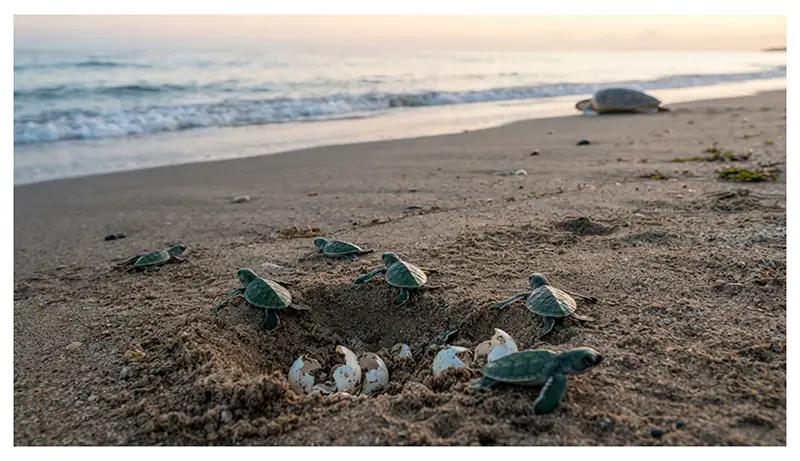
Turtles reproduce sexually, and fertilization occurs internally. In most species, females lay eggs on land, even when the adults live primarily in aquatic environments.
Courtship and mating
Courtship behavior differs among turtle species. It may involve visual displays, touching, movements of the head or limbs, chemical signals, or other behaviors.
Mating usually occurs when environmental conditions are suitable for reproduction. The timing varies by region and species, with temperature, rainfall, food availability, and seasonal cycles influencing reproductive acti
Female turtles generally select a nesting location with suitable soil or sand. Many dig a chamber using their hind limbs, deposit their eggs, and cover the nest before leaving.
The number of eggs varies considerably. Some species lay relatively small clutches, while others produce many eggs during a nesting event. Certain turtles can lay multiple clutches within a breeding season.
Sea turtles often return to sandy beaches to nest. Freshwater turtles may use riverbanks, shorelines, or other suitable terrestrial locations, while tortoises select nesting sites within their land habitats.
Eggs are vulnerable to predators, flooding, temperature extremes, and habitat disturbance.
Incubation and hatchlings
Embryos develop inside the eggs, using stored nutrients until they are ready to hatch. Incubation time varies according to species and environmental conditions.
In many turtles, incubation temperature influences the sex of hatchlings. This phenomenon is called temperature-dependent sex determination. The specific relationship between temperature and sex differs among species.
After hatching, young turtles must locate suitable habitat and avoid predators. Survival during the early stages of life can be low, and many species take years to reach sexual maturity.
Growth and longevity
Turtles often grow over many years, although their growth rates vary with species, food supply, temperature, and other environmental factors.
Some species reach maturity relatively quickly, while others require many years. Several turtle species can live for decades, and certain tortoises may survive for more than a century.
Long lifespans do not necessarily make turtle populations resilient to rapid declines. When adults reproduce slowly and juveniles face high mortality, population recovery can take considerable time.
Behavior and Ecological Importance
Turtle behavior reflects the demands of finding food, avoiding predators, regulating body temperature, reproducing, and moving through their environments.
Thermoregulation and basking
Because turtles are ectothermic, they often use sunlight and shade to regulate their body temperature. Many freshwater turtles bask on logs, rocks, or exposed banks. Warming the body can support digestion, movement, and other physiological processes. When conditions become too hot, turtles may return to the water or seek shade.
Terrestrial species also use behavioral strategies to avoid extreme temperatures, including retreating into burrows or remaining inactive during unfavorable periods.
Movement and migration
Some turtles occupy relatively small home ranges, while others travel considerable distances. Sea turtles undertake long migrations between feeding areas and nesting beaches. Their journeys can cross national boundaries and connect distant marine ecosystems.
Freshwater turtles may move between wetlands, seasonal pools, and nesting areas. Tortoises can also travel to find food, water, shelter, or suitable mates. Roads, dams, fences, and other human structures can interfere with these movements and separate populations.
Ecological roles
Turtles contribute to ecosystems in several ways. Herbivorous species consume vegetation, omnivorous turtles transfer energy between plant and animal food sources, and predators influence populations of prey organisms.
Some turtles disperse seeds and transport nutrients between habitats. Sea turtles can contribute to the functioning of seagrass ecosystems, while freshwater turtles may help move nutrients through aquatic food webs.
Their ecological importance varies across species and environments, so no single role applies to every turtle.
Turtles can also serve as indicators of environmental change. Because many depend on specific nesting sites, water conditions, or food resources, changes in their populations can reveal problems affecting wider ecosystems.
Threats, Conservation, and Survival
Turtles face serious conservation challenges worldwide. The combination of slow population recovery in many species and intense human pressures has placed numerous turtles and tortoises at risk.
The IUCN SSC Tortoise and Freshwater Turtle Specialist Group monitors the conservation status of terrestrial and freshwater turtles and tortoises. Its assessments and species accounts support conservation planning and identify populations requiring urgent attention.
Habitat loss and fragmentation
The destruction of wetlands, forests, nesting beaches, and riverbanks reduces the availability of food, shelter, and reproductive sites.
Agriculture, urban development, mining, road construction, and water-management projects can eliminate habitats or divide populations into isolated groups.
Fragmentation makes it harder for turtles to reach nesting grounds, find mates, or move between seasonal habitats.
Pollution and accidental capture
Plastic waste, chemical contamination, and deteriorating water quality can harm aquatic turtles. Animals may ingest debris or become entangled in discarded fishing lines and other materials.
Fishing activities also create risks. Sea turtles can become trapped in nets or hooked on fishing gear, while freshwater turtles may drown in unattended traps or other equipment.
Reducing bycatch requires practical measures, including appropriate fishing gear, safer handling practices, improved waste management, and protection of critical habitats.
Illegal wildlife trade
Some turtles are captured for the pet trade, food, traditional uses, or collection. Illegal harvesting can remove breeding adults and reduce already small populations.
Trade controls, enforcement, habitat protection, public education, and responsible captive-breeding programs can help address these pressures. However, captive breeding is not a substitute for conserving wild populations and their natural environments.
Climate change
Rising temperatures, changing rainfall patterns, sea-level rise, and more frequent extreme weather events can affect turtle survival. For sea turtles, temperature changes in nesting sand can alter hatchling sex ratios in species with temperature-dependent sex determination. Excessive heat can also reduce embryo survival.
Rising sea levels and coastal development may reduce suitable nesting beaches. Changes in freshwater availability can affect aquatic turtles and the habitats they depend on. The consequences differ among species and locations, making long-term monitoring essential.
Conservation approaches
Effective conservation combines habitat protection, scientific research, law enforcement, and community participation. Important actions include protecting nesting beaches and wetlands, restoring degraded habitats, reducing pollution, modifying fishing practices to reduce accidental capture, and preventing illegal trade.
Researchers monitor populations, study nesting success, track animal movements, and evaluate conservation measures. Community-based programs can help protect nesting sites and encourage coexistence between people and wildlife. The most successful strategies address the causes of population decline rather than focusing only on individual animals.
Conclusion
Testudines represents a distinctive and evolutionarily successful group of reptiles whose history extends across more than 200 million years. Their specialized shells, unusual skeletal arrangement, and diverse feeding and movement adaptations have enabled them to occupy terrestrial, freshwater, and marine environments.
Fossil discoveries reveal that the turtle body plan developed through a long series of evolutionary changes. Living species continue to demonstrate the flexibility of this design, from streamlined sea turtles that migrate across oceans to tortoises adapted to life on land.
Turtles also contribute to ecosystem functioning through feeding, seed dispersal, nutrient movement, and interactions with other organisms. Their ecological roles vary by species, but their presence can be important to the health of many habitats.
Today, however, habitat destruction, pollution, illegal harvesting, accidental capture, and climate change threaten numerous populations. Protecting turtles requires sustained research, effective conservation policies, habitat management, and cooperation between communities and wildlife specialists.
By understanding their anatomy, evolutionary history, behavior, and environmental needs, we gain a clearer picture of why turtles matter and how their survival can be supported for future generations.
Testudines is the scientific order that includes all living turtles, tortoises, and terrapins, along with their extinct relatives.
Yes. Turtles belong to the class Reptilia. They are vertebrates, breathe air using lungs, and are ectothermic.
Tortoises are generally terrestrial turtles belonging to the family Testudinidae. The broader term turtle includes terrestrial, freshwater, and marine species. Common naming conventions vary by region.
The shell provides protection and forms an integrated part of the skeleton. It consists of the carapace and plastron, with underlying bones and associated tissues.
No. Modern turtles lack teeth and use a hard, keratin-covered beak to cut, grasp, or process food.