
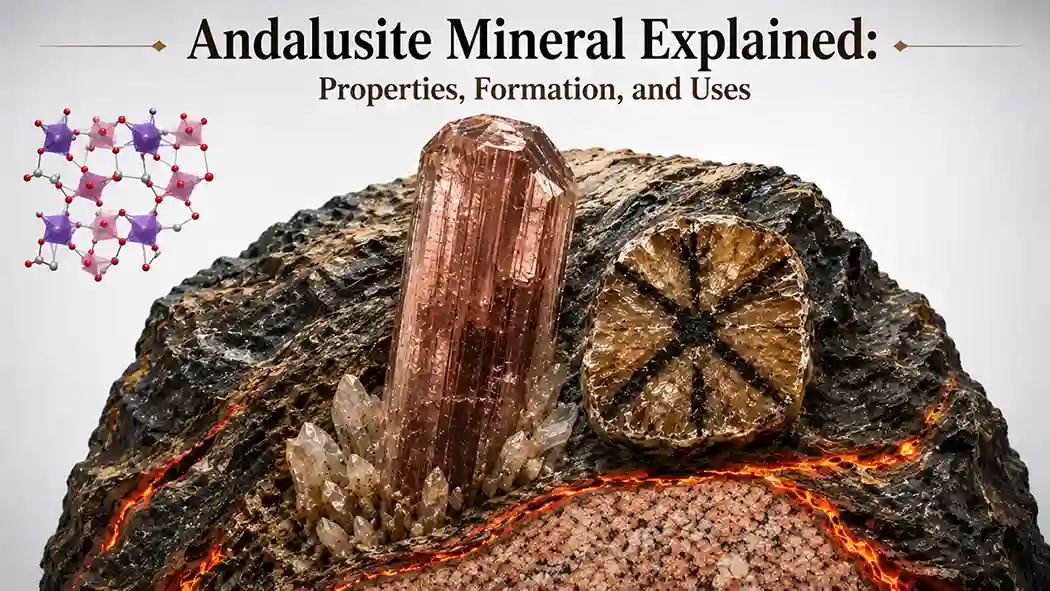
Andalusite is an aluminum silicate mineral commonly found in metamorphic rocks formed under relatively low-pressure conditions. It is one of the three famous aluminum silicate polymorphs, alongside kyanite and sillimanite.
Andalusite is particularly valued because it helps geologists determine the pressure and temperature conditions during metamorphism. Some specimens contain distinctive dark inclusions that form cross-shaped patterns known as chiastolite, making andalusite one of the most recognizable metamorphic minerals.
Andalusite is important because it:
- serves as an index mineral
- indicates low-pressure metamorphism
- forms beautiful chiastolite crystals
- has industrial refractory applications
Learn more → kyanite mineral explained
What Is Andalusite?
Andalusite is an aluminum silicate mineral. Its chemical formula is: . It belongs to the group of aluminum silicate polymorphs
which includes:
- Andalusite
- Kyanite
- Sillimanite
All three minerals share the same chemical composition but have different crystal structures.
Basic Properties of Andalusite
| Property | Value |
|---|---|
| Chemical Formula | Al₂SiO₅ |
| Mineral Group | Nesosilicate |
| Crystal System | Orthorhombic |
| Hardness | 6.5–7.5 |
| Streak | White |
| Luster | Vitreous |
Chiastolite: The Cross Stone
One of the most famous varieties of andalusite is chiastolite. Chiastolite contains dark carbon-rich inclusions arranged in a cross pattern. These inclusions develop during crystal growth and make the mineral easy to identify.
Chiastolite has been used historically in:
- jewelry
- decorative carvings
- religious artifacts
- mineral collections
Crystal Structure of Andalusite
Andalusite contains:
- aluminum atoms
- silicon tetrahedra
- oxygen atoms
Its crystal structure produces:
- prismatic crystals
- moderate hardness
- stable low-pressure conditions
Unlike kyanite, andalusite does not display strongly directional hardness.
Learn more → crystal structure in minerals
Crystal System of Andalusite
Andalusite belongs to the orthorhombic crystal system. Its crystallographic relationship is:
Typical crystal habits include:
- prismatic crystals
- columnar crystals
- massive aggregates
Learn more → orthorhombic crystal system
Physical Properties of Andalusite
| Property | Description |
|---|---|
| Color | Pink, brown, gray, green |
| Streak | White |
| Luster | Vitreous |
| Hardness | 6.5–7.5 |
| Cleavage | Poor |
| Transparency | Transparent to opaque |
| Specific Gravity | 3.1–3.2 |
How Andalusite Forms
Andalusite commonly forms during:
Contact Metamorphism
Heat from nearby magma alters surrounding rocks.
Regional Metamorphism
Forms under relatively low-pressure conditions.
Aluminum-Rich Sediments
Develops in clay-rich sedimentary rocks during metamorphism.
Magmatic Intrusions
Frequently found near granite intrusions.
Andalusite as an Index Mineral
Andalusite forms within a specific pressure-temperature range.
Its presence usually indicates:
- low pressure
- moderate temperature
- contact metamorphism
Geologists use andalusite to reconstruct metamorphic conditions.
Learn more → garnet mineral explained
Andalusite, Kyanite, and Sillimanite
All three minerals share the same formula:
However, they form under different conditions.
| Mineral | Pressure | Temperature |
|---|---|---|
| Andalusite | Low | Moderate |
| Kyanite | High | Moderate |
| Sillimanite | High Temperature | Variable |
These minerals help geologists determine metamorphic environments.
Common Rocks Containing Andalusite
Andalusite commonly occurs in:
- hornfels
- schist
- gneiss
- metamorphosed shale
These rocks often develop near igneous intrusions.
Industrial Uses of Andalusite
Andalusite has several important applications.
Refractory Materials
Used in furnaces and kilns.
Ceramics
Improves thermal stability.
Foundry Products
Used in molds and casting systems.
Gemstones
Transparent crystals may be cut and polished.
Major Uses of Andalusite
| Industry | Application |
|---|---|
| Refractories | Furnace linings |
| Ceramics | Heat-resistant products |
| Foundry | Casting materials |
| Jewelry | Gemstones |
Andalusite in Mineral Identification
Geologists identify andalusite using:
- prismatic crystals
- hardness of 6.5–7.5
- white streak
- orthorhombic crystal form
- chiastolite cross patterns
Chiastolite specimens are especially easy to recognize.
Learn more → mineral identification guide
Andalusite Identification Summary
| Property | Andalusite |
|---|---|
| Formula | Al₂SiO₅ |
| Hardness | 6.5–7.5 |
| Crystal System | Orthorhombic |
| Streak | White |
| Color | Pink-Brown-Green |
| Mineral Group | Nesosilicate |
Andalusite is an aluminum silicate mineral with the formula Al₂SiO₅.
Chiastolite is a variety of andalusite containing cross-shaped carbon-rich inclusions.
It is an index mineral used to identify low-pressure metamorphic conditions.
Andalusite belongs to the orthorhombic crystal system.
Andalusite is commonly found in hornfels, schist, gneiss, and metamorphosed shale near igneous intrusions.
Final Thoughts
Andalusite is one of the most important metamorphic index minerals and a key member of the aluminum silicate polymorph group. Its ability to record low-pressure metamorphic conditions makes it invaluable for understanding Earth's tectonic and thermal history.
From distinctive chiastolite crystals to industrial refractory applications, andalusite demonstrates the scientific and economic importance of metamorphic minerals.