
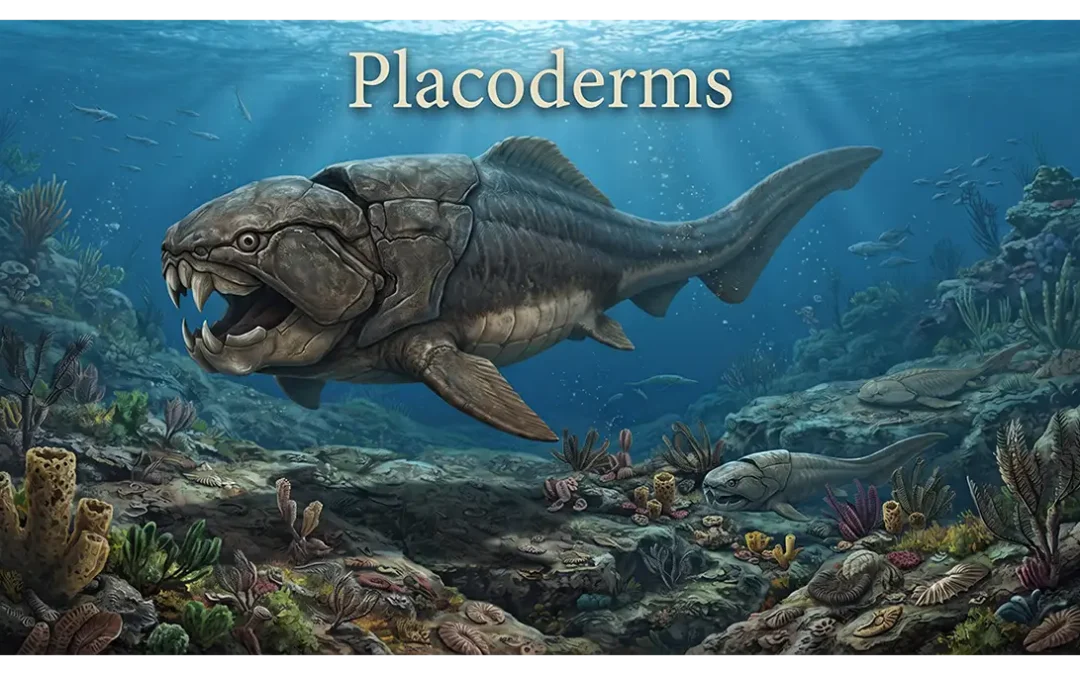
Placoderms were remarkable armored vertebrates that lived in ancient oceans, rivers, and other aquatic environments during the Paleozoic Era. Recognized by their protective bony plates and jaws, these extinct fishes represent an important chapter in the early evolution of jawed vertebrates. They became especially diverse during the Devonian Period, when aquatic ecosystems supported an extraordinary variety of fish.
Some placoderms were powerful predators, while others occupied different ecological roles and had specialized body shapes. The famous Dunkleosteus, for example, possessed massive jaws and heavy armor, whereas smaller forms such as Bothriolepis had a very different appearance and lifestyle. Fossils also reveal that certain placoderms developed reproductive adaptations that were previously thought to have appeared much later in vertebrate history.
Studying these ancient animals helps scientists investigate the development of jaws, the diversity of early vertebrates, and the changing environments of prehistoric Earth. This guide explores placoderm characteristics, major groups, habitats, feeding habits, fossils, reproduction, evolutionary relationships, and extinction.
What Are Placoderms?
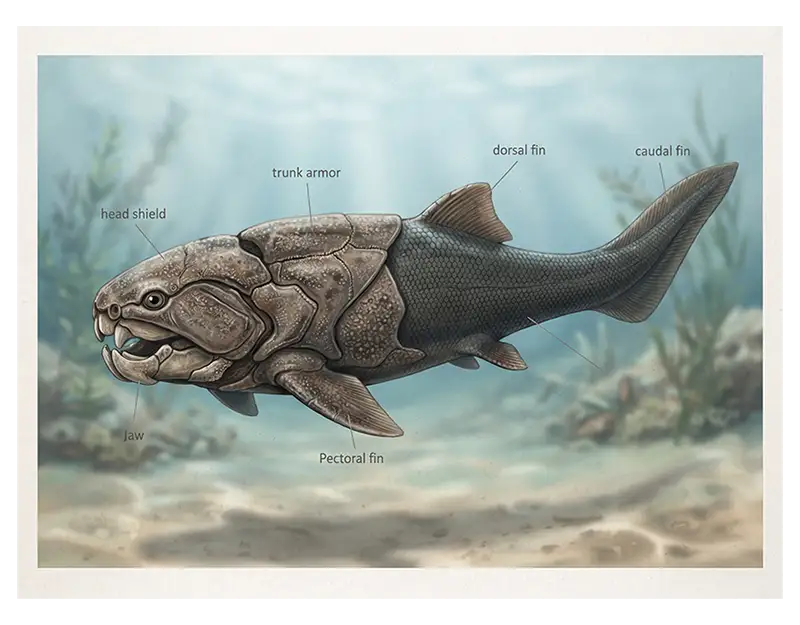
Placoderms were an extinct group of armored, jawed vertebrates that inhabited aquatic environments during the Paleozoic Era. Their name comes from Greek roots meaning “plate” and “skin,” referring to the prominent bony armor that covered parts of their bodies.
Unlike modern fish, which generally have scales or other types of body covering, placoderms possessed substantial external plates over the head and front portion of the trunk. The arrangement and thickness of this armor differed among groups, reflecting their varied body forms and lifestyles.
Placoderms belonged to the broader evolutionary history of jawed vertebrates, a major branch of animals that includes modern bony fishes, cartilaginous fishes, and tetrapods. Their jaws allowed them to capture, hold, or process food in ways that distinguished them from many earlier jawless vertebrates.
However, placoderms were not a single species or one uniform kind of fish. The name traditionally refers to a diverse collection of early jawed vertebrates. Their precise evolutionary relationships remain an important subject of scientific research, and many specialists do not consider traditional Placodermi to be a single natural evolutionary branch containing all descendants of one exclusive common ancestor.
Their fossil record demonstrates that early jawed vertebrates explored a wide range of body designs and ecological roles. Placoderms therefore provide valuable evidence for understanding how vertebrate diversity developed long before the appearance of dinosaurs or mammals.
When Did Placoderms Live?
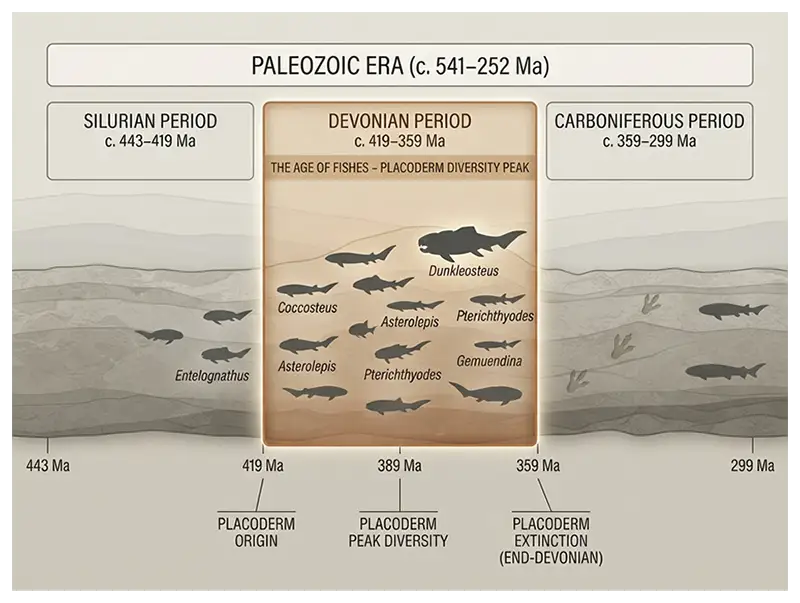
Placoderms appeared in the fossil record by the Silurian Period and became especially abundant and diverse during the Devonian Period. Their history spans tens of millions of years, although the timing of the earliest forms and their evolutionary relationships continues to be refined through new discoveries.
The Devonian, approximately 419 to 359 million years ago, is often called the Age of Fishes because aquatic vertebrates diversified extensively during this interval. Placoderms were among the most distinctive animals in these ecosystems, sharing waterways with other early jawed fishes, jawless vertebrates, and a growing variety of marine organisms.
During the Devonian, placoderms occupied marine seas, coastal waters, and freshwater environments. Different groups developed specialized adaptations suited to their habitats, including flattened bodies for life near the bottom and more robust forms suited to active predation.
Their success did not continue indefinitely. Placoderms disappeared from the fossil record by the end of the Devonian, around 359 million years ago, during a period of major biological and environmental change. This disappearance occurred near the Devonian–Carboniferous boundary, after several extinction episodes and ecological disruptions had affected marine communities.
Although placoderms are often associated with the Devonian, their history began earlier. Recognizing this longer timeline is important because it shows that their diversity developed through an extended evolutionary process rather than appearing suddenly within one geological period.
What Did Placoderms Look Like?
The most recognizable feature of placoderms was their protective armor. Large bony plates covered the head and front part of the body, forming a shield that could be thick and robust in some species but more lightly constructed in others. The rear body was generally less heavily armored, allowing different degrees of movement.
Their body shapes varied considerably. Some possessed broad, flattened bodies suitable for living close to the bottom, while others had streamlined forms associated with swimming through open water. This variation reflects the wide range of environments and feeding strategies represented among placoderms.
Several anatomical features distinguish them from many familiar modern fishes:
- Head armor: Plates protected the skull region and often formed distinctive patterns of ridges, edges, and joints.
- Trunk armor: Additional plates covered the front of the body, although the extent of coverage differed between groups.
- Jaws: As jawed vertebrates, placoderms could grasp or crush food using specialized mouth structures.
- Fins: Paired and median fins helped with movement, stability, and maneuvering, with their form varying among species.
- Specialized mouth structures: Many placoderms possessed hard jaw plates rather than conventional teeth like those of many living vertebrates.
The armor was not simply decorative. It likely offered protection against predators and physical hazards, although the degree of protection and its costs would have varied. Heavy armor could increase body mass and influence swimming performance, while lighter construction may have offered different advantages.
Placoderm size also varied widely. Many species were relatively small, whereas some arthrodires reached several metres in length. The largest forms became impressive predators, but they should not be taken as representative of the entire group.
What Were the Main Groups of Placoderms?
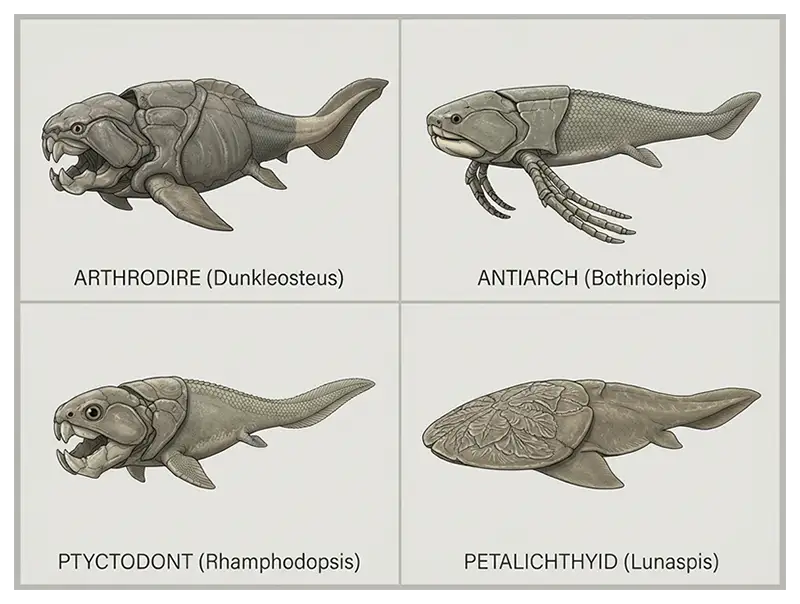
Placoderms included several commonly recognized groups with different body structures, lifestyles, and feeding adaptations. Paleontologists classify them by examining fossil anatomy, including armor patterns, jaw structures, skull features, and other skeletal characteristics.
The following groups illustrate the diversity traditionally associated with placoderms.
Arthrodires
Arthrodires were among the most diverse and familiar placoderms. Many had a joint between the head shield and trunk armor, allowing some movement between these heavily plated regions.
The best-known example is Dunkleosteus, a large arthrodire with powerful jaws and cutting or shearing bony plates. Other arthrodires varied greatly in size and ecology, so this group was not limited to giant predators.
Antiarchs
Antiarchs typically had heavily armored front bodies and distinctive paired pectoral appendages. Some, including Bothriolepis, had broad, box-like armor and lived close to the bottom in aquatic environments.
Their unusual front appendages differed from the familiar fins of modern fishes. Fossils suggest that antiarchs occupied a range of freshwater and marine settings, although the ecology of individual species must be interpreted from their anatomy and geological context.
Ptyctodonts
Ptyctodonts generally had relatively compact armor and specialized jaw plates. Many had more lightly armored bodies than the large arthrodires, and some possessed features associated with active swimming.
Their fossils are particularly important for understanding placoderm reproduction because specimens of certain ptyctodonts preserve evidence of internal fertilization and developing embryos.
Petalichthyids
Petalichthyids were generally small to medium-sized placoderms with flattened bodies and broad head shields. Their form is consistent with life near the bottom, where they may have searched for small animals or other food sources.
Their anatomy differs from the robust construction of many large arthrodires, highlighting the range of body plans that evolved among early armored vertebrates.
Acanthothoracids and other forms
Acanthothoracids were early-diverging placoderms characterized by distinctive armor and anatomical features that help scientists investigate the early history of jawed vertebrates. Other traditionally recognized groups, including rhenanids and phyllolepids, add further variety to the fossil record.
These categories are useful for describing placoderm diversity, but their exact relationships are not fully settled. As new fossils are discovered and existing specimens are reexamined, scientists may revise how particular species and groups are classified.
What Did Placoderms Eat?
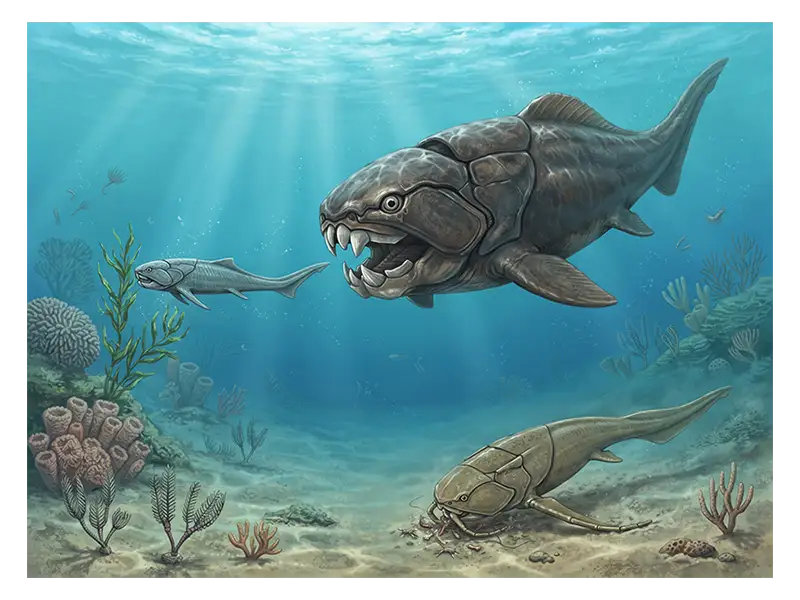
Placoderm diets differed substantially between species. Some were active predators, while others probably fed on smaller aquatic animals or obtained food near the bottom. Their jaws and mouth structures provide important clues, although a fossil skeleton does not always reveal a complete picture of an animal’s diet.
Large predatory arthrodires, including Dunkleosteus, possessed strong jaw mechanisms and hard cutting edges formed by bony plates. These structures could slice or crush prey, making them effective hunters in Devonian aquatic ecosystems.
Other placoderms had different feeding adaptations. Smaller species may have consumed invertebrates or other relatively small organisms. Flattened forms living close to the bottom may have searched sediment or captured prey near the substrate, although exact diets remain uncertain for many species.
Unlike many modern vertebrates, numerous placoderms did not possess rows of conventional teeth. Instead, their jaws often carried hard plates or blade-like edges that performed similar functions. These structures could wear and change as animals grew, and their form varied according to feeding strategy.
Scientists infer diet by combining several kinds of evidence:
- Jaw anatomy: The shape, strength, and arrangement of mouth structures can indicate how food was captured or processed.
- Body form: Swimming adaptations may provide clues about whether an animal pursued prey, moved near the bottom, or occupied another ecological role.
- Fossil associations: Remains found together can suggest possible feeding relationships, although proximity alone does not prove predation.
- Preserved stomach contents: Rare direct evidence, when available, can offer stronger information about what an individual consumed.
It is therefore inaccurate to describe every placoderm as a dangerous predator. Their diets were diverse, and their ecological roles probably ranged from hunting to feeding on smaller organisms in different parts of aquatic food webs.
Where Did Placoderms Live?
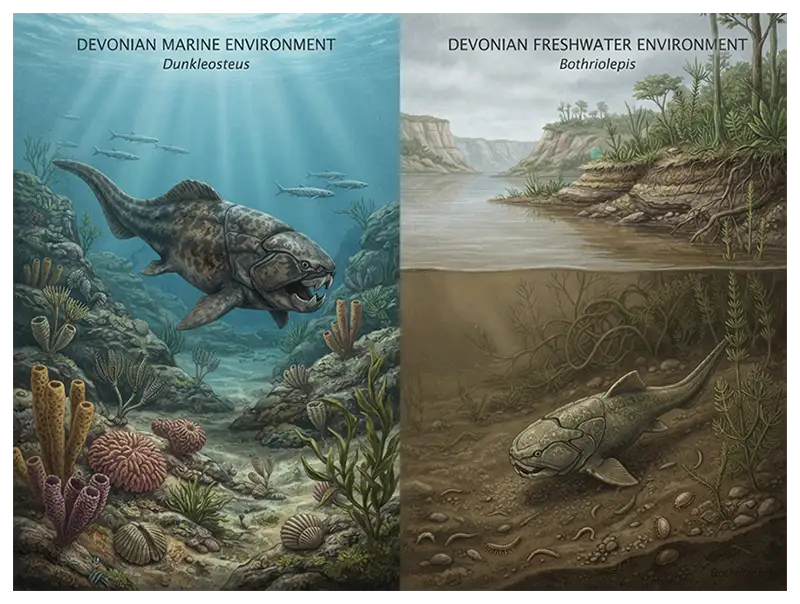
Placoderms inhabited a variety of aquatic environments, including ancient seas, shallow coastal waters, estuaries, and freshwater systems. Their distribution changed over geological time as continents shifted, sea levels fluctuated, and aquatic habitats developed or disappeared.
During the Devonian, continental arrangements differed substantially from those of today. Broad marine regions, inland basins, and river systems provided opportunities for aquatic vertebrates to diversify. Fossils from different geological settings show that placoderms were not restricted to one type of water body.
Some species lived in marine environments, where they shared ecosystems with other fishes and invertebrates. Others inhabited freshwater settings, including rivers and lakes. Certain fossils are associated with deposits interpreted as brackish or nearshore environments, although the precise habitat of an individual species depends on the geological evidence.
Placoderm anatomy often provides clues about habitat. Flattened bodies and broad head shields are consistent with a life close to the bottom, whereas more streamlined forms may have been adapted for swimming through the water column. These interpretations are strongest when body structure is considered alongside sediment type, fossil associations, and the geological setting.
The environments they occupied also influenced how their remains were preserved. Quiet-water sediments could bury carcasses and preserve fine anatomical details, while energetic conditions might scatter bones or destroy delicate structures. As a result, the fossil record does not represent every habitat or species equally.
Studying placoderm fossils from different regions allows paleontologists to reconstruct ancient aquatic communities and investigate how environmental change influenced the distribution of early vertebrates.
Which Famous Placoderms and Fossils Have Been Discovered?
Placoderm fossils are valuable because they preserve distinctive armor, jaw structures, and sometimes evidence of soft tissues or reproductive biology. Several examples have become especially important in scientific research and public understanding of prehistoric life.
Dunkleosteus
Dunkleosteus is one of the most recognizable placoderms. It lived during the Late Devonian and belonged to the arthrodires. Its massive armored head and powerful bony jaw plates made it one of the most formidable known vertebrate predators of its time.
Its body is not completely known from every specimen, so reconstructions of its total length and proportions involve uncertainty. Popular illustrations often emphasize its size, but scientific estimates have been revised as researchers reassess its anatomy and compare it with better-preserved relatives.
Bothriolepis
Bothriolepis was a widely distributed antiarch placoderm known from many fossil-bearing regions. Its armored front body and unusual pectoral appendages make it particularly useful for studying the diversity of early jawed vertebrates.
Different species of Bothriolepis lived in different environments, and the genus is represented by numerous fossil specimens. Its remains help researchers investigate anatomy, growth, and the distribution of placoderms across ancient aquatic systems.
Materpiscis
Materpiscis is notable because a fossil specimen preserves evidence of an embryo within an adult. This discovery provided strong evidence that at least some placoderms reproduced through internal fertilization and live birth.
The specimen is significant not because all placoderms necessarily reproduced in the same way, but because it demonstrates that advanced reproductive strategies existed among early jawed vertebrates much earlier than scientists once recognized.
Coccosteus
Coccosteus was another arthrodire, smaller than the largest famous forms of Dunkleosteus. Its fossils preserve important details of the head and trunk armor, helping paleontologists compare the anatomy of different placoderm lineages.
What can placoderm fossils tell us?
Fossils provide more than evidence of appearance. They help scientists examine growth, feeding adaptations, movement, reproduction, and evolutionary relationships. Armor plates can preserve patterns that distinguish species, while rare specimens may retain evidence of embryos or other structures that are not usually preserved.
However, the fossil record is incomplete. Some species are known from only a few remains, and soft tissues are rarely preserved. Reconstructions must therefore distinguish observed anatomy from features inferred through comparison with related animals.
How Did Placoderms Reproduce?
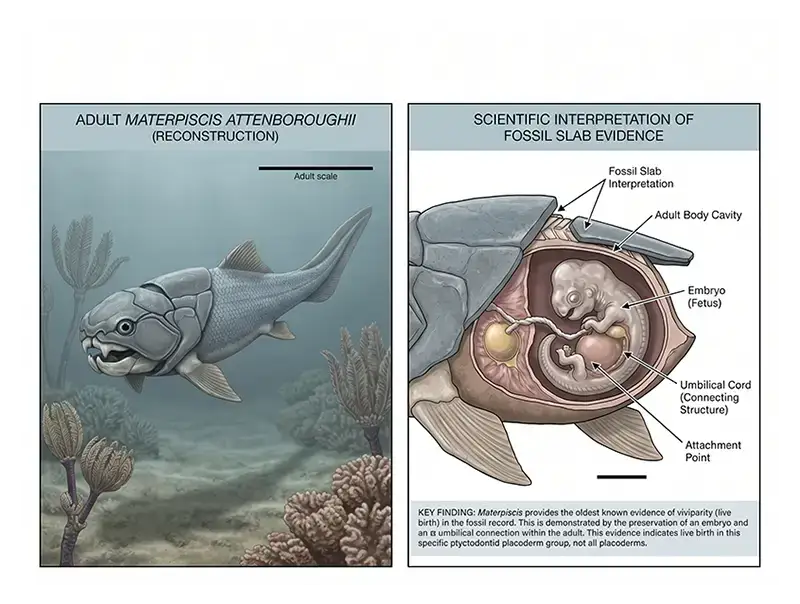
For many placoderm species, the details of reproduction remain unknown because direct evidence is rare. However, some remarkable fossils show that at least certain members of the group used internal fertilization and gave birth to live young.
The most important evidence comes from specimens preserving embryos associated with adult placoderms. Fossils of Materpiscis have been interpreted as showing an embryo within the adult, including structures associated with an umbilical connection. This provides compelling evidence of live birth in that species.
Such discoveries changed scientific understanding of early vertebrate reproduction. Internal fertilization and live birth were once more commonly associated in the fossil record with later vertebrate groups, but placoderm fossils demonstrate that these reproductive strategies had evolved much earlier.
It is important not to generalize this finding to every placoderm. Different lineages may have reproduced in different ways, and many species lack the fossil evidence needed to determine whether they laid eggs, used internal fertilization, or gave birth to live young.
Reproductive fossils are exceptionally valuable because embryos and other delicate structures are rarely preserved. When they are found, they provide direct evidence that can be more informative than conclusions based on body shape alone.
These discoveries also show why new fossil specimens matter. A single exceptionally preserved individual can reveal biological information that thousands of isolated armor plates cannot provide.
How Were Placoderms Related to Other Jawed Vertebrates?
Placoderms are important to vertebrate evolution because they document early diversity among animals with jaws. Jaws transformed how vertebrates could capture and process food, opening opportunities for new feeding strategies and ecological roles.
Modern jawed vertebrates, collectively known as gnathostomes, include cartilaginous fishes such as sharks and rays, bony fishes, and tetrapods—including amphibians, reptiles, birds, and mammals. Placoderms belonged to the early history of this broad group, but their exact position on the evolutionary tree remains debated.
Traditionally, placoderms were often presented as a single group that gave rise to later jawed vertebrates. Many modern phylogenetic analyses, however, suggest that the traditional grouping may be paraphyletic. In other words, the placoderm-like forms grouped under this name may represent several early branches near the origins of other jawed vertebrates rather than one exclusive lineage.
This distinction matters. It is not scientifically accurate to state without qualification that modern sharks, bony fishes, or humans directly descended from a particular familiar placoderm species. Instead, placoderms help researchers investigate the ancestral characteristics and early branching patterns of jawed vertebrates.
Their fossils also contribute to the study of jaw anatomy, paired fins, body armor, and reproductive biology. Comparisons between placoderms and other early vertebrates help scientists test hypotheses about which features evolved first and how those traits changed over time.
Evolutionary relationships are reconstructed using multiple forms of evidence, including anatomical comparisons, fossil ages, and analyses of shared features. As new specimens emerge and analytical methods improve, the position of placoderms within vertebrate evolution may continue to be refined.
Why Did Placoderms Become Extinct?
Placoderms disappeared by the end of the Devonian Period, approximately 359 million years ago. Their extinction occurred during a broader interval of environmental and ecological disruption that affected many marine organisms. Scientists continue to investigate the relative importance of the different factors involved.
The Late Devonian experienced several extinction episodes rather than one simple, instantaneous event affecting all life at once. These disruptions changed marine ecosystems, and different groups responded in different ways. Placoderms were among the vertebrate groups that failed to persist beyond the end of the period.
Several interacting processes have been investigated as possible contributors:
- Changes in ocean conditions: Fluctuations in oxygen availability and other chemical conditions may have reduced suitable habitats for some aquatic organisms.
- Climate and sea-level shifts: Environmental changes altered coastlines, shallow seas, and the distribution of aquatic ecosystems.
- Ecosystem disruption: Changes in food webs and habitat structure may have affected species with specialized ecological requirements.
- Uneven environmental pressures: Different placoderm lineages occupied different habitats, so the pressures they experienced may not have been identical.
These factors should not be treated as a proven single explanation for the disappearance of every placoderm. The causes and timing of Late Devonian extinction events remain active areas of research, and the evidence suggests a complex environmental history.
The end of placoderms also did not mean that all other fishes disappeared. Other jawed vertebrates survived and continued to diversify. Over subsequent geological periods, different fish lineages became increasingly important in aquatic ecosystems.
Their extinction illustrates a broader principle of evolution: a group can be diverse and successful for millions of years yet remain vulnerable to major environmental changes. The fossil record preserves the results of these changes, allowing scientists to investigate how ecosystems respond to disruption.
Conclusion
Placoderms were an important and diverse group of extinct armored jawed vertebrates that flourished during the Paleozoic Era, particularly in the Devonian Period. Their distinctive head and trunk armor, varied body shapes, specialized feeding structures, and broad range of aquatic habitats reveal the remarkable diversity of early jawed fishes.
Famous forms such as Dunkleosteus illustrate the development of powerful predators, while fossils of Bothriolepis and Materpiscis provide insights into anatomy, ecological diversity, and reproduction. These discoveries also help scientists investigate how jaws and other vertebrate characteristics evolved.
Although placoderms disappeared around the end of the Devonian, their fossil record remains essential to understanding the history of vertebrates. Their story demonstrates how ancient animals adapted to changing environments and how fossil evidence can reshape scientific ideas about the evolution of life.
Placoderms were distinguished by bony armor covering the head and front part of the body. They also had jaws and often used specialized bony plates for feeding. The extent of their armor and the shape of their bodies varied among groups.
No. Some, including Dunkleosteus, were large predators, but many placoderms were much smaller and occupied different ecological roles. Their feeding strategies varied according to their anatomy and habitat.
Many placoderms lacked conventional teeth and instead possessed hard jaw plates or cutting edges. These structures helped them capture, cut, or crush food. Jaw anatomy differed among the various groups.
At least some did. A fossil of Materpiscis preserves evidence of an embryo within an adult, supporting internal fertilization and live birth in that species. The reproductive methods of all placoderms are not known.
Placoderms provide evidence about the early diversification of jawed vertebrates. Their fossils help scientists study the development of jaws, body armor, feeding adaptations, and reproductive strategies, although their exact evolutionary relationships remain debated