
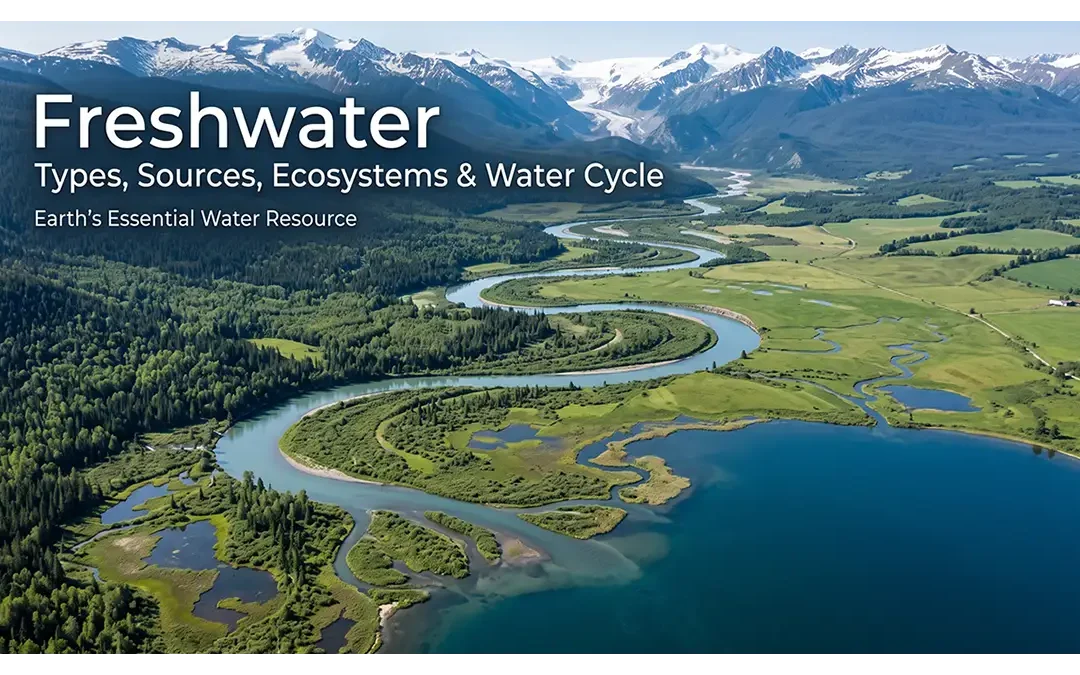
Freshwater is water with a very low concentration of dissolved salts compared with seawater. It occurs in glaciers, ice sheets, groundwater, rivers, lakes, wetlands, soil, and the atmosphere. Although freshwater covers only a small portion of Earth's total water, it supports ecosystems, supplies drinking water, helps grow food, and continuously shapes the planet's surface.
Freshwater is also an important part of Earth's hydrologic system. Water moves between the atmosphere, land, rivers, lakes, groundwater, glaciers, and oceans through evaporation, precipitation, infiltration, runoff, and other processes. Over geological time, flowing freshwater has carved valleys, transported sediments, built floodplains and deltas, and contributed to the formation of many landscapes.
What Is Freshwater?
Freshwater is water containing relatively small amounts of dissolved salts and other minerals. It is found mainly on land and differs chemically from seawater, which contains much higher concentrations of dissolved salts.
Freshwater is not completely free of dissolved substances. Natural freshwater usually contains minerals, gases, nutrients, and small amounts of salts picked up from rocks, soil, and the atmosphere.
Freshwater can occur in several physical settings, including:
- Glaciers and ice sheets
- Groundwater
- Rivers and streams
- Lakes and ponds
- Wetlands
- Soil moisture
- Atmospheric water
- Snow and seasonal ice
The amount of freshwater available for direct human use is much smaller than the total amount of freshwater on Earth. Much of it is locked away in glaciers and ice sheets or stored underground.
Freshwater is also constantly moving. A river may carry water toward an ocean, while some precipitation infiltrates the ground and becomes groundwater. Water can later return to the surface through springs, seepage, plant transpiration, or groundwater discharge.
This continuous movement means freshwater is best understood as part of a connected Earth system rather than as isolated bodies of water.
Where Is Freshwater Found on Earth?
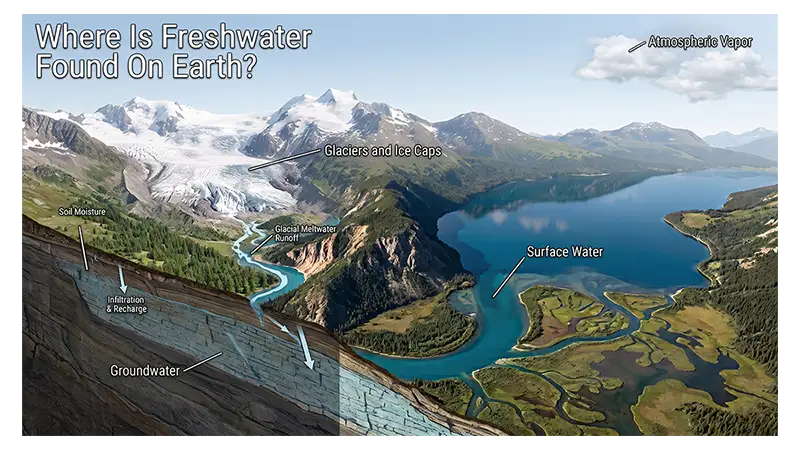
Freshwater is distributed unevenly across the planet. A large proportion is stored in frozen form, while another major portion occurs underground.
The approximate distribution of Earth's freshwater is commonly represented as follows, although percentages vary somewhat among sources and depending on how reservoirs are defined:
| Freshwater reservoir | Approximate share of Earth's freshwater |
|---|---|
| Glaciers and ice caps | About 69% |
| Groundwater | About 30% |
| Surface water and other reservoirs | Less than 1% |
Glaciers and Ice Sheets
Glaciers and ice sheets contain the largest share of Earth's freshwater. Antarctica and Greenland hold enormous quantities of frozen water, while smaller glaciers occur in mountain regions.
This water can remain frozen for centuries or thousands of years. When ice melts, the resulting water can enter streams, lakes, groundwater systems, and eventually the oceans.
Groundwater
Groundwater is water stored below Earth's surface within pores and fractures in soil and rock. It is an important freshwater reservoir and supplies many springs, wetlands, rivers, agricultural systems, and wells.
Groundwater can move slowly through geological formations. The rate depends on factors such as rock permeability, porosity, hydraulic gradients, and the connection between underground formations and surface water.
Lakes and Rivers
Only a very small fraction of Earth's freshwater is stored in lakes, rivers, and other surface-water bodies. Despite their small share, these environments are extremely important because they are accessible to ecosystems and human populations.
Lakes can retain water for periods ranging from days to thousands of years, while rivers generally transport water through landscapes toward larger water bodies.
Soil and Atmosphere
Freshwater also occurs as soil moisture and atmospheric water vapor. These reservoirs are small compared with glaciers and groundwater but are important parts of the water cycle.
Soil moisture supports plants, while atmospheric water contributes to cloud formation and precipitation.
What Are the Main Types of Freshwater?
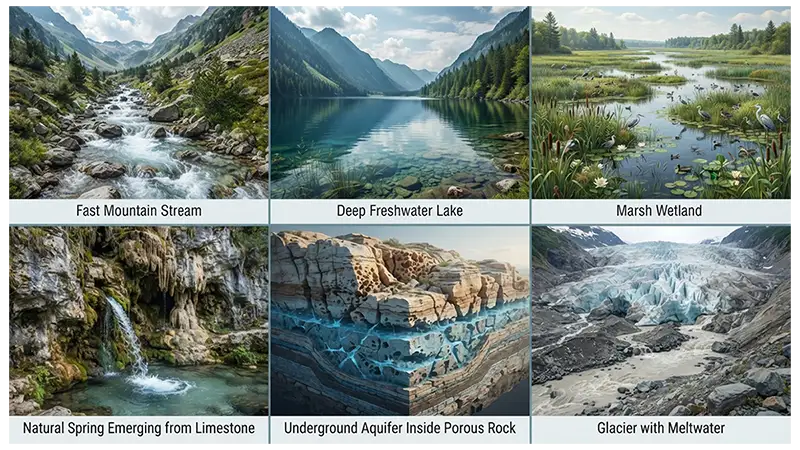
Freshwater occurs in several different environments, each with distinct physical characteristics and geological settings.
Rivers and Streams
Rivers and streams are flowing freshwater systems. Water moves through channels under the influence of gravity, carrying dissolved materials and sediment downstream.
Small streams may originate from springs, rainfall, snowmelt, or groundwater discharge. Multiple streams can join to form larger rivers.
Lakes and Ponds
Lakes and ponds are relatively still bodies of inland water surrounded by land. Their size, depth, temperature, nutrient levels, and water chemistry can vary greatly.
Some lakes form through glacial activity, while others develop through tectonic movements, volcanic processes, river activity, landslides, or dissolution of soluble rock.
Wetlands
Wetlands are environments where water covers or saturates the soil for part or all of the year. They include marshes, swamps, bogs, and other waterlogged landscapes.
Wetlands can store water, trap sediments, support biodiversity, and influence nutrient cycling.
Groundwater
Groundwater occupies spaces within soil and rock beneath the surface. Aquifers are geological formations that can store and transmit significant amounts of groundwater.
Some groundwater remains underground for relatively short periods, while other water may remain isolated for thousands of years.
Springs
A spring occurs where groundwater naturally emerges at Earth's surface. Springs can develop where the water table intersects the land surface or where geological structures channel groundwater upward.
They can create localized freshwater habitats and may feed streams and wetlands.
Glacial Freshwater
Frozen freshwater occurs in glaciers and ice sheets as well as seasonal snow and ice. In mountain regions, melting snow and glaciers can provide water to streams and rivers.
The timing and amount of meltwater can strongly influence downstream freshwater availability.
How Does Freshwater Move Through the Water Cycle?
Freshwater is continually exchanged between Earth's atmosphere, surface, subsurface, and oceans through the water cycle, also called the hydrologic cycle.
The cycle has no single starting point because water is constantly moving between reservoirs.
Evaporation
Solar energy causes water at Earth's surface to change from liquid into water vapor. Oceans are the largest source of evaporation, but freshwater bodies, soil, and other surfaces also contribute.
Transpiration
Plants release water vapor through small openings in their leaves. This process, called transpiration, transfers water from soil and vegetation into the atmosphere.
Evaporation and transpiration are often considered together as evapotranspiration.
Condensation
As moist air cools, water vapor can condense into tiny droplets or ice crystals. These particles contribute to cloud formation.
Precipitation
When water droplets or ice particles become sufficiently large, they return to Earth's surface as precipitation. Rain, snow, sleet, and hail are different forms of precipitation.
Infiltration and Groundwater Recharge
Some precipitation enters the soil rather than flowing directly across the surface. Water can move downward through soil and permeable rock.
When enough water reaches the saturated underground zone, it contributes to groundwater recharge.
Runoff
Water that does not infiltrate may flow over the land surface as runoff. Runoff can enter streams and rivers, eventually reaching lakes, wetlands, or oceans.
Groundwater Flow
Groundwater moves through underground materials according to geological and hydraulic conditions. It can eventually discharge into rivers, lakes, wetlands, springs, or coastal waters.
Through these interconnected processes, freshwater continually moves between different parts of the Earth system.
What Are Freshwater Ecosystems Like?
Freshwater ecosystems are communities of organisms living in environments where water has relatively low salinity. Their conditions can vary enormously depending on water movement, depth, temperature, nutrients, light, and surrounding geology. Freshwater environments are commonly divided into two broad ecological categories.
Lotic Ecosystems
Lotic ecosystems contain flowing water, such as rivers and streams. Flowing water affects everything from sediment transport to oxygen availability. Organisms living in fast-moving streams often have adaptations that help them remain attached to rocks or resist being carried downstream.
Lentic Ecosystems
Lentic ecosystems include relatively still waters such as lakes and ponds. These environments often develop distinct layers based on temperature and density. In deeper lakes, seasonal changes can influence oxygen and nutrient distribution throughout the water column.
Wetland Ecosystems
Wetlands have characteristics of both terrestrial and aquatic environments. Periodic or persistent water saturation creates specialized conditions that support plants and animals adapted to wet soils and changing water levels.
Freshwater ecosystems are also influenced by their surroundings. Soil, bedrock, vegetation, climate, and human land use can all affect the amount and quality of water entering these habitats.
What Plants and Animals Live in Freshwater?
Freshwater habitats support a wide range of organisms, from microscopic producers to large vertebrates.
Freshwater Plants and Producers
Important freshwater producers include:
- Phytoplankton
- Algae
- Aquatic grasses
- Reeds
- Rushes
- Water lilies
- Other submerged and floating plants
These organisms capture energy through photosynthesis and form the foundation of many freshwater food webs. Phytoplankton are especially important in lakes and other open-water environments. Aquatic plants also provide shelter and breeding areas for numerous animals.
Freshwater Animals
Freshwater animals include:
- Fish
- Amphibians
- Aquatic insects
- Crustaceans
- Mollusks
- Worms
- Reptiles
- Birds
- Freshwater mammals
Fish such as trout, salmon, carp, catfish, and many other species occupy different freshwater habitats. Amphibians often depend on freshwater for breeding or early development, while insects such as dragonflies and mayflies spend important parts of their life cycles in water.
Freshwater ecosystems also support predators and scavengers that connect different levels of the food web. Because freshwater environments vary considerably, species often develop specialized adaptations to particular conditions. Some organisms tolerate strong currents, while others are adapted to muddy wetlands, cold mountain streams, deep lakes, or seasonal pools.
How Does Freshwater Shape the Landscape?
Freshwater is one of the most important agents of landscape change. Rivers, streams, groundwater, rainfall, and melting ice interact with rocks and sediments to modify Earth's surface.
River Erosion
Flowing water can erode rock and sediment from river channels and surrounding landscapes. The strength of erosion depends on factors such as water velocity, channel shape, sediment load, slope, and rock resistance.
Over long periods, river erosion can deepen and widen valleys.
Sediment Transport
Rivers carry particles ranging from fine clay to gravel and larger sediment. The amount and size of material transported depend partly on flow conditions.
During floods, rivers can carry substantially more sediment than during normal flow.
Deposition
When flowing water loses energy, it may deposit sediment. Repeated deposition can create features such as:
- Floodplains
- Point bars
- Alluvial fans
- River terraces
- Deltas
These deposits preserve information about past river behavior and environmental conditions.
Valleys and Canyons
Persistent river erosion can produce valleys and, under suitable geological conditions, deep canyons and gorges. Resistant rock layers may influence the shape and rate of erosion.
The landscape produced by a river therefore reflects the interaction of water, rock type, tectonic setting, climate, sediment supply, and time.
Groundwater and Karst Landscapes
Freshwater beneath the surface can also alter landscapes. In areas containing soluble rocks such as limestone, groundwater can dissolve minerals and create caves, sinkholes, underground channels, and other karst features.
These processes demonstrate that freshwater changes landscapes both above and below Earth's surface.
Why Is Freshwater Important?
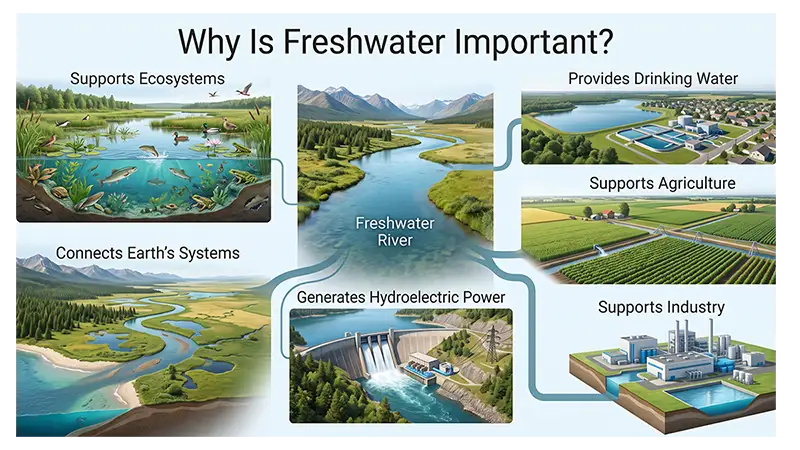
Freshwater supports biological systems and human societies in many ways. Its importance extends well beyond drinking water.
Supports Ecosystems
Freshwater habitats provide food, shelter, breeding grounds, and migration routes for countless organisms. Rivers, lakes, and wetlands also connect terrestrial and aquatic environments.
Provides Drinking Water
Communities obtain drinking water from sources such as rivers, reservoirs, lakes, springs, and groundwater. Water must often be treated before it is suitable for human consumption.
Supports Agriculture
Agriculture requires large quantities of water for crops and livestock. Irrigation allows farming in regions where rainfall is insufficient or seasonal. Groundwater and surface water are both important sources for agricultural production.
Supports Industry
Industries use freshwater for manufacturing, processing, cleaning, cooling, and other activities. Water availability can therefore influence where certain economic activities develop.
Generates Hydroelectric Power
Flowing water can be used to generate electricity through hydropower systems. Dams and reservoirs can also alter river flow, sediment transport, and aquatic habitats, so their benefits and environmental effects must be considered together.
Connects Earth's Systems
Freshwater transports nutrients, dissolved minerals, sediment, and organic material across landscapes. Rivers connect mountains, forests, plains, wetlands, lakes, and coastal environments. Its movement therefore links geological, biological, and atmospheric processes.
What Threats Affect Freshwater Resources?
Freshwater systems face pressure from natural variability and human activities. The severity of individual threats differs among regions.
Water Pollution
Pollutants can enter freshwater from agricultural fields, industrial facilities, urban areas, wastewater, mining operations, and other sources. Excess nutrients can contribute to algal blooms and oxygen depletion, while toxic substances can harm aquatic organisms.
Groundwater Depletion
When groundwater is pumped faster than it is naturally replenished, underground reserves can decline. Long-term depletion can reduce spring flow, lower water tables, affect rivers connected to aquifers, and cause land subsidence in some regions.
Habitat Modification
Dams, channelization, drainage of wetlands, removal of vegetation, and other alterations can change freshwater habitats. River barriers can also interfere with the movement of aquatic organisms and modify natural sediment and water flows.
Climate Change
Changes in temperature, precipitation, snowpack, evaporation, and the timing of ice melt can affect freshwater availability. Some regions may experience increased drought risk, while others may face more intense precipitation and flooding.
Invasive Species
Non-native organisms can alter food webs, compete with native species, spread disease, or change habitat conditions.
Excessive Water Use
Heavy withdrawals for agriculture, cities, and industry can reduce the amount of water remaining in rivers, lakes, wetlands, and aquifers. The effects can become particularly severe during prolonged droughts or periods of low precipitation. Protecting freshwater therefore requires consideration of both water quantity and water quality.
Conclusion
Freshwater is a relatively low-salinity form of water that occurs across Earth's surface, underground, in the atmosphere, and within frozen reservoirs. Although only a small portion of Earth's total water is freshwater, it plays an essential role in ecosystems and human societies.
Its importance also extends into geology. Rivers and groundwater continuously interact with rocks and sediments, producing erosion, transportation, and deposition that reshape landscapes over time. At the same time, freshwater ecosystems support diverse communities of plants, animals, and microorganisms.
Understanding freshwater therefore requires more than studying rivers and lakes. It involves the water cycle, groundwater, ecosystems, geological processes, climate, and human activity. Together, these connections show why freshwater is one of the most important components of Earth's interconnected systems.
Freshwater contains much less dissolved salt than seawater. This difference affects its chemistry and determines which organisms can live in particular aquatic environments.
A freshwater ecosystem is a community of organisms interacting with a low-salinity aquatic environment. Rivers, lakes, ponds, and wetlands are common examples.
Pollution can come from agricultural runoff, wastewater, industrial activities, mining, urban runoff, chemicals, plastics, and other sources.
Freshwater is continuously replenished through the water cycle, but its availability is limited by location, recharge rates, climate, and human demand. A freshwater source can therefore be depleted faster than it is naturally replenished.
Flowing water erodes rock, transports sediment, and deposits material. These processes help form valleys, floodplains, deltas, river terraces, canyons, and other landforms.