
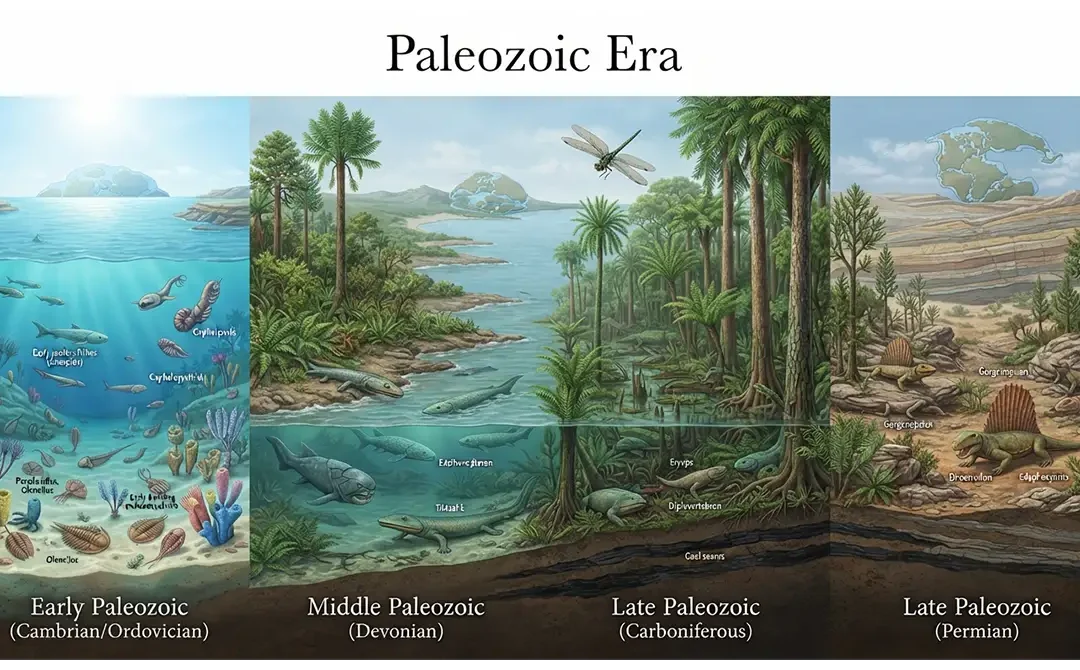
The Paleozoic Era was a major chapter in Earth’s history when marine ecosystems expanded, plants spread across continents, forests developed, and vertebrates gradually moved onto land. It began with the Cambrian Period and ended with the Permian Period, covering more than 289 million years of geological time.
During this era, continents shifted dramatically, mountain ranges formed, atmospheric conditions changed, and life underwent several major evolutionary transitions. Trilobites, brachiopods, corals, early fishes, amphibians, insects, and reptiles all appeared or diversified during different stages of the Paleozoic.
The era ended with the Permian–Triassic mass extinction, the most severe known mass extinction in the fossil record. Its aftermath opened the way for the Mesozoic Era.
What Was the Paleozoic Era?
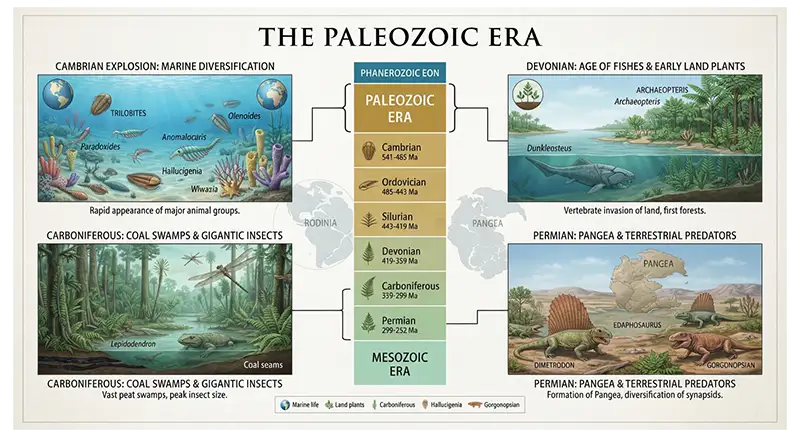
The Paleozoic Era was the first era of the Phanerozoic Eon, the interval of geological time represented by abundant visible fossil evidence. It followed the Precambrian and preceded the Mesozoic Era. The name Paleozoic means “ancient life.” This name reflects the enormous biological changes recorded in rocks from this interval.
At the beginning, most complex life was concentrated in marine environments. Over millions of years, ecosystems expanded onto land. Vascular plants established extensive vegetation, arthropods became common terrestrial animals, and vertebrates eventually developed adaptations for life away from water.
The Paleozoic was not a single uniform environment. Conditions changed greatly between its periods. Some intervals experienced widespread shallow seas, while others saw extensive glaciers, arid interiors, large forests, or major volcanic activity. Its geological record therefore provides a long-term view of how Earth’s environments and living organisms influenced one another.
When Did the Paleozoic Era Begin and End?
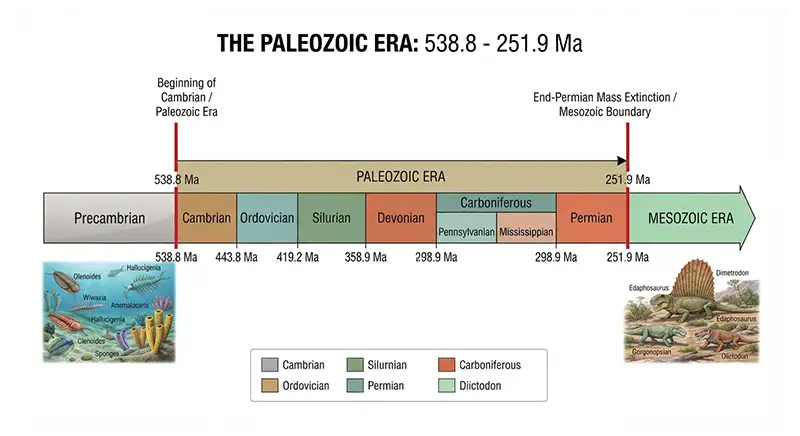
The Paleozoic began about 538.8 million years ago and ended about 251.9 million years ago. These boundaries are based on the internationally recognized geological timescale and mark major changes in Earth’s biological and geological history. Its beginning is associated with the start of the Cambrian Period, when animal fossils become increasingly diverse and abundant in the geological record.
The ending is marked by the boundary between the Permian and Triassic periods. This boundary follows the enormous end-Permian extinction, after which the Mesozoic Era began.
The Paleozoic therefore lasted for roughly 287 million years.
| Boundary | Approximate Age |
|---|---|
| Beginning of Paleozoic | 538.8 million years ago |
| End of Paleozoic | 251.9 million years ago |
| Duration | About 287 million years |
These dates can be refined as geological dating improves, but they provide the standard framework used to study the era.
What Are the Six Periods of the Paleozoic Era?
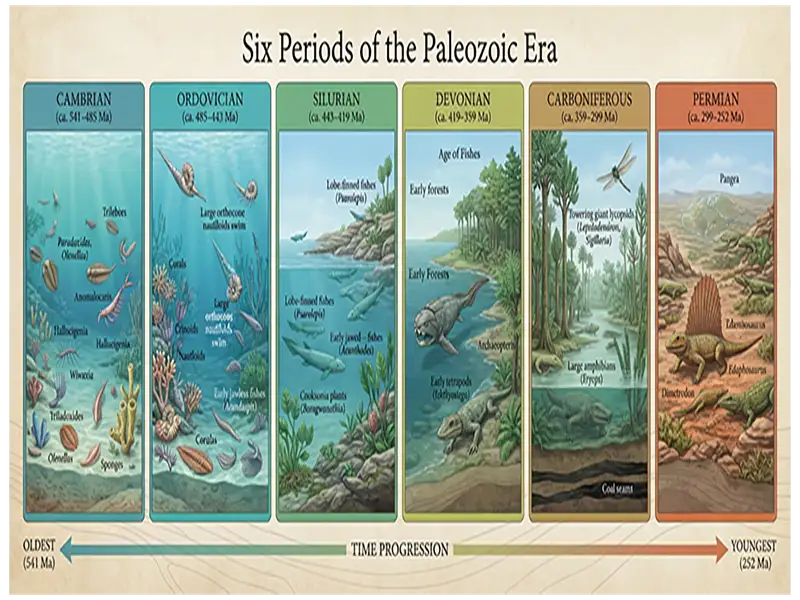
The Paleozoic Era is divided into six geological periods: Cambrian, Ordovician, Silurian, Devonian, Carboniferous, and Permian. Each period represents a different stage in Earth’s geological and biological history. Continents shifted, oceans changed, climates fluctuated, and new forms of life appeared or became dominant.
These periods are arranged from oldest to youngest. Together, they cover the interval from about 538.8 million years ago to 251.9 million years ago.
1. Cambrian Period
The Cambrian Period began about 538.8 million years ago and marked the start of the Paleozoic Era. It is especially famous for the rapid diversification of animal life known as the Cambrian Explosion. Marine environments dominated the planet’s ecosystems. Trilobites became one of the most common fossil groups, while brachiopods, sponges, mollusks, arthropods, and other organisms occupied different ecological roles.
Many animals developed hard shells, exoskeletons, limbs, eyes, and specialized feeding structures during this interval. Most life was still restricted to aquatic environments, while complex terrestrial ecosystems had not yet developed.
Key features:
- Cambrian Explosion
- Major diversification of marine animals
- Abundant trilobites
- Development of many distinctive animal body plans
- Mostly marine ecosystems
2. Ordovician Period
The Ordovician Period followed the Cambrian and lasted from about 486.9 to 443.1 million years ago. Marine biodiversity increased substantially, with brachiopods, bryozoans, mollusks, corals, trilobites, and other groups becoming widespread. Large areas of the continents were covered by shallow seas, creating extensive habitats for marine organisms. Early vertebrates also diversified during this time.
Toward the end of the Ordovician, major climatic changes caused extensive glaciation. Falling sea levels reduced marine habitats and contributed to one of the major mass extinction events in Earth history.
Key features:
- Expansion of marine biodiversity
- Extensive shallow seas
- Diversification of marine invertebrates
- Early vertebrate development
- End-Ordovician mass extinction
3. Silurian Period
The Silurian Period lasted from about 443.1 to 419.6 million years ago. Life recovered from the Ordovician extinction, and marine ecosystems became more stable and diverse. Jawed fishes became increasingly important, while early vascular plants began establishing themselves more successfully on land. Arthropods also expanded into terrestrial environments.
Plant life was still relatively simple compared with the extensive forests that appeared later. Nevertheless, the Silurian represents an important stage in the gradual development of complex land ecosystems.
Key features:
- Recovery after the Ordovician extinction
- Diversification of jawed fishes
- Expansion of vascular plants
- Increasing terrestrial arthropod diversity
- Development of early land ecosystems
4. Devonian Period
The Devonian Period extended from about 419.6 to 358.9 million years ago. It is often called the “Age of Fishes” because jawed fishes underwent major diversification during this interval. Placoderms, sharks, ray-finned fishes, and lobe-finned fishes occupied different aquatic environments. Some lobe-finned vertebrates developed anatomical features that became important in the eventual transition toward tetrapods.
Plants also underwent major changes. The first substantial forests appeared, and tree-like plants transformed terrestrial landscapes. Early tetrapods began exploring shallow-water and land environments. Several extinction episodes occurred toward the end of the Devonian, severely affecting marine ecosystems and reef communities.
Key features:
- Major diversification of fishes
- Development of early tetrapods
- First extensive forests
- Increasingly complex terrestrial ecosystems
- Late Devonian extinction events
5. Carboniferous Period
The Carboniferous Period lasted from about 358.9 to 298.9 million years ago. It is famous for extensive forests, swamp environments, and large amounts of plant material that eventually contributed to many coal deposits. Large lycopsids, horsetails, ferns, and other plants formed dense vegetation in humid regions. Atmospheric oxygen reached unusually high levels during parts of this period, supporting some exceptionally large arthropods.
Amphibians were widespread, while early reptiles became increasingly important. The development of the amniotic egg allowed some vertebrates to reproduce with less dependence on open water. The Carboniferous is commonly divided into the Mississippian and Pennsylvanian subperiods, particularly in the North American geological system.
Key features:
- Extensive swamp forests
- Major coal formation
- High atmospheric oxygen during parts of the period
- Large terrestrial arthropods
- Diversification of amphibians and early reptiles
- Spread of seed plants
6. Permian Period
The Permian Period was the final stage of the Paleozoic and lasted from about 298.9 to 251.9 million years ago. During this period, continental landmasses became increasingly assembled into the supercontinent Pangaea. The arrangement of this enormous landmass influenced climate and created large interior regions that were relatively dry. Terrestrial ecosystems increasingly included reptiles and synapsids, while several older Paleozoic groups declined.
Plants adapted to drier conditions became more important in many regions. Marine ecosystems continued to support diverse organisms, but environmental stresses increased toward the end of the period. The Permian ended with the Permian–Triassic mass extinction, the most severe extinction event known from the fossil record. It eliminated a very large proportion of marine species and caused major losses on land.
Key features:
- Formation and dominance of Pangaea
- Increasingly dry continental interiors
- Diversification of reptiles and synapsids
- Changes in terrestrial vegetation
- End-Permian mass extinction
- Transition from the Paleozoic to the Mesozoic
Paleozoic Periods at a Glance
| Period | Approximate Age | Major Highlights |
|---|---|---|
| Cambrian | 538.8–486.9 Ma | Cambrian Explosion and marine diversification |
| Ordovician | 486.9–443.1 Ma | Marine expansion and end-period extinction |
| Silurian | 443.1–419.6 Ma | Jawed fishes and early vascular plants |
| Devonian | 419.6–358.9 Ma | Fishes, forests, and early tetrapods |
| Carboniferous | 358.9–298.9 Ma | Coal forests, amphibians, and early reptiles |
| Permian | 298.9–251.9 Ma | Pangaea, synapsids, and end-Permian extinction |
Together, these six periods document a remarkable transformation: from predominantly marine ecosystems in the early Paleozoic to increasingly complex terrestrial environments containing forests, arthropods, amphibians, reptiles, and early synapsids by the Permian.
What Was Earth Like During the Paleozoic Era?
Earth’s physical geography changed substantially throughout the Paleozoic. Continents moved across the planet, collided, separated, and eventually assembled into the supercontinent Pangaea. During the early Paleozoic, extensive shallow seas covered large parts of continental areas. These marine environments supported diverse communities of invertebrates and early vertebrates.
Later, continental collisions produced major mountain-building events. The formation of Pangaea created enormous changes in geography and climate because large areas became located far from oceanic moisture. Sea levels also rose and fell repeatedly. These fluctuations altered the amount of shallow marine habitat available for organisms.
Climate varied from relatively warm greenhouse conditions to major glacial intervals. The late Paleozoic included an important ice age associated with the southern portions of the supercontinent Gondwana. Volcanism, erosion, sedimentation, and tectonic movement continuously reshaped the surface. These geological processes also created the rocks that preserve much of the fossil evidence from the era.
How Did Life Evolve During the Paleozoic Era?
Life underwent enormous diversification during the Paleozoic. At the beginning, complex organisms were largely concentrated in oceans, but ecosystems gradually expanded into terrestrial environments. Marine communities became increasingly complex. Predators and prey occupied different ecological roles, while reef systems and seafloor communities developed greater variety.
Plants gradually established themselves on exposed land. Once vegetation became more widespread, terrestrial food webs gained new sources of energy and habitat. Arthropods were among the earliest successful land animals. Later, vertebrates developed adaptations that allowed them to spend increasing amounts of time away from aquatic environments.
The evolutionary history was not a simple sequence in which one group directly replaced another. Many lineages appeared, diversified, declined, and disappeared while others continued into later geological periods. By the Permian, ecosystems contained sophisticated terrestrial communities involving plants, insects, amphibians, reptiles, and synapsids.
What Animals Lived During the Paleozoic Era?
The Paleozoic supported an extraordinary variety of animals, especially in marine environments.
Trilobites were among the most characteristic Paleozoic arthropods. They appeared early in the Cambrian and survived until the end-Permian extinction.
Brachiopods were abundant seafloor organisms that resembled clams in general appearance but belonged to a different animal lineage.
Corals formed reef communities in suitable marine environments, while mollusks such as cephalopods became important predators.
Eurypterids, sometimes called sea scorpions, included several large aquatic arthropods. Their size and body design varied considerably among species.
Fishes underwent major diversification. Jawless forms were joined by jawed groups, including placoderms, cartilaginous fishes, and bony fishes.
On land, arthropods became increasingly widespread. Amphibians appeared later in the Paleozoic, followed by the earliest reptiles and other amniotes. The Permian contained complex terrestrial communities in which synapsids and reptiles occupied numerous ecological roles.
How Did Plants Colonize the Land?
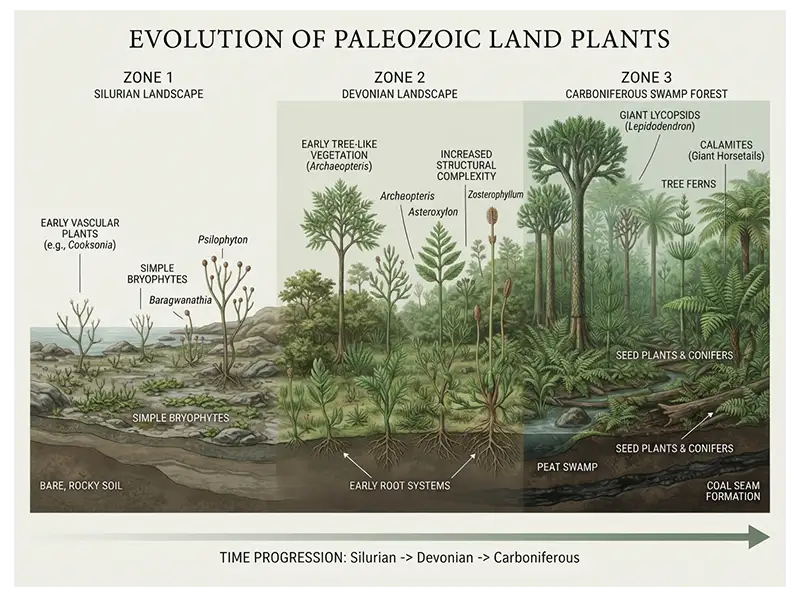
The expansion of plants onto land was one of the most important Paleozoic developments. Early land plants were relatively simple and lacked the complex vascular systems seen in later forests. Over time, plants evolved structures that improved water transport, support, reproduction, and growth.
Vascular plants became increasingly successful because specialized tissues allowed them to transport water and nutrients through larger bodies. By the Devonian, forests had developed in several regions. Trees and tree-like plants created vertical habitats and changed the physical structure of terrestrial ecosystems.
During the Carboniferous, enormous swamp forests covered extensive areas. Plants such as lycopsids, horsetails, ferns, and seed plants contributed large amounts of organic material. Burial of this vegetation under oxygen-poor conditions prevented complete decomposition. Over geological time, pressure and heat transformed some of this material into coal.
Seed plants also became increasingly important because seeds provided embryos with protection and stored nutrients, improving reproduction in environments where free-standing water was less reliable.
How Did Vertebrates Evolve During the Paleozoic?
Vertebrate evolution during the Paleozoic involved several major transitions. Early vertebrates were primarily aquatic. Over time, jawed fishes appeared and diversified, producing new feeding strategies and ecological opportunities.
The Devonian was especially important for vertebrate evolution. Lobe-finned fishes developed robust internal fin skeletons and other features that became relevant to the eventual origin of tetrapods. Some tetrapods developed limbs with digits and increasingly capable land-supporting skeletons. Early members still depended heavily on aquatic environments, but their bodies allowed them to explore shallow water, wetlands, and terrestrial habitats.
Later, amniotes evolved reproductive adaptations that reduced dependence on open water. Their descendants included the lineages leading to modern reptiles, birds, and mammals.The Paleozoic therefore contains several crucial stages in the long evolutionary history connecting aquatic vertebrates with fully terrestrial vertebrate groups.
What Fossils Are Found From the Paleozoic Era?
Paleozoic rocks preserve a wide variety of fossils. Marine deposits commonly contain trilobites, brachiopods, corals, crinoids, mollusks, bryozoans, and fish remains. Terrestrial rocks preserve plant material, pollen and spores, arthropod remains, footprints, and vertebrate bones.
Trace fossils are also valuable. Footprints, burrows, feeding marks, and other activity traces reveal how ancient organisms interacted with their surroundings. Plant fossils can preserve leaves, stems, roots, wood-like tissues, and reproductive structures. These remains help reconstruct ancient forests and identify changes in vegetation through time.
Some sites preserve exceptionally detailed organisms or communities. Such deposits provide snapshots of ancient ecosystems and can reveal soft-bodied structures that are rarely preserved under ordinary conditions. By combining body fossils, trace fossils, sedimentary rocks, and geological dating, scientists can reconstruct aspects of Paleozoic environments and biological history.
What Were the Major Mass Extinctions of the Paleozoic?
Several major extinction episodes affected Paleozoic ecosystems. Three are especially important.
End-Ordovician Extinction
Near the end of the Ordovician, major climatic changes caused extensive glaciation and significant sea-level decline. Marine habitats were reduced, leading to severe losses among ocean-dwelling organisms.
Late Devonian Extinctions
The Late Devonian experienced a prolonged series of extinction events rather than one single sudden catastrophe. Marine ecosystems were strongly affected, particularly reef communities and several groups of fishes. Possible contributing factors include climate change, ocean oxygen depletion, sea-level fluctuations, and changes in nutrient cycles.
End-Permian Extinction
The final Paleozoic extinction was by far the most severe. It eliminated a huge proportion of marine species and caused major losses among terrestrial organisms. Large-scale volcanic activity associated with the Siberian Traps released enormous quantities of gases and affected atmospheric chemistry, climate, ocean conditions, and terrestrial ecosystems. The event fundamentally reshaped life on Earth.
How Did the Paleozoic Era End?
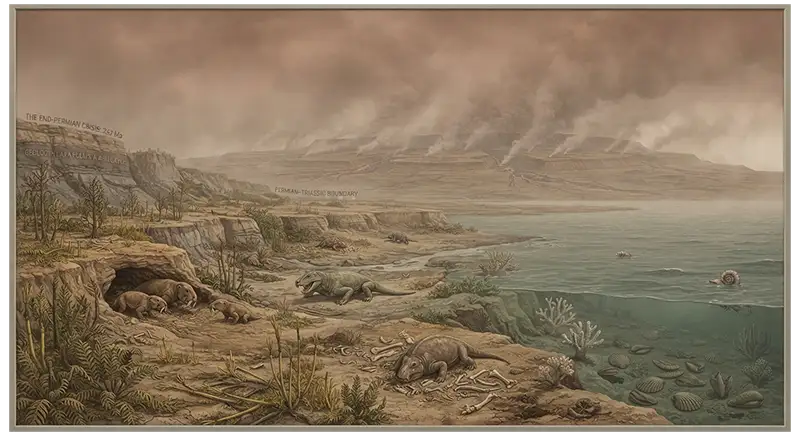
The Paleozoic ended with the Permian–Triassic mass extinction, about 251.9 million years ago. One of the strongest explanations links the crisis to massive volcanic eruptions in the region now known as Siberia. The Siberian Traps released carbon dioxide, sulfur-bearing gases, and other volcanic products over an extended period.
These emissions contributed to major environmental changes, including global warming, ocean acidification, oxygen-poor marine conditions, and disruption of terrestrial ecosystems. Food webs collapsed as many organisms lost suitable habitats or food resources. Marine communities were particularly severely affected.
The extinction was not caused by one simple environmental change. It involved interacting stresses that developed across different timescales. After the crisis, surviving organisms gradually rebuilt ecosystems. The beginning of the Triassic Period marked a new phase of Earth history—the Mesozoic Era, which later became famous for dinosaurs, marine reptiles, and other groups.
Why Is the Paleozoic Era Important?
The Paleozoic is important because many major features of modern life and Earth systems have roots in this era. It records the diversification of complex marine ecosystems, the development of extensive terrestrial vegetation, the emergence of forests, and major stages in vertebrate evolution.
The period also documents important changes in atmospheric chemistry, climate, continental arrangement, and mountain formation. For paleontologists, Paleozoic fossils provide evidence about organisms that have no close modern equivalent. For geologists, the rocks preserve information about ancient oceans, glaciers, deserts, rivers, forests, and tectonic activity.
The era also demonstrates how strongly biological and geological processes can interact. Plants altered terrestrial environments, tectonic movements changed habitats, and environmental disturbances influenced evolutionary patterns. Studying the Paleozoic therefore helps scientists understand not only ancient life but also the long-term development of Earth’s climate, continents, ecosystems, and biodiversity.
Conclusion
The Paleozoic Era was a transformative period in Earth history. It began with rapidly diversifying marine ecosystems and ended with a world profoundly changed by the Permian–Triassic extinction.
Across its six periods, continents moved, oceans expanded and contracted, forests appeared, plants transformed terrestrial habitats, and vertebrates developed new ways of living beyond water. Trilobites, fishes, amphibians, early reptiles, and many other organisms occupied ecosystems that have no exact modern equivalent.
Its fossil record preserves the foundations of many later biological developments. At the same time, its rocks reveal dramatic changes in climate, geography, volcanism, and ocean conditions. For these reasons, the Paleozoic remains one of the most important intervals for understanding how Earth and its life evolved through deep geological time.
The name Paleozoic comes from Greek roots meaning “ancient life.” It refers to the abundant and diverse fossil record from this era.
Important groups included trilobites, brachiopods, corals, mollusks, fishes, eurypterids, amphibians, insects, reptiles, and synapsids.
No. Dinosaurs evolved later, during the Mesozoic Era. The first dinosaurs appeared in the Triassic Period.
The end-Permian extinction was the largest mass extinction known from the geological record.
The Mesozoic Era followed the Paleozoic and began with the Triassic Period.