
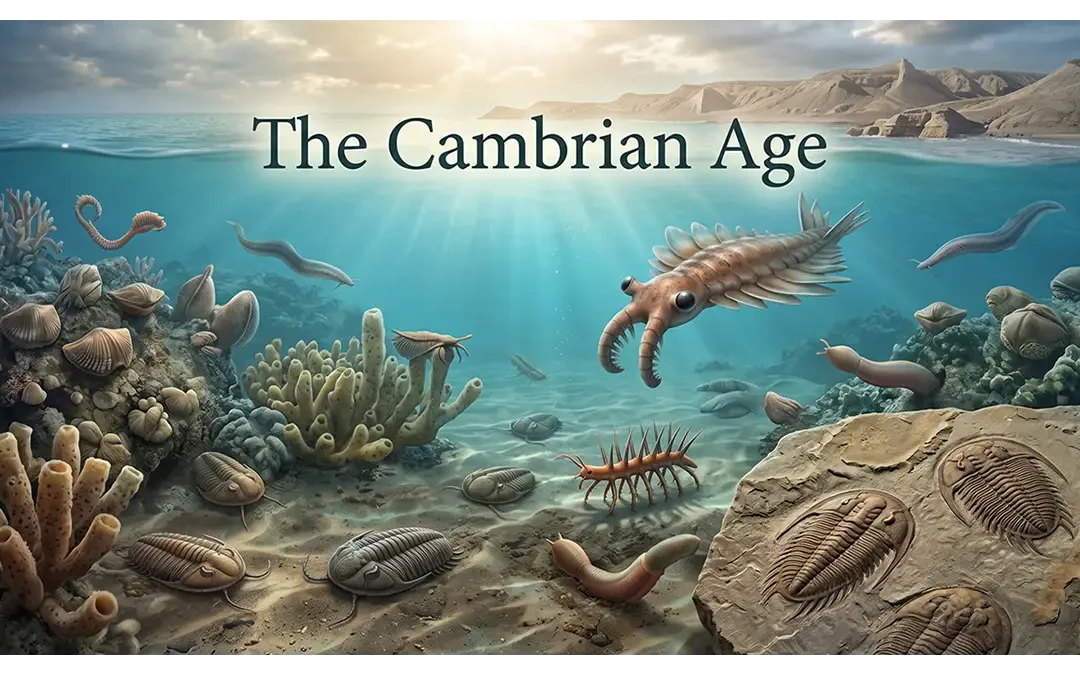
Cambrian Age is one of the most important chapters in Earth's history because it marks a major diversification of complex marine life. During this time, many animal groups developed new body forms, feeding strategies, shells, and other structures that became important in later ecosystems. The Cambrian Period was the first period of the Paleozoic Era and provides some of the earliest detailed evidence of diverse animal communities in the fossil record.
What Was the Cambrian Age?
The Cambrian Age, more accurately called the Cambrian Period, was the first geological period of the Paleozoic Era. It followed the Ediacaran Period of the late Precambrian and came before the Ordovician Period.
The Cambrian was dominated by marine environments. Most known Cambrian animals lived in oceans and shallow coastal seas because complex life had not yet expanded widely onto land. The period is especially famous for the rapid appearance and diversification of many animal groups in the fossil record.
Cambrian organisms included trilobites, brachiopods, arthropods, sponges, mollusk-like animals, worms, and early relatives of vertebrates. Some had hard shells or mineralized skeletons, while others had soft bodies that were preserved only under exceptional conditions.
The period is closely associated with the Cambrian Explosion, a major interval of evolutionary diversification during which many animal body plans became prominent in the fossil record. However, the term does not mean that complex animals suddenly appeared from nothing. Important evolutionary developments had already occurred before the Cambrian, and diversification continued throughout the period.
The Cambrian is therefore important not only because of the number of fossils it contains, but also because it records major changes in animal anatomy, ecology, behavior, and interactions.
When Did the Cambrian Period Begin and End?
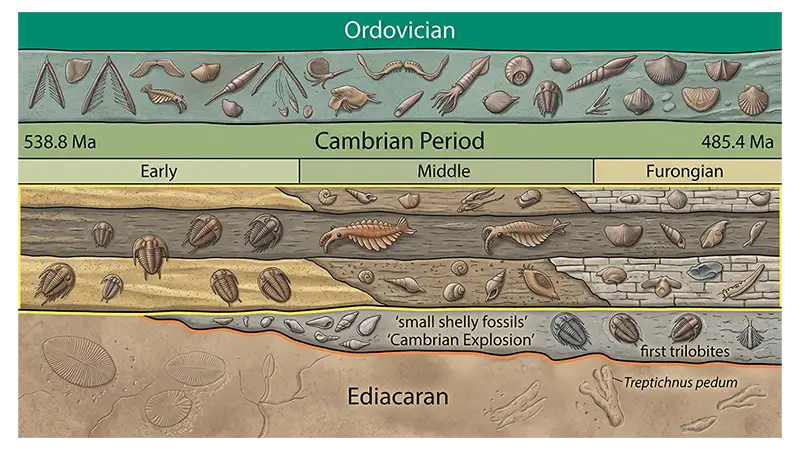
The Cambrian Period began approximately 538.8 million years ago and ended about 485.4 million years ago. It lasted for roughly 53 million years.
It is divided into four internationally recognized series:
- Terreneuvian
- Cambrian Series 2
- Miaolingian
- Furongian
These divisions are further separated into stages that allow geologists and paleontologists to compare rocks and fossils from different parts of the world.
The beginning of the Cambrian is associated with major changes in the fossil record, including the appearance of abundant trace fossils and increasingly diverse animal communities. The boundary between the Cambrian and Ordovician represents another major transition in Earth's biological history.
The exact timing of geological boundaries is refined as new fossils, radiometric dates, and other geological evidence become available. For this reason, modern geological timescales can differ slightly from older sources.
Cambrian Period in the Geological Time Scale
| Geological Unit | Approximate Age |
|---|---|
| Ediacaran Period | 635–538.8 million years ago |
| Cambrian Period | 538.8–485.4 million years ago |
| Ordovician Period | 485.4–443.8 million years ago |
| Silurian Period | 443.8–419.2 million years ago |
The Cambrian therefore represents the earliest period of the Paleozoic Era, making it an essential part of the geological history of complex animal life.
What Was Earth Like During the Cambrian Period?
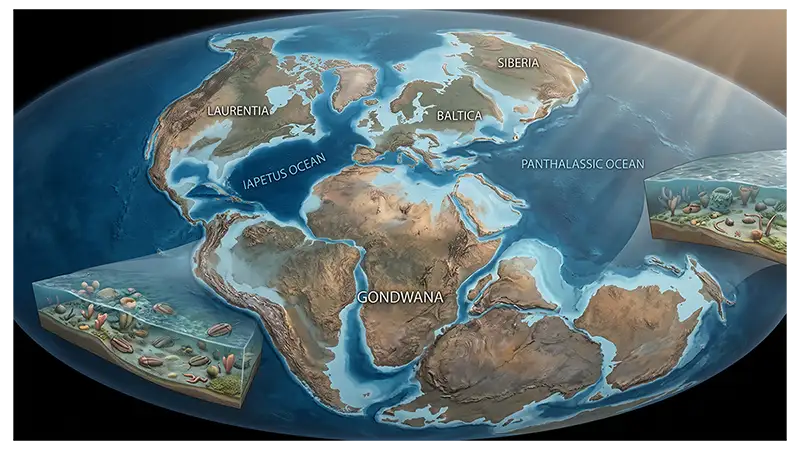
Earth looked very different during the Cambrian Period. The continents were arranged differently from today, and large areas of the planet were covered by shallow marine environments.
Several major continental masses existed, including Gondwana, which occupied a large portion of the southern hemisphere. Other landmasses, such as Laurentia, Baltica, and Siberia, were positioned separately around ancient oceans.
The geography of the period created extensive continental shelves and shallow seas. These environments provided habitats rich in sunlight, nutrients, oxygen, and suitable surfaces for marine organisms.
Unlike modern Earth, Cambrian landscapes did not contain forests, grasslands, or flowering plants. There were no modern terrestrial ecosystems filled with trees and large land animals. Life on land was much less developed than life in the oceans.
Ancient Cambrian Oceans
The oceans contained a wide variety of environments, including shallow continental seas, deeper marine settings, muddy seafloors, sandy bottoms, and microbial-rich habitats.
Many animals lived directly on or within the seafloor. Some crawled across sediment, others burrowed, while suspension feeders collected food from the surrounding water.
These habitats supported increasingly complex communities in which organisms occupied different ecological roles.
Cambrian Seafloors
Cambrian seafloors could contain microbial mats, sediments, shells, burrows, and animal remains. Some organisms lived permanently attached to the substrate, while others moved actively across or through it. The development of widespread burrowing animals also changed marine sediments.
As animals disturbed the seafloor while searching for food or shelter, they altered sediment structure and created new ecological opportunities. This process is known as bioturbation and became increasingly important during the early Paleozoic.
What Was the Cambrian Climate Like?
The Cambrian climate was generally warmer than today's global climate, although conditions varied across different regions and changed throughout the period.
There were no permanent continental-scale ice sheets comparable to those found during major later ice ages. Large shallow seas covered many continental margins, and warm marine environments supported diverse ecosystems.
Climate was influenced by atmospheric composition, ocean circulation, continental arrangement, volcanic activity, and interactions between the atmosphere and Earth's surface.
Warm Shallow Seas
Warm shallow marine environments were particularly important for Cambrian biodiversity. These seas provided favorable conditions for many organisms, including trilobites, brachiopods, sponges, and other marine animals.
The extensive continental shelves also created large areas of shallow habitat where sunlight could penetrate the water and support productive ecosystems.
Changes Through the Period
The Cambrian climate was not completely stable. Geological evidence indicates changes in sea level, ocean chemistry, temperature, and environmental conditions over millions of years. These changes affected marine communities and influenced where different organisms could survive.
Scientists study Cambrian climate using evidence such as sedimentary rocks, chemical signatures, fossils, mineral deposits, and the geographic distribution of ancient environments.
What Animals Lived During the Cambrian Period?
The Cambrian oceans contained a remarkable variety of animals. Many groups that are familiar today had early representatives during this period, while others belonged to evolutionary lineages that later disappeared. Among the most recognizable Cambrian animals were trilobites, an extinct group of marine arthropods with segmented bodies and distinctive mineralized exoskeletons.
Other important organisms included brachiopods, sponges, priapulid-like worms, early mollusk relatives, anomalocaridids, and early chordates.
Trilobites
Trilobites were among the most successful Cambrian arthropods. Their bodies were divided into three major longitudinal lobes and several segments. Many trilobites had compound eyes and could move across the seafloor. Different species occupied different habitats and probably used different feeding strategies. Their durable exoskeletons make them particularly valuable fossils for studying Cambrian environments and geological age.
Anomalocaridids
Anomalocaridids were large predatory or active-feeding arthropod relatives known from several Cambrian fossil deposits. They had flexible bodies, prominent frontal appendages, and a circular or disk-like mouth in some forms. Their anatomy shows that Cambrian oceans already contained active predators capable of interacting with diverse prey.
Brachiopods
Brachiopods were marine animals with two shells that protected their bodies. They are not closely related to modern clams despite their superficially similar appearance. Many brachiopods were attached to the seafloor and used feeding structures to collect suspended particles from the water.
Early Chordates
Some Cambrian fossils show characteristics associated with early chordates, the broader group that includes vertebrates. Fossils such as Pikaia from the Burgess Shale demonstrate that chordate-like animals were already present in Cambrian marine ecosystems. These organisms were generally small and lacked the complex vertebrate skeletons seen in modern fish.
Soft-Bodied Animals
Some of the most scientifically important Cambrian organisms had soft bodies. Their preservation is unusual because soft tissues normally decay rapidly. Exceptional fossil sites have revealed details such as appendages, eyes, digestive structures, muscles, and body outlines. These discoveries greatly expanded scientists' understanding of Cambrian biodiversity.
What Was the Cambrian Explosion?
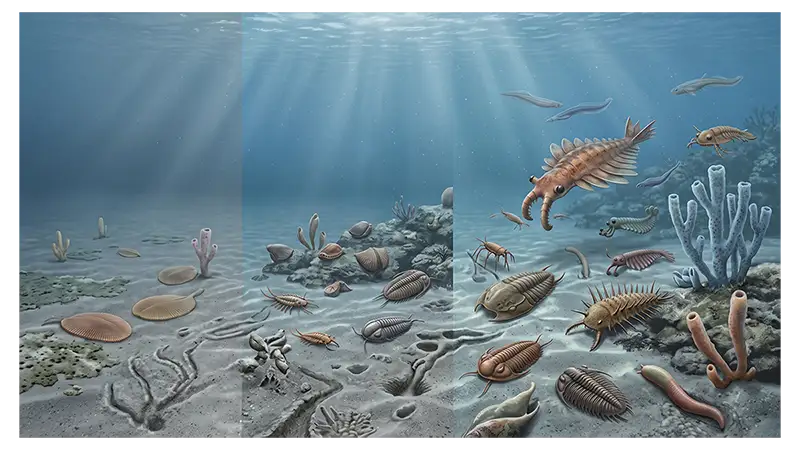
The Cambrian Explosion refers to a major period of diversification in the history of animal life, especially visible in the fossil record of the early Cambrian. During this interval, many animal groups developed recognizable body architectures, mineralized structures, specialized appendages, sensory organs, and new ecological strategies.
The event is often described as an explosion because the diversity and abundance of animal fossils increased substantially over a relatively short interval in geological terms. However, evolution did not happen instantaneously.
Life Before the Cambrian Explosion
Complex organisms existed before the Cambrian. The Ediacaran fossil record contains diverse multicellular organisms, and molecular evidence suggests that several animal lineages originated before their abundant Cambrian fossils appeared.
The Cambrian therefore represents a major diversification and ecological expansion, rather than the absolute beginning of animal life.
Why Did Diversification Accelerate?
Scientists have proposed several interacting explanations for the Cambrian diversification. These include changes in ocean chemistry, increasing oxygen availability, ecological interactions, developmental innovations, genetic changes, environmental changes, and the evolution of mineralized body parts.
Predation may also have played an important role. As animals became better predators and prey developed defenses, evolutionary pressures could have encouraged new body structures, mobility, burrowing behaviors, and protective shells.
The Cambrian Explosion is therefore best understood as a complex evolutionary transition involving biological and environmental factors rather than a single cause.
What Fossils Reveal the Secrets of Cambrian Life?
Cambrian fossils provide some of the most detailed evidence available for early animal ecosystems. Fossils from this period include both body fossils and trace fossils. Body fossils preserve physical remains or impressions of organisms, while trace fossils record activities such as burrowing, crawling, feeding, and resting.
Burgess Shale
The Burgess Shale in British Columbia, Canada, is one of the world's most famous Cambrian fossil deposits. It is particularly important because it preserves many soft-bodied organisms that would rarely fossilize under ordinary conditions. Fossils from this locality have provided detailed information about the anatomy and diversity of Cambrian marine communities.
Chengjiang Fossils
The Chengjiang fossil deposits of Yunnan, China, preserve another exceptionally diverse Cambrian ecosystem. These fossils include arthropods, worms, chordate relatives, and many other organisms. The preservation of soft tissues allows researchers to reconstruct anatomical details that would be impossible to determine from shells alone.
Trace Fossils
Trace fossils are equally important because they reveal animal behavior. Burrows can show how deeply animals penetrated sediments, while crawling trails provide evidence of movement across ancient seafloors. Feeding traces can indicate how organisms interacted with sediment and other resources. Together, body and trace fossils provide a more complete picture of Cambrian ecosystems.
How Did Cambrian Life Evolve and Diversify?
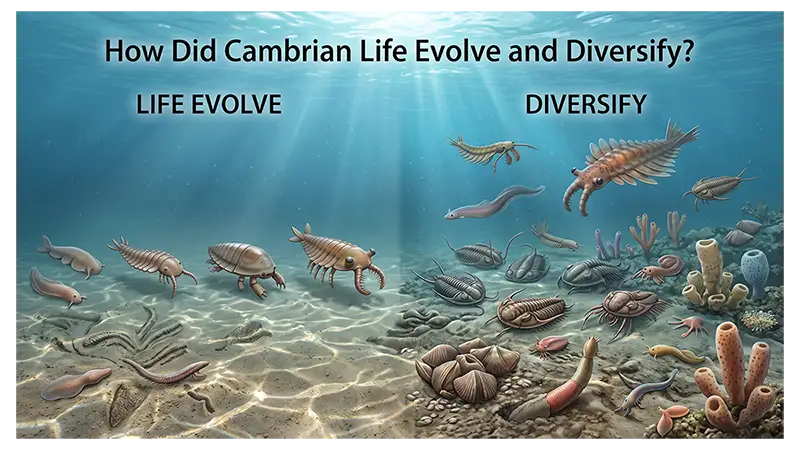
Cambrian life evolved through gradual changes in anatomy, development, ecology, and interactions between organisms. One important feature of this diversification was the development of new body structures. Animals evolved specialized appendages, shells, sensory organs, feeding mechanisms, and locomotion strategies.
Increasing Ecological Complexity
Cambrian ecosystems became increasingly divided into different ecological roles. Some organisms lived on the seafloor, while others burrowed beneath it. Some filtered food from the water, others consumed organic material from sediments, and active predators hunted or scavenged. This separation of ecological roles allowed more species to occupy the same general environment.
The Evolution of Predation
Predation became an increasingly important ecological force during the Cambrian. The appearance of efficient predators created new selective pressures for prey animals. Protective shells, spines, burrowing, increased mobility, and improved sensory systems could all provide advantages against predators. This contributed to increasingly complex interactions between organisms.
Mineralized Skeletons
The development of mineralized shells and skeletal structures was another major evolutionary development. Hard parts provided protection and structural support while also improving fossil preservation. As mineralized organisms became more common, the fossil record became richer and easier to interpret.
Early Animal Body Plans
Cambrian fossils demonstrate a wide range of anatomical designs. Some belong to lineages that survived and eventually gave rise to modern groups, while others represent evolutionary experiments that later disappeared. The period therefore provides an important window into how animal diversity was established during the early Paleozoic.
How Did the Cambrian Period End?
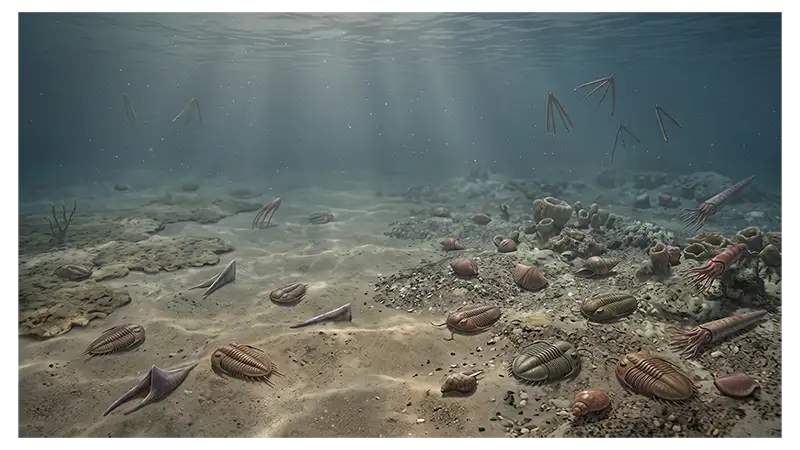
The Cambrian Period ended approximately 485.4 million years ago, when it transitioned into the Ordovician Period. This transition was not a single worldwide extinction event that eliminated all Cambrian life. Instead, marine ecosystems changed as environmental conditions shifted and new communities developed.
Changes in sea level, ocean chemistry, climate, and biological interactions contributed to the restructuring of marine ecosystems around the Cambrian–Ordovician transition. Many Cambrian organisms continued into the Ordovician, while other groups declined or disappeared.
The end of the Cambrian therefore represents an important ecological and evolutionary transition, rather than a simple disappearance of Cambrian life.
The following Ordovician Period would bring another major expansion of marine biodiversity, often called the Great Ordovician Biodiversification Event.
Why Is the Cambrian Period Important?
The Cambrian Period is important because it records a fundamental transformation in the history of animal life. It provides evidence for the development of complex marine ecosystems, major evolutionary innovations, early predator-prey relationships, increasing ecological specialization, and the diversification of many important animal lineages.
Understanding Early Animal Evolution
Cambrian fossils help scientists investigate when different animal groups appeared and how their anatomical features developed. They also provide evidence for relationships among extinct organisms and living groups.
Understanding Ancient Ecosystems
Cambrian communities show that marine ecosystems already contained predators, prey, scavengers, suspension feeders, burrowers, and other ecological specialists. Studying these communities helps researchers understand how complex food webs developed.
Understanding Fossil Preservation
Exceptional Cambrian fossil deposits demonstrate that soft tissues can sometimes survive under unusual geological conditions. These sites provide anatomical information that would otherwise be lost from the fossil record.
Understanding Earth's History
The Cambrian also connects biological evolution with changes in Earth's environment. Continental movement, sea-level changes, ocean chemistry, sedimentation, and climate all influenced the habitats available to early animals. For paleontologists and geologists, the period is therefore an important reference point for reconstructing the early Paleozoic world.
Conclusion
The Cambrian Age was a turning point in Earth's biological history. From about 538.8 to 485.4 million years ago, marine ecosystems became increasingly diverse and complex, with trilobites, brachiopods, arthropods, worms, early chordates, and many other organisms occupying different ecological roles.
The Cambrian Explosion represents one of the most important episodes in this history, but it was part of a longer evolutionary process that began before the Cambrian and continued afterward. Fossil deposits such as the Burgess Shale and Chengjiang provide remarkable evidence of these ancient communities, including delicate soft-bodied organisms rarely preserved elsewhere.
By studying Cambrian fossils, rocks, trace fossils, and environmental evidence, scientists can reconstruct how early animal ecosystems developed and how evolutionary innovations shaped the later history of life. The Cambrian Period therefore remains one of the most valuable windows into the early evolution of complex life on Earth.
The Cambrian Period lasted approximately 53 million years, from about 538.8 million years ago to 485.4 million years ago.
No. Dinosaurs evolved hundreds of millions of years later during the Mesozoic Era. Cambrian ecosystems were dominated mainly by marine organisms.
There were no forests or modern terrestrial plant communities during the Cambrian. Most complex life known from this period lived in marine environments.
The Cambrian Explosion was a major evolutionary diversification during which many animal groups and recognizable body forms became increasingly common in the fossil record.
No. Some Cambrian animal lineages survived into later geological periods. Others disappeared, while related groups continued evolving and diversified further.