
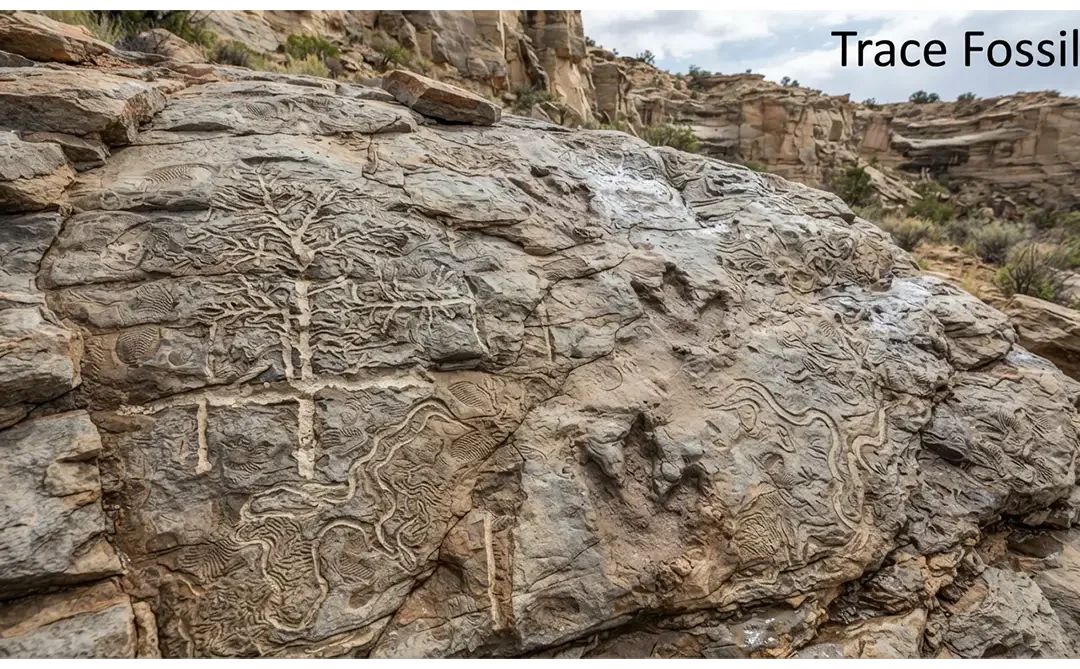
Trace fossils are preserved evidence of biological activity left behind by organisms in the geological past. Unlike body fossils, which preserve physical parts of an organism, trace fossils preserve structures produced while an organism was alive.
Footprints, trackways, burrows, trails, feeding marks, borings, nests, root traces, and coprolites are examples of trace fossils. These structures can preserve evidence of movement, feeding, shelter, reproduction, and interactions between organisms and their surroundings.
Trace fossils are important because they provide information that body fossils often cannot. A dinosaur bone can reveal anatomy, while a dinosaur trackway can provide evidence about movement. A fossil shell can show the structure of a mollusk, while a boring preserved in that shell can record an interaction with another organism.
The scientific study of trace fossils is called ichnology. By examining traces together with the rocks and sediments around them, scientists can investigate ancient behavior, ecosystems, and environmental conditions.
What Are Trace Fossils?
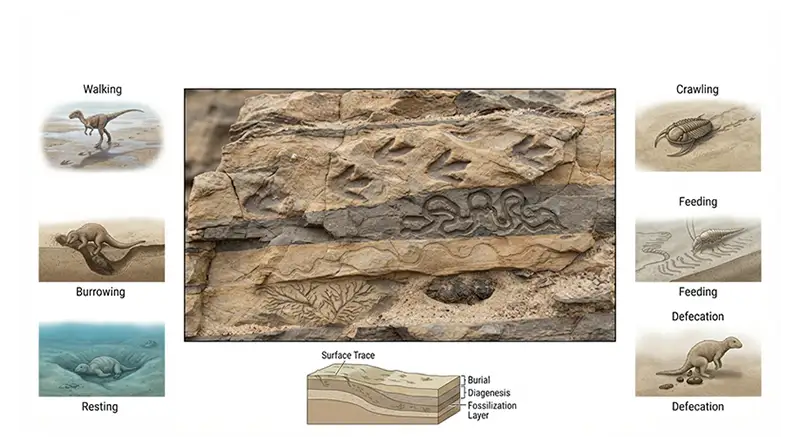
A trace fossil, also called an ichnofossil, is a preserved record of an organism's activity in the geological record. The organism itself does not need to be preserved. When an animal walks across wet sediment, for example, its feet can leave impressions. If the surface remains undisturbed and is later covered by sediment, the footprints may eventually become preserved in rock.
The same principle applies to an animal digging a burrow, feeding on a sediment surface, boring into a shell, or leaving waste behind. If the resulting structure survives erosion and decay and becomes preserved, it can become a trace fossil.
Trace fossils therefore represent a different kind of fossil evidence from bones, teeth, shells, leaves, or other body remains. The U.S. National Park Service defines trace fossils as evidence of biological activity preserved in geological context.
What Can Produce Trace Fossils?
Trace fossils can be produced by many kinds of organisms, including:
- Dinosaurs
- Mammals
- Reptiles
- Birds
- Fish
- Trilobites
- Worms
- Crustaceans
- Mollusks
- Insects
- Other invertebrates
- Plants and their roots
- Microorganisms
The organism responsible for a trace is not always known. A fossil track may show that an animal was present without providing enough information to identify its exact species.
This is one reason trace fossils are usually classified according to the structure of the trace and the activity it represents, rather than simply assigning them the name of a suspected trace-maker.
Trace Fossils Record Life in Action
One of the most important features of trace fossils is that they can preserve a moment of an organism's life. A footprint records movement. A burrow records interaction with sediment. A feeding mark records food-related activity. A nest records reproductive behavior. In this sense, trace fossils provide a record of organisms while they were alive rather than only evidence remaining after death.
How Do Trace Fossils Form?
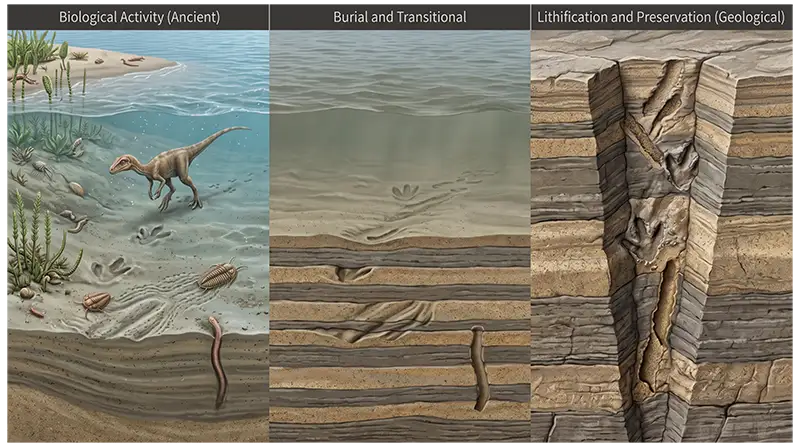
Trace fossil formation begins when an organism interacts with a surface, sediment, rock, plant material, or another substrate. The activity creates a structure, and that structure must then survive long enough to be preserved.
An Organism Produces a Trace
An organism may walk, crawl, burrow, feed, rest, swim, bore, dig, or reproduce. For example, a dinosaur walking across soft sediment can produce footprints. A marine invertebrate moving through the seafloor can leave a trail or burrow.
The Trace Remains Intact
The substrate must have suitable physical properties for the trace to survive. Sediment that is too soft may collapse, while sediment that is too hard may not record the activity clearly. Moist mud and firm sand can be especially effective at preserving surface traces.
The Trace Is Buried
Additional sediment can cover the trace and protect it from erosion and further disturbance. Rapid burial is particularly important because exposed traces can be destroyed by water movement, wind, weathering, scavenging, or later biological activity.
Sediment Becomes Rock
As additional layers accumulate, buried sediment becomes compacted and cemented. Over geological time, the original trace can become preserved within sedimentary rock as an impression, filled structure, or three-dimensional feature.
Geological Processes Expose It
Uplift and erosion may eventually bring the fossil-bearing layer back to the surface. A trace fossil can then be discovered in an exposed rock layer, quarry, cliff, desert surface, river cut, or other geological setting.
Not every footprint or burrow becomes a fossil. Fossilization is uncommon, and preservation depends strongly on burial and geological conditions.
What Are the Main Types of Trace Fossils?
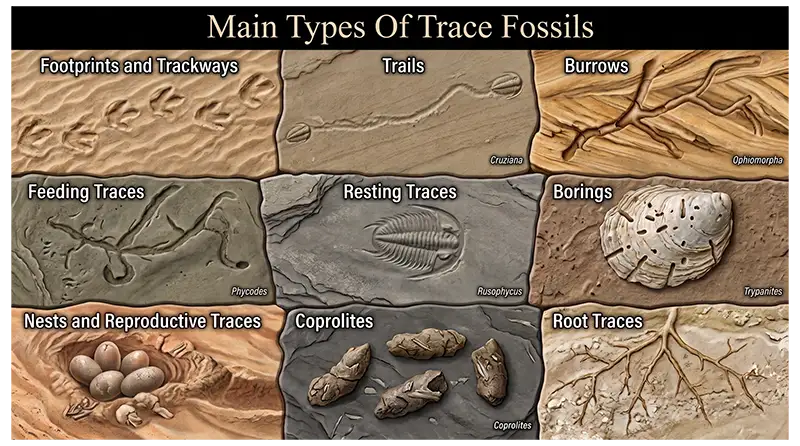
Trace fossils occur in many forms because organisms perform many different activities. The major types are usually distinguished by the kind of structure produced and the behavior represented.
Footprints and Trackways
Footprints are impressions made by the feet of organisms as they move across a surface. A sequence of footprints is called a trackway. Trackways can provide information about:
- Direction of movement
- Stride length
- Foot placement
- Locomotion
- Approximate body size
- Changes in movement
Dinosaur trackways are particularly important because they preserve evidence of dinosaur activity even when dinosaur bones are absent from the same rock layer.
Burrows
Burrows are tunnels, chambers, or networks created within sediment. Animals may construct them for feeding, shelter, reproduction, protection, or other purposes. Some burrows are simple tubes, while others form complex branching systems. Their shape and position within sediment can provide clues about the behavior of the organism that produced them.
Trails
Trails are elongated structures produced as an organism moves across or through sediment. They may be created by crawling, dragging, or other forms of movement. Unlike a single footprint, a trail can preserve a continuous record of movement across a surface.
Feeding Traces
Some organisms leave marks while searching for, collecting, or consuming food. These traces may appear as scratches, grooves, probes, sediment disturbances, or other repeated structures. Feeding traces can help scientists reconstruct how organisms interacted with their food sources and surroundings.
Borings
Borings are holes or cavities made by organisms in hard substrates. Marine organisms may bore into shells, wood, rock, coral, or other hard materials. Fossil borings can preserve evidence of biological interactions that took place millions of years ago.
Resting Traces
An organism may leave an impression when it temporarily rests on a sediment surface. These traces can sometimes preserve the shape of part of the body. When resting traces occur with footprints or feeding structures, they can provide evidence of different activities performed by the same organism.
Nests and Reproductive Traces
Nests and other reproductive structures can be preserved as trace fossils because they represent activities associated with reproduction. Fossil nests can provide evidence about where organisms reproduced and how they interacted with their surroundings. The National Park Service includes nests and eggs among important examples of trace-fossil evidence related to reproductive behavior.
Coprolites
Coprolites are fossilized feces. They are trace fossils because they record an organism's biological activity rather than preserving its body. Coprolites can sometimes contain food remains, making them useful for investigating the diets and ecological relationships of extinct organisms.
Root Traces
Plants can also produce trace fossils. Ancient root systems can leave structures in soils and sediments that preserve evidence of vegetation and ancient terrestrial environments. Root traces can be particularly useful when reconstructing ancient soils and landscapes.
What Do Trace Fossils Reveal About Ancient Behavior?
One of the greatest strengths of trace fossils is their ability to preserve behavior. Body fossils are excellent for studying anatomy, but trace fossils can show what organisms were actually doing.
Movement
Footprints and trackways provide direct evidence of locomotion. A series of tracks can show the direction in which an animal moved and provide clues about its walking pattern. Some trackways may also reveal changes in speed or direction.
Feeding
Feeding traces can show how an organism interacted with sediment or other food sources. For example, probing marks may indicate that an animal searched within sediment for food. Coprolites provide another line of evidence because their contents can reveal what an organism consumed.
Burrowing
Burrows demonstrate that organisms lived or interacted below the sediment surface. The structure of a burrow can provide clues about whether it was used primarily for feeding, shelter, reproduction, or another activity.
Resting
Resting traces provide evidence that an organism stopped temporarily at a particular location. When these structures preserve body outlines, they can sometimes provide information about posture and body position.
Reproduction
Nests, egg-laying structures, and related traces provide evidence of reproductive behavior. They can reveal where organisms reproduced and how they used particular environments during reproduction.
Interactions Between Organisms
Trace fossils can also record interactions between organisms. Borings in shells, feeding marks, and other structures can show that one organism interacted with another. Some trace fossils therefore provide evidence of ancient ecological relationships that would be difficult to identify from body fossils alone.
How Are Trace Fossils Different From Body Fossils?
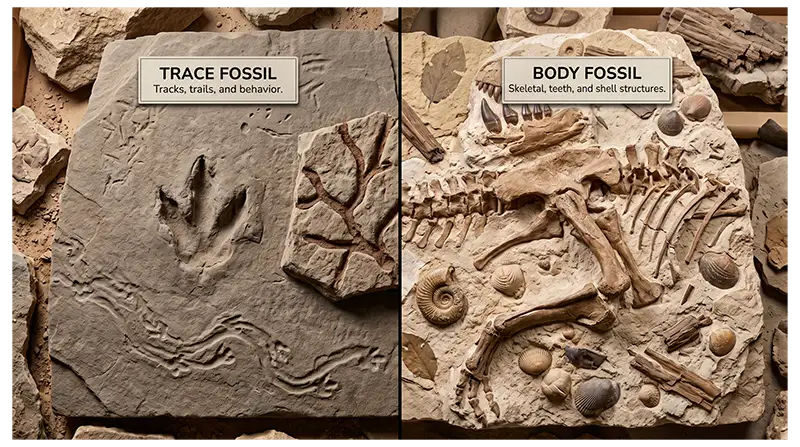
The fundamental difference between the two is what is preserved. Body fossils preserve physical remains or parts of organisms. These may include bones, teeth, shells, wood, leaves, feathers, or other biological material. Trace fossils preserve evidence of biological activity without requiring the organism's body itself to be preserved.
| Feature | Trace Fossils | Body Fossils |
|---|---|---|
| Main evidence | Biological activity | Physical remains |
| Examples | Footprints, burrows, trails, coprolites | Bones, teeth, shells, leaves |
| Best for studying | Behavior and interactions | Anatomy and biological structure |
| Organism itself preserved? | Usually no | Usually some part |
| Environmental information | Often highly useful | Also useful |
For example, a dinosaur skeleton can reveal the animal's anatomy, while a dinosaur trackway can reveal how it moved.
A fossil shell can show the structure of a mollusk, while a boring preserved in that shell can reveal an interaction with another organism. The two forms of fossil evidence are therefore complementary.
Where Are Trace Fossils Found?
Trace fossils occur in many sedimentary environments because organisms have interacted with surfaces and sediments throughout Earth's history. Their preservation is strongly influenced by the geological setting.
Marine Environments
Ancient marine sediments contain many types of trace fossils, including burrows, trails, feeding structures, resting traces, and borings. Shallow marine environments can be particularly productive because organisms frequently interact with the seafloor.
Tidal Flats and Coastal Areas
Tidal flats provide repeatedly exposed surfaces where organisms can leave footprints, trails, and feeding structures. Changing tides can then cover these traces with new sediment.
Rivers and Floodplains
River channels and floodplains can preserve footprints, burrows, and other terrestrial traces. Animals may cross wet floodplain surfaces after rainfall or flooding, while burrowing organisms can leave structures within floodplain sediments.
Lakes
Fine sediments deposited in lakes can preserve footprints, burrows, trails, and other biological structures. Calm water and fine sediment can sometimes provide favorable conditions for preserving small details.
Deserts
Ancient deserts can preserve footprints and trackways, particularly where temporary moisture creates firm surfaces suitable for recording movement. Later burial by wind-blown sand can protect the traces.
Ancient Soils
Trace fossils can also occur in paleosols, or ancient soils. Root traces, insect burrows, and other structures can provide information about terrestrial ecosystems and soil conditions. Trace fossils are therefore not restricted to one environment. Their geological context is an important part of interpreting what they mean.
Fossils, including trace fossils, are commonly preserved in sedimentary settings such as marine environments, coastal areas, rivers, floodplains, lakes, caves, and soils.
How Are Trace Fossils Classified and Studied?
The scientific study of trace fossils is called ichnology. Ichnologists study the physical structure of traces, the organisms that may have produced them, the behavior represented, and the geological conditions in which they formed.
Paleoichnology
Paleoichnology focuses on ancient trace fossils. Scientists examine fossil footprints, burrows, trails, borings, nests, and other structures preserved in geological deposits.
Neoichnology
Neoichnology involves studying traces produced by living organisms. Modern examples can help scientists interpret fossil structures.
For example, researchers can observe how modern animals create burrows or footprints and compare those structures with ancient traces. This comparative approach is important because the exact trace-maker is often uncertain.
Trace Morphology
Scientists carefully examine the shape and structure of a trace.
They may record its:
- Length
- Width
- Depth
- Branching pattern
- Orientation
- Surface texture
- Repetition
- Relationship with sedimentary structures
These characteristics can help distinguish different kinds of traces.
Ichnotaxonomy
Trace fossils can be given formal names through ichnotaxonomy, which classifies traces based on their morphology rather than necessarily identifying the biological species that produced them. This distinction is important because a trace fossil and its producer are not always known with certainty.
Sediment and Geological Context
The surrounding rock is just as important as the trace itself. Scientists examine grain size, bedding, sedimentary structures, rock type, and the position of the trace within the geological sequence. This information helps determine the environment in which the trace formed.
Three-Dimensional Analysis
Modern methods such as photogrammetry and digital scanning can create detailed three-dimensional models of footprints, trackways, burrows, and other traces. These models allow researchers to study measurements and surface details without repeatedly handling the original fossil.
What Can Trace Fossils Reveal About Ancient Environments?
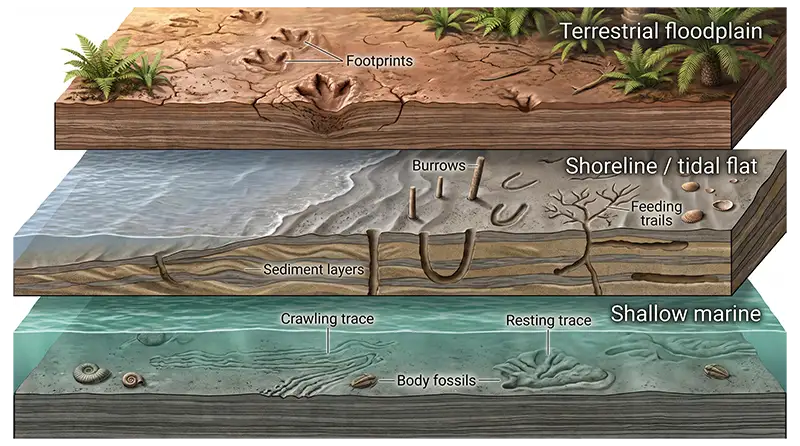
Trace fossils are valuable environmental indicators because organisms respond to the conditions around them. Their distribution, abundance, shape, and relationship with sediment can therefore provide clues about ancient environments.
Water Conditions
Marine and freshwater organisms respond to factors such as water depth, salinity, oxygen availability, and water movement. Certain trace communities can therefore help researchers interpret ancient aquatic conditions.
Sediment Conditions
Burrowing and crawling depend strongly on the properties of the substrate. The size, shape, depth, and complexity of a burrow can provide clues about sediment consistency and stability.
Oxygen Availability
The distribution and depth of some burrows can provide information about oxygen conditions within sediment. This can help distinguish more oxygenated environments from settings where oxygen was limited.
Energy and Water Movement
Strong currents and waves can affect whether organisms can live and burrow within sediment. The combination of trace fossils and sedimentary structures can therefore help reconstruct the energy conditions of an ancient environment.
Food Availability
The abundance and type of feeding traces can provide clues about the availability of food resources. A highly active sediment surface may indicate that organisms had access to sufficient organic material.
Ancient Ecosystems
When several trace types occur together, scientists can reconstruct how different organisms used the same environment. This approach can help distinguish marine, tidal, freshwater, terrestrial, and other depositional settings. Trace fossils are especially valuable because they are often preserved close to where the activity originally occurred. This gives them strong environmental significance compared with many transported body fossils.
Why Are Trace Fossils Important to Paleontology?
Trace fossils are important because they provide a form of fossil evidence that cannot be replaced completely by body fossils.
They Preserve Behavior
A footprint records movement. A burrow records excavation or occupation. A nest records reproductive activity. A coprolite records digestive activity. These are direct clues about what organisms did while they were alive.
They Complement Body Fossils
Body fossils are generally better for studying anatomy, while trace fossils are especially useful for studying behavior and interactions. Using both types of evidence gives researchers a more complete understanding of ancient organisms.
They Help Reconstruct Ancient Ecosystems
A collection of different traces can show how multiple organisms used the same environment. This can reveal ecological relationships and patterns of activity that may not be visible from isolated bones or shells.
They Help Interpret Ancient Environments
Because trace formation is strongly influenced by sediment and environmental conditions, trace fossils can help geologists reconstruct ancient depositional settings. This makes ichnology useful not only in paleontology but also in sedimentology and stratigraphic research.
They Record Activity Where Body Fossils Are Rare
An organism may leave footprints or burrows in a location where its body never becomes fossilized. Trace fossils can therefore extend the known distribution and ecological record of organisms beyond what body fossils alone reveal.
They Preserve a Record of Ancient Life in Place
Trace fossils are often preserved close to where they were produced rather than being transported after formation. This can make them particularly valuable for interpreting the original environment and activity of the trace-maker.
What Are Some Famous Examples of Trace Fossils?
Trace fossils occur throughout the geological record, but some examples are particularly useful for understanding ancient organisms and their behavior.
Dinosaur Trackways
Dinosaur tracks are among the most recognizable trace fossils. They can preserve footprints, trackways, and occasionally other features such as skin impressions or tail-related marks. Dinosaur tracks are particularly important where skeletal fossils are scarce because they provide evidence that dinosaurs were present and active in a particular environment.
Trilobite Trails
Trilobites produced trails as they moved across ancient seafloors. These structures can provide information about locomotion and interactions between trilobites and the substrate.
Burrows
Ancient burrows are extremely widespread. They were produced by many types of organisms and can range from simple tubes to complex networks. Fossil burrows can provide evidence of feeding, shelter, movement, and occupation of sediment.
Insect Trace Fossils
Insects have produced several types of trace fossils, including chew marks, nests, and dung-related structures. Fossil insect traces can be especially useful for investigating ancient relationships between insects and plants. The National Park Service notes that insect trace fossils include chew marks as well as nests and dung-related traces.
Coprolites
Coprolites provide evidence of feeding and digestion. When food remains are preserved inside them, they can help identify what ancient organisms consumed and provide information about ancient food webs.
Dinosaur Nests
Fossil nests and egg-laying structures preserve evidence of reproductive activity. They can provide information about nesting environments and reproductive behavior, particularly when multiple nests occur together.
Prehistoric Beaver Burrows
Fossil burrows attributed to ancient beavers provide another example of how trace fossils can reveal animal behavior. Such structures can preserve evidence of the activities of animals even when their bodies are not preserved at the same location.
Conclusion
Trace fossils are an essential part of the geological record because they preserve evidence of biological activity rather than simply the physical remains of organisms. Footprints, trackways, burrows, trails, feeding marks, borings, nests, root traces, and coprolites can record different aspects of ancient life.
Their formation depends on biological activity, suitable substrates, preservation, burial, and geological processes. When these conditions occur together, a temporary mark or structure can become a permanent record preserved in sedimentary rock.
The greatest value of trace fossils is their ability to reveal behavior. They can show how organisms moved, fed, burrowed, rested, reproduced, and interacted with other organisms. Their relationship with surrounding sediments also makes them valuable evidence for reconstructing ancient environments.
Through ichnology, scientists combine trace morphology, modern biological comparisons, sedimentology, stratigraphy, and modern imaging techniques to interpret these structures.
For paleontology, trace fossils and body fossils provide complementary forms of evidence. Together, they help scientists reconstruct not only what lived in the past, but also how organisms lived, interacted with their surroundings, and responded to ancient environments.