
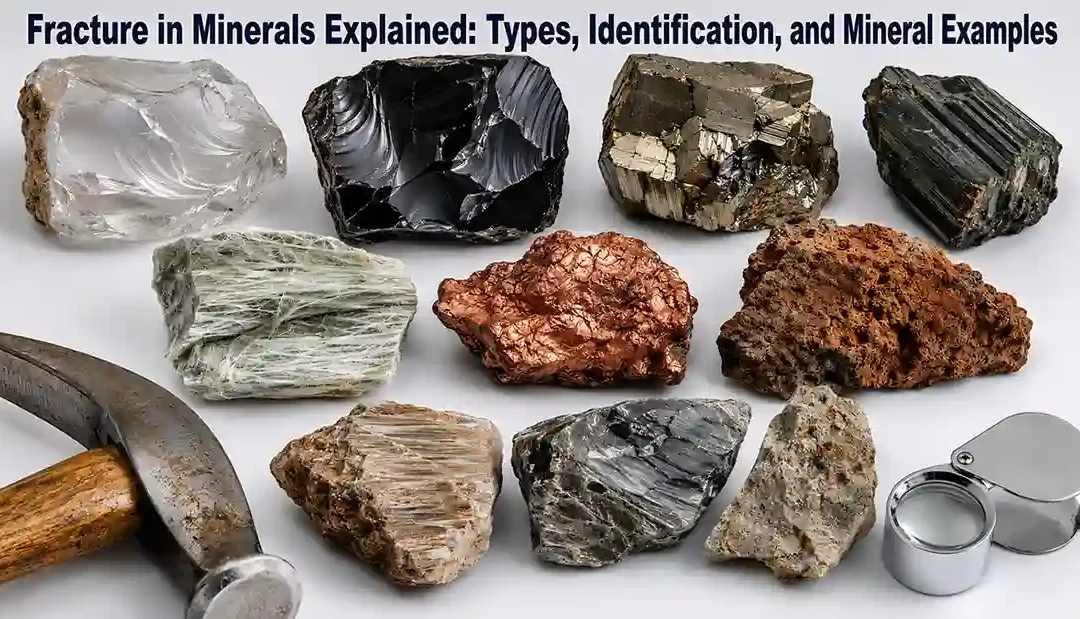
Fracture is one of the most important physical properties used in mineral identification. Unlike cleavage, which produces smooth and predictable breakage along planes of weakness, fracture describes how a mineral breaks when no cleavage planes are present. The shape and texture of a fracture surface are controlled by the mineral's internal atomic structure and bonding strength.
Minerals such as quartz, garnet, and obsidian are famous for their distinctive fracture patterns, making fracture a valuable diagnostic property in geology and mineralogy. When combined with hardness, streak, luster, crystal habit, and specific gravity, fracture helps geologists accurately identify minerals in both laboratory and field settings.
If you are learning mineral identification, understanding fracture is just as important as studying Mineral Hardness Test, and How to Identify Minerals.
What Is Fracture in Minerals?
Fracture refers to the way a mineral breaks when it does not split along cleavage planes.
Instead of producing smooth flat surfaces, fractured minerals typically break into irregular shapes with distinctive textures.
Fracture occurs because:
- Atomic bonds are equally strong in every direction.
- The mineral lacks planes of weakness.
- External force exceeds the strength of the crystal lattice.
Every mineral has a characteristic fracture pattern that can aid identification.
Why Does Fracture Occur?
Minerals consist of atoms arranged in repeating crystal structures. In minerals without well-developed cleavage, atomic bonds are nearly equal in strength throughout the crystal.
When stress is applied:
- Bonds break randomly.
- Cracks spread through the crystal.
- Irregular fracture surfaces form.
For a deeper understanding of atomic arrangements, see our Crystal Systems Explained guide.
Cleavage vs Fracture
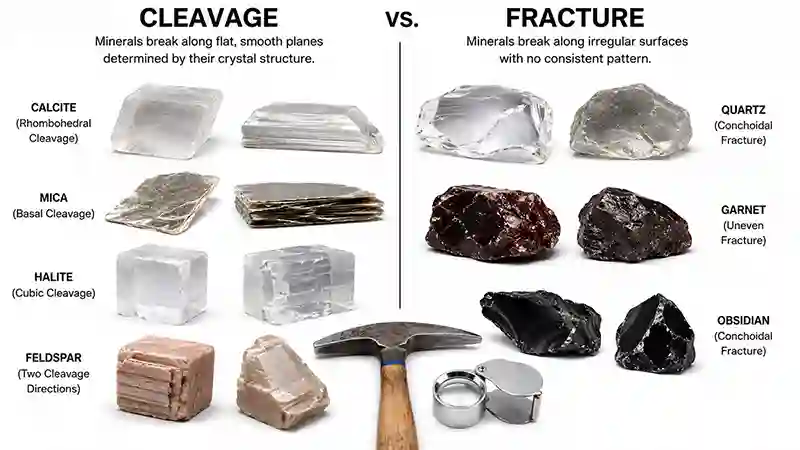
Cleavage and fracture are often confused, but they are fundamentally different properties.
| Cleavage | Fracture |
|---|---|
| Breaks along planes of weakness | Breaks randomly |
| Smooth flat surfaces | Irregular surfaces |
| Controlled by weak atomic bonds | Controlled by uniform bonding |
| Predictable | Unpredictable |
| Common in calcite and mica | Common in quartz and garnet |
A mineral usually shows either cleavage or fracture as its dominant breakage characteristic, although some minerals exhibit both to varying degrees.
For a complete explanation, read Cleavage Test Explained.
Types of Mineral Fracture
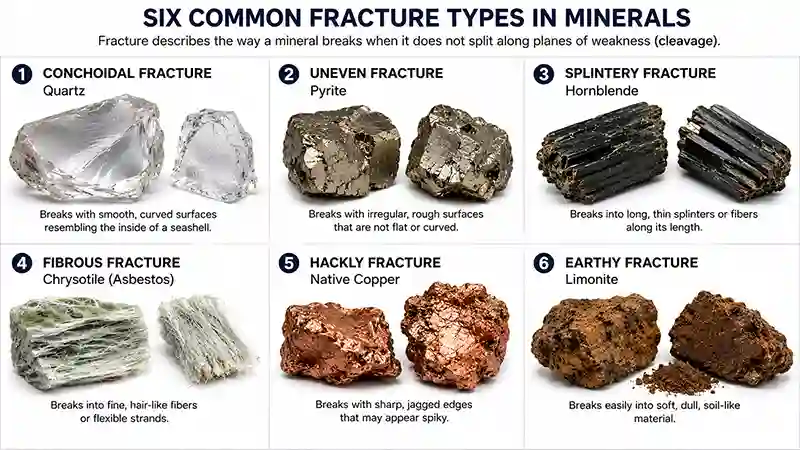
Mineralogists recognize several fracture types based on the appearance of freshly broken surfaces.
Conchoidal Fracture
Conchoidal fracture produces smooth, curved surfaces resembling the inside of a seashell.
Characteristics:
- Curved surfaces
- Sharp edges
- Smooth texture
Common minerals:
- Quartz
- Obsidian
- Flint
- Chert
Quartz is one of the best-known examples of conchoidal fracture.
Uneven Fracture
Uneven fracture produces rough, irregular surfaces with no consistent pattern.
Examples:
- Pyrite
- Magnetite
- Hematite
This is among the most common fracture types.
Splintery Fracture
Splintery fracture creates elongated, sharp fragments similar to broken wood.
Common minerals:
- Hornblende
- Kyanite
These fractures often produce needle-like splinters.
Fibrous Fracture
Fibrous fracture occurs in minerals composed of long fibers.
Examples:
- Chrysotile
- Asbestos minerals
The broken surface appears thread-like.
Hackly Fracture
Hackly fracture produces jagged, torn surfaces.
Common examples:
- Native Copper
- Native Silver
This fracture develops because metals deform before breaking.
Earthy Fracture
Earthy fracture produces dull, powdery surfaces.
Examples:
- Limonite
- Kaolinite
These minerals often crumble rather than break cleanly.
Common Minerals and Their Fracture
| Mineral | Fracture Type |
| Quartz | Conchoidal |
| Obsidian | Conchoidal |
| Garnet | Conchoidal to Uneven |
| Pyrite | Uneven |
| Hornblende | Splintery |
| Chrysotile | Fibrous |
| Native Copper | Hackly |
| Limonite | Earthy |
Recognizing these patterns greatly improves field identification.
How to Perform a Fracture Test
Follow these simple steps:
- Use a fresh mineral specimen.
- Carefully break a small corner using a geological hammer.
- Observe the newly exposed surface.
- Determine whether the surface is smooth or irregular.
- Compare the fracture with standard mineral descriptions.
Fresh surfaces provide the most reliable observations because weathered surfaces may hide fracture characteristics.
Importance of Fracture in Mineral Identification
Fracture helps geologists:
- Identify minerals without cleavage
- Distinguish similar minerals
- Understand crystal bonding
- Recognize weathering effects
- Support field investigations
Although fracture alone rarely identifies a mineral, it becomes extremely useful when combined with other physical properties.
Factors Affecting Fracture
Several factors influence fracture appearance:
- Crystal structure
- Bond strength
- Mineral composition
- Weathering
- Applied force
A freshly broken specimen always provides the most accurate fracture pattern.
Fracture in Common Rock-Forming Minerals
Many rock-forming minerals display fracture rather than perfect cleavage.
Examples include:
- Quartz
- Garnet
- Olivine
These minerals commonly develop irregular or conchoidal fractures because their atomic bonds are relatively uniform in strength.
Practical Applications
Understanding fracture is valuable for:
- Mineral identification
- Geological mapping
- Mining exploration
- Gemology
- Museum specimen classification
- Educational laboratories
Field geologists often rely on fracture observations when crystal faces are absent.
Comparison Table
| Property | Fracture |
| Definition | Irregular mineral breakage |
| Controlled By | Crystal bonding |
| Appearance | Rough or curved surfaces |
| Identification Value | High |
| Common Minerals | Quartz, Garnet, Obsidian |
Summary Table
| Fracture Type | Appearance | Common Minerals |
| Conchoidal | Curved | Quartz, Obsidian |
| Uneven | Rough | Pyrite |
| Splintery | Sharp splinters | Hornblende |
| Fibrous | Thread-like | Chrysotile |
| Hackly | Jagged | Native Copper |
| Earthy | Powdery | Limonite |
Fracture describes how a mineral breaks when it lacks cleavage planes.
It is a smooth, curved fracture resembling the inside of a seashell, commonly seen in quartz and obsidian.
Quartz, garnet, obsidian, pyrite, native copper, and hornblende commonly display characteristic fracture patterns.
Neither is better. Both are important physical properties used together during mineral identification.
Weathering can alter mineral surfaces, making fracture patterns difficult to recognize.
Final Thoughts
Fracture is one of the most valuable diagnostic properties in mineralogy because it reveals how minerals respond to stress when no cleavage planes are present. Whether examining the shell-like fracture of quartz, the jagged hackly break of native copper, or the splintery fracture of hornblende, these patterns provide essential clues for identifying minerals.
For the most accurate results, fracture should always be evaluated alongside hardness, cleavage, streak, luster, crystal habit, and specific gravity. Together, these physical properties form the foundation of reliable mineral identification used by geologists, students, collectors, and researchers worldwide.
Continue Learning
Expand your knowledge with these related guides: