
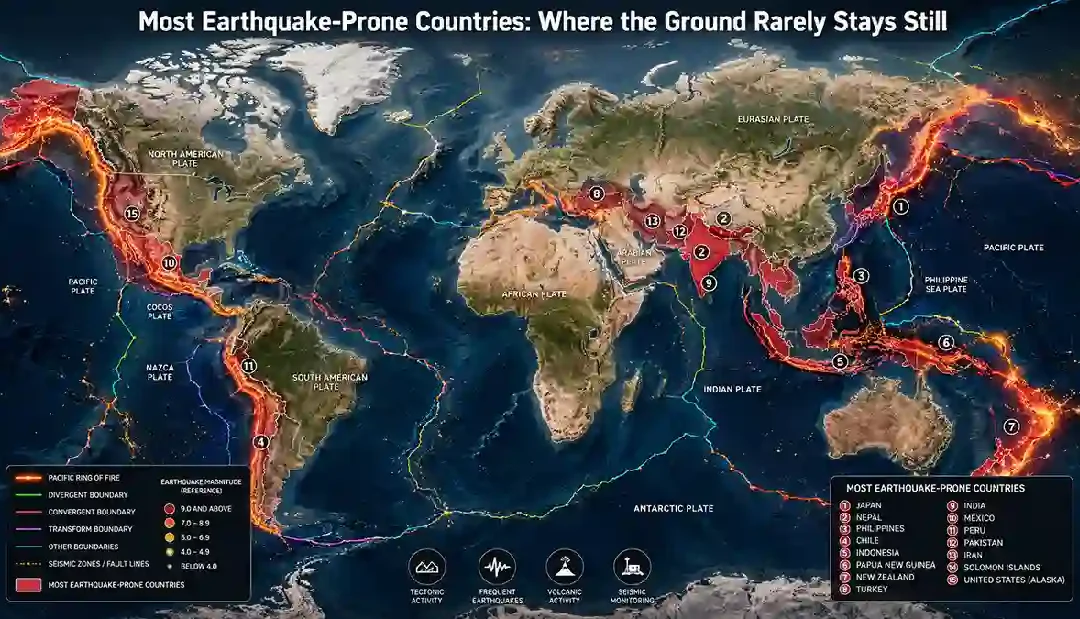
Some countries experience earthquakes only occasionally. Others face seismic activity almost every day. The difference usually comes down to one thing: tectonic plate boundaries.
Countries located near subduction zones, transform faults, or collision regions are far more likely to experience powerful earthquakes. Many of the world’s highest-risk nations lie within the Pacific Ring of Fire.
If you’re new to earthquakes, begin here → what is an earthquake
Why Some Countries Have More Earthquakes
Earthquake-prone countries are usually located where tectonic plates interact.
Here’s the simple explanation:
- Plates collide
- Plates slide past each other
- Plates dive beneath each other
- Stress builds underground
- Earthquakes occur when faults rupture
The stronger the tectonic interaction, the greater the earthquake risk.
Learn more → causes of earthquakes
10 Most Earthquake-Prone Countries in the World
1. Japan — The Triple Plate Earthquake Zone
Japan is one of the world’s most earthquake-active countries.
Why?
- Multiple tectonic plates meet beneath Japan
- Powerful subduction zones
- Frequent megathrust earthquakes
Japan experiences thousands of earthquakes every year.
Learn more → earthquakes Tokyo region
2. Indonesia — Volcanoes & Megathrust Earthquakes
Indonesia lies along the Pacific Ring of Fire.
Main Risks
- Subduction earthquakes
- Volcanic activity
- Tsunamis
See our guide → earthquakes Jakarta
3. Chile — Home of Earth’s Strongest Earthquake
Chile experiences some of the largest earthquakes ever recorded.
Why?
- Nazca Plate dives beneath South America
- Massive subduction zone stress
- Frequent megathrust earthquakes
The strongest recorded earthquake (M9.5) occurred in Chile.
Learn more → earthquakes Santiago Chile
4. Turkey — A Country Split by Active Faults
Turkey sits along major transform fault systems.
Main Risks
- North Anatolian Fault
- East Anatolian Fault
- Large strike-slip earthquakes
Explore → Istanbul fault zone
5. Iran — Continental Collision Earthquakes
Iran lies in a major continental collision zone.
Why?
- Arabian Plate collides with Eurasia
- Active mountain-building
- Numerous crustal faults
Learn more → earthquakes Tehran
6. Philippines — Faults, Volcanoes & Subduction
Philippines faces multiple earthquake sources.
Main Risks
- Philippine Fault Zone
- Manila Trench
- Volcanic earthquakes
See our guide → earthquakes Manila
7. New Zealand — Between Two Moving Plates
New Zealand lies between the Pacific and Australian plates.
Main Risks
- Alpine Fault
- Subduction zones
- Shallow crustal earthquakes
8. Mexico — Powerful Offshore Earthquakes
Mexico experiences major offshore earthquakes.
Why?
- Cocos Plate subduction
- Strong seismic wave amplification in cities
- Frequent Pacific coast earthquakes
Explore → earthquakes Mexico City
9. United States (Western Regions)
The western United States faces major earthquake risks.
Key Areas
- California
- Alaska
- Pacific Northwest
- Hawaii
Learn more → earthquakes Southern California
10. Nepal — Himalayan Collision Earthquakes
Nepal experiences strong earthquakes because of continental collision.
Main Risks
- Himalayan compression
- Shallow earthquakes
- Mountain tectonics
See our guide → earthquakes Nepal
Countries With the Largest Earthquakes Ever Recorded
| Country | Largest Recorded Magnitude |
|---|---|
| Chile | 9.5 |
| Alaska (USA) | 9.2 |
| Indonesia | 9.1 |
| Japan | 9.0 |
Most of these occurred along subduction zones.
Understand magnitude vs impact
Why the Pacific Ring of Fire Dominates Global Earthquakes
The Pacific Ring of Fire surrounds the Pacific Ocean and contains:
- subduction zones
- volcanic arcs
- active plate boundaries
Around 90% of the world’s earthquakes occur here.
Learn more → earthquake risk zones worldwide
Can Scientists Predict Which Country Will Have the Next Big Earthquake?
Scientists cannot predict exact earthquakes.
However, they can identify:
- active fault systems
- seismic gaps
- high-risk tectonic regions
This helps determine which countries face the greatest long-term risk.
Learn more → Can earthquakes be predicted
Japan and Indonesia experience extremely frequent seismic activity.
Chile, with the 1960 Valdivia earthquake (M9.5).
No — Turkey, Iran, and Nepal are outside the Ring of Fire but still highly active.
Because many subduction zones lie beneath oceans.
Final Thoughts
The world’s most earthquake-prone countries are shaped by the movement of tectonic plates deep beneath Earth’s surface. Whether through subduction zones, transform faults, or continental collisions, these regions constantly release enormous geological energy.
Understanding why these countries experience frequent earthquakes helps explain the global pattern of seismic activity — and why some regions remain under constant tectonic pressure.