
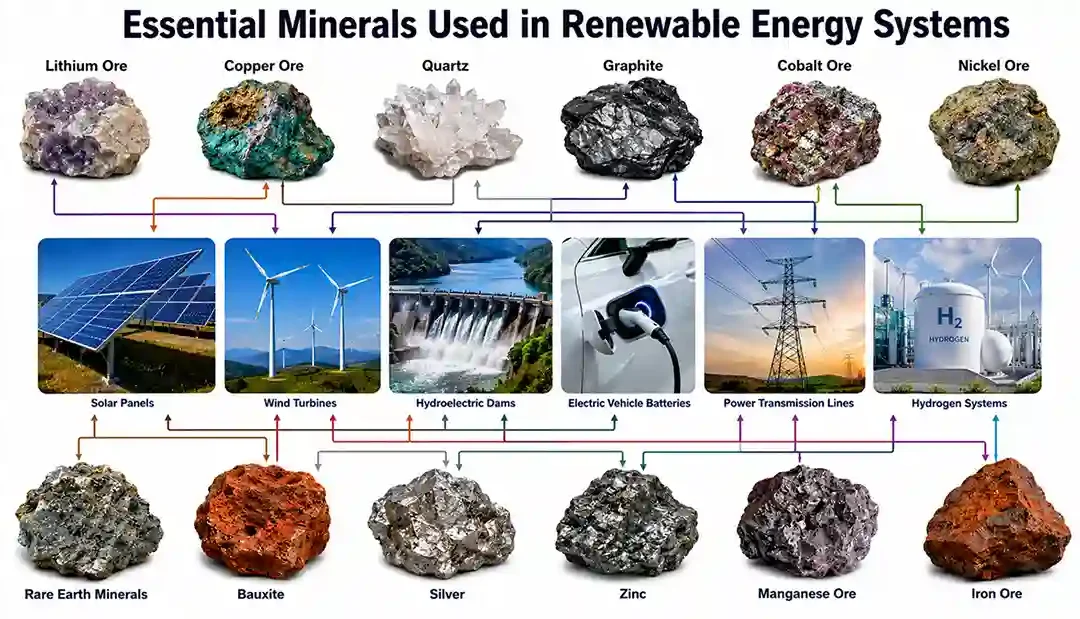
Renewable energy technologies rely on many naturally occurring minerals. Solar panels, wind turbines, electric vehicles, battery storage systems, and power grids all require specific minerals that provide electrical conductivity, energy storage, corrosion resistance, and structural strength.
Minerals used in renewable energy are essential for generating, storing, and transmitting clean electricity. As countries transition away from fossil fuels, demand for these minerals continues to increase.
Understanding these minerals highlights the strong connection between geology, mining, engineering, and sustainable energy development.
This topic should be studied together with Minerals in Food, Mineralogy, Classification of Natural Resources, and Minerals in Cosmetics.
Why Renewable Energy Depends on Minerals
Renewable energy systems require minerals because they provide:
- Electrical conductivity
- Battery energy storage
- Magnetic properties
- Structural strength
- Corrosion resistance
- Heat resistance
- Long equipment life
- High energy efficiency
Without these minerals, modern renewable energy technologies would not function efficiently.
Major Minerals Used in Renewable Energy
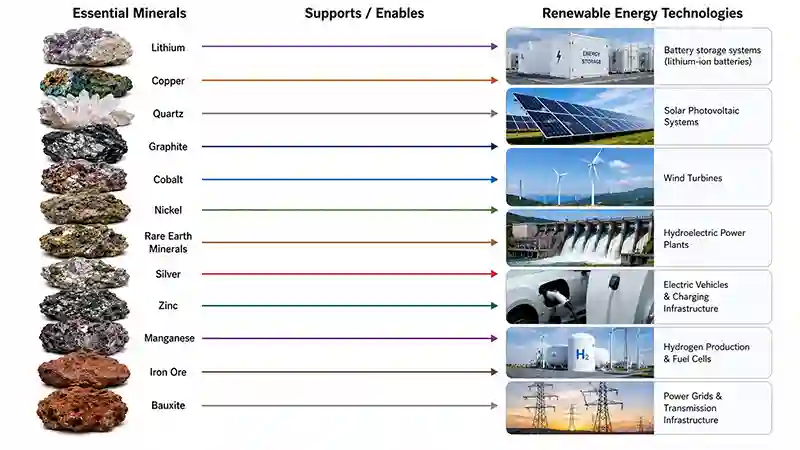
Lithium
Common uses:
- Lithium-ion batteries
- Electric vehicles
- Grid-scale energy storage
Importance:
Lithium stores electrical energy efficiently, making it one of the most important battery minerals.
Copper
Common uses:
- Electrical wiring
- Power cables
- Wind turbines
- Solar farms
Importance:
Copper has excellent electrical conductivity and is essential for transmitting electricity.
Quartz (Silica)
Common uses:
- Solar photovoltaic cells
- Glass for solar panels
Importance:
High-purity quartz is processed into silicon, the primary material used in solar cells.
Graphite
Common uses:
- Battery anodes
- Energy storage systems
Importance:
Graphite allows lithium-ion batteries to charge and discharge efficiently.
Cobalt
Common uses:
- Rechargeable batteries
Importance:
Cobalt improves battery stability and extends battery life.
Nickel
Common uses:
- Battery cathodes
- Energy storage
Importance:
Nickel increases battery energy density and driving range in electric vehicles.
Rare Earth Elements (Neodymium, Dysprosium)
Common uses:
- Permanent magnets
- Wind turbine generators
- Electric motors
Importance:
Rare earth magnets produce powerful magnetic fields for efficient electricity generation.
Silver
Common uses:
- Solar cell conductors
Importance:
Silver provides excellent electrical conductivity inside photovoltaic panels.
Zinc
Common uses:
- Corrosion-resistant coatings
- Renewable energy infrastructure
Importance:
Zinc protects steel structures from rust.
Manganese
Common uses:
- Battery production
Importance:
Manganese improves battery performance and safety.
Iron Ore
Common uses:
- Wind turbine towers
- Hydropower structures
- Solar mounting systems
Importance:
Steel made from iron ore provides structural support for renewable energy facilities.
Bauxite (Aluminum Ore)
Common uses:
- Solar panel frames
- Wind turbine components
Importance:
Aluminum is lightweight, corrosion resistant, and durable.
Minerals by Renewable Energy Application
| Renewable Energy Technology | Major Minerals |
|---|---|
| Solar Panels | Quartz, Silver, Copper, Aluminum |
| Wind Turbines | Rare Earth Elements, Copper, Iron, Zinc |
| Electric Vehicle Batteries | Lithium, Graphite, Nickel, Cobalt, Manganese |
| Grid Energy Storage | Lithium, Graphite, Nickel |
| Power Transmission | Copper, Aluminum |
| Hydroelectric Facilities | Iron, Copper, Aluminum |
| Hydrogen Technologies | Nickel, Platinum |
From Mine to Renewable Energy System
Renewable energy minerals undergo several stages before becoming part of clean energy technologies.
- Minerals are extracted from mines.
- Ores are processed and refined.
- High-purity materials are manufactured.
- Components are assembled into batteries, solar panels, and turbines.
- Renewable energy systems generate and store electricity.
- Materials can often be recovered through recycling.
This process connects geology directly to the global energy transition.
How Minerals Support Renewable Energy
Different minerals perform different functions.
Energy Storage
- Lithium
- Graphite
- Nickel
- Cobalt
- Manganese
Electricity Generation
- Quartz (Silicon)
- Silver
- Copper
Permanent Magnets
- Neodymium
- Dysprosium
Structural Materials
- Iron
- Aluminum
- Zinc
Together, these minerals enable renewable energy systems to operate efficiently.
Geological Importance
Economic geologists study mineral deposits that supply renewable energy technologies.
Research includes:
- Critical mineral exploration
- Ore deposit formation
- Sustainable mining
- Mineral processing
- Resource assessment
These studies help secure long-term supplies of essential minerals.
Laboratory Investigation
Renewable energy minerals are analyzed using:
- X-Ray Fluorescence (XRF)
- X-Ray Diffraction (XRD)
- ICP-MS
- ICP-OES
- Atomic Absorption Spectroscopy (AAS)
- Scanning Electron Microscopy (SEM)
These techniques evaluate mineral composition, purity, and industrial quality.
Applications
Renewable energy minerals are widely used in:
- Solar power plants
- Wind farms
- Electric vehicles
- Battery storage systems
- Smart electrical grids
- Hydroelectric projects
- Hydrogen energy technologies
- Renewable energy infrastructure
Advantages of Studying Minerals Used in Renewable Energy
Understanding renewable energy minerals helps:
- Support clean energy development
- Improve battery technology
- Increase energy efficiency
- Promote sustainable resource management
- Strengthen energy security
- Reduce greenhouse gas emissions
Limitations
Despite their importance, renewable energy minerals present several challenges.
- Mining can affect ecosystems.
- Supply chains are concentrated in a few countries.
- Demand continues to increase rapidly.
- Some minerals are expensive to extract.
- Recycling technologies are still expanding.
For a broader understanding, study this topic together with:
- Economic Geology
- Mineralogy
- Mining Engineering
- Environmental Geology
- Energy Resources
- Materials Science
- Renewable Energy Engineering
- Sustainability
Comparison Table
| Mineral | Primary Renewable Energy Use | Main Benefit |
| Lithium | Batteries | Energy Storage |
| Copper | Wiring & Cables | Electrical Conductivity |
| Quartz (Silicon) | Solar Cells | Electricity Generation |
| Graphite | Battery Anodes | Fast Charging |
| Cobalt | Battery Cathodes | Stability |
| Nickel | Batteries | Higher Energy Density |
| Rare Earth Elements | Wind Turbine Magnets | Powerful Magnets |
| Silver | Solar Panels | High Conductivity |
| Iron Ore | Structural Steel | Strength |
| Bauxite | Aluminum Components | Lightweight Construction |
Summary Table
| Feature | Minerals Used in Renewable Energy |
| Main Purpose | Clean Energy Generation and Storage |
| Major Minerals | Lithium, Copper, Quartz, Graphite |
| Key Technologies | Solar, Wind, Batteries, EVs |
| Study Methods | XRF, XRD, ICP-MS, SEM |
| Geological Importance | Economic Geology and Critical Minerals |
They are naturally occurring minerals used to manufacture solar panels, wind turbines, batteries, electric vehicles, and other clean energy technologies.
Lithium is one of the most important because it is widely used in rechargeable batteries for electric vehicles and energy storage.
Copper has excellent electrical conductivity, making it essential for power cables, motors, generators, and electrical grids.
Rare earth elements such as neodymium and dysprosium are used to produce powerful permanent magnets for wind turbines and electric motors.
They are considered critical because modern clean energy technologies depend on reliable supplies of these minerals, and shortages can slow the global energy transition.
Final Thoughts
Renewable energy depends on a diverse range of minerals that make clean electricity generation, energy storage, and power transmission possible. From lithium batteries and silicon solar cells to copper wiring and rare earth magnets, these geological resources are the foundation of modern renewable energy systems.
As the world continues to expand solar power, wind energy, electric vehicles, and battery storage, responsible mining, recycling, and sustainable resource management will become increasingly important. Understanding the relationship between geology and renewable energy helps support a cleaner, more sustainable future.
Continue Learning
Continue exploring related topics: