
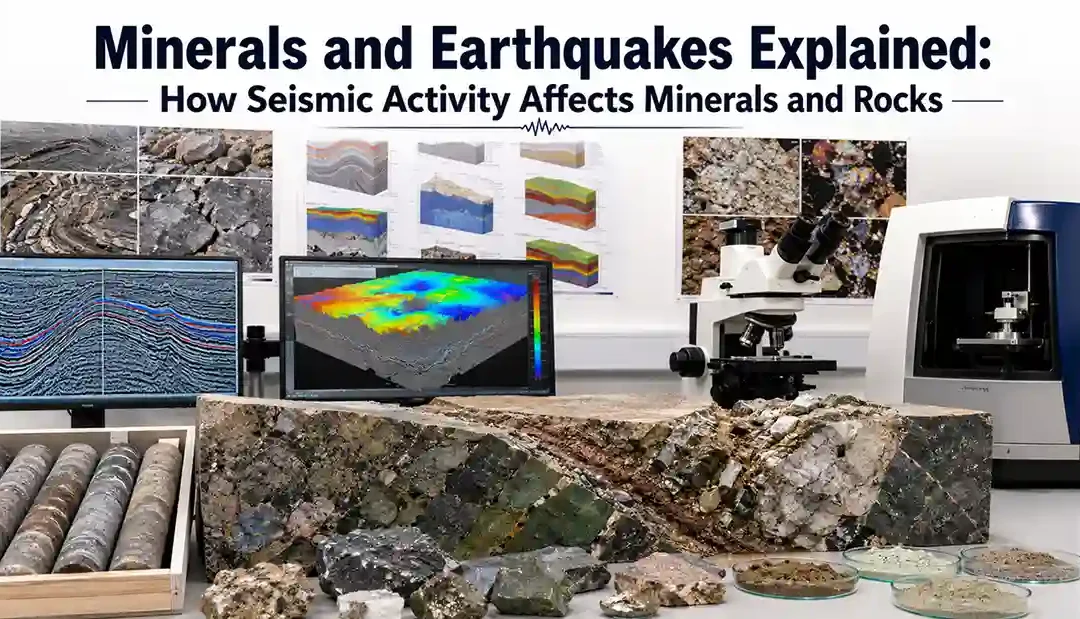
Earthquakes are among the most powerful geological processes shaping Earth's crust. While earthquakes are best known for ground shaking and fault movement, they also influence minerals, rock structures, and fluid circulation deep beneath the surface. During fault movement, rocks fracture, grind together, and interact with mineral-rich fluids, creating new minerals, altering existing ones, and modifying the physical properties of rocks.
Although earthquakes rarely create entirely new mineral species instantly, repeated seismic activity over thousands to millions of years contributes to fault-related mineralization, hydrothermal alteration, pressure solution, and the formation of minerals such as quartz, calcite, chlorite, epidote, serpentine, and various clay minerals.
Understanding the relationship between minerals and earthquakes is essential in structural geology, mineralogy, seismology, tectonics, hydrothermal geology, and earthquake hazard research.
This topic should be studied together with Mineral Veins Explained, Hydrothermal Minerals, and Metamorphism and Minerals.
What Is the Relationship Between Minerals and Earthquakes?
Earthquakes occur when stress accumulated along faults is suddenly released.
During fault movement:
- Rocks fracture.
- Existing minerals break.
- New fractures allow fluid circulation.
- Chemical reactions alter minerals.
- Fault rocks and new mineral assemblages develop.
Over geological time, repeated earthquakes significantly modify mineralogy within fault zones.
How Earthquakes Affect Minerals
Earthquakes influence minerals in several ways.
Major effects include:
- Rock fracturing
- Fault gouge formation
- Pressure solution
- Hydrothermal fluid movement
- Mineral precipitation
- Metamorphic reactions
- Mineral replacement
These processes gradually change the mineral composition of fault zones.
Earthquake Fault Zones
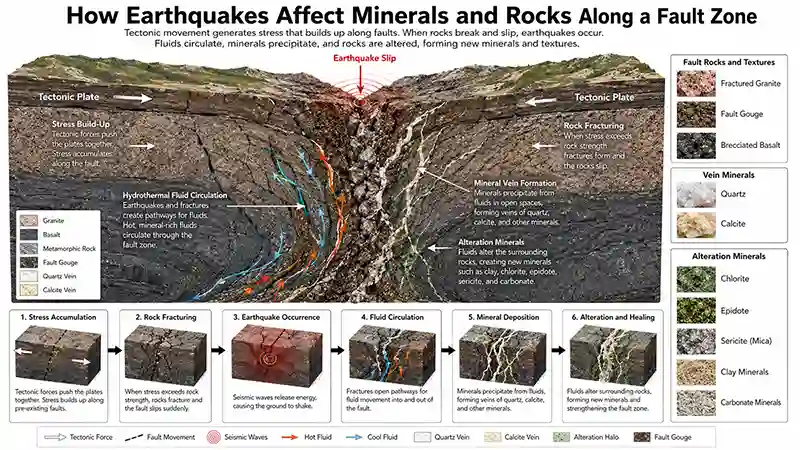
Fault zones contain several distinct rock types.
These include:
- Fault breccia
- Fault gouge
- Cataclasite
- Mylonite
- Pseudotachylite
Each contains characteristic mineral assemblages produced during deformation.
Major Mineral Processes During Earthquakes
Rock Fracturing
Earthquake movement breaks minerals into smaller fragments.
This increases:
- Surface area
- Permeability
- Fluid pathways
These changes accelerate mineral alteration.
Hydrothermal Fluid Circulation
After earthquakes, fractures provide pathways for hot fluids.
These fluids transport:
- Silica
- Calcium
- Iron
- Sulfur
- Carbon dioxide
Minerals precipitate as fluids cool or react with rocks.
Pressure Solution
High stress causes minerals to dissolve where grains touch.
The dissolved material is transported and re-precipitated elsewhere.
Pressure solution commonly affects:
- Quartz
- Calcite
Mineral Replacement
Hydrothermal fluids may replace original minerals with new ones.
Examples include:
- Feldspar → Clay minerals
- Olivine → Serpentine
- Calcite → Dolomite
Vein Formation
Repeated fault movement allows quartz and calcite veins to form as fractures repeatedly open and seal.
Common Minerals Associated with Earthquakes
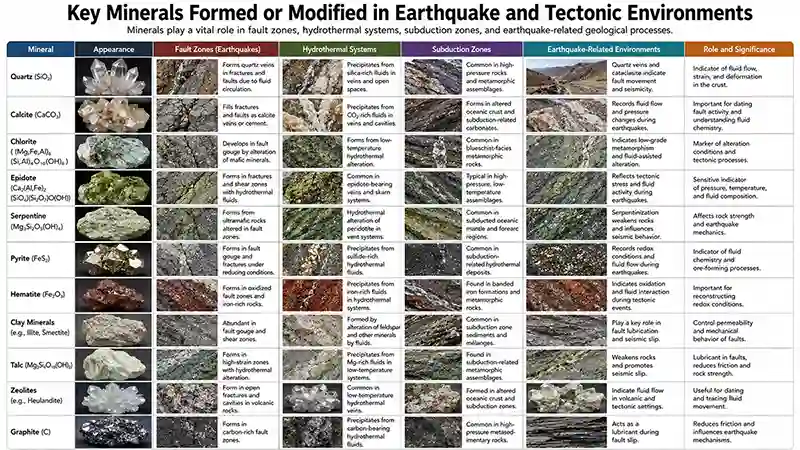
Quartz
Quartz commonly fills fractures created by earthquakes.
Forms:
- Quartz veins
- Silica cement
Calcite
- Calcite precipitates from groundwater in fault fractures.
Chlorite
- Forms through hydrothermal alteration in fault zones.
- Common in low-grade metamorphic environments.
Epidote
- Develops during hydrothermal alteration at moderate temperatures.
Serpentine
- Forms where ultramafic rocks react with water along major faults.
- Serpentinization is common in subduction zones.
Clay Minerals
Fault movement commonly produces:
- Illite
- Smectite
- Kaolinite
- Chlorite
Clay-rich fault gouge strongly influences fault strength.
Pyrite
- Pyrite may crystallize where sulfur-rich fluids circulate after faulting.
Hematite
- Forms in oxidizing fault environments.
Accessory Earthquake-Related Minerals
Other minerals commonly associated with fault zones include:
- Albite
- Adularia
- Zeolites
- Talc
- Actinolite
- Tremolite
- Magnetite
- Graphite
These minerals help geologists interpret fault temperatures, fluid chemistry, and deformation history.
Earthquakes and Hydrothermal Mineralization
Earthquakes frequently promote hydrothermal mineral formation by:
- Opening fractures
- Increasing permeability
- Allowing repeated fluid flow
- Depositing ore minerals
Many gold-bearing quartz veins formed through repeated fault activity.
Earthquakes and Metamorphism
Large fault systems may also generate:
- Dynamic metamorphism
- Cataclastic deformation
- Frictional melting
- Mineral recrystallization
These processes produce distinctive fault rocks.
Minerals Used to Study Ancient Earthquakes
Geologists use minerals to reconstruct seismic history.
Important indicators include:
- Quartz veins
- Calcite twins
- Clay mineral transformations
- Pseudotachylite
- Fluid inclusion minerals
- Isotope signatures
These preserve evidence of ancient fault activity.
Geological Importance
Studying minerals and earthquakes helps geologists:
- Understand fault mechanics
- Reconstruct seismic history
- Interpret fluid circulation
- Explore hydrothermal ore deposits
- Evaluate fault stability
- Study plate tectonics
Minerals provide a long-term record of earthquake activity.
Economic Importance
Earthquake-related structures are important for:
- Gold exploration
- Silver exploration
- Copper deposits
- Geothermal systems
- Groundwater reservoirs
- Engineering geology
Many mineral deposits are closely associated with ancient fault systems.
Laboratory Identification
Earthquake-related minerals are studied using:
- Petrographic Microscopy
- X-Ray Diffraction (XRD)
- Electron Microprobe Analysis (EPMA)
- Scanning Electron Microscopy (SEM)
- Fluid Inclusion Analysis
- Stable Isotope Geochemistry
- Raman Spectroscopy
- X-Ray Fluorescence (XRF)
These techniques reveal deformation history, mineral chemistry, and fluid evolution.
Applications
Studies of minerals and earthquakes are important in:
- Structural Geology
- Seismology
- Mineralogy
- Hydrothermal Geology
- Economic Geology
- Engineering Geology
- Tectonics
- Geochemistry
Advantages of Studying Minerals and Earthquakes
Studying minerals and earthquakes helps scientists:
- Understand fault evolution
- Improve seismic hazard assessment
- Explore hydrothermal mineral deposits
- Interpret crustal deformation
- Reconstruct tectonic history
- Evaluate groundwater movement
Limitations
Studying earthquake-related minerals may be challenging because:
- Individual earthquakes rarely create entirely new mineral assemblages on their own.
- Multiple deformation and fluid events may overprint earlier mineral changes.
- Weathering can obscure evidence preserved in fault rocks.
- Reliable interpretation usually requires detailed structural mapping, petrography, and geochemical analyses.
For comprehensive interpretation, combine earthquake mineral studies with:
- Plate Tectonics and Minerals
- Mineral Veins Explained
- Hydrothermal Minerals
- Metamorphism and Minerals
- Structural Geology
- Petrographic Microscopy
- Mineral Chemistry Analysis
- X-Ray Diffraction in Mineralogy
Comparison Table
| Earthquake Process | Mineral Effect | Common Minerals |
|---|---|---|
| Fault Fracturing | Rock Breakage | Quartz, Feldspar |
| Hydrothermal Circulation | Mineral Precipitation | Quartz, Calcite, Pyrite |
| Pressure Solution | Dissolution & Re-precipitation | Quartz, Calcite |
| Dynamic Metamorphism | Recrystallization | Chlorite, Epidote |
| Serpentinization | Hydration | Serpentine |
Summary Table
| Feature | Minerals and Earthquakes |
| Main Geological Driver | Fault Movement and Seismic Activity |
| Major Processes | Fracturing, Fluid Flow, Alteration, Recrystallization |
| Common Minerals | Quartz, Calcite, Chlorite, Epidote, Serpentine |
| Main Study Methods | Petrography, XRD, EPMA, SEM, Fluid Inclusion Analysis |
| Geological Importance | Fault Evolution, Hydrothermal Systems, Ore Formation |
Earthquakes fracture rocks, create new pathways for fluids, promote mineral alteration, and allow minerals such as quartz and calcite to precipitate in faults over time.
Most earthquakes do not instantly create entirely new mineral species. Instead, repeated seismic activity promotes fluid circulation, mineral replacement, recrystallization, and the gradual formation of new mineral assemblages within fault zones.
Quartz, calcite, chlorite, epidote, serpentine, pyrite, hematite, and clay minerals are commonly associated with earthquake faults and hydrothermal alteration.
They help geologists reconstruct ancient earthquakes, understand fault behavior, identify hydrothermal systems, and locate valuable mineral deposits.
They use field mapping, petrographic microscopy, X-ray diffraction (XRD), electron microprobe analysis (EPMA), scanning electron microscopy (SEM), fluid inclusion analysis, Raman spectroscopy, stable isotope geochemistry, and X-ray fluorescence (XRF).
Final Thoughts
Earthquakes are not only sources of seismic hazards but also important geological processes that reshape rocks and influence mineral formation. Through repeated fault movement, hydrothermal fluid circulation, pressure solution, and mineral replacement, earthquake zones evolve into complex geological systems containing quartz veins, alteration minerals, fault gouge, and economically important ore deposits.
By combining structural mapping with petrographic microscopy, mineral chemistry, geophysical investigations, X-ray diffraction, and fluid inclusion studies, geologists can reconstruct the history of fault activity and better understand the links between tectonics, mineralization, and crustal evolution. The study of minerals and earthquakes remains fundamental to structural geology, seismology, mineral exploration, and Earth science.
Continue Learning
Continue exploring tectonics and mineral formation with these related guides: