
Metamorphism is the geological process in which existing rocks and minerals are transformed by increasing temperature, pressure, and chemically active fluids without completely melting. During metamorphism, minerals become unstable under new conditions and recrystallize into new mineral assemblages that are stable within the changing environment.
Metamorphism affects igneous, sedimentary, and even older metamorphic rocks, producing entirely new textures, structures, and mineral compositions. The resulting metamorphic minerals preserve valuable information about mountain building, continental collision, subduction, burial, and crustal evolution.
Minerals such as chlorite, biotite, garnet, staurolite, kyanite, andalusite, and sillimanite are widely used by geologists to determine the temperature and pressure conditions experienced by rocks during metamorphism.
Understanding metamorphism and minerals is fundamental to metamorphic petrology, structural geology, tectonics, and economic geology.
This topic should be studied together with Minerals in Metamorphic Rocks, Plate Tectonics and Minerals, and Mineral Stability.
What Is Metamorphism?
Metamorphism is the solid-state transformation of rocks caused by changes in physical and chemical conditions.
Unlike igneous processes:
- Rocks do not completely melt.
- Existing minerals recrystallize.
- New minerals form.
- Crystal size often increases.
- Rock texture changes.
The original rock is called the protolith.
Why Do Minerals Change During Metamorphism?
Minerals remain stable only within certain pressure and temperature ranges.
When these conditions change:
- Existing minerals become unstable.
- Atoms rearrange.
- New crystal structures develop.
- Stable metamorphic minerals replace earlier minerals.
These transformations minimize the rock's internal energy under the new conditions.
Main Factors Controlling Metamorphism
Several variables determine which minerals form.
Temperature
Higher temperatures promote:
- Recrystallization
- Grain growth
- Formation of higher-grade minerals
Pressure
Increasing pressure changes mineral stability and crystal structure.
High-pressure environments produce minerals such as:
- Garnet
- Kyanite
- Glaucophane
Chemically Active Fluids
Hot fluids accelerate mineral reactions by transporting dissolved ions.
Common fluids include:
- Water
- Carbon dioxide
These fluids help new minerals crystallize more rapidly.
Protolith Composition
The original rock strongly influences the final mineral assemblage.
For example:
- Limestone → Marble
- Sandstone → Quartzite
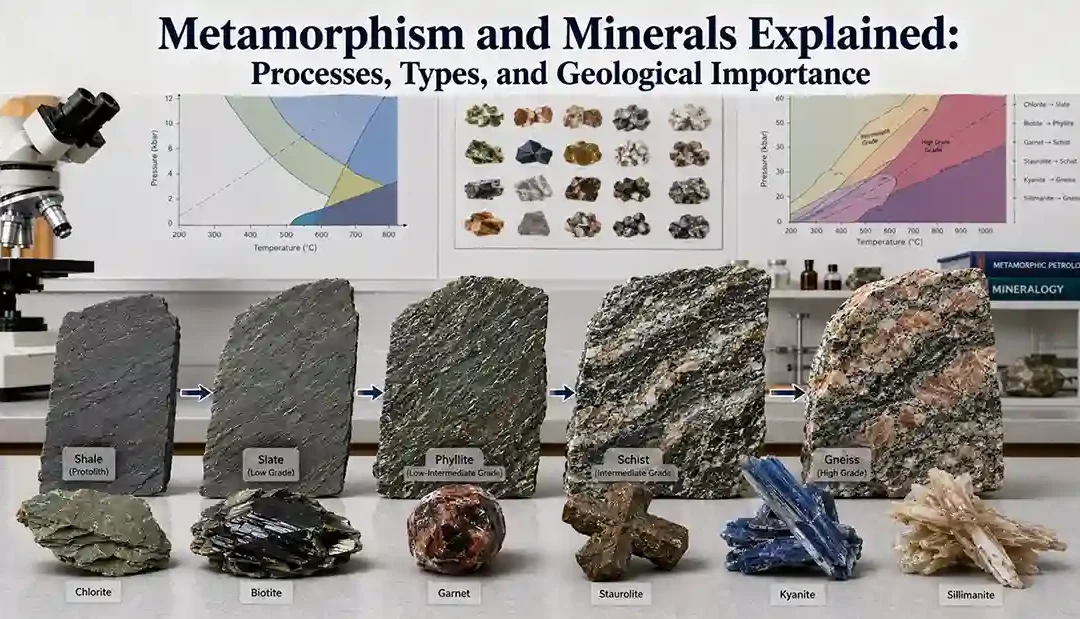
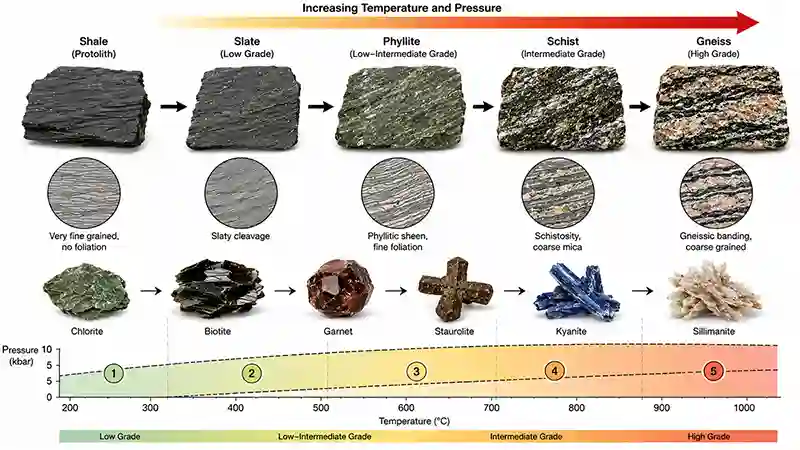
- Shale → Slate → Phyllite → Schist → Gneiss
Types of Metamorphism
Regional Metamorphism
Occurs during large-scale mountain building.
Characteristics:
- High pressure
- High temperature
- Large geographic extent
Common minerals:
- Garnet
- Biotite
- Kyanite
- Sillimanite
Contact Metamorphism
Occurs near magma intrusions.
Characteristics:
- High temperature
- Low pressure
Common minerals:
- Andalusite
- Cordierite
- Wollastonite
Hydrothermal Metamorphism
Produced by hot circulating fluids.
Common minerals:
- Chlorite
- Epidote
- Serpentine
- Actinolite
Common at:
- Mid-ocean ridges
- Geothermal systems
Dynamic Metamorphism
Occurs along fault zones.
Characteristics:
- High stress
- Rock crushing
- Localized recrystallization
Produces:
- Mylonite
- Cataclasite
Burial Metamorphism
Occurs as rocks are buried beneath thick sedimentary sequences.
Typically produces:
- Chlorite
- Low-grade mica
Common Metamorphic Minerals
Chlorite
Forms during low-grade metamorphism.
Characteristics:
- Green color
- Soft
- Excellent low-grade index mineral
Biotite
Appears during medium-grade metamorphism.
Characteristics:
- Dark brown to black
- Perfect cleavage
Garnet
One of the most important index minerals.
Characteristics:
- High hardness
- Red to brown crystals
- Medium- to high-grade metamorphism
Staurolite
Common in medium-grade rocks.
Characteristics:
- Brown crystals
- Cross-shaped twins
Kyanite
Forms under high pressure.
Characteristics:
- Blue crystals
- High-pressure index mineral
Andalusite
- Forms under relatively low pressure.
- Common in contact metamorphism.
Sillimanite
Forms under high temperatures.
Common in:
- Gneiss
- Granulite
Quartz
Quartz recrystallizes rather than changing composition.
Forms:
- Quartzite
- Gneiss
Calcite
Calcite recrystallizes into coarse crystals during marble formation.
Accessory Minerals
Accessory metamorphic minerals include:
- Epidote
- Tourmaline
- Rutile
- Zircon
- Titanite
- Graphite
These minerals help reconstruct metamorphic history and determine rock ages.
Metamorphic Grade
Metamorphic grade describes the intensity of metamorphism.
Low Grade
Typical minerals:
- Chlorite
- Muscovite
Typical rocks:
- Slate
- Phyllite
Medium Grade
Typical minerals:
- Biotite
- Garnet
- Staurolite
Typical rocks:
- Schist
High Grade
Typical minerals:
- Kyanite
- Sillimanite
- Feldspar
Typical rocks:
- Gneiss
- Granulite
Metamorphic Facies
Metamorphic facies represent groups of minerals formed under similar pressure-temperature conditions.
Major facies include:
- Zeolite
- Greenschist
- Amphibolite
- Granulite
- Blueschist
- Eclogite
Each facies corresponds to a characteristic tectonic environment.
Plate Tectonics and Metamorphism
Metamorphism commonly occurs in tectonically active regions.
Examples include:
- Continental collision
- Subduction zones
- Volcanic arcs
- Rift zones
These environments produce distinctive metamorphic mineral assemblages.
Laboratory Identification
Metamorphic minerals are studied using:
- Petrographic Microscopy
- X-Ray Diffraction (XRD)
- Electron Microprobe Analysis (EPMA)
- Scanning Electron Microscopy (SEM)
- Raman Spectroscopy
- Mineral Chemistry Analysis
These methods determine mineral composition, crystal structure, and pressure-temperature history.
Importance of Metamorphism and Minerals
Studying metamorphism helps geologists:
- Estimate pressure and temperature conditions
- Reconstruct mountain-building events
- Interpret tectonic evolution
- Understand crustal deformation
- Identify metamorphic facies
- Explore mineral resources
Metamorphic minerals preserve a record of Earth's deep geological processes.
Applications
Metamorphism studies are important in:
- Metamorphic petrology
- Structural geology
- Plate tectonics
- Economic geology
- Engineering geology
- Geochronology
- Mineral exploration
Advantages of Studying Metamorphism
Studying metamorphism allows scientists to:
- Understand crustal evolution
- Estimate metamorphic conditions
- Interpret tectonic environments
- Identify metamorphic facies
- Reconstruct geological history
- Locate economically valuable minerals
Limitations
Interpreting metamorphic rocks may be difficult because:
- Multiple metamorphic events can overprint earlier mineral assemblages.
- Retrograde metamorphism may alter high-grade minerals.
- Fine-grained rocks often require laboratory analysis.
- Similar minerals may require chemical testing for accurate identification.
For comprehensive interpretation, combine metamorphism studies with:
- Minerals in Metamorphic Rocks
- Mineral Stability
- Plate Tectonics and Minerals
- Hydrothermal Alteration
- Petrographic Microscopy
- X-Ray Diffraction in Mineralogy
- Mineral Chemistry Analysis
Comparison Table
| Metamorphism Type | Dominant Conditions | Typical Minerals |
|---|---|---|
| Regional | High Temperature & Pressure | Garnet, Kyanite, Sillimanite |
| Contact | High Temperature | Andalusite, Cordierite |
| Hydrothermal | Hot Fluids | Chlorite, Epidote, Serpentine |
| Dynamic | High Stress | Quartz, Mica, Mylonite Minerals |
| Burial | Moderate Pressure | Chlorite, Muscovite |
Summary Table
| Feature | Metamorphism and Minerals |
| Main Process | Solid-State Mineral Transformation |
| Major Controls | Temperature, Pressure, Fluids |
| Common Index Minerals | Chlorite, Garnet, Kyanite, Sillimanite |
| Common Study Methods | Petrography, XRD, EPMA, SEM |
| Geological Importance | Mountain Building and Crustal Evolution |
Metamorphism is the process in which existing rocks and minerals are transformed by heat, pressure, and chemically active fluids without completely melting.
Minerals change because they become unstable under new pressure-temperature conditions and recrystallize into new, more stable mineral assemblages.
Index minerals are minerals that form only within specific ranges of temperature and pressure, allowing geologists to estimate metamorphic grade.
Kyanite, sillimanite, garnet, and some feldspars commonly indicate medium- to high-grade metamorphic conditions.
Geologists identify metamorphic minerals using petrographic microscopy, X-ray diffraction (XRD), electron microprobe analysis (EPMA), scanning electron microscopy (SEM), Raman spectroscopy, and mineral chemistry analysis.
Final Thoughts
Metamorphism transforms Earth's rocks and minerals into new mineral assemblages that record the pressure, temperature, and fluid conditions deep within the crust. From low-grade chlorite-bearing slates to high-grade garnet- and sillimanite-rich gneisses, metamorphic minerals provide an invaluable record of mountain building, continental collision, and tectonic evolution.
By integrating field observations with petrographic microscopy, mineral chemistry, X-ray diffraction, electron microprobe analysis, and pressure-temperature modeling, geologists can reconstruct Earth's geological history and better understand the dynamic processes shaping the continents. The study of metamorphism and minerals remains fundamental to metamorphic petrology, tectonics, mineral exploration, and Earth system science.
Continue Learning
Continue exploring metamorphic geology with these related guides: