
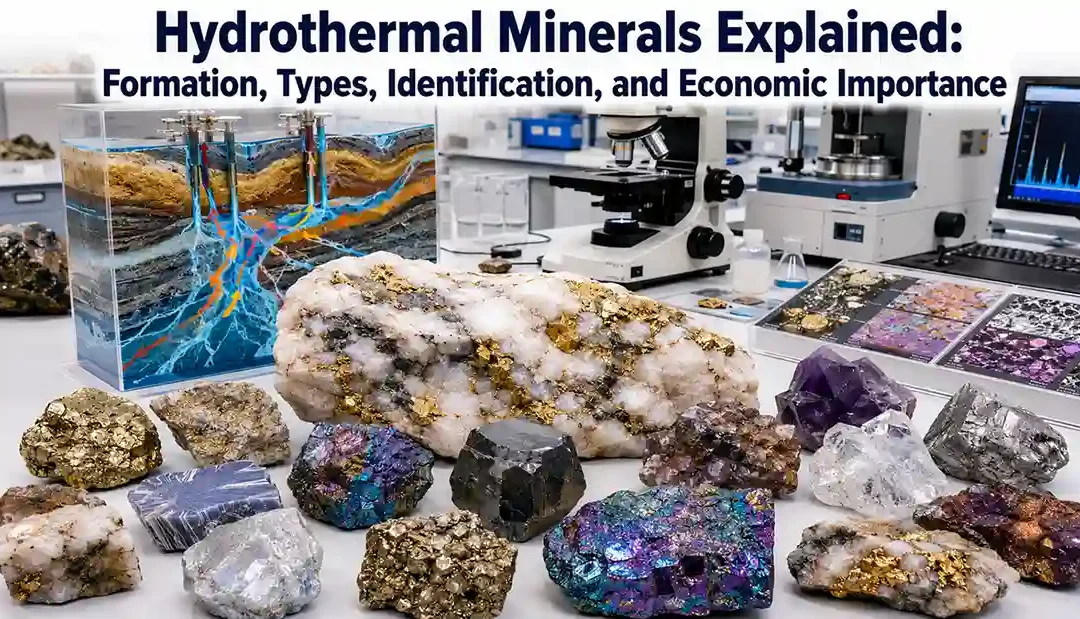
Hydrothermal minerals are minerals that crystallize from hot, mineral-rich fluids circulating through fractures, faults, and porous rocks within Earth's crust. These fluids dissolve chemical elements from surrounding rocks or magma and transport them until changes in temperature, pressure, or fluid chemistry cause new minerals to precipitate.
Hydrothermal activity is responsible for forming many of the world's most valuable ore deposits, including copper, gold, silver, lead, zinc, molybdenum, tin, tungsten, and fluorite deposits. In addition to ore minerals, hydrothermal systems produce abundant alteration minerals that record fluid pathways and changing geological conditions.
Hydrothermal minerals are studied extensively in mineralogy, economic geology, petrology, volcanology, geothermal research, and mining exploration.
This topic should be studied together with Hydrothermal Alteration, Economic Geology, and Mineral Alteration Processes.
What Are Hydrothermal Minerals?
Hydrothermal minerals are minerals that precipitate directly from hot aqueous fluids.
These minerals commonly form:
- Inside fractures
- Along faults
- In veins
- Around magma chambers
- Within volcanic rocks
- Around intrusive bodies
Hydrothermal mineralization occurs from shallow depths to several kilometers below Earth's surface.
How Do Hydrothermal Minerals Form?
Hydrothermal mineral formation generally follows these steps:
- Magma or geothermal heat warms groundwater.
- Hot fluids dissolve metals and silica.
- Fluids migrate through fractures.
- Temperature and pressure decrease.
- Dissolved minerals precipitate.
- Mineral veins and ore bodies develop.
This process may continue for thousands to millions of years.
Conditions Required for Hydrothermal Mineral Formation
Several geological conditions are necessary.
Heat Source
Usually provided by:
- Magma chambers
- Cooling intrusions
- Geothermal systems
Hydrothermal Fluids
Fluids commonly contain:
- Water
- Silica
- Sulfur
- Carbon dioxide
- Chlorine
- Sodium
- Potassium
- Calcium
- Iron
Permeable Rocks
Fractures and faults allow fluid circulation.
Chemical Reactions
Minerals precipitate when:
- Temperature decreases
- Pressure decreases
- Fluids mix
- pH changes
- Oxidation conditions change
Common Hydrothermal Minerals
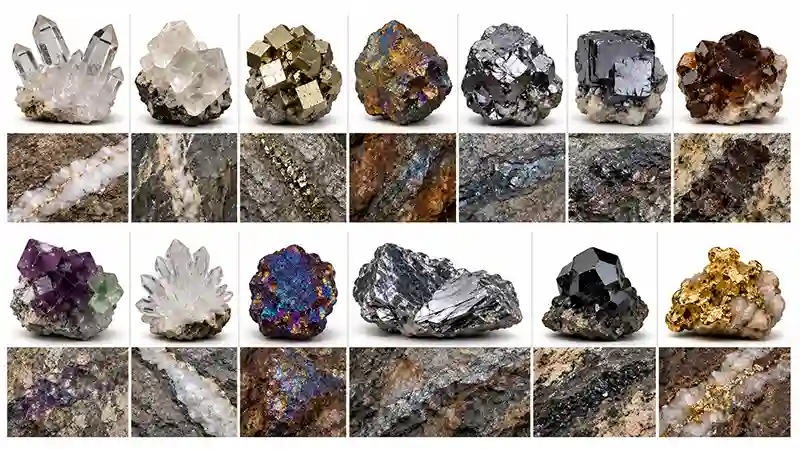
Quartz
Quartz is the most abundant hydrothermal mineral.
Characteristics:
- Colorless to white
- Hardness 7
- Chemically stable
Common occurrence:
- Quartz veins
- Gold deposits
- Epithermal systems
Calcite
Calcite commonly precipitates from hydrothermal fluids.
Typical environments:
- Veins
- Skarns
- Carbonate-hosted deposits
Pyrite
Pyrite is the most widespread hydrothermal sulfide mineral.
Characteristics:
- Metallic luster
- Brass-yellow color
- Cubic crystals
Common deposits:
- Porphyry copper
- Gold deposits
- Massive sulfides
Chalcopyrite
Chalcopyrite is the most important copper ore mineral.
Characteristics:
- Brass-yellow
- Softer than pyrite
Common deposits:
- Porphyry copper
- Skarn
- VMS deposits
Galena
Galena is the primary ore of lead.
Common occurrence:
- Hydrothermal veins
- Carbonate replacement deposits
Sphalerite
Sphalerite is the principal zinc ore mineral.
Often associated with:
- Galena
- Pyrite
- Chalcopyrite
Fluorite
Fluorite commonly forms from fluorine-rich hydrothermal fluids.
Characteristics:
- Purple, green, blue, or colorless
- Cubic crystals
Barite
Barite precipitates from sulfate-rich hydrothermal fluids.
Common environments:
- Hydrothermal veins
- Sedimentary exhalative deposits
Bornite
Bornite is a valuable copper sulfide.
Characteristics:
- Brown when fresh
- Iridescent tarnish
Molybdenite
Molybdenite is the primary ore mineral of molybdenum.
Usually associated with:
- Porphyry copper systems
- Granitic intrusions
Magnetite
Hydrothermal magnetite forms in:
- Skarns
- Iron oxide-copper-gold (IOCG) deposits
Native Gold
Gold commonly precipitates from hydrothermal fluids.
Major deposit types include:
- Epithermal gold
- Orogenic gold
- Porphyry systems
Accessory Hydrothermal Minerals
Other important hydrothermal minerals include:
- Arsenopyrite
- Cinnabar
- Stibnite
- Wolframite
- Scheelite
- Realgar
- Orpiment
- Tourmaline
- Topaz
Hydrothermal Ore Deposit Types
Different hydrothermal systems produce different mineral assemblages.
| Deposit Type | Common Minerals |
|---|---|
| Porphyry Copper | Chalcopyrite, Bornite, Molybdenite |
| Epithermal Gold | Quartz, Gold, Pyrite |
| Skarn | Garnet, Magnetite, Chalcopyrite |
| Vein Deposits | Quartz, Calcite, Galena, Sphalerite |
| VMS Deposits | Chalcopyrite, Pyrite, Sphalerite |
| IOCG Deposits | Magnetite, Hematite, Chalcopyrite |
Hydrothermal Alteration Minerals
Hydrothermal systems also produce alteration minerals.
Common examples include:
- Sericite
- Chlorite
- Epidote
- Kaolinite
- Illite
- Smectite
- Albite
- Potassium Feldspar
These minerals help geologists identify fluid pathways and ore-forming environments.
Laboratory Identification
Hydrothermal minerals are identified using:
- Hand specimen examination
- Petrographic Microscopy
- X-Ray Diffraction (XRD)
- Electron Microprobe Analysis (EPMA)
- Scanning Electron Microscopy (SEM)
- Raman Spectroscopy
- ICP-MS
These methods determine mineral composition, crystal structure, and elemental chemistry.
Importance of Hydrothermal Minerals
Studying hydrothermal minerals helps geologists:
- Locate ore deposits
- Understand hydrothermal systems
- Reconstruct fluid evolution
- Identify mineralization stages
- Evaluate mining targets
- Interpret geothermal systems
Hydrothermal minerals are essential indicators in mineral exploration.
Applications
Hydrothermal minerals are important in:
- Economic geology
- Mining exploration
- Mineralogy
- Geochemistry
- Volcanology
- Geothermal energy
- Environmental geology
- Planetary geology
Advantages of Studying Hydrothermal Minerals
Studying hydrothermal minerals allows scientists to:
- Discover concealed ore deposits
- Understand fluid-rock interaction
- Interpret mineralization history
- Improve exploration success
- Evaluate geothermal resources
- Reconstruct tectonic evolution
Limitations
Hydrothermal systems are often complex because:
- Multiple mineralization events may overlap.
- Weathering can alter primary hydrothermal minerals.
- Fine-grained minerals require laboratory analysis.
- Similar sulfide minerals may need chemical confirmation.
For the most reliable interpretation, combine hydrothermal mineral studies with:
- Hydrothermal Alteration
- Economic Geology
- Mineral Alteration Processes
- Mineral Chemistry Analysis
- Petrographic Microscopy
- X-Ray Diffraction in Mineralogy
- Electron Microprobe Analysis
Comparison Table
| Mineral | Typical Hydrothermal Environment | Economic Importance |
| Quartz | Veins, Epithermal Systems | Gangue Mineral |
| Pyrite | Porphyry, VMS, Gold Deposits | Indicator Mineral |
| Chalcopyrite | Porphyry, Skarn | Copper Ore |
| Galena | Hydrothermal Veins | Lead Ore |
| Sphalerite | Veins, VMS | Zinc Ore |
| Fluorite | Veins | Fluorine Source |
| Molybdenite | Porphyry Systems | Molybdenum Ore |
| Native Gold | Epithermal, Orogenic | Precious Metal |
Summary Table
| Feature | Hydrothermal Minerals |
| Main Formation Process | Precipitation from Hot Fluids |
| Dominant Minerals | Quartz, Sulfides, Calcite, Fluorite |
| Major Deposit Types | Porphyry, Epithermal, Skarn, VMS |
| Common Study Methods | Petrography, XRD, EPMA, SEM |
| Geological Importance | Ore Formation and Mineral Exploration |
Hydrothermal minerals are minerals that crystallize from hot, mineral-rich fluids circulating through Earth's crust, commonly forming veins, alteration zones, and ore deposits.
Quartz, calcite, pyrite, chalcopyrite, galena, sphalerite, fluorite, barite, molybdenite, magnetite, and native gold are among the most common hydrothermal minerals.
They form many of the world's most valuable ore deposits and help geologists locate mineral resources, interpret hydrothermal systems, and understand fluid-rock interactions.
Hydrothermal minerals are minerals that precipitate directly from hydrothermal fluids (such as quartz and chalcopyrite), while hydrothermal alteration minerals (such as sericite, chlorite, and kaolinite) form when existing minerals are chemically altered by those fluids.
Geologists identify hydrothermal minerals using field observations, petrographic microscopy, X-ray diffraction (XRD), electron microprobe analysis (EPMA), scanning electron microscopy (SEM), Raman spectroscopy, ICP-MS, and mineral chemistry analysis.
Final Thoughts
Hydrothermal minerals are among the most economically and scientifically important minerals on Earth because they record the movement of hot, chemically active fluids through the crust and are responsible for concentrating many valuable metals into mineable deposits. From quartz-rich gold veins to chalcopyrite-bearing porphyry copper systems, hydrothermal mineral assemblages provide critical evidence of fluid evolution, tectonic activity, and ore-forming processes.
By integrating petrographic microscopy, mineral chemistry, X-ray diffraction, electron microprobe analysis, and field mapping, geologists can accurately identify hydrothermal minerals, reconstruct mineralization histories, and improve exploration for new mineral resources. Hydrothermal mineral studies remain a cornerstone of economic geology, volcanology, and modern mineral exploration.
Continue Learning
Continue exploring hydrothermal and economic geology with these related guides: