
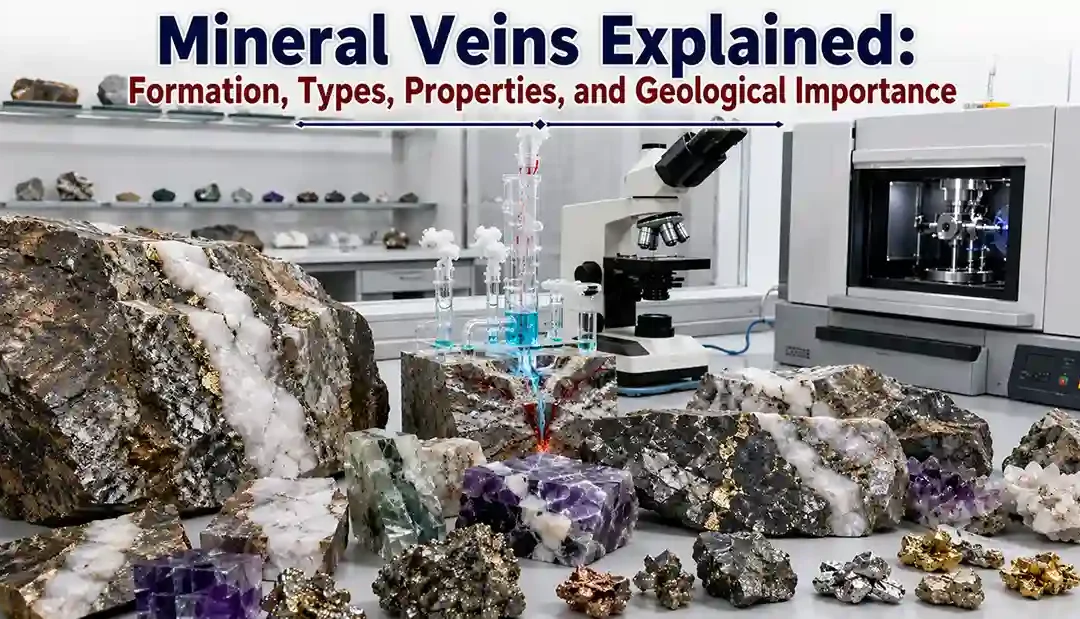
Mineral veins are sheet-like bodies of minerals that fill fractures, faults, joints, or cracks within rocks. Most veins form when hot, mineral-rich hydrothermal fluids circulate through the Earth's crust and deposit dissolved minerals as temperature, pressure, or fluid chemistry changes. These veins commonly contain quartz, calcite, sulfide minerals, fluorite, barite, and many economically valuable metals such as gold, silver, copper, lead, zinc, tin, and tungsten.
Mineral veins are among the world's most important sources of metallic ore deposits. They also preserve evidence of tectonic activity, hydrothermal circulation, and magma evolution, making them valuable records of Earth's geological history.
Understanding mineral veins is fundamental in mineralogy, economic geology, structural geology, hydrothermal geology, mining geology, and exploration.
This topic should be studied together with Hydrothermal Minerals, Pegmatite Minerals, Magma Differentiation, and Economic Geology.
What Are Mineral Veins?
Mineral veins are tabular bodies of minerals that crystallize within fractures in pre-existing rocks.
They are characterized by:
- Fracture-filling mineralization
- Distinct boundaries with host rocks
- Coarse mineral crystals
- Hydrothermal origin
- Association with faults and joints
Veins may range from a few millimeters to several meters wide and extend for kilometers.
How Mineral Veins Form
Most mineral veins develop through hydrothermal activity.
The general process includes:
- Magma or deep crustal heat warms groundwater.
- Hot fluids dissolve metals and minerals.
- Fluids move through fractures and faults.
- Cooling, pressure reduction, or chemical reactions occur.
- Dissolved minerals crystallize.
- Veins gradually fill the fractures.
Multiple pulses of mineralization often produce banded or zoned veins.
Sources of Hydrothermal Fluids
Hydrothermal fluids responsible for vein formation may originate from:
- Cooling magma
- Deep groundwater
- Metamorphic dehydration
- Seawater circulation
- Basin brines
Many ore-forming systems contain mixtures of these fluid sources.
Types of Mineral Veins
Hydrothermal Veins
The most common vein type.
Characteristics:
- Form from hot aqueous fluids
- Rich in quartz and sulfides
- Common near igneous intrusions
Quartz Veins
Dominated by quartz.
Commonly contain:
- Gold
- Pyrite
- Arsenopyrite
- Tourmaline
Quartz veins are major exploration targets for gold deposits.
Carbonate Veins
Dominated by:
- Calcite
- Dolomite
- Siderite
Often form in sedimentary and metamorphic rocks.
Sulfide Veins
Rich in metallic sulfides such as:
- Chalcopyrite
- Galena
- Sphalerite
- Pyrite
These veins are important ore deposits.
Pegmatite Veins
Form from volatile-rich residual magma.
Contain:
- Feldspar
- Quartz
- Mica
- Beryl
- Spodumene
- Tourmaline
Alpine-Type Veins
Develop during mountain building.
Common minerals include:
- Quartz
- Calcite
- Chlorite
- Epidote
Common Vein Minerals
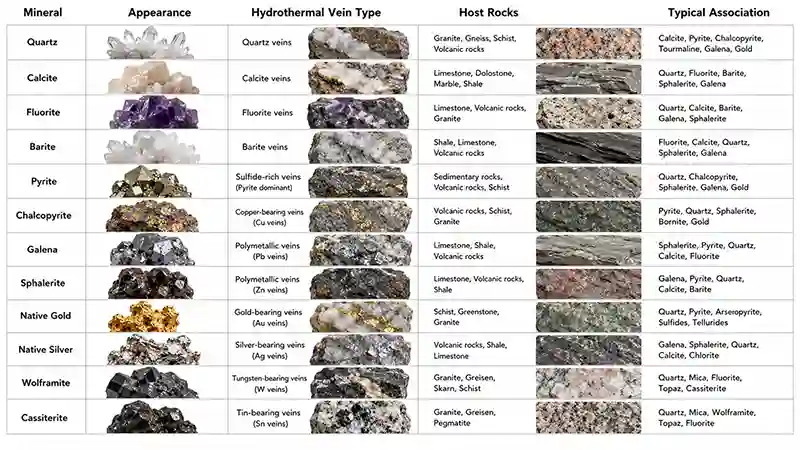
Quartz
The most abundant vein mineral.
Characteristics:
- Hardness 7
- Chemically resistant
- Common gangue mineral
Calcite
Frequently fills fractures in limestone and hydrothermal systems.
Fluorite
Occurs in many hydrothermal veins.
Uses:
- Metallurgy
- Chemical industry
Barite
Common sulfate mineral in hydrothermal veins.
Uses:
- Drilling fluids
- Chemical manufacturing
Pyrite
Known as "fool's gold."
Often accompanies gold mineralization.
Chalcopyrite
The most important copper ore mineral.
Galena
Principal ore of lead. Often associated with silver.
Sphalerite
Major zinc ore mineral. Commonly occurs with galena and pyrite.
Native Gold
Occurs in many quartz veins. One of the world's most valuable vein minerals.
Native Silver
Forms in hydrothermal veins associated with lead and copper ores.
Accessory Vein Minerals
Other important vein minerals include:
- Arsenopyrite
- Wolframite
- Cassiterite
- Molybdenite
- Stibnite
- Tourmaline
- Scheelite
These minerals commonly indicate specialized hydrothermal systems and economically significant ore deposits.
Vein Textures
Mineral veins display several distinctive textures.
Common textures include:
- Massive
- Banded
- Comb texture
- Open-space filling
- Brecciated
- Zoned
These textures record changing conditions during mineral deposition.
Host Rocks
Mineral veins occur in many rock types.
| Host Rock | Common Vein Minerals |
|---|---|
| Granite | Quartz, Tourmaline, Cassiterite |
| Basalt | Quartz, Calcite, Zeolites |
| Limestone | Calcite, Fluorite, Galena |
| Schist | Quartz, Gold, Sulfides |
| Gneiss | Quartz, Feldspar, Tourmaline |
Host rock chemistry influences the minerals that crystallize.
Economic Importance
Mineral veins are major sources of:
- Gold
- Silver
- Copper
- Lead
- Zinc
- Tin
- Tungsten
- Molybdenum
- Antimony
Many of the world's famous mining districts are vein-hosted.
Geological Importance
Mineral veins help geologists:
- Reconstruct hydrothermal systems
- Understand tectonic activity
- Study fluid migration
- Interpret ore-forming processes
- Locate mineral deposits
- Investigate crustal deformation
Veins preserve valuable records of Earth's dynamic crust.
Laboratory Identification
Mineral veins are studied using:
- Petrographic Microscopy
- X-Ray Diffraction (XRD)
- Electron Microprobe Analysis (EPMA)
- Scanning Electron Microscopy (SEM)
- Fluid inclusion analysis
- Stable isotope geochemistry
- X-Ray Fluorescence (XRF)
These techniques determine mineral composition, fluid origin, and crystallization conditions.
Applications
Mineral vein studies are important in:
- Economic Geology
- Mining Geology
- Mineralogy
- Structural Geology
- Hydrothermal Geology
- Geochemistry
- Exploration Geology
- Environmental Geology
Advantages of Studying Mineral Veins
Studying mineral veins helps scientists:
- Discover valuable ore deposits
- Understand hydrothermal circulation
- Interpret tectonic history
- Improve mineral exploration
- Reconstruct fluid evolution
- Evaluate mining potential
Limitations
Interpreting mineral veins may be challenging because:
- Veins often form during multiple mineralization events.
- Alteration can obscure original mineral assemblages.
- Similar-looking veins may have different origins.
- Detailed laboratory analyses are often required to determine fluid sources and ore-forming conditions.
For comprehensive interpretation, combine mineral vein studies with:
- Hydrothermal Minerals
- Pegmatite Minerals
- Magma Differentiation
- Economic Geology
- Mineral Formation
- Petrographic Microscopy
- Mineral Chemistry Analysis
- X-Ray Diffraction in Mineralogy
Comparison Table
| Vein Type | Dominant Minerals | Typical Economic Products |
| Quartz Vein | Quartz, Gold, Pyrite | Gold |
| Carbonate Vein | Calcite, Dolomite | Industrial Minerals |
| Sulfide Vein | Chalcopyrite, Galena, Sphalerite | Copper, Lead, Zinc |
| Pegmatite Vein | Feldspar, Quartz, Beryl, Spodumene | Lithium, Gemstones |
| Alpine Vein | Quartz, Calcite, Epidote | Collector Minerals |
Summary Table
| Feature | Mineral Veins |
| Main Formation Process | Hydrothermal Fluid Deposition |
| Common Minerals | Quartz, Calcite, Sulfides, Fluorite |
| Major Host Structures | Fractures, Faults, Joints |
| Common Study Methods | Petrography, XRD, EPMA, Fluid Inclusion Analysis |
| Geological Importance | Ore Deposits and Hydrothermal Systems |
Mineral veins are fracture-filling bodies of minerals that crystallize from hydrothermal fluids or other mineral-rich solutions within cracks, faults, or joints in rocks.
Most mineral veins form when hot, mineral-rich hydrothermal fluids move through fractures and deposit minerals as they cool, lose pressure, or react with surrounding rocks.
Common vein minerals include quartz, calcite, fluorite, barite, pyrite, chalcopyrite, galena, sphalerite, native gold, and native silver.
Mineral veins are major sources of economically valuable metals such as gold, silver, copper, lead, zinc, tin, and tungsten, and they help geologists understand hydrothermal processes and crustal deformation.
Geologists investigate mineral veins using petrographic microscopy, X-ray diffraction (XRD), electron microprobe analysis (EPMA), scanning electron microscopy (SEM), fluid inclusion studies, stable isotope geochemistry, and whole-rock geochemical analysis.
Final Thoughts
Mineral veins are among the most important geological structures for understanding hydrothermal activity and discovering valuable mineral resources. Formed by mineral-rich fluids moving through fractures in the Earth's crust, they host a remarkable variety of minerals ranging from quartz and calcite to gold, silver, copper, lead, and zinc ores.
By integrating field mapping with petrographic microscopy, fluid inclusion studies, geochemical analyses, X-ray diffraction, and electron microprobe investigations, geologists can reconstruct the evolution of hydrothermal systems and improve mineral exploration. The study of mineral veins remains fundamental to mineralogy, economic geology, structural geology, and modern mining exploration.
Continue Learning
Continue exploring hydrothermal and economic geology with these related guides: