
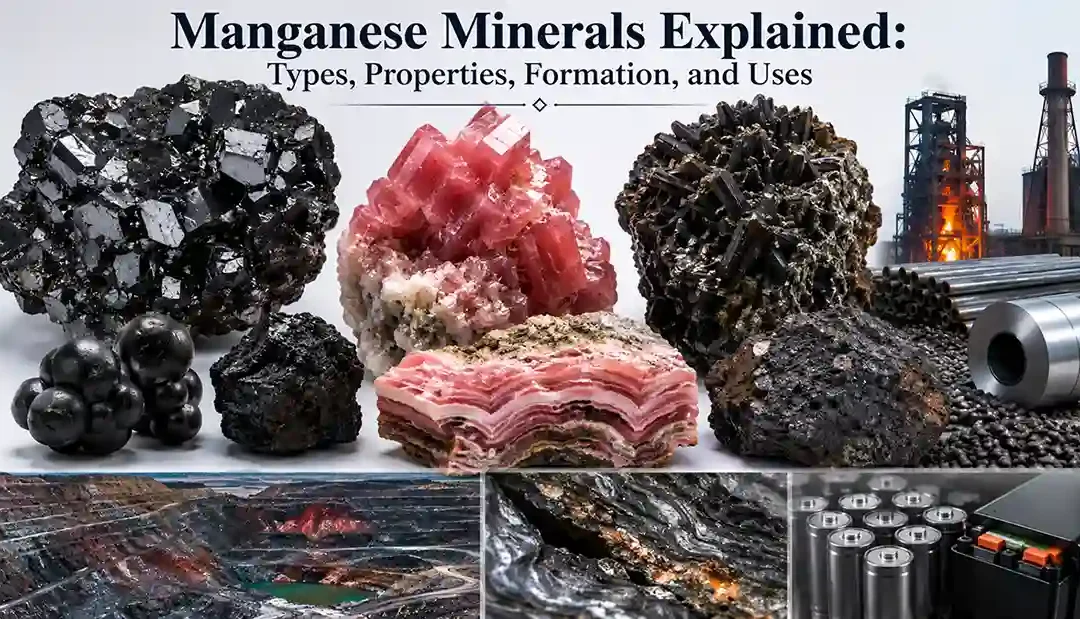
Manganese is one of the most important industrial metals in the modern world. It is essential for steel production and increasingly important for battery technologies used in renewable energy systems and electric vehicles.
Manganese minerals are important because they supply manganese for:
- steel manufacturing
- rechargeable batteries
- chemical industries
- glass production
- fertilizers
- metal alloys
Most manganese production comes from oxide minerals, especially pyrolusite.
Learn more → mineral classification system
What Are Manganese Minerals?
Manganese minerals are naturally occurring minerals that contain significant amounts of manganese.
They commonly occur in:
- sedimentary deposits
- hydrothermal veins
- metamorphic rocks
- marine nodules
- weathering environments
More than 300 manganese minerals are known, but only a few are economically important.
Chemical Formula of Manganese
Manganese is a metallic element represented by:
Basic Properties
| Property | Value |
|---|---|
| Element Name | Manganese |
| Symbol | Mn |
| Atomic Number | 25 |
| Atomic Weight | 54.94 |
| Classification | Transition Metal |
| Density | 7.21 g/cm³ |
Major Manganese Minerals
Pyrolusite – The Most Important Manganese Ore
Pyrolusite is the world's most important manganese mineral.
Its formula is:
Characteristics include:
- black color
- metallic to dull luster
- high manganese content
- soft streaking behavior
Most commercial manganese production comes from pyrolusite-rich deposits.
Rhodochrosite
Rhodochrosite is a manganese carbonate mineral.
Its formula is:
Features include:
- pink coloration
- attractive crystal forms
- gemstone quality specimens
- carbonate composition
Rhodochrosite is both an ore mineral and a popular collector gemstone.
Manganite
Manganite is a manganese oxide-hydroxide mineral.
Its formula is:
Characteristics include:
- steel-gray color
- prismatic crystals
- metallic luster
It commonly occurs in oxidized manganese deposits.
Psilomelane
Psilomelane is a manganese oxide mineral group.
A commonly used generalized formula is:
Features include:
- botryoidal growth
- black coloration
- high manganese content
It often forms massive ore bodies.
Hausmannite
Hausmannite is an important manganese oxide mineral.
Its formula is:
Characteristics include:
- brown-black color
- tetragonal crystal system
- manganese-rich composition
Formation of Manganese Deposits
Sedimentary Processes
Many manganese deposits form in marine environments.
Hydrothermal Activity
Hot fluids can concentrate manganese minerals.
Weathering
Oxidation creates secondary manganese oxides.
Ocean Floor Processes
Manganese nodules form on the deep seafloor.
Marine Manganese Deposits
Major manganese resources occur in:
- sedimentary basins
- marine nodules
- hydrothermal systems
- weathered ore zones
These environments can concentrate manganese into economically valuable deposits.
Manganese and Steel Production
Manganese is used in:
Steel Manufacturing
Improves strength and durability.
Alloy Production
Enhances hardness and wear resistance.
Industrial Metals
Improves mechanical properties.
Nearly all steel contains some manganese.
Manganese in Battery Technology
Manganese is increasingly important for:
- lithium-ion batteries
- electric vehicles
- renewable energy storage
- advanced battery chemistries
Demand for manganese is growing alongside battery production.
Major Uses of Manganese
| Industry | Application |
|---|---|
| Steel Industry | Steel Production |
| Energy Storage | Batteries |
| Manufacturing | Metal Alloys |
| Chemicals | Industrial Chemicals |
| Agriculture | Fertilizers |
Major Manganese-Producing Countries
Important manganese producers include:
- South Africa
- Australia
- Gabon
- Brazil
- India
- China
South Africa hosts some of the world's largest manganese reserves.
How Geologists Identify Manganese Minerals
Pyrolusite
- black color
- black streak
- soft texture
Rhodochrosite
- pink coloration
- carbonate reaction
- rhombohedral cleavage
Manganite
- metallic luster
- prismatic crystals
Hausmannite
- dark color
- manganese oxide composition
Learn more → mineral identification guide
Manganese Minerals Summary
| Mineral | Formula | Main Use |
|---|---|---|
| Pyrolusite | MnO₂ | Manganese Ore |
| Rhodochrosite | MnCO₃ | Ore & Gemstone |
| Manganite | MnO(OH) | Manganese Ore |
| Psilomelane | BaMn₉O₁₆(OH)₄ | Manganese Ore |
| Hausmannite | Mn₃O₄ | Manganese Ore |
Pyrolusite (MnO₂) is the world's primary manganese ore mineral.
The chemical symbol for manganese is Mn.
Rhodochrosite (MnCO₃) is famous for its distinctive pink color.
Manganese is primarily used in steel production, batteries, alloys, and industrial chemicals.
Manganese deposits commonly form in sedimentary basins, hydrothermal systems, and marine environments.
Final Thoughts
Manganese minerals are essential resources for modern industry and technology. Minerals such as pyrolusite, rhodochrosite, and manganite provide the manganese needed for steel production, battery manufacturing, and industrial applications.
As demand for infrastructure, renewable energy, and electric vehicles continues to grow, manganese minerals will remain critical components of the global economy and future technological development.