
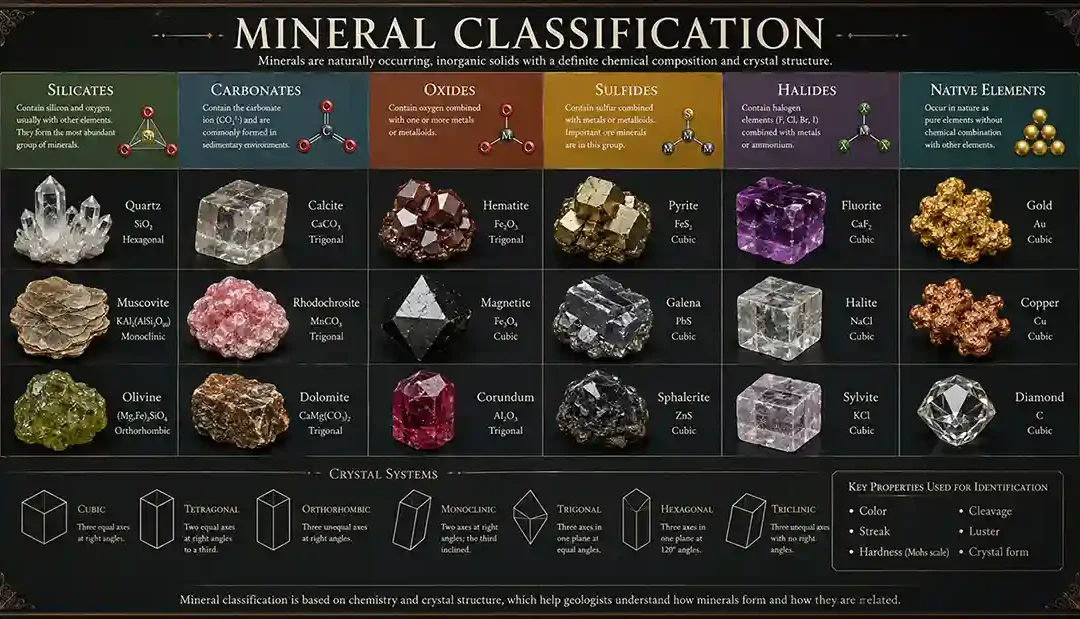
Scientists classify minerals into groups based mainly on their chemical composition and crystal structure. This organization system is called the mineral classification system.
Because thousands of minerals exist on Earth, classification helps geologists:
- identify minerals
- study geological processes
- understand rock formation
- locate economic resources
Most mineral groups are named after their dominant chemical components.
The largest and most important group is the silicate minerals, which make up most of Earth’s crust.
Learn more → chemical properties of minerals
Major Mineral Groups
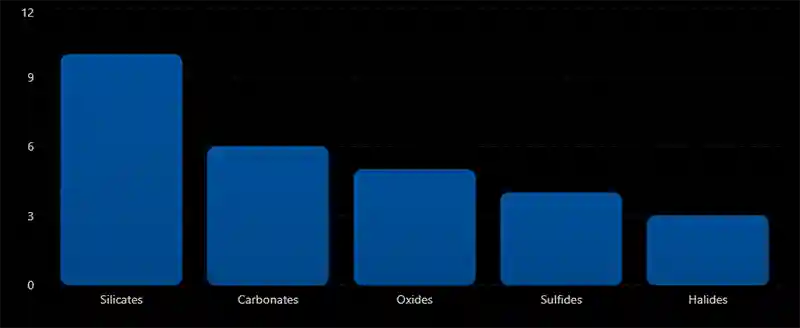
Major Mineral Classification Groups
Main mineral groups based on chemical composition.
Why Minerals Are Classified
Minerals differ in:
- chemical composition
- crystal structure
- physical properties
- formation environment
Classification helps scientists organize minerals into related chemical families. This makes mineral identification and geological study much easier.
Silicate Minerals
Silicates are the largest mineral group.
They contain:
- silicon
- oxygen
Silicates form most of Earth’s crust and mantle.
Common Silicate Minerals
- Quartz
- Feldspar
- Mica
- Olivine
- Pyroxene
Silicates are extremely important in:
- igneous rocks
- metamorphic rocks
- crust formation
Carbonate Minerals
Carbonates contain Carbonate ions (CO₃)
Common Carbonate Minerals
- Calcite
- Dolomite
Carbonates commonly form in:
- sedimentary rocks
- marine environments
- caves
Many carbonate minerals react strongly with acid.
Learn more → chemical properties of minerals
Oxide Minerals
Oxides contain oxygen bonded with metals
Common Oxide Minerals
- Hematite
- Magnetite
- Corundum
Oxides are important sources of:
- iron
- aluminum
- chromium
Some oxide minerals are major ore minerals.
Sulfide Minerals
Sulfides contain sulfur combined with metals
Common Sulfide Minerals
- Pyrite
- Galena
- Chalcopyrite
Sulfides are important because they often contain:
- copper
- lead
- zinc
- gold-related ores
Many sulfides have metallic luster.
Halide Minerals
Halides form from halogen elements
such as:
- chlorine
- fluorine
Common Halides
- Halite
- Fluorite
Many halides form through the evaporation of salty water.
Sulfate Minerals
Sulfates contain sulfate ions (SO₄)
Common Sulfate Minerals
- Gypsum
- Barite
Sulfates often form in:
- evaporite environments
- dry lake basins
- sedimentary deposits
Native Elements
Native elements are minerals made from a single chemical element.
Examples
- Gold
- Silver
- Copper
- Sulfur
These minerals occur naturally without combining with other elements.
Mineral Groups and Examples
| Mineral Group | Common Examples |
|---|---|
| Silicates | Quartz, Feldspar |
| Carbonates | Calcite, Dolomite |
| Oxides | Hematite, Magnetite |
| Sulfides | Pyrite, Galena |
| Halides | Halite, Fluorite |
Chemical composition is the main basis of mineral classification.
Silicates: The Most Important Group
Silicates are the dominant minerals in:
- granite
- basalt
- sandstone
- many metamorphic rocks
Their silicon-oxygen structure makes them the foundation of Earth’s crust.
Mineral Classification and Rock Formation
Mineral groups help scientists understand:
- rock origins
- geological environments
- magma chemistry
- sedimentary processes
Different rock types contain different mineral combinations.
Economic Economic Importance of Mineral Groups
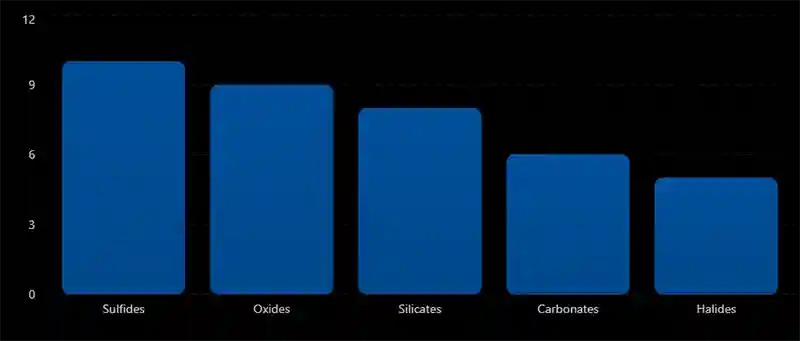
Economic Importance of Mineral Groups
Some mineral groups are especially important for industry and mining.
Why Mineral Classification Matters
Mineral classification is important for:
- geology
- mining
- environmental science
- engineering
- gemstone studies
Scientists use classification systems to better understand: Earth’s materials and geological processes.
A scientific system used to group minerals based on chemical composition and structure.
Silicate minerals are the most abundant group in Earth’s crust.
To organize minerals and better understand their properties and formation.
Sulfides and oxides are major sources of metal ores.
Final Thoughts
The mineral classification system helps scientists organize and study the thousands of minerals found on Earth. By grouping minerals according to chemical composition and crystal structure, geologists can better understand rock formation, Earth processes, and valuable natural resources.
Learning mineral classification provides a strong foundation for mineralogy, geology, and Earth science research.
Start learning here → characteristics of minerals