
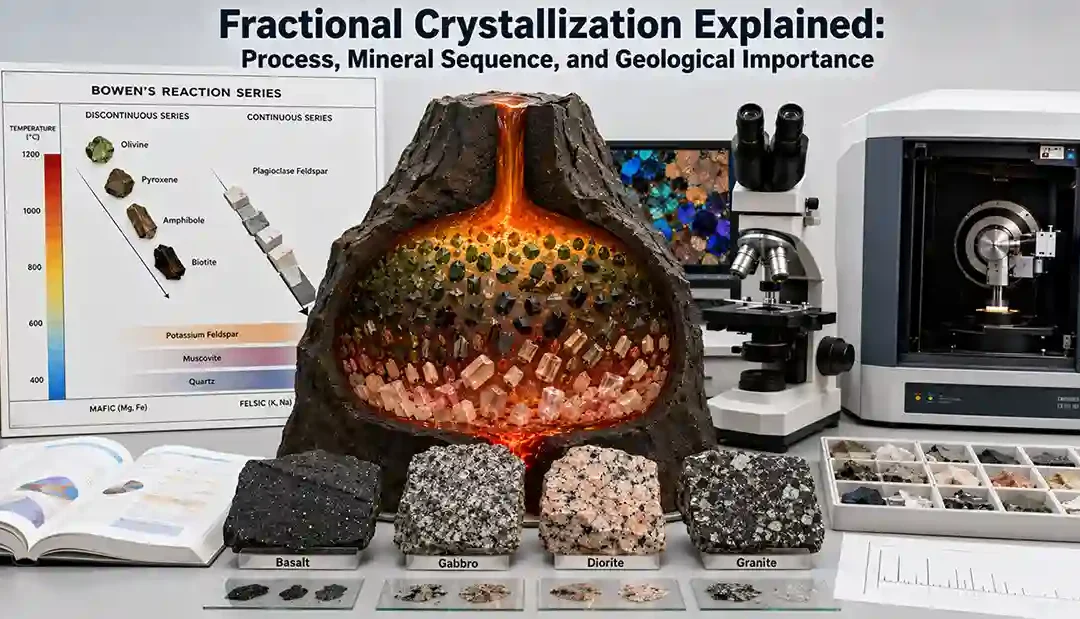
Fractional crystallization is one of the most important processes in igneous petrology. It explains how a single body of magma can produce many different minerals and rock types as it cools. During cooling, minerals do not crystallize simultaneously. Instead, they crystallize in a predictable sequence according to their melting temperatures. As newly formed crystals separate from the remaining liquid magma, the chemical composition of the magma changes continuously, allowing new minerals to crystallize later.
This process is responsible for the formation of a wide variety of igneous rocks, from ultramafic peridotite and basalt to andesite, diorite, granite, and rhyolite. Fractional crystallization also concentrates many economically valuable elements, leading to the formation of important ore deposits.
Understanding fractional crystallization is fundamental to mineralogy, igneous petrology, volcanology, geochemistry, and economic geology.
This topic should be studied together with Igneous Rocks Explained, Bowen's Reaction Series, and Volcanic Minerals.
What Is Fractional Crystallization?
Fractional crystallization is the progressive removal of newly formed mineral crystals from cooling magma.
As crystals separate from the melt:
- The remaining magma changes composition.
- New minerals become stable.
- Different igneous rocks eventually form.
This process is called magmatic differentiation because it creates magmas with different chemical compositions from a common parent magma.
How Fractional Crystallization Works
The process follows several stages.
- Magma begins to cool.
- High-temperature minerals crystallize first.
- These crystals settle, float, or become isolated from the melt.
- The remaining magma becomes enriched in silica and incompatible elements.
- Lower-temperature minerals crystallize.
- The magma evolves into progressively more felsic compositions.
Repeated crystal removal dramatically changes magma chemistry.
Why Do Minerals Crystallize at Different Temperatures?
Every mineral has its own stability range.
High-temperature minerals contain abundant:
- Magnesium
- Iron
- Calcium
Lower-temperature minerals contain more:
- Silicon
- Potassium
- Sodium
As temperature decreases, mineral stability changes, producing a predictable crystallization sequence.
Bowen's Reaction Series
Fractional crystallization closely follows Bowen's Reaction Series, developed by Canadian geologist Norman L. Bowen.
The series consists of two crystallization branches.
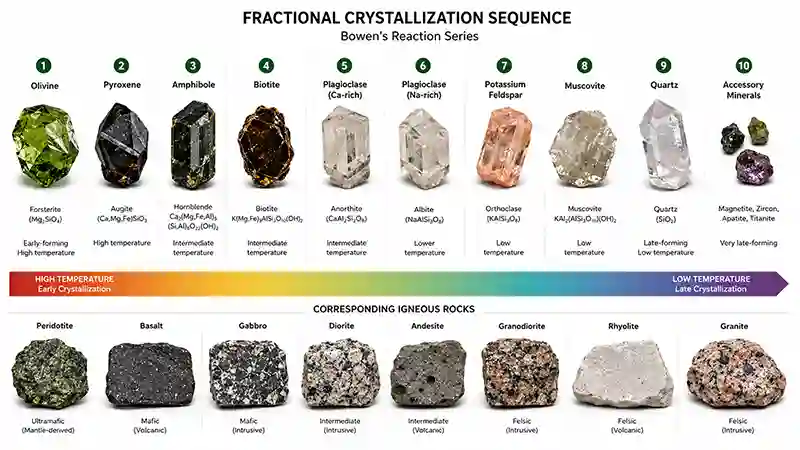
Discontinuous Series
Minerals crystallize in this order:
- Olivine
- Pyroxene
- Amphibole
- Biotite
Each mineral becomes unstable as temperature decreases and reacts to form the next mineral in the sequence.
Continuous Series
Plagioclase feldspar changes composition gradually.
Sequence:
- Calcium-rich plagioclase
- Intermediate plagioclase
- Sodium-rich plagioclase
The crystal structure remains similar while chemistry changes continuously.
Final Minerals
The last minerals to crystallize are:
- Potassium feldspar
- Muscovite
- Quartz
These minerals form from silica-rich residual magma.
Minerals Formed During Fractional Crystallization
Olivine
Forms first at the highest temperatures.
Characteristics:
- Rich in magnesium and iron
- Common in peridotite and basalt
Pyroxene
Forms after olivine.
Common rocks:
- Basalt
- Gabbro
Amphibole
Forms at intermediate temperatures.
Common rocks:
- Diorite
- Andesite
Biotite
Forms during later cooling stages.
Common rocks:
- Granite
- Diorite
Plagioclase Feldspar
Crystallizes throughout cooling. Composition changes from calcium-rich to sodium-rich.
Potassium Feldspar
Forms late from silica-rich magma.
Common rocks:
- Granite
- Rhyolite
Muscovite
Forms near the end of crystallization. Usually occurs in highly evolved granitic magmas.
Quartz
Quartz crystallizes last because it forms at relatively low temperatures from silica-rich residual magma.
Accessory Minerals
Late-stage magmas may also crystallize:
- Zircon
- Apatite
- Tourmaline
- Topaz
- Monazite
- Titanite
These minerals commonly concentrate rare elements and are valuable in geochronology and ore exploration.
Chemical Changes in Magma
As early minerals crystallize, the remaining magma becomes enriched in:
- Silicon
- Sodium
- Potassium
- Water
- Rare elements
At the same time, it becomes depleted in:
- Magnesium
- Iron
- Calcium
This chemical evolution produces increasingly felsic magma.
Fractional Crystallization and Igneous Rocks
Different stages of crystallization produce different rock types.
| Stage | Dominant Rocks | Major Minerals |
|---|---|---|
| Early | Peridotite | Olivine, Pyroxene |
| Intermediate | Basalt, Gabbro | Pyroxene, Plagioclase |
| Intermediate-Felsic | Diorite, Andesite | Amphibole, Biotite |
| Late | Granite, Rhyolite | Quartz, Feldspar, Muscovite |
Fractional Crystallization and Ore Deposits
Fractional crystallization concentrates incompatible elements in the remaining melt.
This leads to deposits rich in:
- Lithium
- Tin
- Tungsten
- Rare Earth Elements
- Uranium
- Zirconium
Many granitic pegmatites form during the final stages of crystallization.
Geological Importance
Fractional crystallization explains:
- Magma evolution
- Diversity of igneous rocks
- Formation of continental crust
- Volcanic magma differentiation
- Layered igneous intrusions
It is one of the most fundamental processes in Earth's interior.
Laboratory Identification
Fractional crystallization is studied using:
- Petrographic Microscopy
- X-Ray Diffraction (XRD)
- Electron Microprobe Analysis (EPMA)
- Scanning Electron Microscopy (SEM)
- Whole-rock geochemistry
- Isotope geochemistry
- Experimental petrology
These techniques reveal mineral chemistry and crystallization history.
Applications
Fractional crystallization studies are important in:
- Igneous Petrology
- Mineralogy
- Volcanology
- Economic Geology
- Geochemistry
- Planetary Geology
- Mining Exploration
- Materials Science
Advantages of Studying Fractional Crystallization
Studying fractional crystallization helps scientists:
- Understand magma evolution
- Explain igneous rock diversity
- Predict mineral assemblages
- Explore ore deposits
- Reconstruct volcanic history
- Interpret planetary crust formation
Limitations
Interpreting fractional crystallization may be challenging because:
- Magma mixing can modify crystallization trends.
- Crustal contamination may change magma chemistry.
- Partial melting and assimilation may occur simultaneously.
- Multiple crystallization events can overprint earlier mineral assemblages.
For comprehensive interpretation, combine fractional crystallization studies with:
- Bowen's Reaction Series
- Mineral Formation
- Igneous Rocks Explained
- Volcanic Minerals
- Minerals in Igneous Rocks
- Petrographic Microscopy
- Mineral Chemistry Analysis
- X-Ray Diffraction in Mineralogy
Comparison Table
| Crystallization Stage | Dominant Minerals | Magma Composition |
| High Temperature | Olivine, Pyroxene | Mafic |
| Intermediate | Amphibole, Biotite | Intermediate |
| Low Temperature | Potassium Feldspar, Muscovite, Quartz | Felsic |
Summary Table
| Feature | Fractional Crystallization |
| Main Process | Progressive Crystal Removal from Magma |
| Primary Control | Cooling Temperature |
| Major Model | Bowen's Reaction Series |
| Common Study Methods | Petrography, XRD, EPMA, Geochemistry |
| Geological Importance | Magma Differentiation and Igneous Rock Formation |
Fractional crystallization is the process in which minerals crystallize from cooling magma and are separated from the remaining melt, causing the magma to change composition over time.
It explains how one parent magma can produce a wide variety of igneous rocks and helps concentrate economically valuable elements into late-stage magmas.
Olivine generally crystallizes first from mafic magma because it is stable at the highest temperatures, followed by pyroxene and other high-temperature minerals.
Bowen's Reaction Series describes the predictable sequence of mineral crystallization during cooling, while fractional crystallization explains how the removal of those minerals changes the composition of the remaining magma.
Geologists study it using petrographic microscopy, X-ray diffraction (XRD), electron microprobe analysis (EPMA), scanning electron microscopy (SEM), whole-rock geochemistry, isotope analysis, and experimental petrology.
Final Thoughts
Fractional crystallization is one of the key mechanisms responsible for the remarkable diversity of Earth's igneous rocks. As magma cools, early-forming minerals such as olivine and pyroxene remove magnesium, iron, and calcium from the melt, leaving behind increasingly silica-rich magma that eventually crystallizes minerals such as quartz and potassium feldspar.
By integrating field observations with petrographic microscopy, geochemical analyses, X-ray diffraction, electron microprobe analysis, and experimental studies, geologists can reconstruct magma evolution, understand volcanic systems, and explore economically important mineral deposits. Fractional crystallization remains a cornerstone of modern igneous petrology, geochemistry, volcanology, and economic geology.
Continue Learning
Continue exploring igneous processes with these related guides: