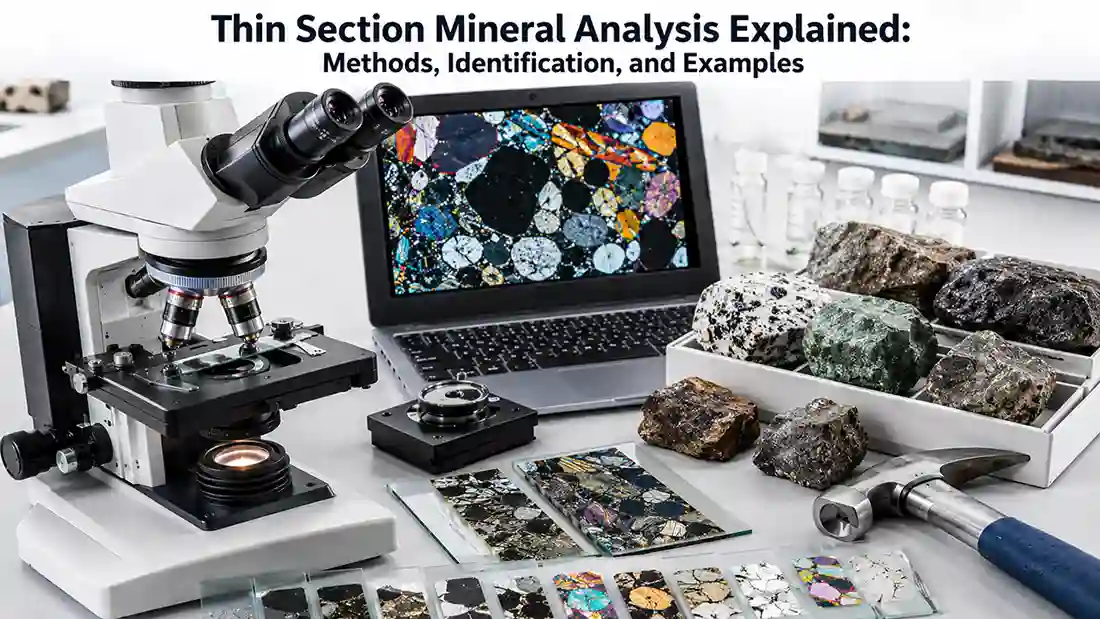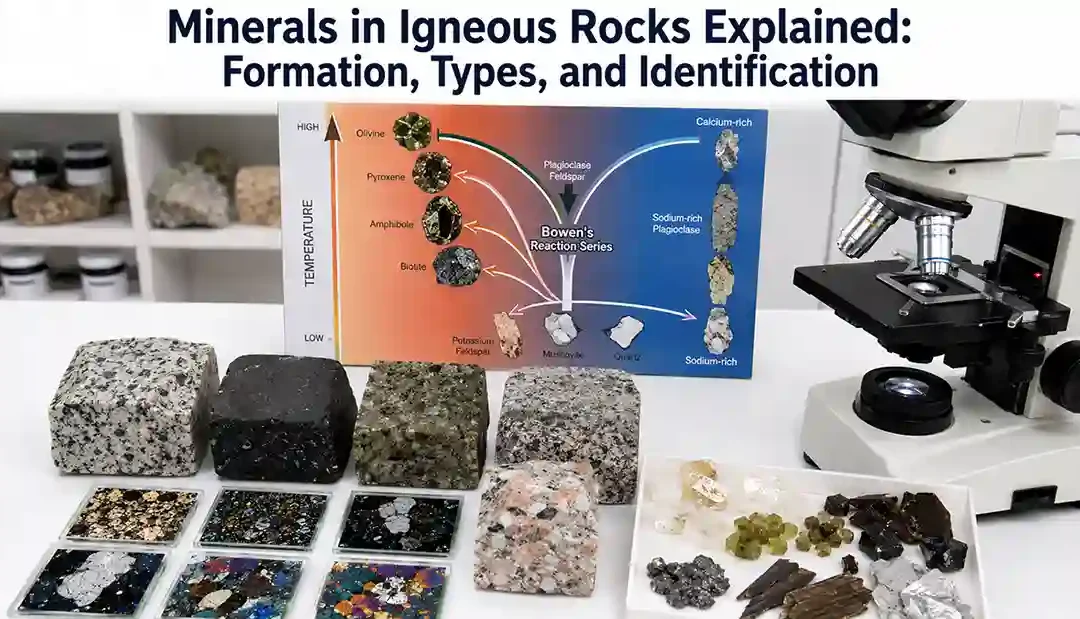
Igneous rocks form when molten magma or lava cools and solidifies. During cooling, different minerals crystallize at different temperatures, producing a wide variety of igneous rock compositions and textures. These minerals, known as rock-forming minerals, make up nearly all igneous rocks and provide valuable information about how and where the rocks formed.
The type of minerals present depends mainly on magma composition, cooling rate, pressure, water content, and crystallization sequence. Minerals such as quartz, feldspar, olivine, pyroxene, amphibole, and mica dominate most igneous rocks. Their presence helps geologists classify rocks, reconstruct magma evolution, and understand tectonic environments.
Understanding minerals in igneous rocks is fundamental to mineralogy, petrology, volcanology, and economic geology.
This topic should be studied together with Bowen's Reaction Series, Crystal Growth in Minerals, and Petrographic Microscopy.
What Are Minerals in Igneous Rocks?
Minerals in igneous rocks are crystals that form as magma or lava cools.
As temperature decreases:
- Different minerals crystallize.
- Crystal size increases with slower cooling.
- Remaining magma changes composition.
- New minerals continue forming until the rock solidifies.
The final mineral assemblage reflects the rock's cooling history.
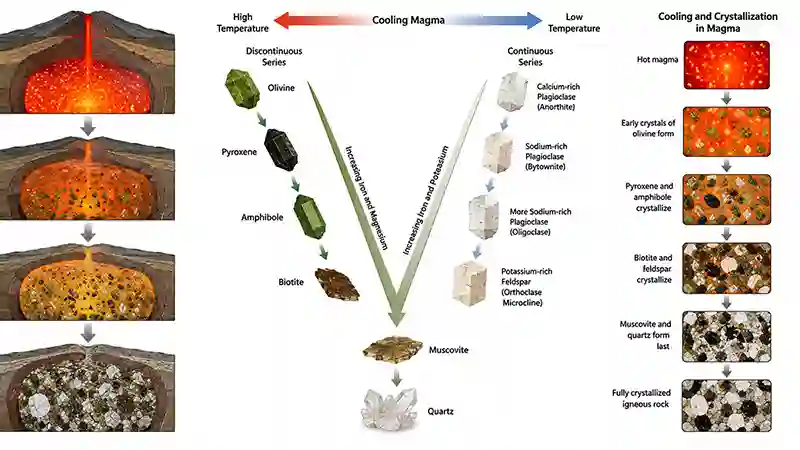
How Do Minerals Form in Magma?
Minerals crystallize according to their melting temperatures.
High-temperature minerals crystallize first.
Lower-temperature minerals crystallize later.
This sequential crystallization is explained by Bowen's Reaction Series, one of the most important concepts in igneous petrology.
Factors Affecting Mineral Formation
Several factors determine which minerals crystallize.
Magma Composition
Silica-rich magma forms quartz and potassium feldspar.
Magnesium- and iron-rich magma forms olivine and pyroxene.
Cooling Rate
Slow cooling produces large crystals.
Rapid cooling produces very small crystals or volcanic glass.
Temperature
Different minerals crystallize at different temperatures.
Pressure
Pressure influences mineral stability and crystallization depth.
Water Content
Water lowers melting temperatures and promotes the formation of hydrous minerals such as amphibole and biotite.
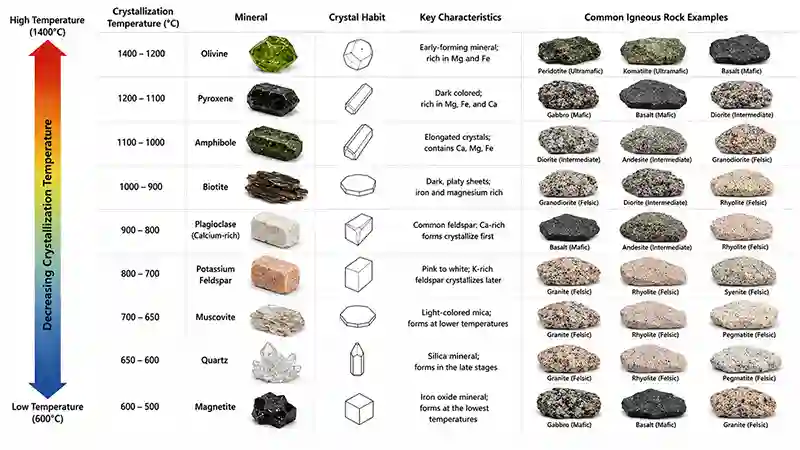
Common Minerals in Igneous Rocks
Quartz
Quartz forms in silica-rich magmas.
Characteristics:
- Colorless to gray
- Hardness 7
- No cleavage
- High chemical stability
Common rocks:
- Granite
- Rhyolite
- Pegmatite
Feldspar
Feldspar is the most abundant mineral group in Earth's crust.
Types include:
- Plagioclase Feldspar
- Potassium Feldspar
Common rocks:
- Granite
- Diorite
- Gabbro
- Basalt
Olivine
Olivine crystallizes at very high temperatures.
Characteristics:
- Green color
- High magnesium and iron
- High density
Common rocks:
- Peridotite
- Basalt
- Gabbro
Pyroxene
Pyroxene commonly forms after olivine.
Characteristics:
- Dark green to black
- Two cleavages near 90°
- Iron- and magnesium-rich
Common rocks:
- Basalt
- Gabbro
Amphibole
Amphibole crystallizes at moderate temperatures.
Characteristics:
- Black to dark green
- Two cleavages at approximately 60° and 120°
Common rocks:
- Diorite
- Andesite
- Granite
Biotite
Biotite is a dark mica rich in iron and magnesium.
Characteristics:
- Perfect basal cleavage
- Brown to black color
- Flexible sheets
Common rocks:
- Granite
- Diorite
- Pegmatite
Muscovite
Muscovite forms during the late stages of crystallization.
Characteristics:
- Colorless to silvery
- Perfect cleavage
- Thin transparent sheets
Common rocks:
- Granite
- Pegmatite
Magnetite
Magnetite is a common accessory mineral.
Characteristics:
- Black color
- Strong magnetism
- High density
Common rocks:
- Gabbro
- Basalt
- Diorite
Accessory Minerals
Many igneous rocks contain small amounts of:
- Zircon
- Apatite
- Titanite
- Ilmenite
- Rutile
- Allanite
Although present in small quantities, these minerals provide valuable information about magma evolution and rock age.
Minerals in Different Igneous Rocks
| Igneous Rock | Major Minerals |
|---|---|
| Granite | Quartz, K-Feldspar, Plagioclase, Biotite, Muscovite |
| Diorite | Plagioclase, Amphibole, Biotite |
| Gabbro | Plagioclase, Pyroxene, Olivine |
| Basalt | Plagioclase, Pyroxene, Olivine |
| Rhyolite | Quartz, Feldspar, Biotite |
| Andesite | Plagioclase, Amphibole, Biotite |
| Peridotite | Olivine, Pyroxene |
| Pegmatite | Quartz, Feldspar, Muscovite |
Bowen's Reaction Series
Bowen's Reaction Series explains the order in which minerals crystallize.
Discontinuous Series
- Olivine
- Pyroxene
- Amphibole
- Biotite
Continuous Series
- Calcium-rich Plagioclase
- Intermediate Plagioclase
- Sodium-rich Plagioclase
Late-stage minerals include:
- Potassium Feldspar
- Muscovite
- Quartz
This sequence explains why different igneous rocks contain different mineral assemblages.
Mineral Identification
Geologists identify igneous minerals using:
- Color
- Hardness
- Cleavage
- Crystal habit
- Density
- Optical properties
- Chemical composition
Laboratory methods include:
- Petrographic Microscopy
- X-Ray Diffraction (XRD)
- Electron Microprobe Analysis (EPMA)
- Scanning Electron Microscopy (SEM)
Importance of Minerals in Igneous Rocks
Studying igneous minerals helps geologists:
- Classify rocks
- Interpret magma evolution
- Determine tectonic settings
- Understand volcanic processes
- Locate mineral resources
- Estimate crystallization conditions
These minerals record the history of magma from its origin to solidification.
Applications
Minerals in igneous rocks are important in:
- Mineralogy
- Igneous petrology
- Volcanology
- Economic geology
- Mining exploration
- Engineering geology
- Geochemistry
Advantages of Studying Igneous Minerals
Studying igneous minerals allows scientists to:
- Reconstruct magma evolution
- Understand crystallization sequences
- Identify rock types
- Evaluate mineral deposits
- Interpret tectonic environments
Limitations
Mineral identification may be difficult because:
- Fine-grained volcanic rocks contain microscopic crystals.
- Weathering may alter primary minerals.
- Similar minerals may require laboratory analysis.
For complete interpretation, combine igneous mineral studies with:
- Bowen's Reaction Series
- Crystal Growth in Minerals
- Petrographic Microscopy
- Mineral Chemistry Analysis
- X-Ray Diffraction in Mineralogy
- Thin Section Mineral Analysis
- How to Identify Minerals
Comparison Table
| Mineral | Typical Crystallization Temperature | Common Igneous Rocks |
| Olivine | Very High | Peridotite, Basalt |
| Pyroxene | High | Gabbro, Basalt |
| Amphibole | Moderate | Diorite, Andesite |
| Biotite | Moderate-Low | Granite, Diorite |
| Feldspar | Wide Range | Nearly All Igneous Rocks |
| Quartz | Low | Granite, Rhyolite |
Summary Table
| Feature | Minerals in Igneous Rocks |
| Main Process | Magma Crystallization |
| Dominant Minerals | Quartz, Feldspar, Olivine, Pyroxene |
| Key Concept | Bowen's Reaction Series |
| Common Study Methods | Petrography, XRD, EPMA |
| Geological Importance | Rock Classification and Magma Evolution |
The most common minerals include quartz, plagioclase feldspar, potassium feldspar, olivine, pyroxene, amphibole, biotite, muscovite, and magnetite.
Feldspars crystallize over a wide temperature range and make up more than half of Earth's crust, making them the most abundant minerals in many igneous rocks.
Olivine generally crystallizes first from high-temperature mafic magma, followed by pyroxene, amphibole, and biotite according to Bowen's Reaction Series.
Quartz crystallizes during the final stages of cooling from silica-rich magma, making it abundant in felsic rocks such as granite and rhyolite.
They are identified using physical properties, petrographic microscopy, X-ray diffraction (XRD), electron microprobe analysis (EPMA), and other laboratory techniques.
Final Thoughts
Minerals in igneous rocks preserve a detailed record of magma crystallization and Earth's internal geological processes. From the high-temperature crystallization of olivine and pyroxene to the late formation of quartz and potassium feldspar, each mineral reflects the composition, cooling history, and evolution of the magma from which it formed.
By combining field observations with petrographic microscopy, mineral chemistry, X-ray diffraction, and Bowen's Reaction Series, geologists can accurately classify igneous rocks, reconstruct tectonic environments, and explore valuable mineral resources. Understanding igneous minerals provides an essential foundation for studying petrology, volcanology, and economic geology.
Continue Learning
Continue exploring igneous petrology with these related guides: