
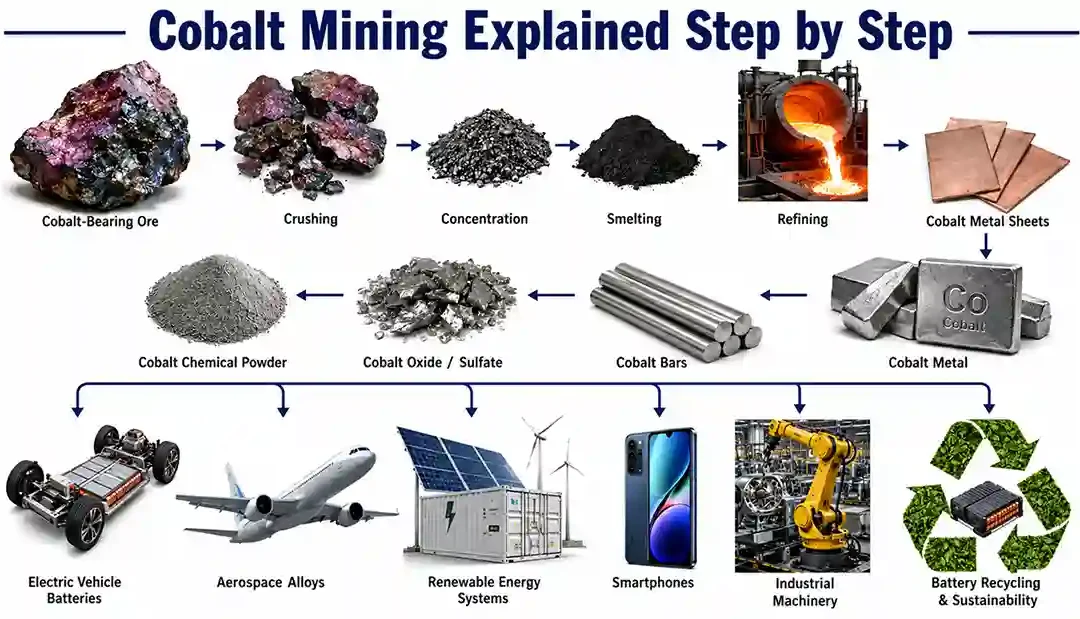
Cobalt is one of the world's most valuable critical minerals because it plays a major role in rechargeable batteries, superalloys, aerospace engineering, electronics, and renewable energy technologies. Although cobalt has many industrial uses, it is best known for its importance in lithium-ion batteries used by electric vehicles (EVs) and energy storage systems.
Cobalt mining refers to the exploration, extraction, processing, and refining of cobalt-bearing ores into high-purity cobalt products for industrial applications. Since cobalt rarely occurs as a standalone mineral deposit, it is commonly produced as a by-product of copper and nickel mining.
Understanding cobalt mining demonstrates the close relationship between geology, mining engineering, metallurgy, battery technology, and the global transition toward clean energy.
This topic should be studied together with Volcanic Minerals, Mineralogy, Clay Minerals, Soil Minerals, and Crystal Defects.
Why Cobalt Is Important
Cobalt is widely used because it provides:
- Excellent thermal stability
- High energy density in batteries
- Superior corrosion resistance
- High-temperature strength
- Long battery life
- Reliable electrochemical performance
- Strong wear resistance
- Improved alloy performance
These properties make cobalt an essential material for many advanced technologies.
Major Stages of Cobalt Mining
Geological Exploration
Common activities:
- Geological mapping
- Geochemical sampling
- Geophysical surveys
- Diamond drilling
Importance:
Exploration identifies economically viable cobalt-bearing deposits.
Mine Development
Common methods:
- Open-pit mining
- Underground mining
Importance:
The mining method depends on ore depth, grade, and local geology.
Ore Extraction
Common equipment:
- Excavators
- Drilling rigs
- Blasting equipment
- Haul trucks
Importance:
Ore is safely extracted and transported to processing facilities.
Crushing and Grinding
Common processes:
- Primary crushing
- Secondary crushing
- Fine grinding
Importance:
Ore size is reduced to release valuable cobalt-bearing minerals.
Mineral Processing
Common methods:
- Flotation
- Gravity separation
- Magnetic separation
Importance:
Concentrates cobalt minerals while removing waste rock.
Smelting and Refining
Common processes:
- Roasting
- Smelting
- Hydrometallurgical refining
- Solvent extraction
Importance:
Produces high-purity cobalt suitable for industrial use.
Battery Material Production
Common products:
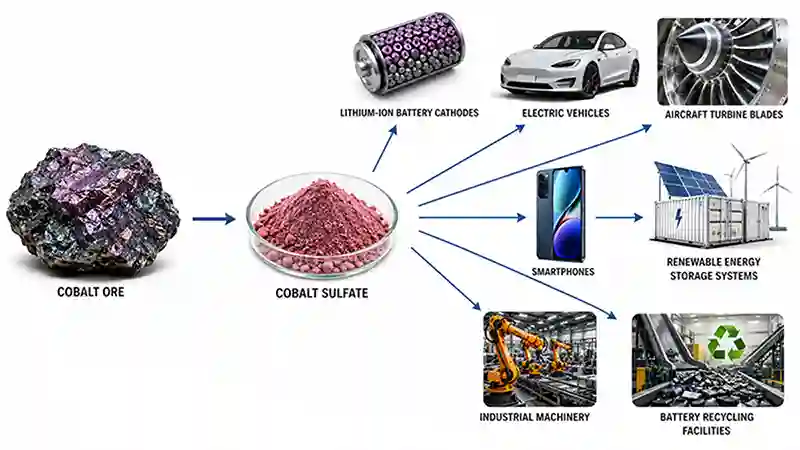
- Cobalt sulfate
- Battery-grade cobalt chemicals
Importance:
These refined materials are used to manufacture lithium-ion battery cathodes.
Recycling
Common activities:
- Battery recycling
- Metal recovery
- Circular economy
Importance:
Recovered cobalt reduces dependence on newly mined resources.
Environmental Management
Common activities:
- Water treatment
- Land rehabilitation
- Waste management
- Air quality monitoring
Importance:
Responsible mining minimizes environmental impacts.
Supply Chain Distribution
Common destinations:
- Battery manufacturers
- Aerospace companies
- Electronics manufacturers
Importance:
Refined cobalt reaches industries around the world.
Major Sources of Cobalt
| Source | Description |
|---|---|
| Copper Deposits | Most cobalt is produced as a by-product of copper mining |
| Nickel Deposits | Major secondary source of cobalt |
| Laterite Deposits | Important tropical nickel-cobalt resources |
| Sediment-Hosted Deposits | Copper-cobalt mineralization |
| Hydrothermal Deposits | Localized cobalt mineralization |
From Cobalt Ore to Finished Products
The journey of cobalt involves several stages.
- Geological exploration identifies deposits.
- Ore is mined.
- Ore is crushed and concentrated.
- Cobalt is separated from copper or nickel.
- Metal is refined into high-purity products.
- Battery chemicals and alloys are manufactured.
- Finished products are used in batteries, electronics, and aerospace systems.
- Used materials are recycled.
This process connects geology directly to advanced manufacturing.
How Cobalt Supports Modern Industries
Cobalt plays an essential role in many sectors.
Electric Vehicles
- Battery cathodes
- Long battery life
Renewable Energy
- Grid energy storage
- Battery systems
Aerospace
- Jet engine superalloys
- Heat-resistant components
Consumer Electronics
- Smartphones
- Laptops
- Tablets
Industrial Manufacturing
- Cutting tools
- Industrial alloys
These applications make cobalt one of the world's most important critical minerals.
Geological Importance
Economic geologists study cobalt deposits to ensure long-term mineral supplies.
Research includes:
- Copper-cobalt deposits
- Nickel-cobalt laterites
- Ore genesis
- Resource estimation
- Sustainable exploration
These studies support responsible development of critical mineral resources.
Laboratory Investigation
Cobalt-bearing ores are analyzed using:
- X-Ray Fluorescence (XRF)
- X-Ray Diffraction (XRD)
- ICP-MS
- ICP-OES
- Atomic Absorption Spectroscopy (AAS)
- Scanning Electron Microscopy (SEM)
These techniques determine cobalt concentration, mineral composition, and processing suitability.
Applications
Cobalt is widely used in:
- Lithium-ion batteries
- Electric vehicles
- Battery energy storage systems
- Aerospace superalloys
- Gas turbine engines
- Smartphones
- Laptops
- Medical equipment
- Industrial cutting tools
- Catalysts
Advantages of Studying Cobalt Mining
Understanding cobalt mining helps:
- Explain critical mineral supply chains
- Understand battery manufacturing
- Improve resource management
- Support renewable energy development
- Advance sustainable mining
- Promote mineral recycling
Limitations
Despite its importance, cobalt mining presents several challenges.
- Environmental impacts require careful management.
- Many deposits are by-products of copper and nickel mining.
- Global supply is geographically concentrated.
- Battery demand continues to increase rapidly.
- Responsible sourcing and recycling remain important priorities.
For a broader understanding, study this topic together with:
- Economic Geology
- Mineralogy
- Mining Engineering
- Metallurgy
- Materials Science
- Environmental Geology
- Battery Engineering
- Sustainability
Comparison Table
| Industry | Role of Cobalt | Main Benefit |
| Electric Vehicles | Battery Cathodes | High Energy Density |
| Aerospace | Superalloys | High-Temperature Strength |
| Electronics | Rechargeable Batteries | Reliable Performance |
| Renewable Energy | Energy Storage | Grid Stability |
| Medical Equipment | Specialized Alloys | Durability |
| Industrial Manufacturing | Cutting Tools | Wear Resistance |
| Catalysts | Chemical Processing | Improved Efficiency |
| Recycling | Metal Recovery | Resource Conservation |
Summary Table
| Feature | Cobalt Mining |
| Main Purpose | Extraction and Production of Cobalt |
| Main Sources | Copper and Nickel Deposits |
| Major Products | Cobalt Metal, Cobalt Sulfate, Battery Chemicals |
| Study Methods | XRF, XRD, ICP-MS, SEM |
| Geological Importance | Critical Mineral for Modern Industries |
Cobalt mining is the process of exploring, extracting, processing, and refining cobalt-bearing ores for industrial applications.
Most cobalt is produced as a by-product of copper and nickel mining, with major production coming from countries such as the Democratic Republic of the Congo, Indonesia, Australia, Canada, and Russia.
Cobalt improves battery stability, energy density, lifespan, and safety in many lithium-ion battery chemistries.
In most cases, no. Cobalt is primarily recovered as a by-product of copper or nickel mining rather than from dedicated cobalt mines.
Yes. Cobalt can be recovered from used batteries and industrial materials, helping reduce demand for newly mined cobalt.
Final Thoughts
Cobalt mining is a cornerstone of the global clean energy transition and advanced manufacturing industry. From exploration and extraction to refining and battery production, cobalt supports electric vehicles, renewable energy storage, aerospace engineering, and modern electronics. As demand for critical minerals continues to grow, responsible cobalt mining, improved recycling, and sustainable resource management will become increasingly important.
Understanding cobalt mining provides valuable insight into the connection between geology, mining engineering, metallurgy, and the technologies shaping the future.
Continue Learning
Continue exploring related topics: