
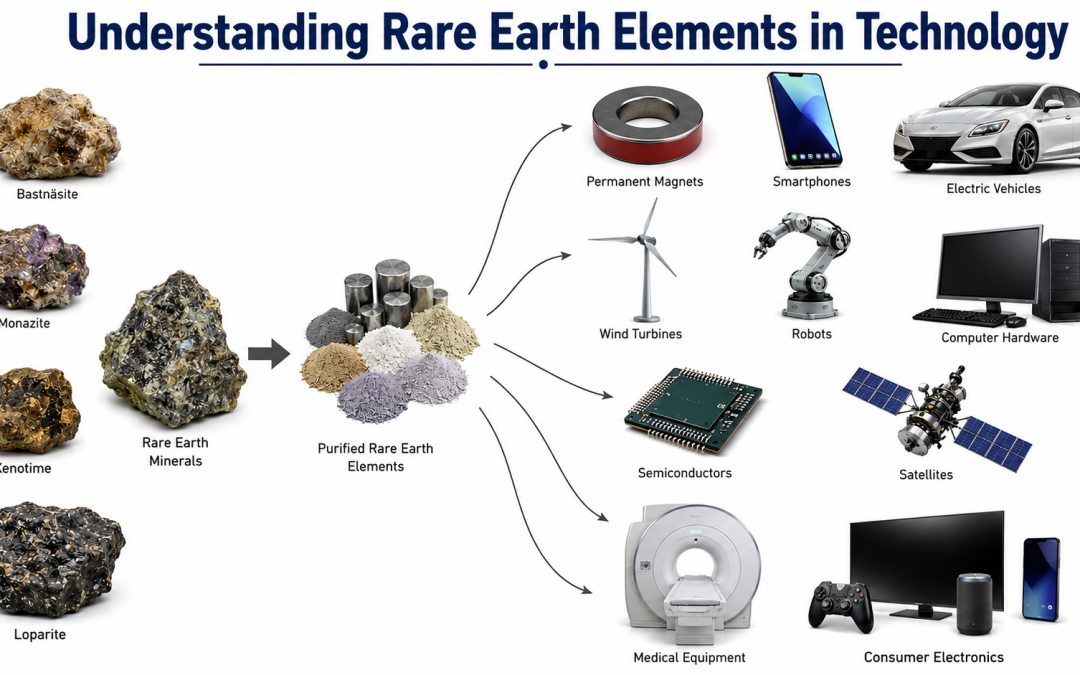
Rare earth elements (REEs) are a group of critical metals that play a vital role in modern technology. Although they are called "rare," many are relatively abundant in the Earth's crust. Their unique magnetic, optical, catalytic, and electrical properties make them essential for manufacturing smartphones, electric vehicles, wind turbines, computer hardware, robotics, defense systems, and renewable energy technologies.
Rare earth elements in technology refers to the use of these specialized elements in advanced electronic devices, clean energy systems, communication technologies, and industrial equipment. As the world becomes increasingly digital and electrified, demand for rare earth elements continues to grow.
Understanding rare earth elements demonstrates the strong connection between geology, mineralogy, chemistry, materials science, and modern engineering.
This topic should be studied together with Hydrothermal Alteration, Mineralogy, Volcanic Minerals, Mantle Minerals, and Copper in Renewable Energy.
Why Technology Depends on Rare Earth Elements
Rare earth elements are widely used because they provide:
- Powerful magnetic properties
- Excellent optical performance
- High thermal stability
- Superior electrical characteristics
- High corrosion resistance
- Efficient catalytic behavior
- Reliable long-term performance
- Essential support for miniaturized electronics
Without rare earth elements, many modern technologies would be less efficient or impossible to manufacture.
Major Applications of Rare Earth Elements in Technology
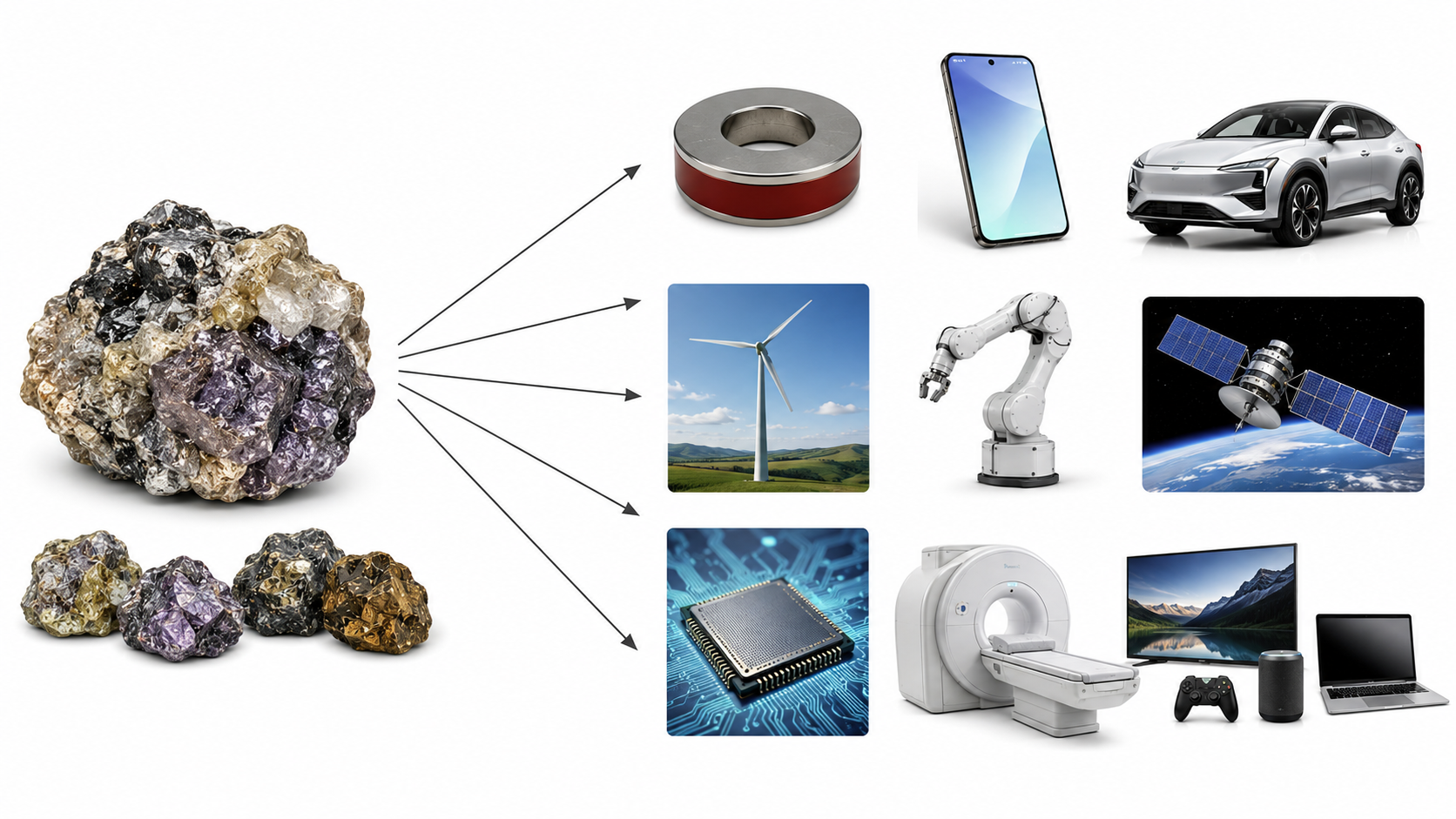
Permanent Magnets
Common uses:
- Neodymium magnets
- Samarium-cobalt magnets
- Industrial motors
Importance:
Rare earth magnets provide exceptional magnetic strength for compact and efficient devices.
Electric Vehicles
Common uses:
- Electric motors
- Drive systems
- Regenerative braking
Importance:
Neodymium and dysprosium improve motor efficiency and vehicle performance.
Wind Turbines
Common uses:
- Permanent magnet generators
- Offshore wind turbines
Importance:
Rare earth magnets enable highly efficient renewable electricity generation.
Smartphones
Common uses:
- Speakers
- Microphones
- Vibration motors
- Display technology
Importance:
Rare earth elements support compact, high-performance mobile devices.
Computer Hardware
Common uses:
- Hard disk drives
- Cooling systems
- Precision motors
Importance:
Rare earth magnets improve computing performance and reliability.
Semiconductors and Electronics
Common uses:
- Electronic components
- Precision manufacturing
- Optical devices
Importance:
Rare earth materials enhance electronic performance and manufacturing quality.
Robotics and Automation
Common uses:
- Servo motors
- Precision actuators
- Industrial robots
Importance:
Rare earth magnets enable accurate and energy-efficient robotic movement.
Medical Equipment
Common uses:
- MRI systems
- Medical lasers
- Diagnostic equipment
Importance:
Rare earth elements improve imaging quality and medical technology.
Satellites and Aerospace
Common uses:
- Communication satellites
- Guidance systems
- Space electronics
Importance:
Rare earth materials provide lightweight and reliable aerospace components.
Defense Technology
Common uses:
- Radar systems
- Missile guidance
- Precision sensors
Importance:
Rare earth elements are critical for advanced defense electronics.
Major Rare Earth Elements and Their Technology Uses
| Rare Earth Element | Main Technology Application |
|---|---|
| Neodymium (Nd) | Permanent Magnets |
| Praseodymium (Pr) | High-Strength Magnets |
| Dysprosium (Dy) | High-Temperature EV Motors |
| Terbium (Tb) | Green Displays & Magnets |
| Europium (Eu) | LED Displays |
| Yttrium (Y) | Lasers & Ceramics |
| Lanthanum (La) | Camera Lenses & Batteries |
| Cerium (Ce) | Glass Polishing & Catalysts |
| Gadolinium (Gd) | MRI Systems |
| Samarium (Sm) | Aerospace Magnets |
From Rare Earth Minerals to Modern Technology
Rare earth elements pass through several stages before becoming part of advanced technologies.
- Rare earth minerals are mined.
- Ore is crushed and concentrated.
- Rare earth oxides are separated.
- Individual rare earth elements are refined.
- Magnets, alloys, and advanced materials are manufactured.
- Technology products are assembled.
- Components are recycled and reused where possible.
This process connects geology directly to modern technological innovation.
How Rare Earth Elements Support Modern Technology
Rare earth elements perform several essential functions.
Magnetic Performance
- Permanent magnets
- Electric motors
- Wind turbines
Electronics
- Smartphones
- Computers
- Semiconductor devices
Renewable Energy
- Wind power
- Electric vehicles
Healthcare
- MRI scanners
- Medical lasers
Aerospace and Defense
- Satellites
- Aircraft systems
- Advanced sensors
Together, these applications make rare earth elements some of the world's most strategically important critical minerals.
Geological Importance
Economic geologists study rare earth deposits that supply global technology industries.
Research includes:
- Carbonatite deposits
- Ion-adsorption clay deposits
- Alkaline igneous complexes
- Resource estimation
- Sustainable mining
These investigations ensure long-term supplies of critical minerals for future technologies.
Laboratory Investigation
Rare earth minerals are analyzed using:
- X-Ray Fluorescence (XRF)
- X-Ray Diffraction (XRD)
- ICP-MS
- ICP-OES
- Scanning Electron Microscopy (SEM)
- Electron Probe Microanalysis (EPMA)
These techniques identify mineral composition, rare earth concentration, and processing suitability.
Applications
Rare earth elements in technology are widely used in:
- Smartphones
- Electric vehicles
- Wind turbines
- Computer hardware
- Semiconductor manufacturing
- Industrial robotics
- Medical equipment
- Satellites
- Consumer electronics
- Defense systems
Advantages of Studying Rare Earth Elements in Technology
Understanding rare earth elements helps:
- Explain modern electronic devices
- Support renewable energy technologies
- Improve electric vehicle performance
- Strengthen critical mineral supply chains
- Advance high-tech manufacturing
- Promote sustainable resource management
Limitations
Despite their importance, rare earth elements present several challenges.
- Mining and processing can affect the environment.
- Separation and refining are technically complex.
- Global production is concentrated in a limited number of countries.
- Demand continues to increase rapidly.
- Recycling technologies are still developing.
For a broader understanding, study this topic together with:
- Economic Geology
- Mineralogy
- Materials Science
- Electronics Engineering
- Renewable Energy Engineering
- Mining Engineering
- Environmental Geology
- Sustainability
Comparison Table
| Technology | Role of Rare Earth Elements | Main Benefit |
| Electric Vehicles | Permanent Magnets | Efficient Motors |
| Wind Turbines | Generator Magnets | Renewable Power Generation |
| Smartphones | Speakers & Displays | Compact High Performance |
| Computer Hardware | Magnets & Components | Reliable Operation |
| Robotics | Precision Motors | Accurate Motion |
| Medical Equipment | Imaging Materials | Better Diagnostics |
| Satellites | Lightweight Components | Reliable Space Systems |
| Defense Systems | Sensors & Guidance | Advanced Performance |
Summary Table
| Feature | Rare Earth Elements in Technology |
| Main Purpose | High-Performance Electronic and Magnetic Materials |
| Source | Rare Earth Mineral Deposits |
| Major Applications | EVs, Wind Turbines, Smartphones, Robotics |
| Study Methods | XRF, XRD, ICP-MS, SEM |
| Geological Importance | Critical Minerals for Modern Technology |
Rare earth elements are a group of 17 metallic elements with unique magnetic, optical, and chemical properties used in advanced technologies.
They enable powerful magnets, efficient motors, high-performance electronics, advanced medical equipment, and renewable energy technologies.
Neodymium is widely used to manufacture powerful permanent magnets for high-efficiency electric motors. Dysprosium is often added to improve high-temperature performance.
Many rare earth elements are relatively abundant in the Earth's crust, but economically concentrated deposits are less common and difficult to process.
Yes. Rare earth elements can be recovered from magnets, electronic waste, and batteries, although recycling technologies are still expanding.
Final Thoughts
Rare earth elements are among the most important critical minerals supporting today's technological revolution. Their exceptional magnetic, optical, and electrical properties make them indispensable for smartphones, electric vehicles, wind turbines, robotics, semiconductors, aerospace systems, and medical equipment. As demand for clean energy and advanced electronics grows, rare earth elements will continue to shape the future of global technology.
Understanding rare earth elements in technology demonstrates the essential connection between geology, mining, materials science, engineering, and sustainable technological development.
Continue Learning
Continue exploring related topics: