
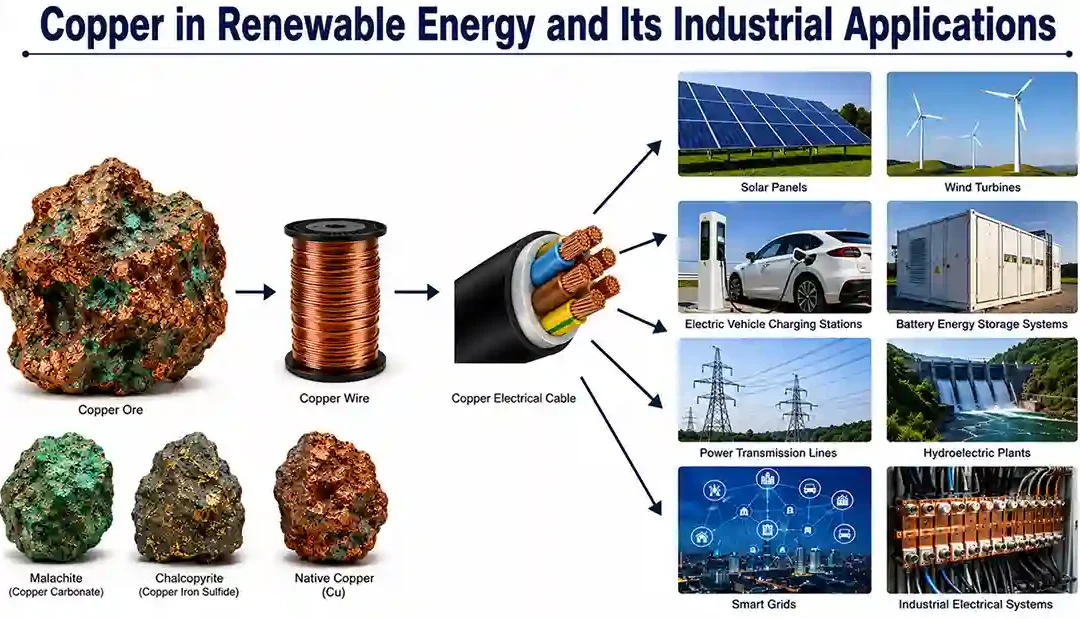
Copper is one of the most important metals driving the global transition to renewable energy. Its outstanding electrical conductivity, corrosion resistance, and durability make it essential for generating, transmitting, storing, and using clean electricity. Nearly every renewable energy technology depends on copper, from solar panels and wind turbines to electric vehicles (EVs), battery storage systems, and smart electrical grids.
Copper in renewable energy refers to the use of copper in renewable energy technologies and infrastructure. As countries invest in cleaner power generation and electrification, the demand for copper continues to grow rapidly.
Understanding copper demonstrates the close relationship between geology, mining, electrical engineering, and sustainable energy development.
This topic should be studied together with Minerals in Agriculture, Mineralogy, Minerals in AI Hardware, Battery Minerals Explained, and Minerals Used in Renewable Energy.
Why Renewable Energy Depends on Copper
Copper is widely used because it provides:
- Excellent electrical conductivity
- High thermal conductivity
- Corrosion resistance
- Long service life
- Mechanical flexibility
- Easy fabrication
- High recycling potential
- Reliable performance under harsh conditions
Without copper, modern renewable energy systems would be far less efficient.
Major Applications of Copper in Renewable Energy
Solar Panels
Common uses:
- Electrical wiring
- Busbars
- Inverters
- Grounding systems
Importance:
Copper carries electricity generated by photovoltaic cells with minimal energy loss.
Wind Turbines
Common uses:
- Generator windings
- Power cables
- Transformers
- Grounding
Importance:
Copper enables efficient electricity generation and transmission from wind turbines.
Electric Vehicles (EVs)
Common uses:
- Electric motors
- High-voltage wiring
- Battery connections
- Charging systems
Importance:
Electric vehicles use significantly more copper than conventional gasoline-powered vehicles.
Battery Energy Storage Systems
Common uses:
- Battery connectors
- Busbars
- Current collectors
- Power management systems
Importance:
Copper transfers electricity efficiently between battery cells and external circuits.
Power Transmission and Distribution
Common uses:
- Transmission lines
- Distribution cables
- Transformers
- Substations
Importance:
Copper minimizes electrical losses while delivering renewable electricity to homes and industries.
Hydroelectric Power Plants
Common uses:
- Generators
- Transformers
- Electrical control systems
Importance:
Copper ensures reliable electricity generation and transmission.
Smart Grids
Common uses:
- Grid automation
- Digital substations
- Communication equipment
Importance:
Copper supports modern electrical infrastructure for efficient energy management.
Electric Vehicle Charging Stations
Common uses:
- Charging cables
- Power electronics
- Switchgear
Importance:
Copper enables fast and efficient charging of electric vehicles.
Renewable Energy Inverters
Common uses:
- Power electronics
- Electrical circuits
Importance:
Copper improves energy conversion efficiency between renewable energy systems and the electrical grid.
Industrial Renewable Energy Systems
Common uses:
- Industrial motors
- Renewable-powered manufacturing
- Control equipment
Importance:
Copper supports efficient industrial electrification.
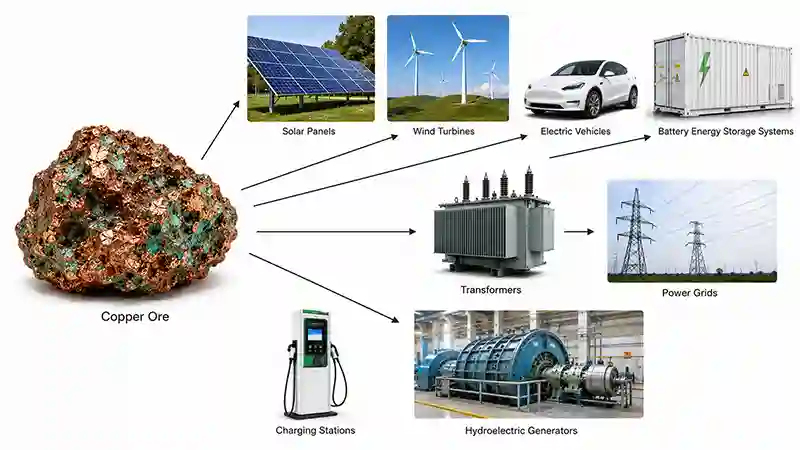
Copper by Renewable Energy Application
| Renewable Energy Technology | Copper Application |
|---|---|
| Solar Panels | Electrical Wiring & Busbars |
| Wind Turbines | Generator Windings |
| Electric Vehicles | Motors & High-Voltage Wiring |
| Battery Storage | Busbars & Connectors |
| Smart Grids | Distribution Networks |
| Power Transmission | Electrical Cables |
| Hydroelectric Plants | Generators & Transformers |
| EV Charging Stations | Charging Equipment |
From Copper Ore to Renewable Energy Systems
Copper passes through several stages before becoming part of renewable energy infrastructure.
- Copper ore is mined.
- Ore is crushed and concentrated.
- Copper is smelted and refined.
- Copper wire, cables, and components are manufactured.
- Renewable energy equipment is assembled.
- Systems generate and distribute clean electricity.
- Copper is recovered through recycling for future use.
This process connects geology directly to the clean energy transition.
How Copper Supports Renewable Energy
Copper performs several essential functions.
Electricity Generation
- Solar panels
- Wind turbines
- Hydroelectric generators
Electricity Transmission
- Power cables
- Transformers
- Distribution systems
Energy Storage
- Battery connections
- Current collectors
Electric Transportation
- Electric motors
- Charging infrastructure
Smart Infrastructure
- Smart grids
- Renewable energy control systems
Together, these applications make copper one of the world's most important renewable energy metals.
Geological Importance
Economic geologists explore copper deposits that supply renewable energy industries.
Research includes:
- Copper ore exploration
- Porphyry copper deposits
- Resource assessment
- Mineral processing
- Sustainable mining
These studies ensure a stable supply of copper for future energy technologies.
Laboratory Investigation
Copper ores are analyzed using:
- X-Ray Fluorescence (XRF)
- X-Ray Diffraction (XRD)
- ICP-MS
- ICP-OES
- Atomic Absorption Spectroscopy (AAS)
- Scanning Electron Microscopy (SEM)
These methods determine copper grade, purity, and suitability for industrial applications.
Applications
Copper is widely used in:
- Solar power plants
- Wind farms
- Electric vehicles
- Battery energy storage systems
- Smart electrical grids
- Hydroelectric power stations
- EV charging networks
- Renewable energy substations
- Power transmission systems
- Industrial electrification
Advantages of Studying Copper in Renewable Energy
Understanding copper helps:
- Explain renewable energy infrastructure
- Improve electrical efficiency
- Support sustainable energy development
- Strengthen critical mineral supply chains
- Advance electric transportation
- Promote resource recycling
Limitations
Despite its importance, copper presents several challenges.
- Mining can affect ecosystems.
- High global demand increases supply pressure.
- Copper prices fluctuate with market conditions.
- New mines require significant investment.
- Processing consumes substantial energy.
For a broader understanding, study this topic together with:
- Economic Geology
- Mineralogy
- Materials Science
- Electrical Engineering
- Renewable Energy Engineering
- Mining Engineering
- Environmental Geology
- Sustainability
Comparison Table
| Renewable Energy System | Role of Copper | Main Benefit |
| Solar Panels | Electrical Wiring | Efficient Power Collection |
| Wind Turbines | Generator Windings | Reliable Electricity Generation |
| Electric Vehicles | Motors & Wiring | High Electrical Efficiency |
| Battery Storage | Busbars & Connectors | Reliable Energy Transfer |
| Smart Grids | Distribution Networks | Stable Power Delivery |
| Hydroelectric Plants | Generators | Efficient Electricity Production |
| Charging Stations | Charging Cables | Fast EV Charging |
| Power Transmission | Electrical Cables | Low Energy Loss |
Summary Table
| Feature | Copper in Renewable Energy |
| Main Purpose | Electricity Generation, Transmission, and Storage |
| Source Mineral | Copper Ore |
| Major Applications | Solar, Wind, EVs, Batteries, Power Grids |
| Study Methods | XRF, XRD, ICP-MS, SEM |
| Geological Importance | Critical Mineral for Clean Energy |
Copper is essential because it efficiently conducts electricity in solar panels, wind turbines, battery systems, electric vehicles, and power grids.
Copper is used in electrical wiring, busbars, grounding systems, and inverters to collect and transmit electricity generated by photovoltaic cells.
Electric vehicles use copper in motors, battery connections, charging systems, and high-voltage cables, requiring much more copper than conventional vehicles.
Yes. Copper is highly recyclable and can be reused repeatedly with very little loss of quality, making it an important material for the circular economy.
Copper is considered a critical mineral because modern renewable energy systems and global electrification depend on a reliable supply of high-quality copper.
Final Thoughts
Copper is one of the most valuable minerals supporting the transition to renewable energy. Its exceptional electrical conductivity, durability, and recyclability make it indispensable for solar panels, wind turbines, electric vehicles, battery storage systems, smart grids, and modern power networks. As the world continues to expand clean energy infrastructure, copper will remain at the center of sustainable electricity generation and electrification.
Understanding the role of copper in renewable energy highlights the essential connection between geology, mining, engineering, and the future of global clean energy.
Continue Learning
Continue exploring related topics: