
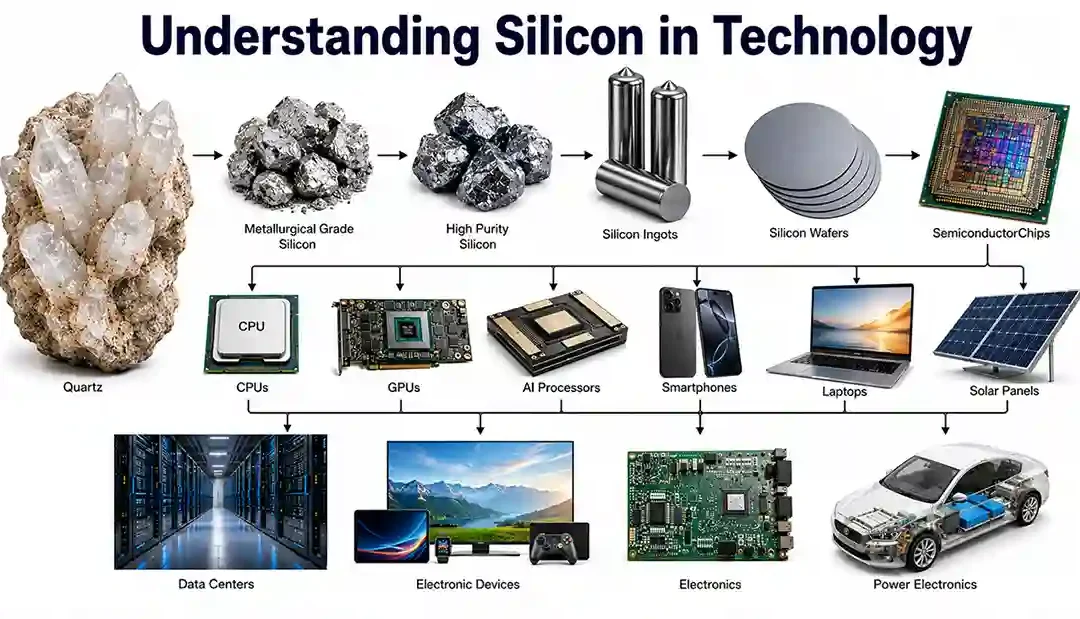
Silicon is one of the most important elements in modern technology. Derived primarily from high-purity quartz (silica), silicon forms the foundation of semiconductor chips that power computers, smartphones, artificial intelligence (AI), communication systems, automobiles, and renewable energy technologies.
Silicon in technology refers to the widespread use of purified silicon in semiconductor devices, solar cells, integrated circuits, microprocessors, memory chips, and countless electronic products. Its unique electrical properties make it the most widely used semiconductor material in the world.
Understanding silicon demonstrates the strong relationship between geology, mineralogy, materials science, electronics, and computer engineering.
This topic should be studied together with Mineralogy, Battery Minerals Explained, Semiconductor Minerals, Minerals in Paint, and Minerals in Food.
Why Silicon Is Important in Technology
Silicon is widely used because it provides:
- Excellent semiconductor properties
- Reliable electrical performance
- High thermal stability
- Abundant natural availability
- Low manufacturing cost
- Excellent durability
- Compatibility with modern chip fabrication
- High processing efficiency
Without silicon, modern digital technology would not exist.
Major Applications of Silicon in Technology
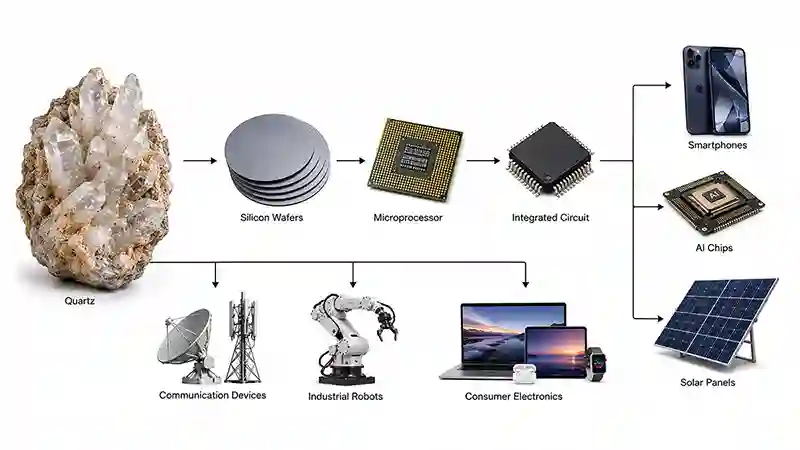
Semiconductor Chips
Common uses:
- CPUs
- GPUs
- AI processors
- Memory chips
Importance:
Silicon forms the foundation of nearly every modern semiconductor chip.
Integrated Circuits
Common uses:
- Computer processors
- Mobile devices
- Consumer electronics
Importance:
Silicon enables billions of tiny transistors to operate efficiently on a single chip.
Smartphones and Computers
Common uses:
- Processors
- Storage controllers
- Sensors
Importance:
Every smartphone and computer depends on silicon-based electronic components.
Artificial Intelligence Hardware
Common uses:
- AI accelerators
- Machine learning processors
- Data center chips
Importance:
Silicon enables high-speed processing required for artificial intelligence applications.
Solar Panels
Common uses:
- Photovoltaic cells
- Solar modules
Importance:
Purified silicon converts sunlight into electricity efficiently.
Power Electronics
Common uses:
- Inverters
- Power management systems
- Electric vehicles
Importance:
Silicon controls electrical energy in modern electronic systems.
Communication Systems
Common uses:
- Network processors
- Telecommunications equipment
- Internet infrastructure
Importance:
Silicon enables reliable high-speed communication.
Medical Electronics
Common uses:
- Imaging equipment
- Medical sensors
- Diagnostic devices
Importance:
Silicon provides accurate and reliable electronic performance.
Industrial Automation
Common uses:
- Robotics
- Industrial controllers
- Smart manufacturing
Importance:
Silicon powers automation technologies used in modern industries.
Consumer Electronics
Common uses:
- Tablets
- Smart TVs
- Gaming consoles
- Wearable devices
Importance:
Silicon delivers efficient computing and digital processing.
Silicon by Technology Application
| Technology | Silicon Application |
|---|---|
| Semiconductor Chips | Integrated Circuits |
| AI Hardware | AI Processors |
| Smartphones | Mobile Processors |
| Computers | CPUs and Memory |
| Solar Panels | Photovoltaic Cells |
| Electric Vehicles | Power Electronics |
| Communication Networks | Network Chips |
| Medical Equipment | Sensors and Processors |
| Industrial Automation | Control Systems |
From Quartz to Silicon Chip
Silicon passes through several stages before becoming advanced technology.
- Quartz is mined.
- Silica is refined into metallurgical-grade silicon.
- High-purity electronic-grade silicon is produced.
- Silicon crystals are grown.
- Silicon wafers are manufactured.
- Semiconductor chips are fabricated.
- Chips are assembled into electronic devices.
This process connects geology directly to the digital world.
How Silicon Supports Modern Technology
Silicon performs several important roles.
Semiconductor Material
- Microprocessors
- Integrated circuits
- Memory chips
Energy Conversion
- Solar photovoltaic cells
Power Management
- Electric vehicles
- Industrial electronics
Artificial Intelligence
- AI processors
- Data center chips
Consumer Electronics
- Smartphones
- Computers
- Tablets
Together, these applications make silicon the backbone of modern technology.
Geological Importance
Economic geologists study quartz deposits that supply high-purity silica for semiconductor manufacturing.
Research includes:
- Quartz exploration
- Silica purity analysis
- Ore processing
- Resource assessment
- Sustainable mining
These studies ensure reliable supplies of silicon for future technologies.
Laboratory Investigation
Silicon-bearing materials are analyzed using:
- X-Ray Fluorescence (XRF)
- X-Ray Diffraction (XRD)
- ICP-MS
- ICP-OES
- Scanning Electron Microscopy (SEM)
- Electron Probe Microanalysis (EPMA)
These methods evaluate purity, crystal structure, and suitability for semiconductor manufacturing.
Applications
Silicon is widely used in:
- Semiconductor chips
- Artificial intelligence hardware
- Smartphones
- Computers
- Data centers
- Solar panels
- Electric vehicles
- Medical electronics
- Communication systems
- Industrial automation
Advantages of Studying Silicon in Technology
Understanding silicon helps:
- Explain semiconductor manufacturing
- Support electronics innovation
- Advance artificial intelligence
- Improve renewable energy technologies
- Strengthen digital infrastructure
- Promote sustainable resource management
Limitations
Despite its importance, silicon has several limitations.
- Manufacturing requires extremely high purity.
- Semiconductor fabrication is expensive.
- Production facilities require advanced technology.
- Silicon mining and processing consume significant energy.
- Some specialized applications require alternative semiconductor materials.
For a broader understanding, study this topic together with:
- Mineralogy
- Economic Geology
- Materials Science
- Electronics Engineering
- Semiconductor Engineering
- Computer Engineering
- Artificial Intelligence
- Renewable Energy Engineering
Comparison Table
| Technology Area | Role of Silicon | Main Benefit |
| Semiconductor Chips | Integrated Circuits | High-Speed Computing |
| AI Hardware | AI Processors | Machine Learning |
| Smartphones | Mobile Chips | Digital Communication |
| Computers | CPUs & Memory | Data Processing |
| Solar Panels | Photovoltaic Cells | Electricity Generation |
| Electric Vehicles | Power Electronics | Energy Control |
| Medical Devices | Sensors | Precision Electronics |
| Industrial Automation | Controllers | Smart Manufacturing |
Summary Table
| Feature | Silicon in Technology |
| Main Purpose | Semiconductor and Electronic Manufacturing |
| Source Mineral | Quartz (Silica) |
| Major Applications | Chips, AI, Solar Panels, Electronics |
| Study Methods | XRF, XRD, ICP-MS, SEM, EPMA |
| Geological Importance | High-Purity Silica Resources |
Silicon is a semiconductor material used to manufacture computer chips, integrated circuits, solar cells, and countless electronic devices.
Silicon has electrical properties that allow it to control the flow of electricity, making it ideal for transistors and integrated circuits.
Silicon is produced from high-purity quartz (silica), one of the most abundant minerals in the Earth's crust.
AI processors and high-performance computing chips are primarily built using silicon-based semiconductor technology.
No. Silicon is also used in solar panels, power electronics, medical devices, communication systems, and industrial automation.
Final Thoughts
Silicon is the foundation of modern technology. From quartz mined from the Earth's crust to advanced semiconductor chips powering artificial intelligence, smartphones, computers, renewable energy systems, and communication networks, silicon enables the digital world we rely on every day. Its exceptional semiconductor properties, abundance, and reliability make it the most important material in the electronics industry.
As technology continues to evolve, silicon will remain essential for innovations in artificial intelligence, renewable energy, autonomous systems, and next-generation computing. Understanding silicon in technology highlights the vital connection between geology, materials science, and the future of global technological development.
Continue Learning
Continue exploring related topics: