
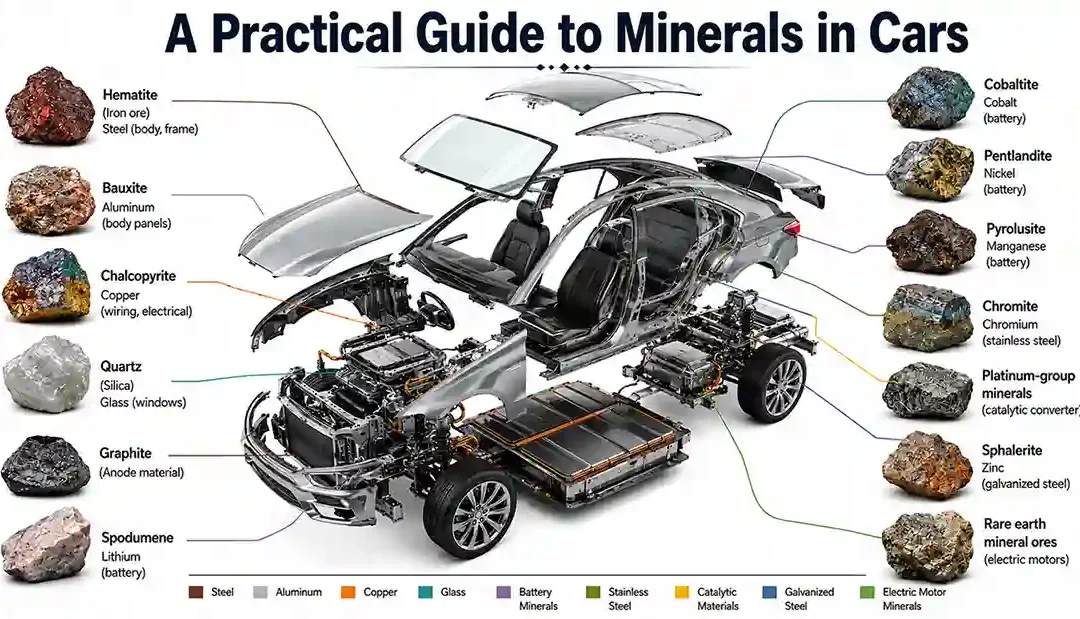
Modern cars are engineering marvels built from hundreds of different materials, many of which originate from naturally occurring minerals. Whether powered by gasoline, diesel, hybrid systems, or electricity, every vehicle depends on minerals that provide strength, durability, electrical conductivity, corrosion resistance, energy storage, and heat management.
Minerals in cars are transformed into steel, aluminum, copper wiring, glass, batteries, catalytic converters, electronic components, and electric motors. Traditional vehicles primarily rely on iron, aluminum, copper, and platinum-group metals, while electric vehicles (EVs) also require large quantities of lithium, graphite, nickel, cobalt, manganese, and rare earth elements.
Understanding these minerals demonstrates how geology plays a critical role in transportation and the automotive industry.
This topic should be studied together with Critical Minerals, Battery Minerals, and Mineralogy.
Why Cars Depend on Minerals
Vehicles require materials with specialized physical and chemical properties.
These minerals provide:
- Structural strength
- Corrosion resistance
- Electrical conductivity
- Energy storage
- Heat resistance
- Lightweight construction
- Durability
Without these minerals, modern automobiles would not be possible.
Major Minerals Used in Cars
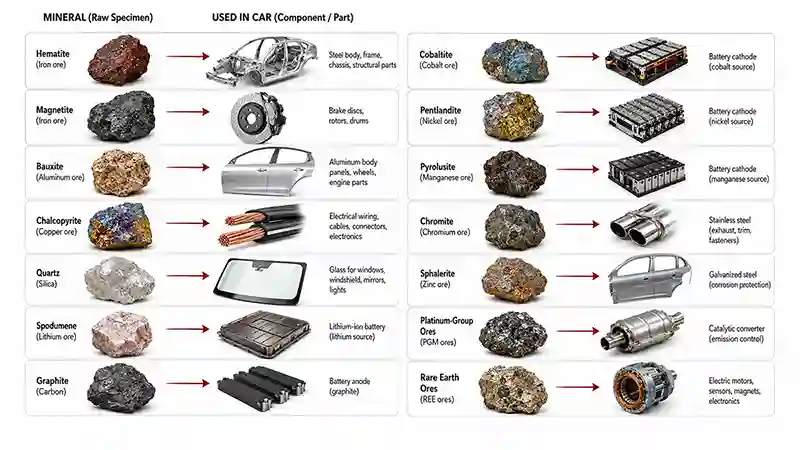
Iron Minerals
Common source minerals:
- Hematite
- Magnetite
Uses:
- Steel chassis
- Engine blocks
- Suspension
- Body structure
Importance:
Steel remains the primary structural material in most vehicles.
Aluminum Minerals
Common source:
- Bauxite
Uses:
- Body panels
- Engine components
- Wheels
- Heat exchangers
Importance:
Aluminum reduces vehicle weight and improves fuel efficiency.
Copper Minerals
Common source:
- Chalcopyrite
- Bornite
Uses:
- Electrical wiring
- Motors
- Alternators
- Charging systems
Importance:
Copper is one of the most important conductive materials in automobiles.
Quartz
Uses:
- Windshields
- Side windows
- Electronic components
Importance:
Quartz supplies silica for automotive glass and silicon for electronic systems.
Graphite
Uses:
- Lithium-ion battery anodes
- Brake linings
- Lubricants
Importance:
Graphite is essential in electric vehicle batteries and several mechanical components.
Lithium Minerals
Common sources:
- Spodumene
- Lepidolite
Uses:
- Electric vehicle batteries
Importance:
Provides lightweight, high-capacity energy storage.
Nickel Minerals
Common source:
- Pentlandite
Uses:
- EV battery cathodes
- Stainless steel components
Importance:
Improves battery capacity and driving range.
Cobalt Minerals
Common source:
- Cobaltite
Uses:
- Battery cathodes
Importance:
Enhances battery stability and lifespan.
Manganese Minerals
Common source:
- Pyrolusite
Uses:
- Battery cathodes
- Steel production
Importance:
Improves battery safety and steel strength.
Chromium Minerals
Common source:
- Chromite
Uses:
- Stainless steel
- Decorative trim
Importance:
Provides corrosion resistance.
Zinc Minerals
Common source:
- Sphalerite
Uses:
- Galvanized steel
- Corrosion protection
Importance:
Protects steel from rust.
Platinum Group Minerals
Important metals:
- Platinum
- Palladium
- Rhodium
Uses:
- Catalytic converters
Importance:
Reduce harmful vehicle emissions by converting toxic gases into less harmful substances.
Rare Earth Elements
Important elements:
- Neodymium
- Dysprosium
- Praseodymium
Uses:
- Electric motors
- Power steering
- Sensors
- Speakers
Importance:
Produce powerful permanent magnets for electric and hybrid vehicles.
Rubber and Tire Minerals
Common minerals:
- Silica (Quartz)
- Carbon black (industrial carbon)
Uses:
- Tire reinforcement
- Improved grip
Importance:
Increase tire durability and fuel efficiency.
Minerals by Car Component
| Car Component | Main Minerals |
|---|---|
| Chassis | Hematite, Magnetite |
| Body Panels | Bauxite |
| Wiring | Chalcopyrite |
| Windows | Quartz |
| Battery | Lithium, Graphite, Nickel, Cobalt, Manganese |
| Electric Motor | Rare Earth Elements |
| Catalytic Converter | Platinum, Palladium, Rhodium |
| Wheels | Aluminum |
| Brakes | Iron, Graphite |
| Electronics | Quartz, Copper, Gold, Silver |
Traditional Cars vs Electric Cars
Internal Combustion Engine (ICE) Vehicles
Main minerals:
- Iron
- Aluminum
- Copper
- Platinum-group metals
- Zinc
Depend primarily on structural and engine materials.
Electric Vehicles (EVs)
Main minerals:
- Lithium
- Graphite
- Nickel
- Cobalt
- Rare earth elements
- Copper
Require significantly more critical minerals than conventional vehicles.
From Mine to Car
Automotive minerals undergo several stages before becoming vehicle components.
- Geological exploration
- Mining
- Ore processing
- Metal refining
- Component manufacturing
- Vehicle assembly
- Consumer use
- Vehicle recycling
Each stage contributes to modern automobile production.
Environmental Challenges
The automotive industry faces several mineral-related challenges.
These include:
- Critical mineral supply risks
- Energy-intensive mining
- Carbon emissions
- Mine waste
- Battery recycling
- Sustainable sourcing
Responsible mining and recycling reduce environmental impacts.
Recycling Automotive Minerals
Many valuable minerals can be recovered from end-of-life vehicles.
Recovered materials include:
- Steel
- Aluminum
- Copper
- Lithium
- Nickel
- Cobalt
- Platinum
- Rare earth elements
Vehicle recycling conserves natural resources and supports the circular economy.
Geological Importance
Car manufacturing has become one of the largest consumers of industrial and critical minerals.
Geologists help:
- Discover new mineral deposits
- Estimate reserves
- Improve mining efficiency
- Support sustainable resource development
- Secure supply chains for future transportation
Laboratory Investigation
Scientists analyze automotive minerals using:
- X-Ray Diffraction (XRD)
- X-Ray Fluorescence (XRF)
- Scanning Electron Microscopy (SEM)
- Electron Probe Microanalysis (EPMA)
- ICP-MS
- Raman Spectroscopy
These techniques identify mineral composition, purity, and structural characteristics.
Applications
Automotive minerals are essential in:
- Passenger vehicles
- Electric vehicles
- Hybrid vehicles
- Commercial trucks
- Buses
- Motorcycles
- Construction equipment
- Agricultural machinery
Advantages of Studying Automotive Minerals
Understanding automotive minerals helps scientists and engineers:
- Improve vehicle performance
- Develop lightweight materials
- Increase battery efficiency
- Reduce emissions
- Improve recycling technologies
- Secure critical mineral supplies
Limitations
Despite their importance, automotive minerals present several challenges.
- Demand for critical minerals is increasing rapidly due to electric vehicle adoption.
- Mining and mineral processing require significant energy.
- Some critical minerals are geographically concentrated.
- Recycling systems for EV batteries are still expanding.
- Sustainable sourcing remains a major challenge.
For a broader understanding, study this topic together with:
- Economic Minerals
- Critical Minerals
- Battery Minerals
- Mineral Resources
- Sustainable Mining
- Vehicle Recycling
- Environmental Geology
- Mineralogy
Comparison Table
| Mineral | Main Automotive Function | Example Source Mineral |
| Hematite | Steel | Hematite |
| Bauxite | Aluminum | Bauxite |
| Chalcopyrite | Copper Wiring | Chalcopyrite |
| Quartz | Glass | Quartz |
| Spodumene | Lithium Batteries | Spodumene |
| Graphite | Battery Anodes | Graphite |
| Pentlandite | Nickel Batteries | Pentlandite |
| Cobaltite | Battery Cathodes | Cobaltite |
| Chromite | Stainless Steel | Chromite |
| Platinum Group Ores | Catalytic Converters | Platinum-bearing Ores |
Summary Table
| Feature | Minerals in Cars |
| Main Purpose | Vehicle Manufacturing |
| Key Minerals | Iron, Aluminum, Copper, Quartz |
| Critical Minerals | Lithium, Nickel, Cobalt, Rare Earth Elements |
| Study Methods | XRD, XRF, SEM, ICP-MS |
| Geological Importance | Transportation, Manufacturing, Critical Mineral Supply |
Modern cars commonly use iron, aluminum, copper, quartz, zinc, chromium, and platinum-group metals. Electric vehicles also require lithium, graphite, nickel, cobalt, manganese, and rare earth elements.
Copper provides excellent electrical conductivity and is widely used in wiring, motors, alternators, sensors, and charging systems.
Most EV batteries contain lithium, graphite, nickel, cobalt, manganese, copper, and aluminum, while some also use iron and phosphate in lithium iron phosphate (LFP) batteries.
Platinum, palladium, and rhodium are used in catalytic converters to reduce harmful exhaust emissions from gasoline and diesel vehicles.
Yes. Steel, aluminum, copper, lithium, nickel, cobalt, platinum-group metals, and many other materials can be recovered and reused through vehicle recycling.
Final Thoughts
Modern cars rely on a wide variety of minerals that provide strength, conductivity, corrosion resistance, energy storage, and emission control. Traditional vehicles depend heavily on iron, aluminum, copper, and platinum-group metals, while electric vehicles require additional critical minerals such as lithium, graphite, nickel, cobalt, and rare earth elements.
As transportation continues to evolve toward electrification, understanding the geology, extraction, processing, and recycling of automotive minerals will become increasingly important. Responsible resource management will help ensure a sustainable supply of the minerals needed to build the next generation of vehicles.
Continue Learning
Continue exploring related topics: