
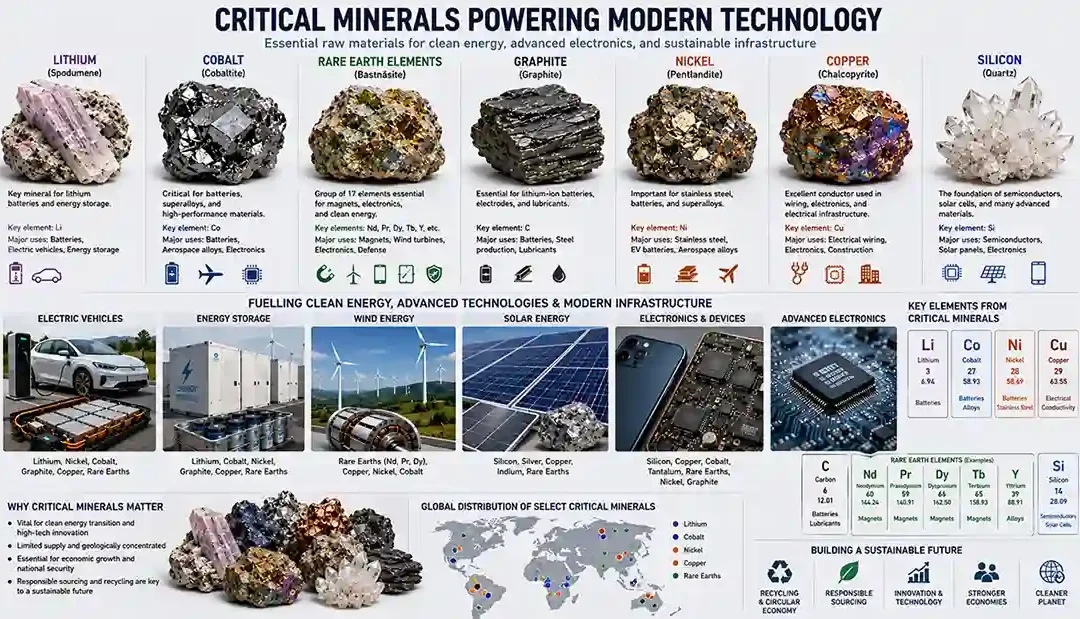
Modern technology depends on a relatively small group of mineral resources known as critical minerals. These minerals are essential for manufacturing advanced technologies, renewable energy systems, electric vehicles, defense equipment, and consumer electronics.
As countries transition toward cleaner energy and digital technologies, demand for critical minerals continues to grow rapidly.
Without critical minerals, many modern innovations would not be possible.
What Are Critical Minerals?
Critical minerals are mineral resources that are:
- economically important
- essential for technology
- vulnerable to supply disruptions
- difficult to replace
Governments often classify minerals as "critical" when they are necessary for national security, industrial development, and energy infrastructure.
Why Are Critical Minerals Important?
Critical minerals support:
Renewable Energy
- wind turbines
- solar panels
- battery storage
Transportation
- electric vehicles
- charging infrastructure
Electronics
- smartphones
- computers
- communication systems
Defense Technology
- aerospace systems
- advanced sensors
- military equipment
Major Critical Minerals
| Mineral | Primary Technology Use |
|---|---|
| Lithium | Batteries |
| Cobalt | Battery Cathodes |
| Nickel | EV Batteries |
| Graphite | Battery Anodes |
| Rare Earth Elements | Magnets |
| Copper | Electrical Systems |
| Silicon | Semiconductors |
| Platinum Group Metals | Fuel Cells |
Lithium
Lithium is one of the world's most important critical minerals.
Uses include:
- lithium-ion batteries
- electric vehicles
- energy storage systems
- portable electronics
Important lithium minerals:
- spodumene
- lepidolite
- petalite
Learn more → lithium minerals explained
Cobalt
Cobalt improves battery performance and stability.
Major applications include:
- electric vehicle batteries
- smartphones
- laptops
- energy storage
Important cobalt minerals:
- cobaltite
- erythrite
- carrollite
Learn more → cobalt minerals explained
Nickel
Nickel is increasingly important for:
- high-capacity batteries
- stainless steel
- aerospace alloys
Nickel-rich batteries can provide:
- longer driving range
- higher energy density
Important nickel minerals include:
- pentlandite
- garnierite
- millerite
Rare Earth Elements
Rare earth elements (REEs) are essential for:
- electric motors
- wind turbines
- smartphones
- advanced electronics
Important REE minerals include:
- bastnäsite
- monazite
- xenotime
Key rare earth elements:
- neodymium (Nd)
- dysprosium (Dy)
- praseodymium (Pr)
Learn more → rare earth minerals explained
Graphite
Graphite is a critical mineral because:
- battery anodes require graphite
- demand is increasing rapidly
- EV batteries consume large amounts
Graphite occurs as:
- flake graphite
- amorphous graphite
- vein graphite
Learn more → graphite mineral explained
Copper
Copper is often overlooked as a critical mineral.
However, modern technologies require enormous amounts of copper for:
- electrical wiring
- charging stations
- renewable energy systems
- power grids
Electric vehicles use significantly more copper than conventional vehicles.
Silicon
Silicon is essential for:
- semiconductors
- solar panels
- computer chips
- electronic devices
Most silicon comes from:
- quartz
- silica-rich deposits
Platinum Group Metals
Platinum group elements support:
Hydrogen Fuel Cells
Clean energy systems.
Catalytic Converters
Emission reduction technologies.
Electronics
Specialized industrial applications.
Important PGM minerals include:
- sperrylite
- cooperite
- braggite
Learn more → platinum group minerals explained
Critical Minerals and Their Technologies
| Critical Mineral | Technology |
|---|---|
| Lithium | Batteries |
| Cobalt | EV Batteries |
| Nickel | Energy Storage |
| Graphite | Battery Anodes |
| Rare Earths | Magnets |
| Copper | Power Systems |
| Silicon | Semiconductors |
| Platinum | Fuel Cells |
Critical Minerals and the Energy Transition
The global energy transition depends heavily on:
- battery minerals
- renewable energy materials
- electrical infrastructure metals
Many clean-energy technologies require significantly more minerals than traditional technologies.
Supply Chain Challenges
Critical minerals face several challenges:
Geographic Concentration
Production is concentrated in a limited number of countries.
Growing Demand
Demand is increasing rapidly.
Long Mine Development Times
New mines require years to develop.
Environmental Considerations
Responsible mining practices are increasingly important.
Major Producers of Critical Minerals
Important producing countries include:
- China
- Australia
- Chile
- Canada
- Democratic Republic of the Congo
- United States
These countries play key roles in global mineral supply chains.
Future Demand for Critical Minerals
Experts expect demand to increase because of:
- electric vehicle adoption
- renewable energy expansion
- battery storage growth
- digital technologies
- artificial intelligence infrastructure
Critical minerals will remain essential for future technological development.
Why Critical Minerals Matter
| Sector | Critical Minerals Used |
|---|---|
| Electric Vehicles | Lithium, Cobalt, Nickel |
| Wind Turbines | Rare Earths |
| Solar Energy | Silicon, Copper |
| Electronics | Rare Earths, Copper |
| Hydrogen Energy | Platinum |
Critical minerals are economically important minerals that are essential for technology and vulnerable to supply disruptions.
Lithium is essential for rechargeable batteries used in electric vehicles and energy storage systems.
Rare earth elements are used in magnets, wind turbines, electric motors, and electronics.
Lithium, cobalt, nickel, graphite, copper, and rare earth elements are widely used in EVs.
They are essential for batteries, wind turbines, solar panels, and electrical infrastructure.
Final Thoughts
Critical minerals are the building blocks of modern technology and the global energy transition. From lithium and cobalt batteries to rare earth magnets and copper power grids, these resources are essential for clean energy, transportation, communications, and advanced manufacturing.
As demand for electric vehicles, renewable energy systems, and digital technologies continues to grow, critical minerals will become increasingly important for economic development and technological innovation.