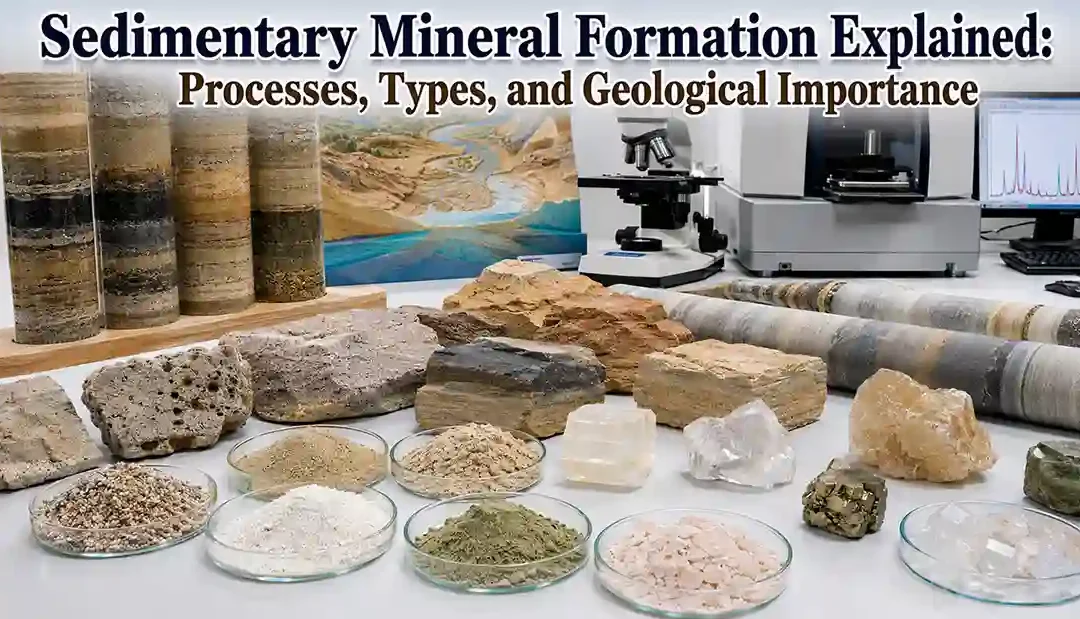
Sedimentary mineral formation is the process by which minerals are produced, transported, deposited, or chemically precipitated at or near Earth's surface. Unlike igneous minerals that crystallize from magma or metamorphic minerals that form under high temperature and pressure, sedimentary minerals develop through weathering, erosion, transportation, deposition, chemical precipitation, biological activity, and diagenesis.
Sedimentary environments produce a wide variety of minerals, including quartz, clay minerals, calcite, dolomite, gypsum, halite, pyrite, glauconite, and many iron oxides. These minerals preserve valuable information about ancient climates, oceans, rivers, deserts, lakes, and biological evolution.
Understanding sedimentary mineral formation is essential for sedimentology, mineralogy, petroleum geology, hydrogeology, environmental geology, and economic geology.
This topic should be studied together with Minerals in Sedimentary Rocks, Weathering and Mineral Formation, Carbonate Minerals, and Evaporite Minerals.
What Is Sedimentary Mineral Formation?
Sedimentary mineral formation refers to the origin of minerals through processes operating at Earth's surface or in shallow subsurface environments.
These processes include:
- Physical weathering
- Chemical weathering
- Biological activity
- Chemical precipitation
- Evaporation
- Diagenesis
Most sedimentary minerals form at relatively low temperatures and pressures.
Stages of Sedimentary Mineral Formation
The formation of sedimentary minerals generally follows several stages.
- Weathering of existing rocks
- Erosion and transport
- Deposition of sediments
- Burial
- Compaction
- Cementation
- Diagenesis
- Growth of new minerals
Each stage contributes to the final mineral assemblage.
Sources of Sedimentary Minerals
Sedimentary minerals originate from:
- Igneous rocks
- Metamorphic rocks
- Older sedimentary rocks
- Volcanic ash
- Marine organisms
- Dissolved ions in water
These materials provide the building blocks for new sedimentary minerals.
Major Processes of Sedimentary Mineral Formation
Weathering
Weathering breaks down existing minerals.
Two main types occur:
Physical Weathering
Produces smaller rock fragments without changing mineral composition.
Examples:
- Freeze-thaw action
- Wind abrasion
- Thermal expansion
Chemical Weathering
Changes mineral chemistry.
Common reactions include:
- Hydrolysis
- Oxidation
- Dissolution
- Hydration
Chemical weathering forms many secondary minerals.
Transportation
Sediments move by:
- Rivers
- Wind
- Glaciers
- Ocean currents
During transport:
- Unstable minerals break down.
- Resistant minerals survive.
- Grain size becomes sorted.
Quartz commonly survives long transport distances.
Deposition
Sediments accumulate in:
- Rivers
- Lakes
- Oceans
- Deserts
- Deltas
- Floodplains
The depositional environment strongly influences mineral composition.
Diagenesis
After burial, sediments undergo:
- Compaction
- Cementation
- Mineral replacement
- Recrystallization
New minerals grow during this stage.
Types of Sedimentary Minerals
Detrital Minerals
These minerals are transported from older rocks.
Common examples:
- Quartz
- Feldspar
- Muscovite
- Heavy minerals
Quartz dominates most sandstones because of its high resistance to weathering.
Clay Minerals
Clay minerals form mainly through chemical weathering.
Common species include:
- Kaolinite
- Illite
- Smectite
- Chlorite
These dominate mudstones and shales.
Carbonate Minerals
Carbonates form by:
- Chemical precipitation
- Biological activity
Major minerals:
- Calcite
- Aragonite
- Dolomite
Evaporite Minerals
Form by evaporation of saline water.
Common minerals:
- Halite
- Gypsum
- Anhydrite
- Sylvite
Authigenic Minerals
These minerals crystallize directly within sediments during diagenesis.
Examples:
- Glauconite
- Pyrite
- Siderite
- Chert
- Zeolites
Accessory Sedimentary Minerals
Other important sedimentary minerals include:
- Goethite
- Hematite
- Gibbsite
- Barite
- Phosphorite (apatite)
- Vivianite
These minerals commonly indicate specific depositional or diagenetic environments.
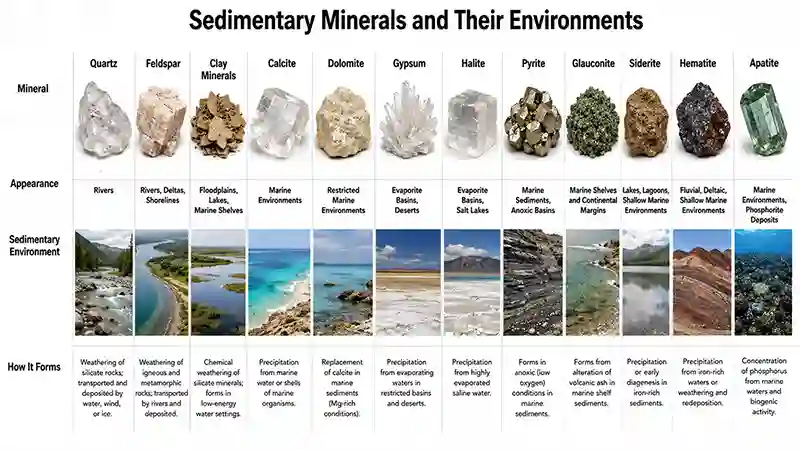
Sedimentary Environments and Mineral Formation
Different environments produce different minerals.
| Environment | Common Minerals |
|---|---|
| River | Quartz, Feldspar |
| Desert | Quartz, Gypsum |
| Lake | Clay Minerals, Calcite |
| Ocean | Calcite, Aragonite |
| Reef | Calcite, Aragonite |
| Evaporite Basin | Halite, Gypsum |
| Delta | Quartz, Clay Minerals |
| Deep Marine | Clay Minerals, Pyrite |
Each environment leaves a distinctive mineral signature.
Biological Role in Sedimentary Mineral Formation
Many sedimentary minerals form through biological activity.
Examples include:
- Coral reefs producing calcite and aragonite
- Shell-forming organisms producing calcium carbonate
- Microorganisms forming pyrite
- Algae promoting carbonate precipitation
Life has played a major role in sedimentary mineral formation throughout Earth's history.
Geological Importance
Sedimentary mineral formation helps geologists:
- Reconstruct ancient environments
- Interpret paleoclimate
- Study basin evolution
- Understand groundwater systems
- Explore petroleum reservoirs
- Locate industrial mineral deposits
Sedimentary minerals preserve Earth's environmental history.
Economic Importance
Sedimentary minerals provide important natural resources.
Major products include:
- Limestone
- Gypsum
- Halite
- Potash
- Phosphate
- Silica sand
- Clay
- Building stone
Many are essential for agriculture, construction, and manufacturing.
Laboratory Identification
Sedimentary minerals are commonly studied using:
- Petrographic Microscopy
- X-Ray Diffraction (XRD)
- Electron Microprobe Analysis (EPMA)
- Scanning Electron Microscopy (SEM)
- X-Ray Fluorescence (XRF)
- Grain-size analysis
- Stable isotope geochemistry
These methods identify mineral composition, depositional history, and diagenetic changes.
Applications
Sedimentary mineral formation studies are important in:
- Sedimentology
- Mineralogy
- Petroleum Geology
- Hydrogeology
- Environmental Geology
- Economic Geology
- Paleoclimatology
- Basin Analysis
Advantages of Studying Sedimentary Mineral Formation
Studying sedimentary mineral formation helps scientists:
- Reconstruct ancient environments
- Understand climate evolution
- Explore petroleum reservoirs
- Discover industrial mineral resources
- Interpret groundwater chemistry
- Improve sedimentary basin models
Limitations
Studying sedimentary mineral formation may be challenging because:
- Minerals can be altered during burial and diagenesis.
- Multiple depositional environments may contribute sediments to one basin.
- Weathering may destroy unstable minerals before deposition.
- Detailed petrographic and geochemical analyses are often required to distinguish primary from secondary minerals.
For comprehensive interpretation, combine sedimentary mineral formation studies with:
- Minerals in Sedimentary Rocks
- Weathering and Mineral Formation
- Carbonate Minerals
- Evaporite Minerals
- Clay Minerals
- Petrographic Microscopy
- Mineral Chemistry Analysis
- X-Ray Diffraction in Mineralogy
Comparison Table
| Formation Process | Common Minerals | Typical Environment |
| Detrital Deposition | Quartz, Feldspar | Rivers, Deserts |
| Chemical Precipitation | Calcite, Dolomite | Oceans, Lakes |
| Evaporation | Halite, Gypsum | Evaporite Basins |
| Biological Activity | Aragonite, Calcite | Reefs, Marine Shelves |
| Diagenesis | Pyrite, Glauconite, Siderite | Buried Sediments |
Summary Table
| Feature | Sedimentary Mineral Formation |
| Main Processes | Weathering, Transport, Deposition, Diagenesis |
| Dominant Minerals | Quartz, Clay Minerals, Calcite, Halite |
| Major Environments | Rivers, Lakes, Oceans, Deserts |
| Common Study Methods | Petrography, XRD, SEM, EPMA |
| Geological Importance | Environmental Reconstruction and Basin Evolution |
Sedimentary mineral formation is the process by which minerals form through weathering, transport, deposition, chemical precipitation, biological activity, and diagenesis at or near Earth's surface.
Quartz is the most common detrital mineral because it is highly resistant to physical and chemical weathering.
Clay minerals mainly form through the chemical weathering of feldspar, mica, volcanic ash, and other silicate minerals, followed by deposition and diagenesis.
Detrital minerals are transported as solid particles from older rocks, while chemical sedimentary minerals precipitate directly from water or form during diagenesis.
They use petrographic microscopy, X-ray diffraction (XRD), electron microprobe analysis (EPMA), scanning electron microscopy (SEM), grain-size analysis, stable isotope geochemistry, and sedimentological investigations.
Final Thoughts
Sedimentary mineral formation is a continuous process that transforms weathered rock fragments and dissolved ions into new mineral assemblages through weathering, transport, deposition, chemical precipitation, biological activity, and diagenesis. From quartz-rich sandstones and clay-rich shales to carbonate reefs and evaporite deposits, these minerals record Earth's changing landscapes, climates, oceans, and life.
By integrating field observations with petrographic microscopy, sedimentology, mineral chemistry, X-ray diffraction, and geochemical analyses, geologists can reconstruct ancient environments, evaluate natural resources, and better understand Earth's surface processes. Sedimentary mineral formation remains a fundamental topic in sedimentology, mineralogy, petroleum geology, environmental geology, and economic geology.
Continue Learning
Continue exploring sedimentary geology with these related guides: