
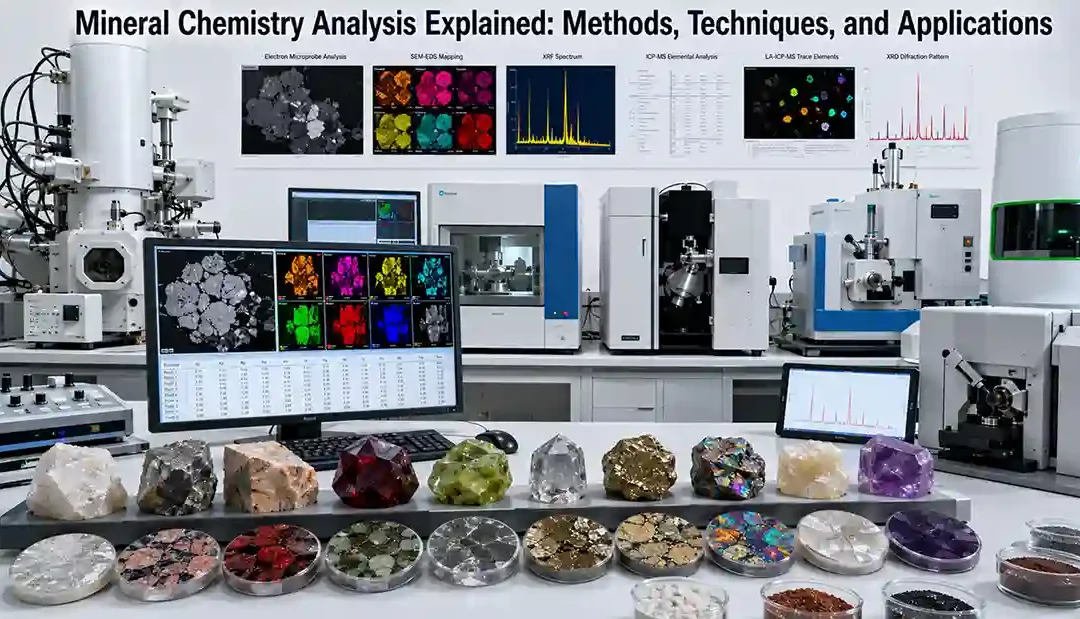
Mineral chemistry analysis is the scientific study of the chemical composition of minerals. It determines which chemical elements are present in a mineral, their concentrations, and how they are distributed within the crystal structure. Since many minerals share similar physical appearances but differ chemically, mineral chemistry plays a vital role in accurate mineral identification and geological interpretation.
Modern analytical techniques allow scientists to measure both major and trace elements with remarkable precision. These analyses reveal mineral formation conditions, metamorphic histories, magma evolution, hydrothermal alteration, and ore-forming processes. They are widely used in mineralogy, petrology, economic geology, environmental science, planetary geology, and materials science.
Mineral chemistry analysis is commonly performed using instruments such as Electron Microprobe Analysis (EPMA), X-ray Fluorescence (XRF), Inductively Coupled Plasma Mass Spectrometry (ICP-MS), Laser Ablation ICP-MS (LA-ICP-MS), Scanning Electron Microscopy with Energy Dispersive Spectroscopy (SEM-EDS), and X-ray Diffraction (XRD).
For comprehensive mineral characterization, this topic should be studied together with Electron Microprobe Analysis, X-Ray Diffraction in Mineralogy, and Spectroscopy in Mineralogy.
What Is Mineral Chemistry Analysis?
Mineral chemistry analysis determines the chemical composition of minerals by measuring the abundance of individual elements within a sample.
The analysis helps scientists determine:
- Major elements
- Minor elements
- Trace elements
- Chemical substitutions
- Mineral formulas
- Elemental zoning
These measurements provide valuable information about how minerals formed and evolved.
Why Is Mineral Chemistry Important?
Chemical analysis allows geologists to:
- Identify minerals accurately
- Differentiate similar mineral species
- Determine mineral formulas
- Study magma evolution
- Investigate metamorphism
- Explore ore deposits
- Understand crystal chemistry
Many minerals cannot be distinguished reliably without chemical analysis.
Major Elements vs Trace Elements
Mineral chemistry commonly separates elements into two groups.
Major Elements
Usually present in concentrations greater than 1 wt.%.
Examples include:
- Silicon (Si)
- Aluminum (Al)
- Iron (Fe)
- Magnesium (Mg)
- Calcium (Ca)
- Sodium (Na)
- Potassium (K)
Trace Elements
Present in very small concentrations.
Examples include:
- Lithium (Li)
- Chromium (Cr)
- Nickel (Ni)
- Cobalt (Co)
- Zirconium (Zr)
- Rare Earth Elements (REE)
Trace elements often reveal the origin and evolution of minerals.
Major Methods of Mineral Chemistry Analysis
Several analytical techniques are used depending on the type of information required.
Electron Microprobe Analysis (EPMA)
EPMA measures quantitative elemental concentrations in microscopic areas.
Applications include:
- Major element analysis
- Mineral zoning
- Element mapping
- Mineral formula calculations
It provides excellent analytical precision.
X-Ray Fluorescence (XRF)
XRF measures bulk elemental composition.
Common applications:
- Rock chemistry
- Ore analysis
- Industrial minerals
- Mining exploration
Portable XRF instruments are widely used in field investigations.
Inductively Coupled Plasma Mass Spectrometry (ICP-MS)
ICP-MS measures extremely low concentrations of trace elements.
Applications include:
- Rare earth elements (REE)
- Precious metals
- Isotope studies
- Geochemical fingerprinting
It is one of the most sensitive analytical techniques available.
Laser Ablation ICP-MS (LA-ICP-MS)
LA-ICP-MS combines laser sampling with ICP-MS.
Advantages include:
- Minimal sample destruction
- Trace element mapping
- Zircon dating
- Fluid inclusion analysis
SEM-EDS Analysis
Scanning Electron Microscopy with Energy Dispersive Spectroscopy provides:
- High-resolution imaging
- Semi-quantitative elemental analysis
- Mineral identification
- Microstructural observations
X-Ray Diffraction (XRD)
Although XRD primarily identifies crystal structures, it complements chemical analyses by confirming mineral phases.
Elements Commonly Measured
Mineral chemistry laboratories routinely analyze:
| Element | Symbol | Common Minerals |
|---|---|---|
| Silicon | Si | Quartz, Feldspar |
| Oxygen | O | Nearly All Silicates |
| Aluminum | Al | Feldspar, Mica |
| Iron | Fe | Magnetite, Olivine |
| Magnesium | Mg | Olivine, Pyroxene |
| Calcium | Ca | Calcite, Plagioclase |
| Sodium | Na | Albite |
| Potassium | K | Orthoclase, Muscovite |
| Titanium | Ti | Rutile, Ilmenite |
| Zirconium | Zr | Zircon |
These elements define mineral composition and crystal chemistry.
Chemical Zoning in Minerals
Many minerals show chemical variations from core to rim.
Common examples include:
- Garnet
- Plagioclase
- Zircon
- Tourmaline
Chemical zoning helps geologists reconstruct pressure, temperature, and fluid conditions during mineral growth.
Applications in Geology
Mineral chemistry analysis is essential in:
- Mineral identification
- Igneous petrology
- Metamorphic petrology
- Sediment provenance studies
- Economic geology
- Hydrothermal alteration
- Geochronology
- Planetary geology
It provides direct evidence of geological processes.
Applications in Mining
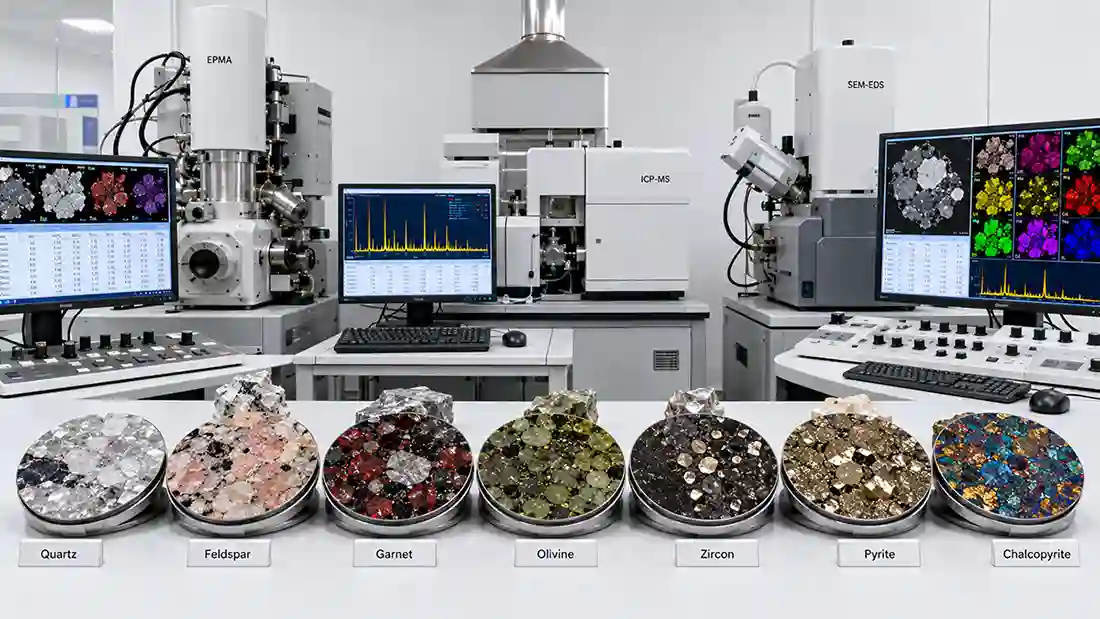
Mining companies use mineral chemistry to:
- Evaluate ore quality
- Identify valuable minerals
- Optimize processing
- Monitor beneficiation
- Assess exploration targets
Accurate chemical analyses improve resource evaluation.
Advantages of Mineral Chemistry Analysis
Mineral chemistry analysis provides:
- Highly accurate elemental measurements
- Quantitative chemical data
- Detection of trace elements
- Chemical zoning analysis
- Reliable mineral identification
- Support for geological interpretation
It is one of the most important tools in modern mineralogy.
Limitations
Despite its advantages, mineral chemistry analysis has some limitations.
- Advanced instruments are expensive.
- Sample preparation may be time-consuming.
- Different techniques provide different types of information.
- Crystal structure usually requires complementary methods such as XRD.
For comprehensive mineral characterization, combine mineral chemistry with:
- Electron Microprobe Analysis
- X-Ray Diffraction in Mineralogy
- Spectroscopy in Mineralogy
- Petrographic Microscopy
- Thin Section Mineral Analysis
- Scanning Electron Microscopy (SEM)
- How to Identify Minerals
Comparison Table
| Technique | Primary Information |
| EPMA | Quantitative Major Elements |
| XRF | Bulk Elemental Composition |
| ICP-MS | Trace Elements |
| LA-ICP-MS | Trace Elements & Element Mapping |
| SEM-EDS | Imaging & Semi-Quantitative Chemistry |
| XRD | Crystal Structure |
Summary Table
| Feature | Mineral Chemistry Analysis |
| Main Purpose | Determine Chemical Composition |
| Sample Types | Minerals, Rocks, Ores |
| Common Instruments | EPMA, XRF, ICP-MS, LA-ICP-MS, SEM-EDS |
| Best For | Elemental and Trace Element Analysis |
| Scientific Importance | Mineralogy, Geochemistry, Mining, Research |
Mineral chemistry analysis determines the elemental composition of minerals using advanced laboratory techniques to measure major, minor, and trace elements.
The best instrument depends on the objective. EPMA is ideal for quantitative major-element analysis, ICP-MS excels at trace-element analysis, XRF is widely used for bulk elemental composition, and SEM-EDS provides rapid elemental screening with imaging.
Mineral chemistry helps identify minerals, understand crystal chemistry, reconstruct geological processes, evaluate ore deposits, and interpret the conditions under which minerals formed.
EPMA provides highly accurate quantitative analyses of major and minor elements at microscopic scales, while ICP-MS is optimized for measuring extremely low concentrations of trace elements and isotopes.
Yes. Chemical composition is one of the most reliable characteristics for distinguishing minerals, especially when combined with crystal structure, optical properties, and physical tests.
Final Thoughts
Mineral chemistry analysis is one of the foundations of modern mineralogy because it reveals the elemental composition that controls a mineral's properties and geological history. From determining major elements with EPMA to measuring trace elements with ICP-MS and confirming mineral phases with XRD, modern analytical techniques provide an exceptionally detailed understanding of Earth's materials.
When integrated with spectroscopy, petrographic microscopy, and crystallographic analysis, mineral chemistry enables geologists to identify minerals accurately, reconstruct geological environments, evaluate mineral resources, and investigate processes ranging from magma crystallization to ore formation. It remains an indispensable tool in geological research, mining, environmental science, and materials engineering.
Continue Learning
Expand your mineralogy knowledge with these related guides: