
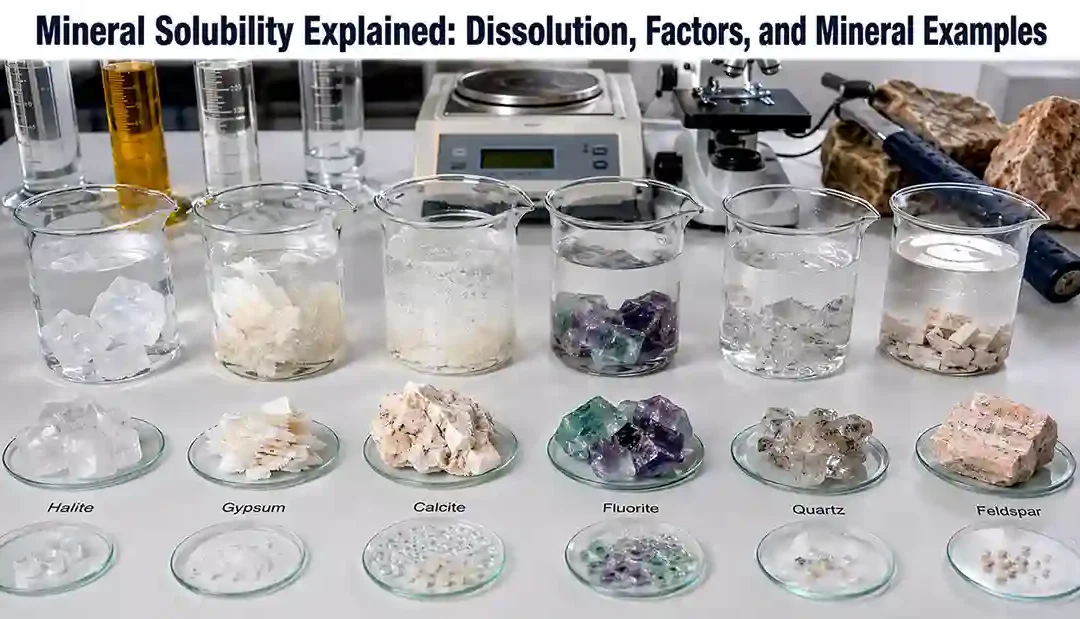
Mineral solubility is the ability of a mineral to dissolve in water or other natural fluids under specific environmental conditions. It is one of the most important chemical properties in mineralogy because it controls weathering, cave formation, groundwater chemistry, soil development, and the transport of dissolved elements through Earth's crust.
Some minerals, such as halite, dissolve rapidly in water, while others, such as quartz, are extremely resistant to dissolution. The rate and extent of mineral dissolution depend on several factors, including chemical composition, temperature, pressure, pH, and the composition of the surrounding fluid.
Understanding mineral solubility helps geologists explain how landscapes evolve, how caves form, how ore deposits develop, and why certain minerals are abundant in sediments while others disappear during weathering.
If you are studying mineral chemistry, this topic should be learned together with Chemical Properties of Minerals, Mineral Stability, and How to Identify Minerals.
What Is Mineral Solubility?
Mineral solubility is the maximum amount of a mineral that can dissolve in a solvent, usually water, under specific conditions.
When a mineral dissolves:
- Atoms leave the crystal.
- Ions enter the solution.
- The crystal gradually becomes smaller.
- Dissolved elements may later form new minerals elsewhere.
Solubility varies greatly among different mineral species.
How Does Mineral Dissolution Occur?
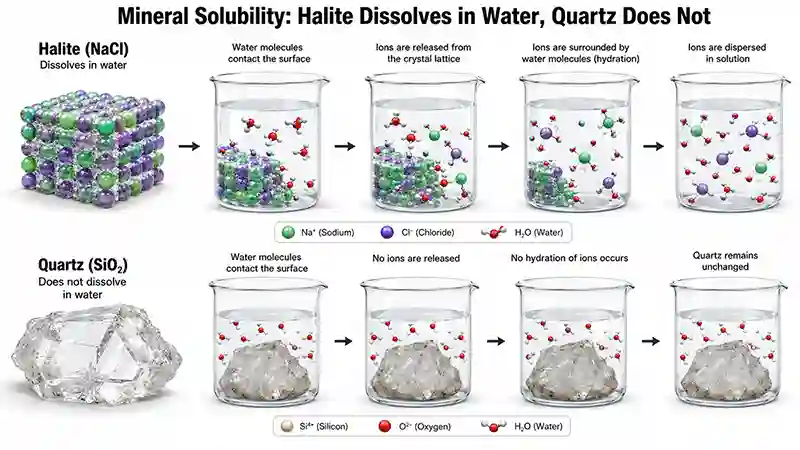
Mineral dissolution begins when water comes into contact with the mineral surface.
The process generally follows these steps:
- Water molecules reach the crystal surface.
- Chemical bonds begin to weaken.
- Mineral ions separate from the crystal.
- Dissolved ions enter the surrounding water.
- The mineral gradually dissolves.
The rate of dissolution depends on both the mineral and environmental conditions.
Why Is Mineral Solubility Important?
Mineral solubility influences:
- Chemical weathering
- Groundwater chemistry
- Soil formation
- Cave development
- Sediment transport
- Ore deposit formation
Without mineral dissolution, many geological processes would occur much more slowly.
Factors Affecting Mineral Solubility
Several factors control how easily minerals dissolve.
Chemical Composition
Minerals containing highly soluble ions dissolve more readily.
For example:
- Halite dissolves easily.
- Quartz dissolves very slowly.
Temperature
Higher temperatures generally increase the solubility of many minerals. Warm groundwater often dissolves minerals faster than cold water.
Pressure
Pressure affects the solubility of certain minerals, especially carbonates and gases dissolved in groundwater.
pH (Acidity)
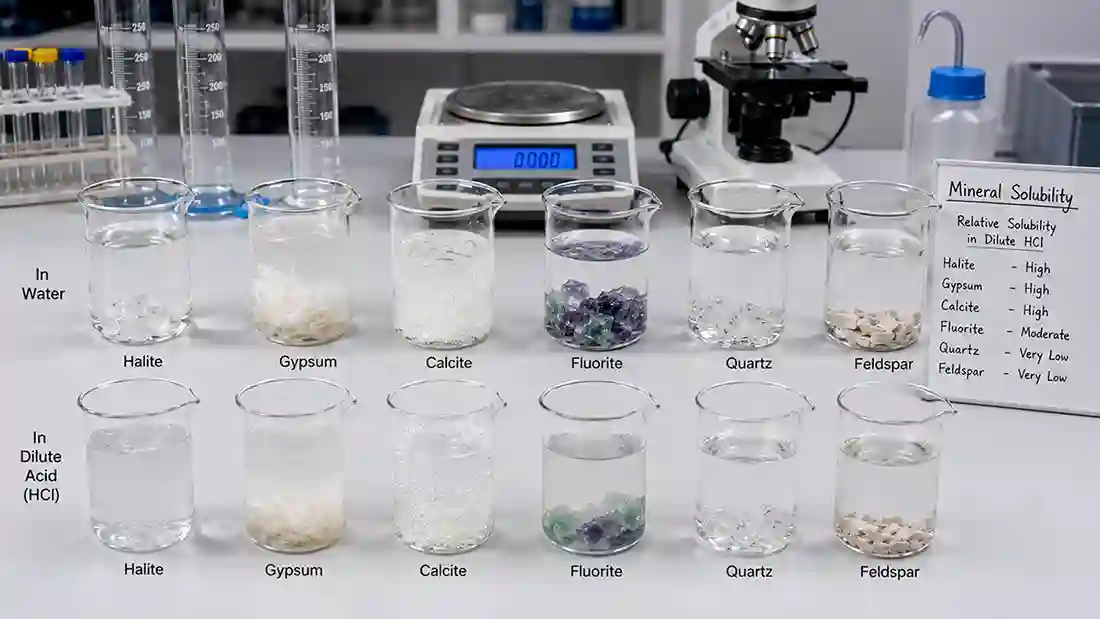
Acidic water increases the dissolution of many minerals.
Examples include:
- Calcite
- Dolomite
- Limestone
This process contributes to karst landscape development.
Water Chemistry
Groundwater containing dissolved carbon dioxide forms weak carbonic acid, increasing the dissolution of carbonate minerals. Salinity and dissolved ions also influence mineral solubility.
Surface Area
Finely crushed minerals dissolve faster than large crystals because more surface is exposed to water.
Solubility of Common Minerals
| Mineral | Relative Solubility |
|---|---|
| Halite | Very High |
| Sylvite | Very High |
| Gypsum | High |
| Calcite | Moderate |
| Dolomite | Moderate to Low |
| Fluorite | Low |
| Feldspar | Very Low |
| Quartz | Extremely Low |
Halite is among the most soluble common minerals, whereas quartz is one of the least soluble.
Soluble vs Insoluble Minerals
| Highly Soluble Minerals | Poorly Soluble Minerals |
| Halite | Quartz |
| Sylvite | Feldspar |
| Gypsum | Garnet |
| Epsomite | Zircon |
| Mirabilite | Tourmaline |
These differences strongly influence sediment composition and weathering.
Carbonate Mineral Solubility
Carbonate minerals dissolve readily in slightly acidic water.
Examples include:
- Calcite
- Aragonite
- Dolomite
The reaction between calcite and carbonic acid is responsible for the formation of:
- Limestone caves
- Sinkholes
- Karst landscapes
- Stalactites
- Stalagmites
Learn more in Acid Test for Minerals.
Silicate Mineral Solubility
Silicate minerals are generally much less soluble.
Examples:
- Quartz
- Feldspar
- Muscovite
- Garnet
Although these minerals dissolve slowly, prolonged weathering eventually transforms many of them into clay minerals.
Quartz remains stable because of its strong silicon-oxygen framework.
Mineral Solubility and Weathering
Mineral solubility plays a major role in chemical weathering.
Highly soluble minerals weather rapidly.
Poorly soluble minerals remain in soils and sediments for millions of years.
This explains why:
- Quartz dominates many sand deposits.
- Halite rarely survives long in humid environments.
Learn more in Mineral Stability Explained.
Mineral Solubility in Groundwater
Groundwater dissolves minerals as it moves through rocks.
Common dissolved ions include:
- Calcium (Ca²⁺)
- Magnesium (Mg²⁺)
- Sodium (Na⁺)
- Potassium (K⁺)
- Bicarbonate (HCO₃⁻)
- Sulfate (SO₄²⁻)
These dissolved ions influence water hardness and groundwater chemistry.
Applications of Mineral Solubility
Understanding mineral solubility is important in:
- Hydrogeology
- Environmental geology
- Mining
- Civil engineering
- Soil science
- Petroleum geology
- Geochemistry
It helps scientists predict how minerals behave in natural environments.
Advantages of Studying Mineral Solubility
Understanding solubility helps geologists:
- Predict chemical weathering
- Explain groundwater chemistry
- Study cave formation
- Evaluate ore deposits
- Interpret sediment transport
- Understand environmental change
Limitations
Mineral solubility depends on many interacting factors.
Results may vary because of:
- Temperature changes
- Water chemistry
- Pressure differences
- Biological activity
- Mineral impurities
For accurate interpretation, combine solubility studies with:
- Chemical Properties of Minerals
- Mineral Stability
- Acid Test for Minerals
- Crystal Structure Explained
- Mineral Density Test
- Optical Properties of Minerals
- How to Identify Minerals
Comparison Table
| Property | High Solubility | Low Solubility |
| Water Resistance | Low | High |
| Weathering Rate | Fast | Slow |
| Common Example | Halite | Quartz |
| Sediment Survival | Poor | Excellent |
Summary Table
| Feature | Mineral Solubility |
| Main Concept | Ability to Dissolve |
| Most Soluble Common Mineral | Halite |
| Least Soluble Common Mineral | Quartz |
| Main Controlling Factors | Chemistry, Temperature, pH, Water |
| Geological Importance | Weathering & Groundwater |
Mineral solubility is the ability of a mineral to dissolve in water or other fluids under specific environmental conditions.
Halite (rock salt) is one of the most soluble common minerals and dissolves rapidly in water.
Quartz has a strong three-dimensional silicon-oxygen crystal framework that resists chemical dissolution under most surface conditions.
Acidic water increases the solubility of many minerals, especially carbonate minerals such as calcite and dolomite.
Mineral solubility controls chemical weathering, groundwater chemistry, cave formation, soil development, and many other geological processes.
Final Thoughts
Mineral solubility is a fundamental chemical property that influences nearly every aspect of Earth's surface processes. From the rapid dissolution of halite to the remarkable resistance of quartz, differences in solubility determine how minerals weather, how caves develop, how groundwater acquires dissolved ions, and how sediments evolve over time.
By understanding the factors that control mineral dissolution, geologists can better interpret weathering processes, groundwater systems, ore formation, and environmental change. Combined with mineral stability, crystal structure, and other physical and chemical properties, solubility provides an essential foundation for understanding the behavior of minerals in natural environments.
Continue Learning
Continue exploring mineral chemistry with these related guides: