
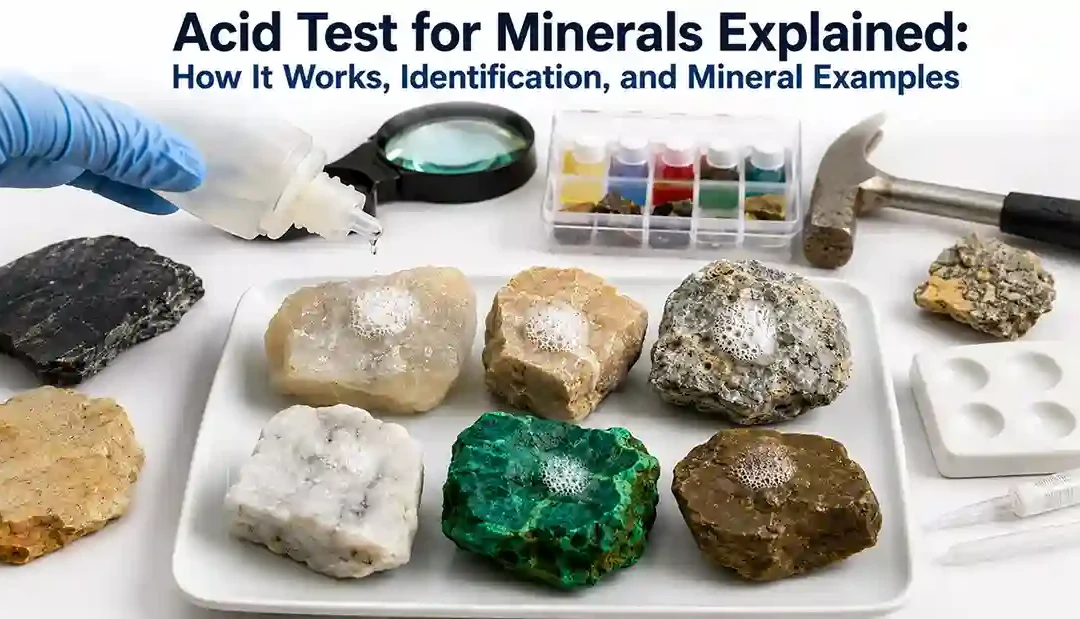
The acid test is one of the quickest and most reliable methods used to identify carbonate minerals in geology and mineralogy. By placing a small drop of dilute hydrochloric acid (HCl) on a mineral's surface, geologists can determine whether the specimen contains carbonate ions based on the production of carbon dioxide bubbles, a reaction known as effervescence.
This simple field and laboratory test is especially useful for identifying minerals such as calcite and distinguishing them from visually similar minerals like quartz or feldspar. When combined with hardness, cleavage, streak, luster, and specific gravity, the acid test greatly improves the accuracy of mineral identification.
If you're learning mineral identification, the acid test should be studied alongside the Mineral Hardness Test, Cleavage Test Explained, and How to Identify Minerals.
What Is the Acid Test?
The acid test is a mineral identification method that uses dilute hydrochloric acid to detect carbonate minerals. When hydrochloric acid reacts with carbonate minerals, carbon dioxide gas is released, producing visible bubbles.
This reaction helps geologists quickly identify minerals that contain carbonate ions.
Why Does the Acid Test Work?
Carbonate minerals contain the carbonate ion (CO₃²⁻). When hydrochloric acid comes into contact with these minerals, a chemical reaction releases carbon dioxide gas. This gas appears as tiny bubbles on the mineral surface.
The stronger the reaction, the easier the mineral is to identify.
Chemical Reaction
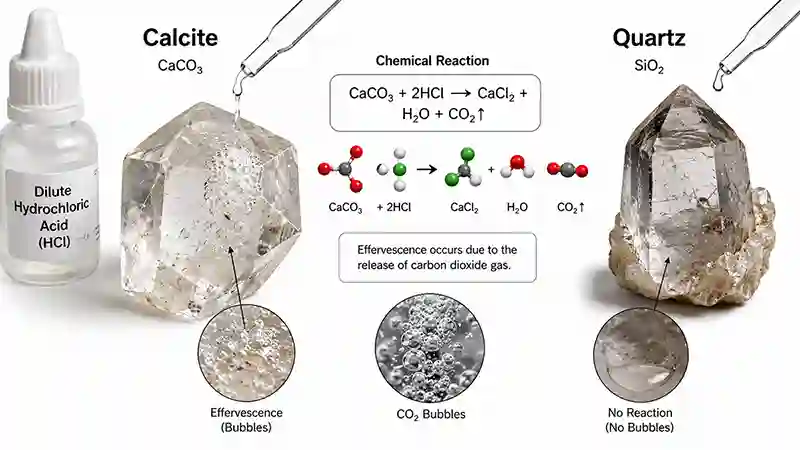
The reaction between calcite and hydrochloric acid is: CaCO₃ + 2HCl → CaCl₂ + H₂O + CO₂↑ The release of carbon dioxide produces the characteristic fizzing or effervescence observed during the test.
Minerals That React with Acid
Several carbonate minerals react with dilute hydrochloric acid.
| Mineral | Formula | Reaction |
|---|---|---|
| Calcite | CaCO₃ | Strong Immediate Reaction |
| Aragonite | CaCO₃ | Strong Immediate Reaction |
| Limestone | Mainly CaCO₃ | Strong Reaction |
| Marble | Recrystallized CaCO₃ | Strong Reaction |
| Dolomite | CaMg(CO₃)₂ | Weak (Powdered Sample Reacts Better) |
| Malachite | Cu₂CO₃(OH)₂ | Slow Reaction |
| Azurite | Cu₃(CO₃)₂(OH)₂ | Slow Reaction |
| Siderite | FeCO₃ | Weak Reaction |
Calcite is the standard mineral used to demonstrate the acid test.
Minerals That Do Not React
Many common minerals show no visible reaction with dilute hydrochloric acid.
Examples include:
- Quartz
- Feldspar
- Garnet
- Olivine
- Pyrite
- Magnetite
- Hematite
This negative result helps eliminate carbonate minerals during identification.
How to Perform the Acid Test
Follow these simple steps:
- Clean the mineral surface.
- Place the specimen on a stable surface.
- Apply one drop of 10% dilute hydrochloric acid.
- Observe for bubbling.
- If no reaction occurs, scratch the mineral and test the fresh powder.
- Compare the results with known mineral properties.
Always use a fresh surface because weathering may reduce the visible reaction.
Types of Acid Reactions
Strong Reaction
Immediate vigorous bubbling.
Examples:
- Calcite
- Limestone
- Marble
Weak Reaction
Small or delayed bubbles.
Examples:
- Dolomite
- Siderite
No Reaction
No visible bubbles.
Examples:
- Quartz
- Feldspar
- Garnet
Calcite vs Dolomite
The acid test is commonly used to distinguish calcite from dolomite.
| Property | Calcite | Dolomite |
| Acid Reaction | Strong | Weak |
| Powder Reaction | Strong | Stronger than solid |
| Hardness | 3 | 3.5–4 |
| Cleavage | Perfect Rhombohedral | Rhombohedral |
Many geologists powder dolomite before testing because fresh powder reacts more readily.
Equipment Required
The acid test requires only a few tools:
- Dilute hydrochloric acid (10%)
- Dropper bottle
- Geological hammer
- Hand lens
- Safety glasses
- Gloves
- Tissue or cloth
This makes it one of the simplest field tests in geology.
Safety Precautions
Although dilute hydrochloric acid is commonly used, proper safety is essential.
Always:
- Wear eye protection.
- Wear gloves.
- Avoid skin contact.
- Work in a well-ventilated area.
- Keep acid away from children.
- Neutralize spills with water or baking soda.
Never use concentrated hydrochloric acid for routine mineral testing.
Where the Acid Test Is Used
The acid test is widely used in:
- Mineral identification
- Geological mapping
- Sedimentary geology
- Carbonate rock studies
- Mining exploration
- University laboratories
- Museum collections
Field geologists often carry a small acid bottle during mapping projects.
Advantages of the Acid Test
The acid test is:
- Fast
- Inexpensive
- Reliable
- Easy to perform
- Highly accurate for carbonate minerals
It often provides an immediate identification clue.
Limitations
The acid test should not be used alone.
Some limitations include:
- Weathered surfaces may not react.
- Dolomite reacts weakly.
- Some coatings hide reactions.
- Additional tests are often necessary.
For best results, combine the acid test with:
- Mineral Hardness Test
- Cleavage Test
- Streak Test
- Specific Gravity Test
- Crystal Habit
Comparison Table
| Test | Identifies |
| Acid Test | Carbonate Minerals |
| Hardness Test | Scratch Resistance |
| Cleavage Test | Crystal Weakness |
| Streak Test | Powder Color |
| Specific Gravity | Density |
| Luster Test | Surface Reflection |
Summary Table
| Feature | Acid Test |
| Main Purpose | Identify Carbonates |
| Acid Used | Dilute HCl (10%) |
| Positive Result | Carbon Dioxide Bubbles |
| Most Common Mineral | Calcite |
| Field Use | Excellent |
The acid test is used to identify carbonate minerals by observing their reaction with dilute hydrochloric acid.
Calcite shows an immediate, vigorous reaction.
Dolomite's crystal structure slows the reaction, especially on smooth surfaces. Powdered samples react more readily.
No. Quartz does not react with dilute hydrochloric acid under normal conditions.
Dilute hydrochloric acid is relatively safe when handled correctly, but protective equipment should always be used.
Final Thoughts
The acid test remains one of the simplest and most effective techniques for identifying carbonate minerals in both the field and laboratory. Its rapid reaction with calcite, limestone, marble, and other carbonate-rich minerals makes it an essential tool for geologists, students, and mineral collectors.
Although powerful on its own, the acid test should always be used alongside other mineral identification methods. Combining acid reaction with hardness, cleavage, fracture, streak, luster, and specific gravity provides the most reliable mineral identification.
Continue Learning
Explore these related guides to build a complete understanding of mineral identification: