
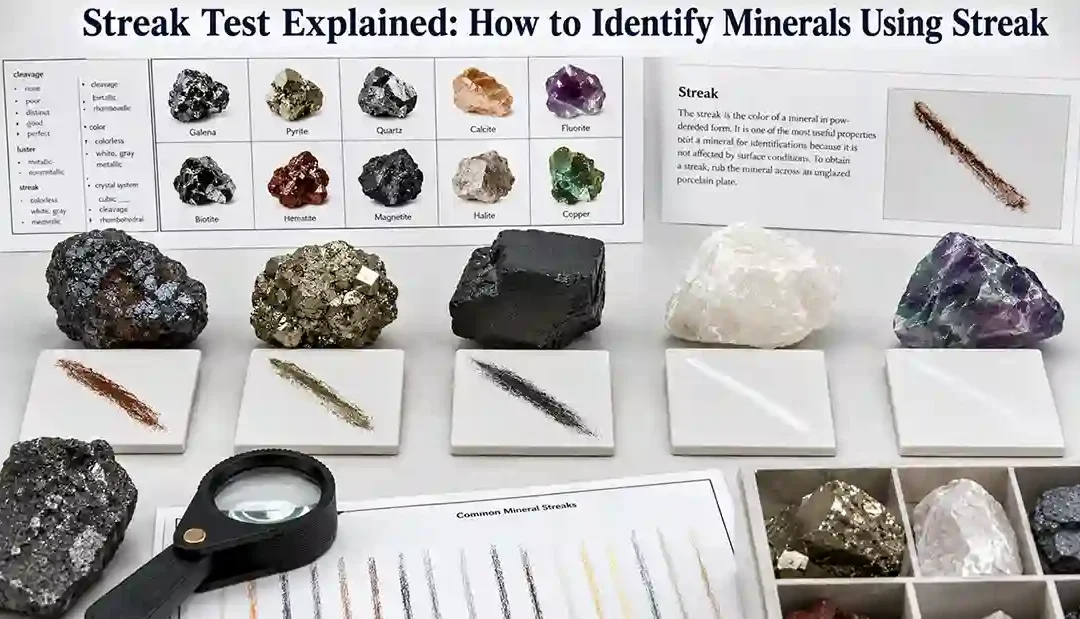
The streak test is one of the simplest and most reliable methods used to identify minerals. While a mineral's surface color can vary due to impurities or weathering, its streak often remains consistent.
Geologists use streak tests to distinguish between minerals that may look similar but produce different powdered colors.
The streak test is a fundamental tool in:
- mineral identification
- geology fieldwork
- mineralogy laboratories
- educational geology studies
What Is a Streak Test?
A streak test determines the color of a mineral in powdered form. The test is performed by rubbing a mineral across an unglazed porcelain surface called a streak plate. The resulting powder color is known as the mineral's streak.
Because powdered mineral color is often more consistent than surface color, streak is considered a valuable identification property.
Why Is Streak Important?
Many minerals have variable surface colors.
For example:
Quartz
May appear:
- clear
- white
- pink
- purple
- brown
Hematite
May appear:
- metallic gray
- silver
- black
Yet hematite almost always produces a reddish-brown streak.
This consistency makes streak a powerful identification tool.
Color vs Streak
| Property | Reliability |
|---|---|
| Surface Color | Moderate |
| Streak Color | High |
| Luster | Moderate |
| Hardness | High |
| Cleavage | High |
What Is a Streak Plate?
A streak plate is:
- made of unglazed porcelain
- harder than many minerals
- used to produce mineral powder
Most streak plates have a hardness of approximately:
This means minerals softer than quartz usually leave visible streaks.
How to Perform a Streak Test
Step 1
Select a fresh mineral surface.
Step 2
Hold the mineral firmly.
Step 3
Drag it across the streak plate.
Step 4
Observe the powder color left behind.
Step 5
Compare the streak with known mineral properties.
The resulting streak often provides valuable identification clues.
Common Mineral Streak Colors
| Mineral | Streak Color |
|---|---|
| Hematite | Reddish Brown |
| Magnetite | Black |
| Pyrite | Greenish Black |
| Galena | Lead Gray |
| Calcite | White |
| Quartz | White |
| Fluorite | White |
| Gypsum | White |
Gold vs Pyrite Streak
| Mineral | Appearance | Streak |
|---|---|---|
| Gold | Golden Yellow | Yellow |
| Pyrite | Brass Yellow | Greenish Black |
This is one of the most useful streak comparisons in mineral identification.
Minerals That Produce White Streaks
Many non-metallic minerals produce white streaks.
Examples include:
- quartz
- calcite
- gypsum
- fluorite
- feldspar
For these minerals, other tests such as hardness and cleavage are usually needed for identification.
Why Some Minerals Leave No Streak
Minerals harder than the streak plate may scratch the plate rather than leave powder.
Examples:
Quartz
Hardness 7
Topaz
Hardness 8
Corundum
Hardness 9
Diamond
Hardness 10
These minerals may not produce useful streaks on standard streak plates.
Factors Affecting Streak Tests
Surface Weathering
Can affect results.
Mineral Hardness
Hard minerals may scratch the plate.
Contamination
Dust and dirt can alter streak color.
Streak Plate Quality
Damaged plates may produce inaccurate results.
Always use clean specimens and clean plates.
Streak Test in Mineral Identification
The streak test works best when combined with:
- hardness testing
- luster observation
- cleavage examination
- crystal habit analysis
- density measurements
No single test should be used alone.
Important Streak Colors
| Streak Color | Possible Minerals |
|---|---|
| Reddish Brown | Hematite |
| Black | Magnetite |
| Greenish Black | Pyrite |
| Gray | Galena |
| White | Quartz, Calcite, Gypsum |
Advantages of the Streak Test
Simple
Easy to perform.
Inexpensive
Requires only a streak plate.
Reliable
Often more useful than color.
Portable
Suitable for fieldwork.
Limitations of the Streak Test
Hard Minerals
May not leave streaks.
Similar Streak Colors
Several minerals may share streak colors.
Specimen Damage
Testing may scratch specimens.
Requires Interpretation
Works best with other identification methods.
Common Mineral Identification Workflow
Geologists typically use:
- Color observation
- Luster examination
- Hardness testing
- Streak testing
- Cleavage analysis
- Crystal habit evaluation
Together, these methods provide accurate mineral identification.
Streak Test Equipment
Common tools include:
- streak plate
- hand lens
- mineral hardness kit
- field notebook
- mineral identification guide
These tools are standard equipment in geology laboratories.
Quick Streak Reference Guide
| Mineral | Streak |
|---|---|
| Hematite | Reddish Brown |
| Magnetite | Black |
| Pyrite | Greenish Black |
| Galena | Gray |
| Quartz | White |
| Calcite | White |
| Fluorite | White |
| Gypsum | White |
A streak test identifies minerals by examining the color of their powdered form on a streak plate.
Streak remains relatively consistent even when a mineral's surface color varies due to impurities or weathering.
A streak plate is an unglazed porcelain plate used to obtain mineral powder for streak testing.
Hematite is famous for its reddish-brown streak.
No. Very hard minerals may scratch the plate instead of leaving a powder streak.
Final Thoughts
The streak test is one of the most useful tools in mineral identification. By revealing the true color of a mineral in powdered form, it often provides more reliable information than surface color alone.
Whether identifying hematite, magnetite, pyrite, or other minerals, the streak test remains a simple, effective, and widely used method in geology and mineralogy. Combined with hardness, luster, cleavage, and crystal habit, it helps geologists accurately identify Earth's mineral resources.
Continue learning with → /how-to-identify-minerals/, /mineral-hardness-test/, and /mohs-hardness-scale/.