
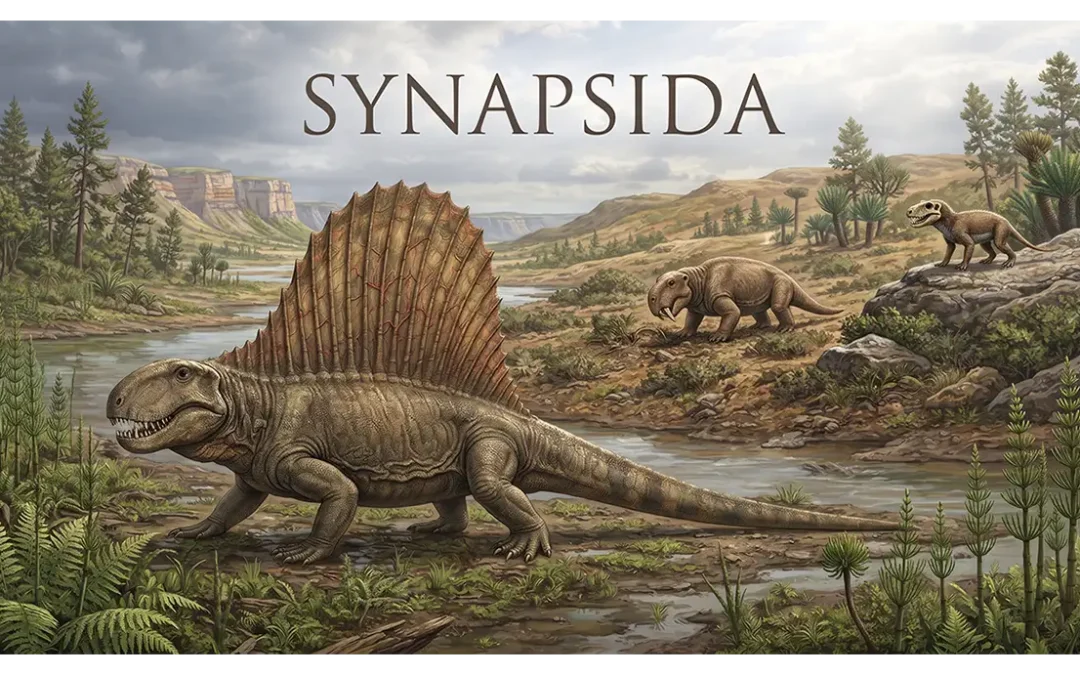
Synapsida is an important evolutionary group of vertebrates that includes modern mammals and many extinct relatives that lived millions of years before the first true mammals appeared. Its history stretches back more than 300 million years, making synapsids central to understanding how mammalian characteristics developed over geological time.
Some ancient synapsids looked very different from animals alive today. The sail-backed Dimetrodon, for example, had a long tail, sprawling limbs, and a large fin-like structure along its back. Other members of the lineage developed specialized teeth, stronger jaw muscles, more upright limbs, and other features associated with the eventual emergence of mammals.
Despite these differences, synapsids share an evolutionary ancestry that distinguishes them from other major groups of amniotes, including reptiles and birds. Fossils document a long series of changes in their skulls, skeletons, teeth, and feeding mechanisms.
In this article, you will discover what Synapsida means, how scientists recognize synapsids, which groups belong to this lineage, when they evolved, and how their history eventually led to modern mammals.
What Is Synapsida?
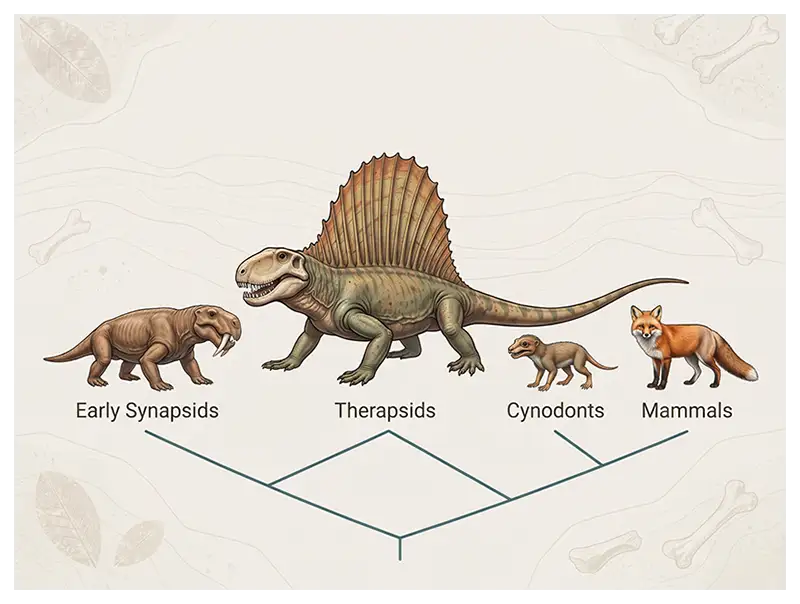
Synapsida is an evolutionary group of amniotes that includes mammals and their extinct relatives. Amniotes are vertebrates whose reproductive biology evolved features that allowed embryos to develop in an amniotic environment, reducing dependence on standing water for reproduction. The group also includes reptiles and birds, which belong to a different major evolutionary branch.
Synapsids first appeared during the Carboniferous Period, more than 300 million years ago. Their descendants diversified extensively during the Permian Period and continued to evolve through the Triassic and later geological periods. Mammals are the only living members of the synapsid lineage today, although the fossil record reveals many extinct forms with distinctive anatomy and lifestyles.
The name Synapsida refers to a characteristic opening in the skull behind each eye. This feature is important for distinguishing the traditional skull pattern associated with synapsids from those of other major amniote groups. However, evolutionary classification relies on a broader range of anatomical evidence, not on one opening alone.
Early synapsids were not mammals, and many lacked several features commonly associated with modern mammals, such as a fully developed mammalian middle ear or specialized mammalian jaw joint. These characteristics appeared gradually in different branches of the lineage.
Synapsida is therefore best understood as a long evolutionary branch rather than a single type of prehistoric animal. Its members ranged from early terrestrial vertebrates to specialized herbivores and predators, eventually giving rise to the extraordinary diversity of mammals living today.
What Are the Defining Characteristics of Synapsids?
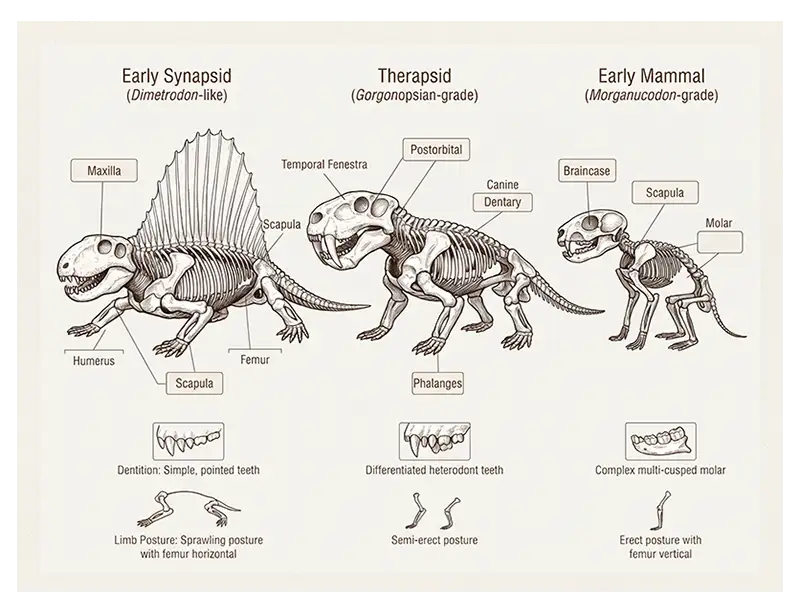
Synapsids varied considerably in size, body shape, posture, and lifestyle. A small early species and a large Permian predator might have looked very different, but shared ancestry can be recognized through features of the skull and skeleton.
Skull structure
The traditional defining feature of the synapsid skull is a single temporal opening on each side, behind the eye socket. This opening is called the temporal fenestra. It provides space associated with the jaw muscles and forms part of the broader anatomical pattern used to identify the lineage.
As synapsids evolved, their skulls underwent substantial changes. In many later forms, the temporal region became more specialized, and the attachment areas for jaw muscles changed in ways that supported increasingly effective biting and chewing.
Teeth and feeding adaptations
Teeth provide some of the clearest evidence of synapsid diversity. Early members often had relatively simple teeth, while later groups evolved more specialized arrangements.
Some species had prominent canine-like teeth suited to seizing prey. Others developed broad or complex teeth for processing plant material. Along the mammalian lineage, tooth shapes became increasingly differentiated in many groups, allowing incisors, canines, premolars, and molars to perform different tasks.
Not every synapsid had the same tooth arrangement. Dental characteristics changed repeatedly in response to diet and evolutionary history.
Limbs and movement
Early synapsids generally had limbs that projected more sideways than those of many modern mammals. This sprawling or semi-sprawling posture affected how their bodies moved and how weight was supported.
In several later groups, the limbs became positioned more beneath the body. This change supported different styles of locomotion, although the transition was gradual and varied among lineages. Fossils show that posture cannot be inferred from one bone alone; the proportions of the limbs, joints, pelvis, and shoulder region must be considered together.
Other mammalian features
Many familiar mammalian traits evolved progressively within synapsids rather than appearing in the earliest members. These include complex tooth replacement patterns, changes to the lower jaw, structures associated with mammalian hearing, and evidence for increasingly sophisticated physiological regulation.
Fur, milk production, and other defining features of living mammals are not directly preserved in most fossils. Scientists investigate their origins through skeletal evidence, rare soft-tissue preservation, evolutionary relationships, and comparisons with living animals.
Consequently, synapsids should not all be imagined as furry, warm-blooded animals. The lineage includes a wide range of forms, and many details of their physiology remain uncertain.
What Is the Synapsid Temporal Opening?
The temporal opening is one of the most important anatomical features in the traditional identification of synapsids. To understand its significance, it helps to consider how the skull works.
The eye sockets occupy the front or middle portions of the skull, while jaw muscles attach to areas around the sides and rear of the skull. In the synapsid skull pattern, an opening behind each eye provides space associated with these muscles and contributes to the arrangement of the temporal region.
This opening is known as a temporal fenestra. The term fenestra means a window or opening. Because the skull contains one principal temporal opening on each side in the traditional synapsid pattern, the group is often contrasted with other amniote skull configurations.
The opening is not a hole through which the brain or eyes protrude. Instead, it is part of the skull's structural organization. The surrounding bones and muscle attachments helped shape how the jaws operated.
Over evolutionary time, the temporal region changed substantially. In later synapsids, the skull often became more specialized for powerful biting or more controlled chewing. The jaw muscles, their attachment areas, and the proportions of the skull evolved alongside changes in diet and feeding behavior.
In the mammalian lineage, these transformations contributed to the distinctive structure of the mammalian jaw. Modern mammals have a single dentary bone forming each half of the lower jaw, while several bones that once formed part of the ancestral jaw joint became incorporated into the middle ear.
Although the temporal opening is a valuable clue, paleontologists do not classify a fossil solely by looking for one feature. They examine multiple anatomical traits and compare them within an evolutionary framework. This helps distinguish genuine shared ancestry from superficial similarities that may have developed independently.
What Are the Major Groups of Synapsids?
Synapsida contains several major evolutionary branches. The broadest distinction often used in introductory explanations is between early-diverging synapsids traditionally called “pelycosaurs” and the later group known as Therapsida.
These terms describe different parts of synapsid evolutionary history, but they are not equivalent in status: Therapsida is a formal evolutionary group, while “pelycosaur” is a traditional informal term for a collection of early synapsids that does not represent a single natural group in modern classification.
Early-diverging synapsids
Early synapsids included a wide variety of animals that lived mainly during the Carboniferous and Permian periods. Many had sprawling limbs, relatively long tails, and skulls that differed from those of later mammal-line descendants.
Well-known examples include Dimetrodon and Edaphosaurus. Although both lived during the Permian and had prominent back sails, they belonged to different branches and had different feeding adaptations.
Some early synapsids were predators, while others were herbivores. Their diversity shows that the synapsid lineage developed a broad range of ecological roles long before mammals appeared.
Therapsida
Therapsids became especially prominent during the Permian Period. Compared with many earlier synapsids, numerous therapsids showed changes in skull structure, teeth, jaw muscles, and limb proportions.
Therapsida includes several branches, among them anomodonts, therocephalians, and cynodonts. Anomodonts included highly successful herbivores such as dicynodonts, many of which had beak-like jaws and reduced teeth. Therocephalians included predators and other forms with varied feeding adaptations.
Cynodonts are particularly important because they include the branch that ultimately gave rise to mammals. They developed a combination of features that increasingly resembled the mammalian condition, including differentiated teeth and changes in the jaw and skull.
Mammalia and its extinct relatives
Mammals arose from within the cynodont branch of synapsids. The transition involved many anatomical changes rather than a sudden transformation from one clearly defined animal into another.
Early mammals were generally small compared with many of the large synapsids that had lived earlier. Over time, mammals diversified into numerous forms, including insect-eaters, herbivores, predators, aquatic species, and eventually the modern groups of mammals.
The evolutionary tree is more complex than a simple ladder. Several synapsid branches became extinct, while the mammalian branch survived and diversified. Living mammals are therefore one part of a much larger evolutionary history.
When Did Synapsids First Evolve?
Synapsids appeared more than 300 million years ago, during the Carboniferous Period of the Paleozoic Era. This was a time when extensive wetlands, forests, and varied terrestrial ecosystems supported the diversification of early land vertebrates.
The earliest known synapsid fossils are fragmentary, so the precise timing and appearance of the first members remain subjects of research. Nevertheless, fossil evidence places the origin of the lineage well before the age of dinosaurs.
During the Permian Period, synapsids became an important component of terrestrial ecosystems. They included large predators, plant-eating animals, and smaller species with different ecological roles. Some, such as Dimetrodon, became iconic examples of Permian life.
Near the end of the Permian, approximately 252 million years ago, Earth experienced the most severe known mass extinction in its history. This event eliminated many species and dramatically altered terrestrial and marine ecosystems. Synapsids suffered major losses, but some lineages survived.
During the Triassic Period, surviving synapsids continued to evolve, although dinosaurs and other archosaurs also became increasingly prominent in many terrestrial environments. Cynodonts persisted and eventually gave rise to mammals.
The earliest mammals appeared in the Late Triassic, roughly around 225–200 million years ago, depending on how early mammal fossils and mammalian characteristics are interpreted. This means that synapsid evolution had already been underway for many tens of millions of years before mammals emerged.
The timeline illustrates a central point: mammalian evolution was a gradual process embedded within a much older lineage, not an event that began with the first recognizable mammal.
What Were the Most Notable Early Synapsids?
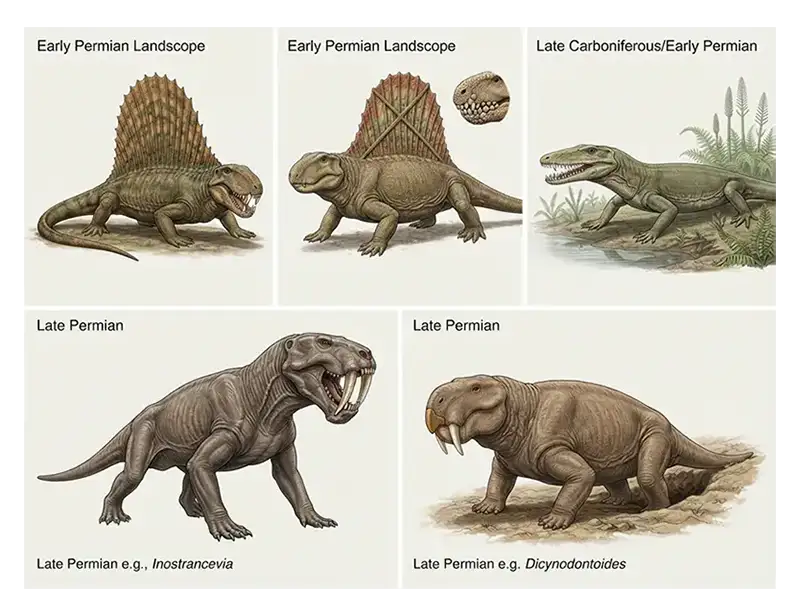
Several early synapsids are especially useful for understanding the diversity of the group. Their fossils reveal different body plans, diets, and ecological roles.
Dimetrodon
Dimetrodon lived during the Permian Period, approximately 295–272 million years ago, depending on the species and fossil record considered. It had a long skull, powerful teeth, a sprawling body, and a prominent sail formed by elongated spines extending from the vertebrae.
Despite its dinosaur-like appearance in popular illustrations, Dimetrodon was not a dinosaur. It was an early synapsid, and it lived millions of years before the first dinosaurs appeared.
Its teeth indicate that it was a predator capable of capturing and processing animal prey. The function of its sail remains debated. It may have contributed to heat exchange, display, or other biological functions, but no single explanation is conclusively established.
Edaphosaurus
Edaphosaurus was another Permian synapsid with an impressive back sail. Unlike the predatory Dimetrodon, it was primarily a plant-eater. Its skull and teeth indicate adaptations for processing vegetation.
Although the two animals shared a striking silhouette, they differed in skull structure, dentition, and evolutionary relationships. Their resemblance is a useful reminder that a similar body feature does not necessarily mean that two species had the same diet or belonged to the same close-knit group.
Ophiacodon
Ophiacodon was an early synapsid that lived during the Permian. It had a long skull and numerous teeth, and its anatomy has been interpreted as consistent with a carnivorous or animal-eating lifestyle.
Its fossils help researchers understand the range of skull shapes and feeding strategies among early synapsids. Like other extinct animals, however, its precise behavior cannot be reconstructed from one anatomical feature alone.
Gorgonopsians
Gorgonopsians were later Permian therapsids rather than early-diverging “pelycosaurs.” Many were formidable predators with long canine teeth and skulls adapted for seizing prey.
Their anatomy illustrates the variety of predatory forms that evolved within Therapsida. Gorgonopsians became extinct during the end-Permian mass extinction, leaving no living descendants.
Dicynodonts
Dicynodonts were therapsids that became highly successful herbivores. Many had a beak-like jaw and a pair of prominent tusks, although tusk size and development varied among species.
They occupied important ecological roles during the Permian and Triassic. Some dicynodont lineages survived the end-Permian extinction and persisted into the Triassic, demonstrating that the synapsid story continued after one of Earth's most devastating biological crises.
Together, these animals show that synapsids were not a uniform collection of mammal-like creatures. They included different evolutionary branches with distinct adaptations, some of which disappeared long before mammals became dominant in many modern ecosystems.
How Did Synapsids Evolve into Mammals?
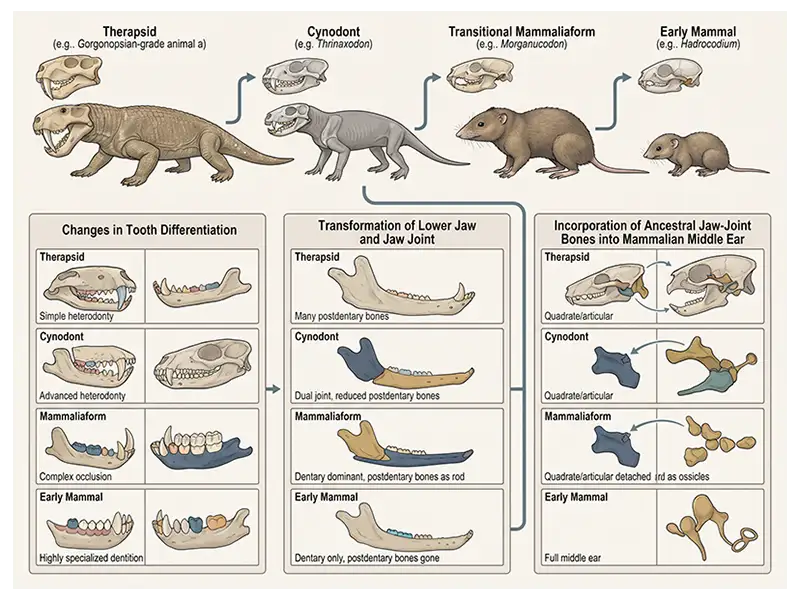
The origin of mammals was a long evolutionary transition within Synapsida, especially through the therapsid and cynodont branches. There was no single generation in which a non-mammal suddenly produced a fully modern mammal. Instead, mammalian characteristics appeared in different combinations over many millions of years.
Changes in the skull and teeth
One of the clearest trends was the evolution of increasingly specialized teeth. Many cynodonts developed distinct incisors, canines, and cheek teeth, allowing them to cut, pierce, and process food more efficiently.
The skull also changed as jaw muscles and feeding mechanics evolved. These changes supported more controlled movements and, in later mammalian groups, increasingly effective chewing.
Transformation of the lower jaw
Early synapsids had several bones in the lower jaw. Along the mammalian lineage, the dentary bone became increasingly dominant, eventually forming the entire lower jaw in living mammals.
At the same time, bones involved in the ancestral jaw joint became reduced in size and were incorporated into the mammalian middle ear. This evolutionary transition is supported by fossils showing intermediate arrangements, including forms with both a dentary-squamosal jaw joint and remnants of the older joint.
The change is especially significant because it links feeding anatomy with hearing. Structures that once helped articulate the jaw became part of a system for transmitting sound.
Changes in posture and movement
Many later synapsids developed limbs positioned more beneath the body than in the sprawling posture common among early forms. This change was not uniform across every branch, but it contributed to a range of locomotor styles.
More upright limbs can support different patterns of movement and weight distribution. The details varied among animals, so the transition should not be interpreted as a simple, uninterrupted march toward the posture of modern mammals.
Physiology and insulation
Mammals maintain relatively stable internal body temperatures through complex physiological systems. Evidence suggests that aspects of mammal-like physiology developed gradually among therapsids and cynodonts, but the exact timing of particular traits remains debated.
Fossil bones, growth patterns, tooth structure, and rare evidence of body coverings help researchers investigate these questions. Fur and other soft tissues are rarely preserved, making some aspects of early mammalian biology difficult to establish directly.
The appearance of mammals
By the Late Triassic, early mammals had emerged. These animals were generally small and lived alongside many other groups of vertebrates, including dinosaurs.
Early mammals were not merely miniature versions of modern species. They had their own combinations of primitive and derived traits, and their later descendants diversified into the wide range of mammals known today.
The evolutionary transition from early synapsids to mammals is therefore best understood as a branching process involving many intermediate forms, changing ecosystems, and the gradual accumulation of anatomical innovations.
What Did Synapsids Eat?
Synapsids occupied a wide range of dietary niches. Their feeding habits changed over time and differed among species, reflecting differences in tooth shape, jaw structure, body size, and the environments in which they lived.
Carnivorous synapsids
Predatory species often had sharp teeth and skulls suited to capturing or cutting animal prey. Dimetrodon is a well-known example of an early synapsid with prominent teeth, while gorgonopsians were later therapsid predators with large canine teeth.
However, the presence of pointed teeth does not provide a complete record of an animal's diet. Scientists also examine jaw mechanics, tooth wear, fossil associations, and comparisons with other extinct and living animals.
Herbivorous synapsids
Plant-eating synapsids evolved several ways of processing vegetation. Edaphosaurus had teeth adapted for plant consumption, while many dicynodonts developed beak-like jaws capable of cropping plant material.
Herbivory became particularly important among several therapsid lineages. Their fossils demonstrate that synapsids were not simply predators competing with other large carnivores; they also formed a substantial part of the plant-eating animal community.
Insectivory and mixed diets
Some small-bodied members of the mammalian lineage were likely adapted to feeding on insects and other small invertebrates. Such diets are inferred from dental characteristics, jaw proportions, and other anatomical evidence.
The diets of some extinct species remain uncertain. Fossils can reveal likely feeding adaptations, but they do not always establish the exact foods an animal consumed. It is therefore important to distinguish well-supported dietary interpretations from speculation.
Overall, synapsid feeding diversity reflects a long history of ecological specialization, from early predators to herbivores and the many dietary types found among mammals.
Where Did Synapsids Live?
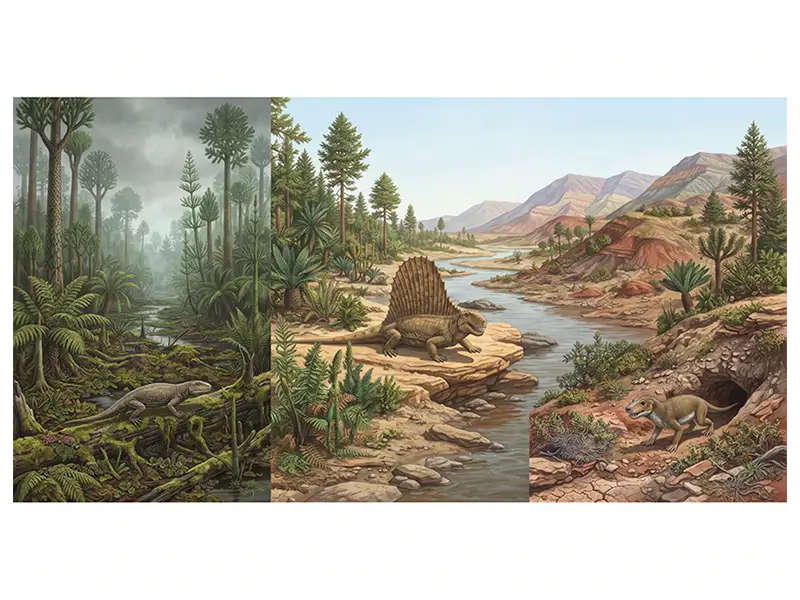
Synapsids inhabited terrestrial environments across many parts of the ancient world. Their distribution changed over time as continents shifted, climates changed, and new ecosystems developed.
Carboniferous environments
The earliest synapsids evolved when many regions of the world supported extensive wetlands and forests. These environments contained diverse plants and early terrestrial vertebrates, providing the ecological setting in which amniotes diversified.
The exact habitats of the earliest synapsids are difficult to reconstruct because the fossil record is incomplete. Nevertheless, their remains show that the lineage emerged during an important period in the evolution of life on land.
Permian ecosystems
During the Permian, synapsids occupied a wide variety of terrestrial settings, including floodplains, seasonally dry regions, and other environments with changing vegetation and water availability.
Fossil deposits from what are now South Africa, Russia, North America, and other regions preserve important synapsid remains. These records reveal that the group became geographically widespread and included animals with different ecological roles.
Triassic environments
Following the end-Permian mass extinction, surviving synapsid groups continued to inhabit terrestrial ecosystems. Cynodonts and dicynodonts persisted in various regions, although their diversity and relative abundance changed as ecosystems recovered and new groups expanded.
Early mammals also evolved in Triassic environments. Their small size and varied anatomy suggest that they occupied ecological niches different from those of many larger vertebrates, although the exact lifestyles of individual species remain under investigation.
Later habitats and the modern world
As mammalian lineages diversified, their descendants spread into nearly every major terrestrial habitat. Some later mammals also returned to aquatic environments, and bats evolved powered flight.
These adaptations belong to later branches of the mammalian lineage rather than to all early synapsids. The broad history of Synapsida therefore spans ancient terrestrial ecosystems and the much more diverse habitats occupied by modern mammals.
What Do Synapsid Fossils Reveal?
Fossils are the primary evidence for reconstructing synapsid evolution. They preserve hard tissues, such as bones and teeth, and occasionally provide impressions or other traces of soft tissues and behavior.
Skull and jaw fossils
Skulls reveal the structure of the temporal region, the arrangement of teeth, the shape of the jaw, and the areas where muscles attached. These features help scientists compare species and identify evolutionary changes.
The fossil record of the mammal-line synapsids is especially informative because it documents changes in the jaw joint and the bones associated with hearing. Different fossil species preserve different stages of these transformations, providing evidence for the evolutionary connection between ancestral jaw structures and the mammalian middle ear.
Teeth and diet
Teeth are often among the most abundant synapsid fossils. Their shape, wear patterns, and microscopic structure can provide clues about feeding behavior and growth.
For example, sharp canine teeth may indicate a role in seizing prey, while specialized cheek teeth can indicate the ability to process plant material. Such interpretations become stronger when dental evidence agrees with other anatomical and geological clues.
Skeletons and locomotion
Limb bones, vertebrae, and pelvic structures help researchers estimate how an animal moved. These fossils can reveal changes in limb posture, body proportions, and the mechanical demands placed on the skeleton.
A complete interpretation usually requires multiple bones. One isolated limb or vertebra rarely provides enough information to reconstruct an animal's full locomotor abilities.
Geological context
The rock layers surrounding fossils help establish their relative ages and the environments in which the animals lived. Researchers use stratigraphy, radiometric dating where suitable, and comparisons with other fossil-bearing deposits to build a geological timeline.
Fossils from different regions can also reveal how synapsid communities changed through time. They document the rise of early forms, the diversification of therapsids, the effects of mass extinction, and the emergence of mammals.
The fossil record is incomplete, but it provides strong evidence that mammalian anatomy developed through a long and branching evolutionary history.
Why Are Synapsids Important in Evolutionary History?
Synapsids are important because they document the deep evolutionary history of mammals. Without their fossils, many of the anatomical transitions that shaped mammals would be much harder to understand.
Evidence for evolutionary change
The synapsid fossil record shows how skulls, teeth, jaws, and limbs changed over millions of years. Rather than appearing all at once, many mammalian characteristics emerged gradually in different combinations.
This evidence helps scientists test hypotheses about how anatomical structures evolve and how changes in one part of the body can be associated with changes in feeding, movement, or sensory abilities.
Recovery after mass extinction
Synapsids also provide insight into how vertebrate communities responded to environmental crises. The end-Permian mass extinction eliminated many species, yet some synapsid lineages survived and continued evolving.
The later history of cynodonts and mammals shows that survival does not mean an immediate return to previous levels of diversity. Evolutionary recovery can involve major changes in which groups dominate ecosystems and how ecological roles are distributed.
Understanding mammalian origins
Modern mammals belong to the synapsid lineage, so studying extinct synapsids helps researchers understand the ancestry of humans, whales, bats, elephants, and every other living mammal.
Features such as the mammalian jaw joint, middle ear, differentiated teeth, and limb anatomy have histories that extend into extinct branches of the group.
Synapsids are therefore not merely an assortment of strange prehistoric animals. They form a major chapter in the evolutionary history of vertebrates and provide a detailed record of how one ancient lineage eventually produced mammals.
Conclusion
Synapsida is one of the most significant evolutionary groups in vertebrate history because it includes modern mammals and their many extinct relatives. Originating more than 300 million years ago, synapsids diversified into predators, herbivores, and other specialized forms across the Carboniferous, Permian, and Triassic periods.
Their fossils document major changes in skull structure, teeth, jaw mechanics, and limb anatomy. Over time, one branch of therapsids—the cynodont lineage—gave rise to mammals through a gradual series of evolutionary transitions.
Famous animals such as Dimetrodon demonstrate the diversity of early synapsids, while the fossils of later cynodonts help explain the origins of mammalian features. Together, these discoveries reveal that the mammals living today are the surviving members of an ancient and once highly diverse lineage.
Understanding Synapsida helps place mammalian evolution in its proper context: not as an isolated event, but as the outcome of hundreds of millions of years of evolutionary change.
Synapsida is an evolutionary group of amniotes that includes mammals and their extinct relatives. Its members are recognized through shared ancestry and anatomical features, including the characteristic temporal opening in the skull.
No. Synapsids and reptiles belong to separate major branches of the amniote family tree. Although some early synapsids looked superficially reptile-like, they are not classified as reptiles in modern evolutionary taxonomy.
No. Dimetrodon was an early synapsid that lived during the Permian Period, tens of millions of years before the first dinosaurs evolved.
Yes. Modern mammals are the living members of Synapsida. Many other synapsid groups are extinct, but their fossils document the lineage's long evolutionary history.
The earliest known synapsids appeared during the Carboniferous Period, more than 300 million years ago. The precise timing of the group's origin remains uncertain because the earliest fossil record is incomplete.