
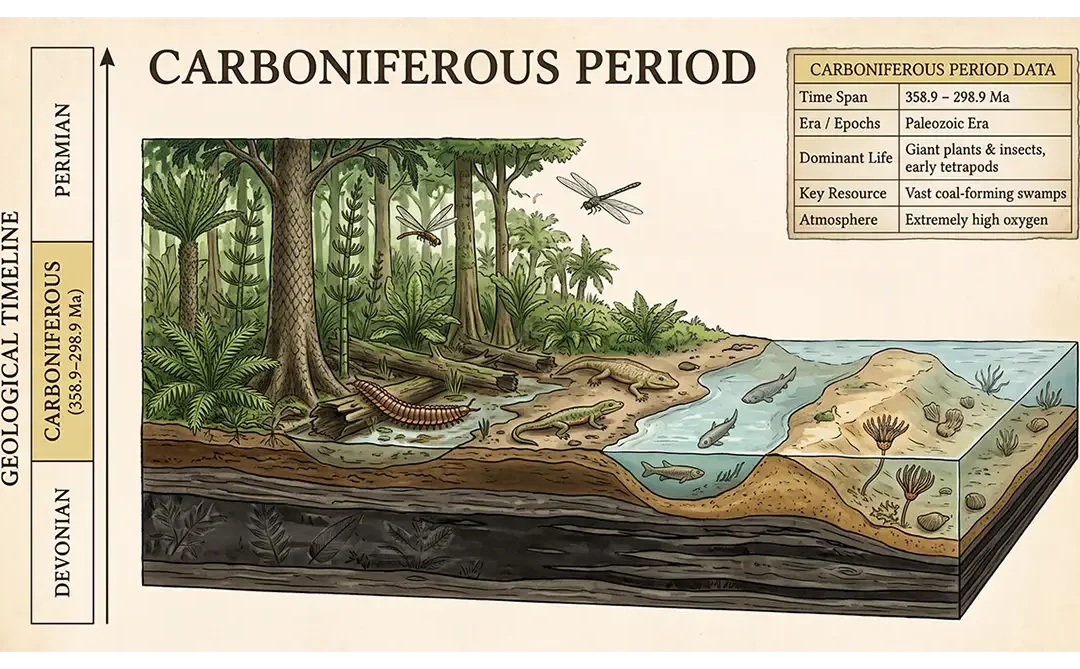
The Carboniferous Period was a major interval of the Paleozoic Era when extensive forests covered many humid regions, marine ecosystems flourished, and vertebrates became increasingly adapted to life on land. It lasted from about 358.9 to 298.9 million years ago and is especially famous for the formation of many coal deposits.
During this period, giant tree-like plants created dense wetlands, while amphibians and early reptiles occupied terrestrial habitats. Fishes remained important in rivers and seas, and arthropods became remarkably diverse. Some insects and other arthropods also reached sizes that are unusual compared with their modern relatives.
The Carboniferous was not environmentally uniform. Its climate, vegetation, sea levels, and ecosystems changed considerably through time. These changes helped shape the evolutionary history of plants and animals and eventually led into the Permian Period.
What Was the Carboniferous Period?
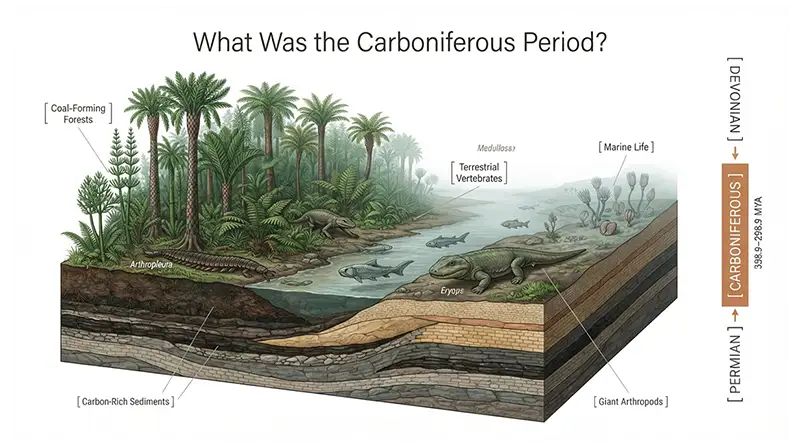
The Carboniferous was the fifth period of the Paleozoic Era. It followed the Devonian Period and preceded the Permian Period. Its name refers to the abundant carbon-rich deposits associated with rocks from this interval, particularly the extensive coal seams that formed from ancient vegetation.
The period is especially important because terrestrial ecosystems became increasingly complex. Large forests developed in humid lowland areas, creating habitats for numerous plants, arthropods, amphibians, and early amniotes. Marine environments were also widespread. Shallow seas supported corals, brachiopods, crinoids, mollusks, fishes, and other organisms.
The Carboniferous also contains important stages in the evolution of land vertebrates. Early amniotes appeared during this interval, developing reproductive features that reduced their dependence on aquatic environments. Rather than being a single unchanging “coal swamp,” the Carboniferous included wet forests, rivers, coastal plains, shallow seas, uplands, and increasingly seasonal or dry regions.
When Did the Carboniferous Period Begin and End?
The Carboniferous Period began about 358.9 million years ago and ended about 298.9 million years ago. It therefore lasted for roughly 60 million years.
Its beginning followed the Devonian Period, while its end marked the transition into the Permian.
| Geological boundary | Approximate age |
|---|---|
| Beginning of Carboniferous | 358.9 million years ago |
| End of Carboniferous | 298.9 million years ago |
| Approximate duration | 60 million years |
The exact subdivision of this interval differs between geological classification systems.
In the international geological timescale, the Carboniferous is divided into two periods:
- Mississippian
- Pennsylvanian
In many European geological traditions, however, the Carboniferous is treated as a single period with its own internal stages. The term is also commonly divided into Mississippian and Pennsylvanian subperiods in North American geology. Understanding this distinction is useful when comparing geological maps, textbooks, and fossil studies from different regions.
What Are the Mississippian and Pennsylvanian?
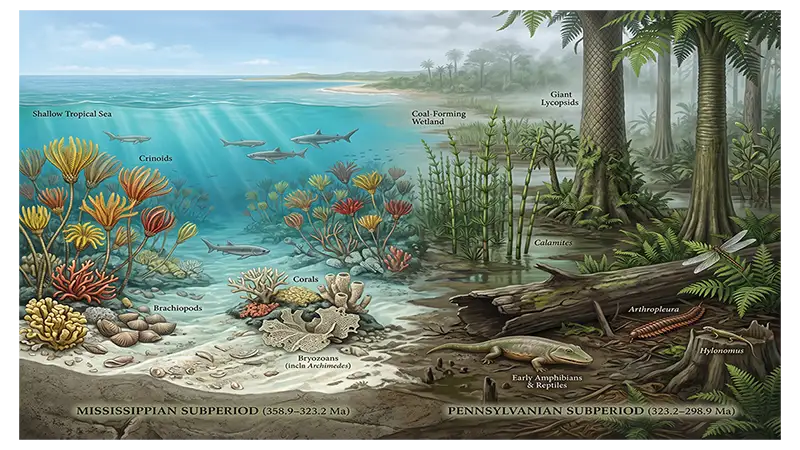
In the North American geological system, the Carboniferous is divided into two major subdivisions: the Mississippian and the Pennsylvanian. Together, they span the entire Carboniferous interval, from approximately 358.9 to 298.9 million years ago.
The two intervals are distinguished mainly by differences in rock types, depositional environments, geography, and biological communities. The Mississippian is strongly represented by marine carbonate rocks, whereas the Pennsylvanian is especially associated with terrestrial sediments and coal-bearing strata.
Mississippian
The Mississippian occupied the earlier portion of the Carboniferous, from roughly 358.9 to 323.2 million years ago. Large parts of present-day North America were covered by warm, shallow seas. These waters supported abundant crinoids, brachiopods, corals, bryozoans, and mollusks. Crinoids were particularly widespread, and their broken skeletal pieces accumulated on seafloors to form thick carbonate sediments.
As these sediments were buried and compacted, they produced extensive limestone formations. Such rocks are among the most recognizable geological records of this interval. Away from the seas, vegetation was spreading across lowland environments. Amphibians occupied moist habitats, while the earliest amniotes had already appeared, representing an important development in terrestrial vertebrate history.
Key characteristics:
- Extensive shallow marine environments
- Abundant crinoid communities
- Major limestone deposition
- Diverse marine invertebrates
- Expanding terrestrial vegetation
- Presence of early amniotes
Pennsylvanian
The Pennsylvanian followed the Mississippian and lasted approximately 323.2 to 298.9 million years ago. This interval is especially famous for enormous coal-forming wetlands. Warm, humid lowlands supported tree-sized lycopsids, giant horsetails, ferns, and seed plants. Dense vegetation created multilayered habitats for numerous terrestrial organisms.
When plants died, large quantities of organic material accumulated in waterlogged settings. Poor drainage and limited oxygen slowed decomposition. Repeated burial eventually transformed some of this material into coal seams. Terrestrial vertebrate communities became increasingly varied. Amphibians remained important, while reptiles and other amniotes expanded into habitats that offered greater independence from permanent water sources.
Arthropods occupied numerous ecological roles. Some species reached extraordinary dimensions, although such giants represented only a fraction of the overall fauna. Climate also fluctuated during this interval. Glacial cycles affecting Gondwana caused repeated changes in global sea level, while equatorial regions experienced shifts between humid and more seasonal conditions.
Key characteristics:
- Extensive coal-producing wetlands
- Tree-sized lycopsids and other vegetation
- Diverse terrestrial arthropods
- Widespread amphibians
- Increasing amniote diversity
- Repeated glacial and sea-level fluctuations
How Did the Two Subdivisions Differ?
| Feature | Mississippian | Pennsylvanian |
|---|---|---|
| Position | Earlier Carboniferous | Later Carboniferous |
| Approximate age | 358.9–323.2 Ma | 323.2–298.9 Ma |
| Dominant setting in many North American deposits | Shallow seas | Terrestrial wetlands and coastal plains |
| Characteristic rocks | Limestone and other marine carbonates | Coal, shale, sandstone, and associated sediments |
| Notable organisms | Crinoids and marine invertebrates | Forest plants, arthropods, amphibians, and amniotes |
| Major geological significance | Extensive carbonate deposition | Major coal accumulation |
The Mississippian and Pennsylvanian therefore provide two useful windows into changing Carboniferous environments. Their contrasting rock records preserve evidence of shifting seas, developing terrestrial habitats, changing vegetation, and evolving animal communities.
What Was Earth Like During the Carboniferous?
Earth looked very different from today. Continents were arranged in configurations that eventually contributed to the formation of Pangaea. Large landmasses were approaching one another, producing mountain-building events in several regions. Continental collisions created new uplands and altered drainage systems.
Extensive shallow seas covered portions of continental areas, particularly during intervals when sea levels were higher. These marine settings supported productive ecosystems and left behind thick layers of limestone and other sediments. Low-lying continental areas contained enormous wetlands and river systems. In humid regions, vegetation could grow rapidly and accumulate large amounts of organic material.
The southern supercontinent Gondwana experienced significant glaciation during parts of the Carboniferous. Ice sheets affected sea levels as water became stored on land. At the same time, many equatorial regions remained warm and humid enough to support extensive forests.
As the period progressed, the geography and climate became increasingly seasonal in some areas. This environmental shift influenced the distribution of forests and the animals that depended on them.
What Was the Carboniferous Climate Like?
The Carboniferous climate varied considerably across different regions and stages of the period. Many equatorial areas experienced warm, humid conditions that supported dense vegetation and large wetlands. High rainfall and abundant surface water allowed forests to flourish.
The southern parts of Gondwana experienced substantial glaciation. Growth and retreat of ice sheets influenced global sea levels and repeatedly changed the extent of shallow marine habitats. Climate was not identical throughout the entire period. Some regions became more seasonal and drier toward the late Carboniferous.
This transition reduced the extent of certain wetland forests and created opportunities for plants and animals better suited to less consistently wet environments. Atmospheric oxygen was also unusual during parts of the Carboniferous. Geological and biological evidence indicates that oxygen concentrations rose well above modern levels at certain times, although estimates vary.
Carbon dioxide concentrations changed as well, influenced by volcanic activity, weathering, plant growth, burial of organic carbon, and other processes. These interacting factors produced a complex climate system rather than one permanently warm and humid world.
Why Were Carboniferous Forests So Important?
Carboniferous forests transformed terrestrial landscapes and played an important role in the formation of coal. Many wetlands contained enormous lycopsids, some of which grew into tree-sized forms. Their tall trunks and narrow crowns created a distinctive forest structure.
Large horsetails and fern-like plants were also common. Seed plants became increasingly important, especially in environments that were becoming more seasonal or dry. When vegetation died, some plant material accumulated in waterlogged environments where oxygen was limited. Slow decomposition allowed thick layers of organic matter to build up. Over geological time, burial, pressure, and heat transformed some of this material into coal.
These deposits became important records of ancient vegetation and are also economically significant today. Carboniferous forests affected more than the carbon cycle. They provided shelter and food for terrestrial animals, stabilized soils, influenced local water systems, and created complex vertical habitats. Their disappearance or reduction in some regions later changed entire ecosystems.
What Animals Lived During the Carboniferous?
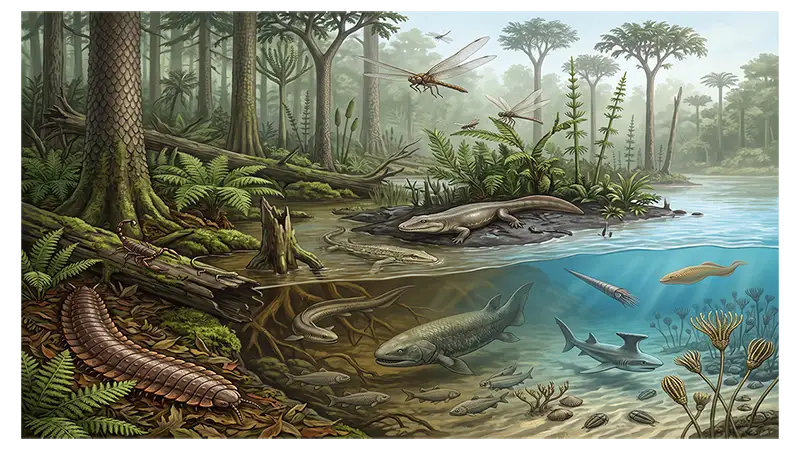
The Carboniferous supported diverse communities both on land and in water.
Amphibians
Amphibians were widespread and included many forms that differed greatly in size and body shape. Wetlands, rivers, and forest environments provided suitable habitats for numerous species. Their dependence on moist environments remained an important limitation compared with later amniotes.
Early Reptiles
The earliest reptiles appeared during the Carboniferous. These animals belonged to the broader group of amniotes and developed reproductive adaptations that allowed them to reproduce away from open water. Their appearance represented an important step in the evolution of fully terrestrial vertebrate communities.
Fishes
Marine and freshwater fishes remained abundant. Sharks, ray-finned fishes, and other groups occupied different aquatic environments. Some Carboniferous waters also contained unusual armored or elongated fish forms that are now extinct.
Arthropods
Insects, arachnids, myriapods, and other arthropods became important components of terrestrial ecosystems. Some were predators, others consumed plants or decaying material, and many occupied specialized ecological roles.
Marine Invertebrates
Shallow seas contained brachiopods, crinoids, corals, bryozoans, mollusks, and other invertebrates. Crinoids were particularly abundant in some marine environments and contributed substantial amounts of skeletal material to seafloor sediments.
Why Were Some Carboniferous Arthropods So Large?
Some Carboniferous arthropods reached remarkable sizes compared with most living relatives. One famous example is Arthropleura, a giant millipede-like arthropod that could reach more than 2 meters in length. Another well-known example is Meganeura, a large griffinfly with a wingspan approaching 70 centimeters.
Several factors may have contributed to unusually large body sizes.
High Atmospheric Oxygen
Carboniferous oxygen levels were higher than today during parts of the period. Because many terrestrial arthropods rely on a tracheal system to deliver oxygen directly through their bodies, elevated oxygen availability may have helped support larger sizes.
However, oxygen alone does not explain every example. Body size is influenced by many factors, including food availability, temperature, habitat, predators, competition, and evolutionary history.
Abundant Vegetation
Extensive forests produced large quantities of plant material. This created abundant food resources for herbivores, detritivores, and organisms that depended indirectly on vegetation.
Different Ecological Conditions
Carboniferous ecosystems lacked many modern combinations of predators and competitors. Some ecological opportunities may therefore have favored unusually large arthropods. Large size was not universal, however. Most Carboniferous arthropods were much smaller, just as most modern arthropods are not giant forms.
How Did Vertebrates Evolve During the Carboniferous?
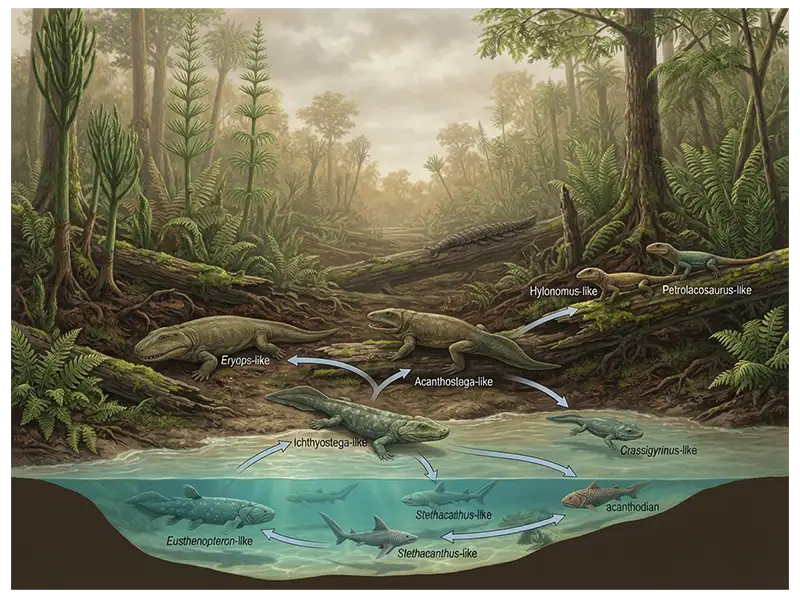
The Carboniferous was an important period in the development of terrestrial vertebrates. Amphibians diversified and occupied many wetland environments. Some developed large bodies, while others remained relatively small. At the same time, early amniotes appeared. Their reproductive system included membranes surrounding the developing embryo, and the amniotic egg provided protection, nutrients, gas exchange, and waste storage.
This adaptation reduced the need to return to open water for reproduction. Early amniotes eventually separated into major evolutionary lineages. One branch led toward synapsids, which eventually included mammals, while another led toward sauropsids, the lineage containing reptiles and birds.
Carboniferous amniotes were still relatively primitive compared with their later descendants, but their appearance represented a major evolutionary development. Changes in limb structure, skin, lungs, skulls, and reproduction allowed vertebrates to exploit increasingly diverse terrestrial environments.
What Fossils Are Found From the Carboniferous?
Carboniferous rocks preserve an exceptional variety of fossils.
Plant Fossils
Leaves, stems, roots, bark impressions, spores, and other plant remains are common in many Carboniferous deposits. Tree-sized lycopsids and other swamp plants are especially important for reconstructing ancient forests.
Coal Deposits
Coal seams contain compressed and altered organic material derived largely from ancient vegetation. They provide evidence about the environments where large quantities of plant matter accumulated.
Arthropod Fossils
Insects, arachnids, myriapod-like animals, and other arthropods are preserved at several Carboniferous sites. Some fossils retain remarkable details of wings, body segments, and appendages.
Vertebrate Fossils
Fish scales, teeth, jaws, bones, and complete or partial skeletons occur in marine and freshwater deposits. Amphibian and early reptile remains are particularly important for understanding the transition toward more independent terrestrial life.
Trace Fossils
Footprints, trackways, burrows, feeding marks, and other traces provide information about animal activity and movement. Together, body fossils and trace fossils allow paleontologists to reconstruct not only which organisms lived during the Carboniferous but also how they interacted with their environments.
How Did the Carboniferous Period End?
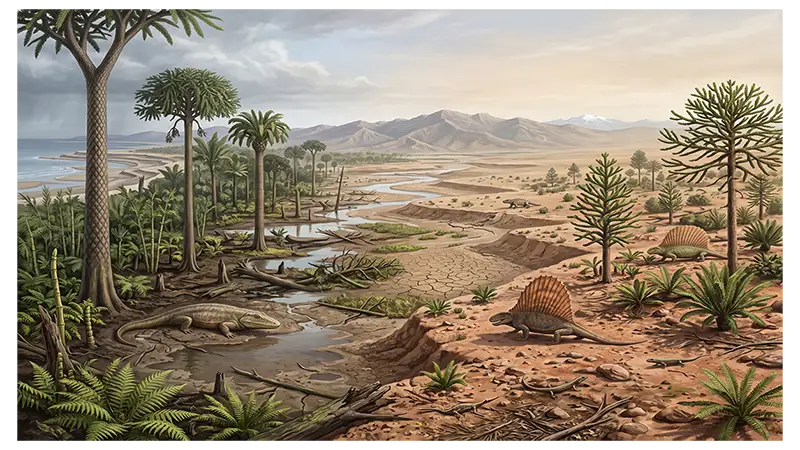
The Carboniferous gradually transitioned into the Permian Period rather than ending through one sudden global catastrophe. One important change was increasing climate seasonality and drying in many regions. Extensive wetland forests became less widespread, especially in areas that experienced stronger seasonal conditions. Glacial cycles in Gondwana influenced global sea levels.
Repeated changes in the amount of water stored in ice altered the size of shallow marine habitats. Vegetation also changed. Plants better adapted to drier environments became increasingly important, while some swamp-dwelling groups declined. The development of Pangaea further influenced climate. Vast continental interiors were located far from oceanic moisture and became more prone to dry conditions.
These changes reshaped terrestrial ecosystems and created environmental conditions that continued into the Permian. The transition was therefore a long-term ecological and climatic reorganization, not a single extinction event comparable to the end-Permian crisis that came much later.
Conclusion
The Carboniferous Period was a remarkable stage in Earth history when forests transformed terrestrial environments, coal deposits accumulated, arthropods diversified, and vertebrates developed important adaptations for life on land. Its landscapes included humid wetlands, dense forests, rivers, shallow seas, uplands, and glaciated regions. Conditions changed through time, producing different ecological opportunities for plants and animals.
The appearance of early amniotes was particularly significant because their reproductive adaptations opened new possibilities for vertebrate life away from water. Meanwhile, extensive vegetation influenced atmospheric chemistry and left behind the coal-bearing rocks that make the period so recognizable today.
Although the Carboniferous ended about 298.9 million years ago, its geological and fossil record continues to reveal how plants, animals, climate, and continental change interacted during a crucial stage of Paleozoic evolution.