
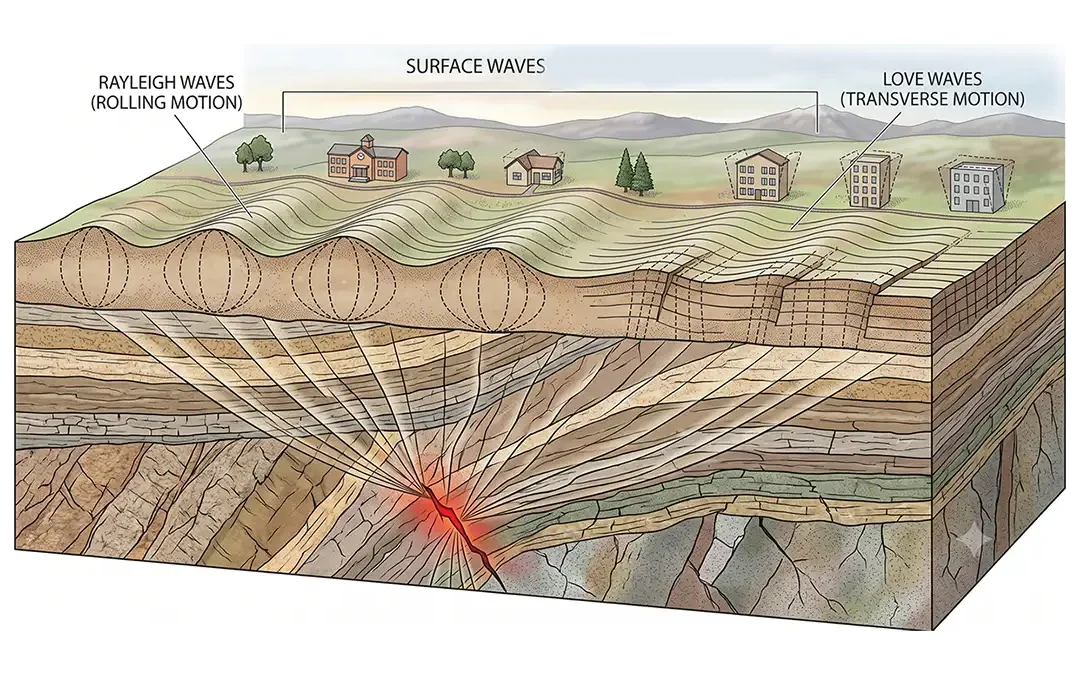
Surface waves are seismic waves that travel along or close to Earth’s surface. They are produced by earthquakes and other seismic events and are different from body waves, which travel through Earth’s interior.
Surface waves are important because they can produce strong ground movement during earthquakes. By studying how these waves move and behave, scientists can better understand earthquake shaking, investigate shallow layers of Earth, and assess potential earthquake hazards.
What Are Surface Waves?
Surface waves are seismic waves that propagate along Earth's surface or within shallow layers near the surface. They are generated when seismic energy interacts with Earth's surface and subsurface layers. Surface waves generally travel more slowly than body waves, which include P waves and S waves. Because they travel near the surface, however, they can produce significant ground motion in areas affected by an earthquake.
The movement of surface waves depends on the properties of the materials through which they travel. Rock type, density, elasticity, layering, and depth can all influence their speed and behavior Surface waves can travel considerable distances from the earthquake source.
Their characteristics can be recorded by seismometers, allowing scientists to study the location, magnitude, duration, and effects of earthquakes.
Types of Surface Waves
The two principal types of surface waves are Love waves and Rayleigh waves. They differ mainly in how the ground particles move as the waves pass.
Love Waves
Love waves are surface waves that produce primarily horizontal ground motion perpendicular to the direction in which the wave travels. They are named after British mathematician Augustus Edward Hough Love, who developed the mathematical theory describing this type of wave.
As a Love wave passes through the ground, particles move from side to side in a horizontal direction. Unlike Rayleigh waves, Love waves do not normally produce significant vertical particle motion.
Love waves commonly develop in layered geological materials where a low-velocity layer overlies a higher-velocity layer. The properties and thickness of these layers influence how the waves propagate.
The horizontal movement produced by Love waves can be particularly important during earthquakes. Strong side-to-side motion can place considerable stress on structures, especially buildings and infrastructure that are not designed to withstand significant lateral movement.
Love waves can also disperse, meaning that waves with different frequencies may travel at different velocities. Scientists can study this behavior to learn about the structure and physical properties of Earth's shallow crust.
Rayleigh Waves
Rayleigh waves are another major type of surface wave. They are named after British physicist Lord Rayleigh, who mathematically described their existence in the nineteenth century.
The particle motion associated with Rayleigh waves is often described as elliptical or rolling. As a Rayleigh wave passes, particles near the surface move both vertically and horizontally, producing a motion that resembles the rolling movement of ocean waves.
Rayleigh waves can travel along the surface of solid materials and are capable of producing noticeable vertical and horizontal ground movement. Their motion can contribute significantly to the shaking experienced during earthquakes.
Like Love waves, Rayleigh waves can disperse. Their velocity depends on factors such as frequency and the physical properties of the rocks and sediments through which they travel.
Rayleigh waves are particularly useful to seismologists because their characteristics contain information about the shallow structure of Earth. By analyzing their speed and dispersion, scientists can estimate properties of subsurface materials.
How Do Surface Waves Travel?
Surface waves travel along Earth's surface rather than passing directly through the deep interior. Their behavior is strongly influenced by the physical properties of shallow geological layers.
When an earthquake occurs, energy travels away from the source in different forms. Some of this energy travels through Earth's interior as body waves, while other energy reaches the surface and produces surface-wave motion.
The velocity of a surface wave depends on the material through which it travels. Dense, rigid rocks generally transmit seismic energy differently from softer sediments. Consequently, the same surface wave can behave differently as it encounters changes in geological materials.
Surface waves can also undergo reflection, refraction, scattering, and attenuation. These processes occur when seismic energy encounters boundaries between materials with different physical properties.
One important characteristic of many surface waves is dispersion. Different frequencies can travel at different speeds, causing the shape of the wave train to change as it travels. Scientists can analyze this behavior to investigate subsurface structures.
Surface-wave velocity is generally lower than the velocity of the fastest body waves. This is one reason surface waves commonly arrive at a seismic station after the initial P- and S-wave arrivals.
Surface Waves vs. Body Waves
Surface waves and body waves are the two broad categories of seismic waves. The main difference is the path they follow through Earth.
| Feature | Surface Waves | Body Waves |
|---|---|---|
| Main path | Along or near Earth's surface | Through Earth's interior |
| Main types | Love waves and Rayleigh waves | P waves and S waves |
| Typical velocity | Generally slower | Generally faster |
| Particle motion | Depends on wave type | Depends on P or S wave |
| Ground motion | Often strong near the surface | Can occur throughout Earth's interior |
| Major geological use | Shallow structure and earthquake studies | Earthquake location and Earth's internal structure |
Body waves can travel through the Earth's interior, while surface waves are concentrated near the surface. P waves are compressional body waves, whereas S waves involve shear motion.
Surface waves usually arrive later than P and S waves at a seismic station because their velocities are generally lower. Their later arrival and distinctive waveforms allow seismologists to identify them in earthquake records.
Although surface waves can produce strong ground motion, it is important not to assume that they are always responsible for the greatest earthquake damage. The actual effects of an earthquake depend on many factors, including magnitude, depth, distance from the source, local geology, wave characteristics, and building design.
Why Surface Waves Cause the Most Earthquake Damage
When engineers and geologists analyze earthquake disasters, they consistently find that surface waves cause the vast majority of structural failures. Several physical characteristics explain why a surface wave is so destructive:
1. Large Amplitudes
The amplitude (height) of a surface wave is significantly larger than that of a body wave. While P and S waves might produce subtle vibrations, a surface wave physically moves the ground by several centimeters or even meters during severe quakes.
2. Complex Multi-Directional Forces
Rayleigh waves push the ground up and down while pulling it back and forth, while Love waves violently shake it from side to side. When both wave types hit a building simultaneously, the structure is twisted, stretched, and compressed all at once. Most traditional building materials (like unreinforced brick or concrete) cannot endure these multi-directional forces.
3. Extended Shaking Duration
Because surface waves travel slower than body waves and spread out over longer paths, their energy arrives spread over time. This extends the total duration of ground shaking. Prolonged shaking fatigues structural beams, eventually causing buildings that survived the initial P and S waves to collapse.
4. Resonant Frequency with Buildings
Surface waves have low frequencies (longer time between wave crests). Tall buildings and long bridges happen to share these same natural low frequencies. When a low-frequency surface wave matches the natural vibration frequency of a tall building, resonance occurs—amplifying the swaying motion until the structure collapses.
How Geologists Use Surface Waves to Study Earth
While surface waves cause severe damage to human infrastructure, they are also invaluable scientific tools. Geophysicists and seismologists analyze surface wave recordings to uncover critical information about Earth's internal structure and earthquake mechanics.
- Mapping Earth's Crust and Upper Mantle: Because Rayleigh and Love waves travel through the outer layers of the Earth, their speeds depend heavily on the density and composition of the rock they pass through. By measuring how fast different frequencies of surface waves travel across continents and oceans (a property called dispersion), geologists build 3D maps of crustal thickness and upper mantle temperature.
- Determining Earthquake Magnitude: For moderate to large earthquakes, traditional Richter scale measurements can saturate and underestimate the quake's true energy. Seismologists rely on the Surface Wave Magnitude scale, which measures the amplitude of Rayleigh waves with a 20-second period, providing a reliable measure of an earthquake's size across global distances.
- Improving Earthquake Engineering: By studying how surface waves interact with different soil types (such as soft river sediments versus hard bedrock), geologists help structural engineers design safer, flexible building foundations and update municipal building codes in active fault zones.
Surface waves are seismic waves that travel along or near Earth's surface. They are mainly represented by Love waves and Rayleigh waves.
The two principal types of surface waves are Love waves and Rayleigh waves. They differ mainly in their particle motion.
Love waves mainly produce horizontal side-to-side motion perpendicular to the direction of wave propagation. Rayleigh waves produce a rolling or elliptical motion with both horizontal and vertical components.
Generally, no. Surface waves usually travel more slowly than P and S body waves, which is why they commonly arrive later at seismic recording stations.
Surface waves can produce strong ground motion and travel long distances. Their characteristics are therefore important for understanding earthquake shaking and assessing seismic hazards.
Conclusion
Surface waves are an important class of seismic waves that travel along or near Earth's surface. Unlike body waves, which pass through Earth's interior, surface waves are concentrated in shallow parts of the Earth and can produce significant ground motion.
The two principal types are Love waves and Rayleigh waves. Love waves primarily generate horizontal side-to-side motion, while Rayleigh waves produce a rolling or elliptical movement with both horizontal and vertical components.
Because surface waves can travel long distances and produce strong ground motion, they are important in earthquake studies and seismic hazard assessment. Their velocity, dispersion, and waveforms also provide valuable information about the physical properties and structure of Earth's shallow subsurface.
Understanding surface waves therefore helps scientists explain earthquake ground motion while also providing a useful method for investigating the geological structure beneath Earth's surface.