
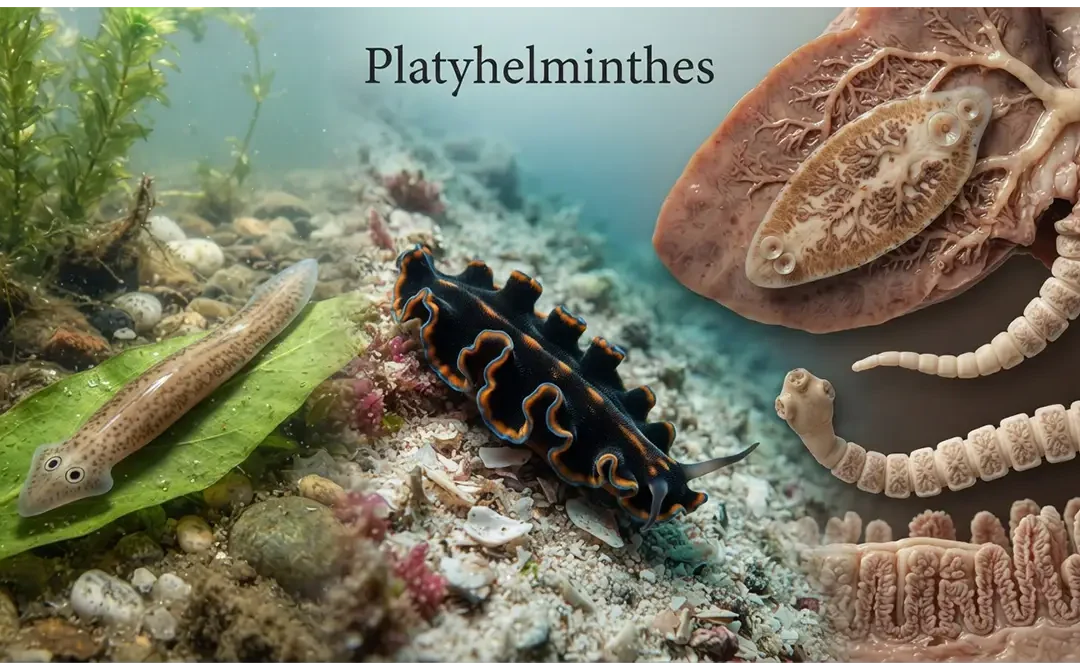
Platyhelminthes are a group of soft-bodied animals commonly known as flatworms. They have flattened bodies and include both free-living species and parasites that live in or on other animals. Flatworms occur in marine and freshwater environments, moist soils, and the bodies of many hosts.
Some platyhelminths are small and harmless, while others are important parasites. Tapeworms and flukes, for example, can live inside humans or other animals and have specialized structures for surviving in their hosts. Free-living flatworms, such as planarians, are also important for studying regeneration, development, and animal evolution.
What Are Platyhelminthes?
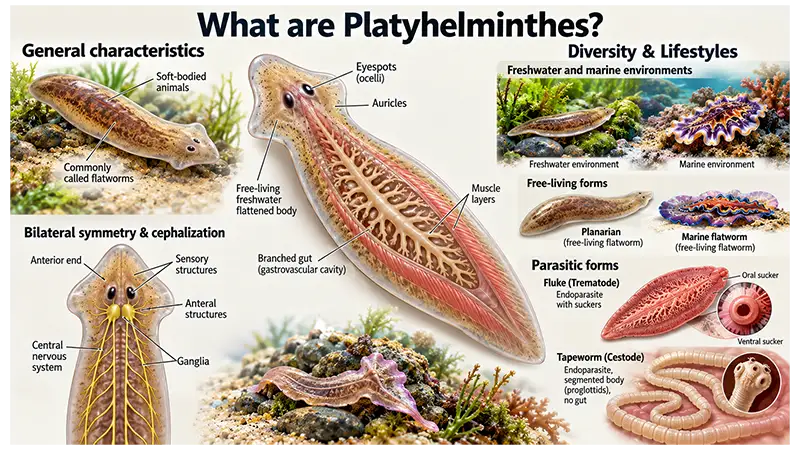
Platyhelminthes is the name of a phylum of soft-bodied, bilaterally symmetrical animals commonly called flatworms. Their bodies are usually flattened from top to bottom, giving the group its familiar name. Most flatworms are relatively small, although some parasitic species can become much longer than free-living forms. Their bodies do not have a hard skeleton, and most species have simple internal organization compared with more complex animals.
Platyhelminths include several very different lifestyles. Some species move freely through water or moist environments, while others spend most or all of their lives as parasites.
Important examples include:
- Planarians, which are mostly free-living flatworms found in freshwater and other moist environments.
- Flukes, which are parasitic flatworms belonging mainly to the group Trematoda.
- Tapeworms, which are parasitic flatworms belonging to Cestoda.
- Monogeneans, which are mostly external parasites of aquatic animals, especially fish.
Flatworms are important because they show how relatively simple animal bodies can support different ways of feeding, moving, reproducing, and surviving.
What Are the Main Characteristics of Platyhelminthes?
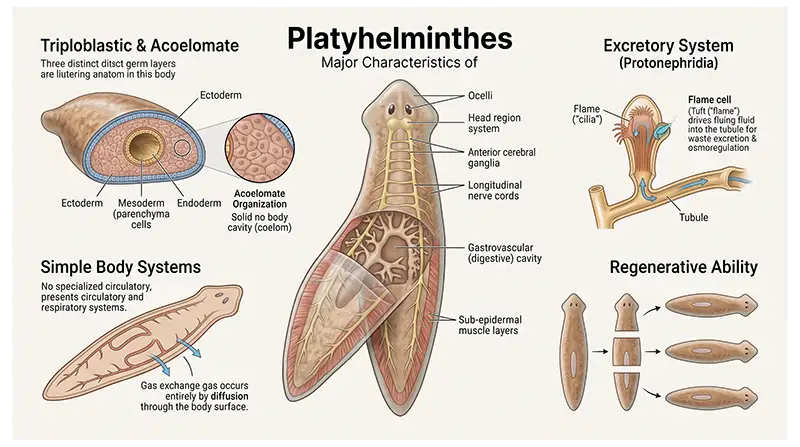
Platyhelminthes have several biological features that distinguish them from other groups of animals. Their bodies are generally soft, flattened, and bilaterally symmetrical. They have specialized tissues and organ systems, but their internal organization is simpler than that of many larger and more complex animals.
Bilateral Symmetry
Platyhelminthes have bilateral symmetry, which means their bodies can be divided into two roughly matching sides: a left side and a right side. This body arrangement is important because it is associated with directional movement. Many flatworms have a distinct front end, or head region, where sensory structures and nervous tissue are concentrated. This arrangement allows the animal to detect its surroundings as it moves forward.
Dorsoventrally Flattened Body
The body of a flatworm is usually flattened from the upper surface to the lower surface. This shape is one of the most recognizable characteristics of the group. A thin body helps materials such as oxygen and carbon dioxide move between the surrounding environment and internal tissues. This is especially important because most flatworms do not have specialized respiratory organs or a complex circulatory system.
Three Germ Layers
Platyhelminthes are triploblastic animals, meaning their embryos develop from three primary tissue layers: the ectoderm, mesoderm, and endoderm. These layers give rise to different tissues and structures of the adult animal. The presence of three germ layers allows flatworms to have muscles, digestive tissues, nervous tissue, and other specialized structures.
Acoelomate Body Plan
Flatworms are traditionally described as acoelomates. This means they do not have a true fluid-filled body cavity surrounding their internal organs. Instead, the space between their outer body wall and internal digestive structures is largely filled with tissues. This body organization differs from that of animals that have a true coelom.
Soft and Flexible Body
Most platyhelminths have soft bodies without a hard external skeleton or internal bony skeleton. Their muscles allow them to bend, contract, and change body shape. This flexibility is useful for free-living species moving through water, sediment, or vegetation. In parasitic species, a flexible body can also help the animal remain attached to or move within its host.
Simple but Specialized Organ Systems
Platyhelminthes have specialized organ systems, although these systems are generally simpler than those found in many other animals. Depending on the group, they may have digestive, nervous, excretory, reproductive, and muscular systems. Parasitic flatworms often have highly modified structures because their bodies are adapted to particular hosts and lifestyles.
No Specialized Circulatory System
Most flatworms do not have a separate circulatory system containing blood vessels. Their flattened bodies and internal branching structures allow nutrients and other substances to move relatively short distances. This is one reason why a thin body shape is particularly useful for flatworms.
No Specialized Respiratory Organs
Platyhelminthes generally lack lungs, gills, or other specialized respiratory organs. Oxygen usually enters the body through the surface, while carbon dioxide moves outward. Their flattened shape provides a relatively large surface area compared with their body volume, making this type of gas exchange possible.
Simple Nervous System
Many free-living flatworms have a relatively simple nervous system with a concentration of nerve tissue near the head. Long nerve cords extend through the body and connect with smaller branches. This arrangement allows the animal to respond to light, chemicals, touch, and other environmental signals. Parasitic flatworms may have nervous systems adapted to their more specialized lifestyles.
Specialized Excretory System
Many platyhelminths have an excretory system containing structures called flame cells. These cells are connected to small tubules that help regulate water and remove certain metabolic wastes. The system is especially important for maintaining the proper balance of water and dissolved substances inside the animal.
Diverse Feeding Strategies
Flatworms have different feeding methods depending on their lifestyle. Free-living species may consume small animals, microorganisms, organic particles, or other food sources. Some free-living flatworms use a muscular pharynx to take food into their digestive system. Parasitic forms have developed specialized feeding strategies. Tapeworms, for example, do not have a conventional digestive tract and absorb nutrients directly through their body surface.
Strong Regenerative Ability in Some Species
Some free-living flatworms, particularly planarians, have remarkable regenerative abilities. After injury, they can regenerate missing body parts because their bodies contain populations of specialized stem cells called neoblasts. This ability makes certain flatworms important research organisms for studying tissue regeneration, stem cells, development, and wound repair.
Free-Living and Parasitic Lifestyles
One of the most important characteristics of Platyhelminthes is their wide range of lifestyles. Some species live independently in freshwater, marine environments, or moist terrestrial habitats. Others are parasites that depend on animals for food, shelter, or reproduction.
Flukes, tapeworms, and monogeneans have evolved specialized structures and life cycles that allow them to survive in or on their hosts. Overall, the characteristics of Platyhelminthes show how a relatively simple, flattened body plan can support free-living, predatory, scavenging, and highly specialized parasitic lifestyles.
What Is the Body Structure of Platyhelminthes?
The body structure of a flatworm depends strongly on whether it is free-living or parasitic. Planarians, flukes, and tapeworms have very different body forms because they have adapted to different environments. Free-living flatworms usually have a distinct head region, eyespots, a mouth, a digestive cavity, muscles, and a nervous system. Many parasitic flatworms have specialized structures that help them attach to and survive inside or on their hosts.
Body Wall
The outer body surface protects the animal and interacts with its environment. Free-living species often have a ciliated surface that helps them move across surfaces or through water. Parasitic species may have a specialized outer covering that helps protect them from the host's digestive enzymes and immune responses.
Digestive System
Many free-living flatworms have a mouth connected to a branching digestive cavity. Food enters through the mouth, is digested internally, and nutrients move through the body. Many flatworms have no separate anus. Waste material may leave through the same opening used for food intake.
Tapeworms are an important exception. Adult tapeworms lack a conventional digestive tract and absorb nutrients directly through their body surface.
Nervous System
Many free-living flatworms have a simple nervous system with a concentration of nerve tissue toward the head. Long nerve cords extend through the body. This arrangement is more organized than the diffuse nervous systems found in some simpler animals and supports directional movement and responses to the environment.
Excretory System
Flatworms have a specialized excretory system involving structures called flame cells in many groups. These cells help control water balance and remove certain waste products.
Muscles and Movement
Muscle layers allow flatworms to bend, contract, and move. Free-living species may also use tiny cilia on their body surface to glide across surfaces. Parasitic species have attachment structures and body shapes suited to their hosts rather than active movement through open environments.
What Are the Main Groups of Platyhelminthes?
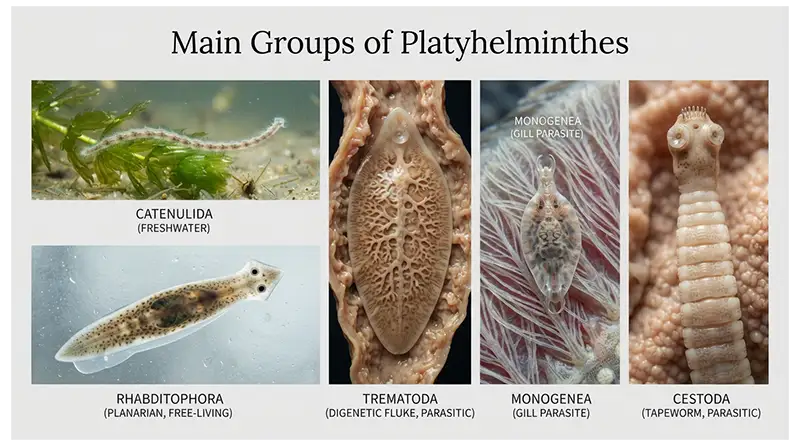
Platyhelminthes contains several evolutionary lineages with very different lifestyles. Modern classification is based on anatomical, developmental, and molecular evidence, and some older textbook groupings are no longer treated as formal evolutionary groups.
Major groups commonly discussed include Rhabditophora, Catenulida, Trematoda, Monogenea, and Cestoda.
Rhabditophora
Rhabditophora includes most free-living flatworms and several parasitic lineages. Many members have ciliated body surfaces and complex sensory systems. Planarians are among the best-known examples. They are commonly found in freshwater and other moist environments.
Catenulida
Catenulids are small aquatic flatworms. Many live in freshwater environments and have relatively simple bodies. They are an important lineage for understanding flatworm diversity and evolution.
Trematoda
Trematodes are commonly called flukes. They are parasitic flatworms that live in or on animals. Many species have complex life cycles involving more than one host. Some use snails as intermediate hosts before reaching their final host.
Monogenea
Monogeneans are mostly parasites of aquatic animals, particularly fish. Many attach directly to the external surfaces of their hosts, such as the skin or gills. They often have specialized attachment structures that help them remain on the host.
Cestoda
Cestodes are commonly called tapeworms. Adult tapeworms live mainly inside the digestive systems of vertebrate hosts. Their bodies are highly specialized for parasitic life. They absorb nutrients through their outer surface and often consist of a head region called a scolex followed by repeated segments called proglottids. These groups demonstrate how the flatworm body plan has evolved into very different forms and lifestyles.
Where Do Platyhelminthes Live?
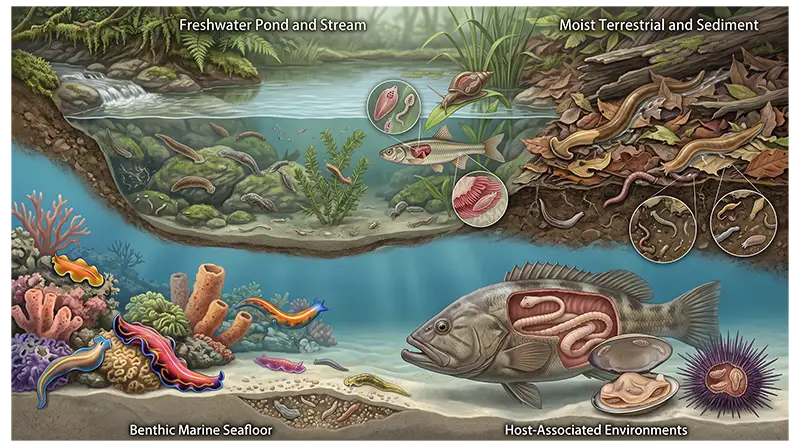
Platyhelminths occur in a wide range of environments. Their distribution depends on their lifestyle and evolutionary group. Free-living species commonly occur in:
- Freshwater streams and ponds
- Lakes
- Marine environments
- Wet sediments
- Moist soils
- Vegetation and other damp surfaces
Many marine flatworms live among rocks, algae, coral rubble, or sediment on the seafloor. Parasitic species have a very different distribution because their habitats are the bodies of their hosts. They may live in the digestive system, blood vessels, liver, lungs, skin, gills, or other tissues.
Their hosts can include:
- Fish
- Amphibians
- Reptiles
- Birds
- Mammals
- Other aquatic animals
Because many parasitic flatworms depend on particular hosts, their life cycles are closely connected with the ecology of those animals and the environments where the hosts live.
How Do Platyhelminthes Feed and Digest Food?
Feeding methods vary greatly among flatworms. Free-living species may feed on small organisms, microorganisms, organic material, or other small animals. Some are predators and can capture prey using their muscular pharynx.
Planarians, for example, can extend a muscular feeding structure from the mouth and use it to take in food. Their branching digestive cavity distributes nutrients through the body because they generally lack a specialized circulatory system. Parasitic flatworms have developed different feeding strategies.
Flukes may absorb nutrients or feed on materials available within their host. Tapeworms are especially specialized because adult tapeworms do not have a digestive tract. Instead, they absorb nutrients directly through their outer surface. This difference between free-living and parasitic feeding shows how the same broad animal group can adapt to very different sources of food.
How Do Platyhelminthes Reproduce?
Platyhelminths reproduce through both sexual and asexual processes, depending on the group. Many flatworms are hermaphroditic, meaning an individual has both male and female reproductive organs. However, the details of reproduction vary widely among species.
Free-living flatworms can reproduce sexually by exchanging sperm with another individual. Fertilized eggs develop into young flatworms. Some species can also reproduce asexually. Planarians are particularly well known for their ability to divide or produce new individuals through body fragmentation followed by regeneration.
Parasitic flatworms often have complex reproductive systems and can produce large numbers of eggs. This is especially useful for parasites because only a small proportion of their offspring may successfully reach a suitable host. Some parasitic species also have complicated life cycles involving several developmental stages and different hosts.
How Do Parasitic Flatworms Survive Inside Their Hosts?
Parasitic flatworms have evolved specialized features that allow them to live in or on other animals.
Their survival depends on several important adaptations.
Attachment Structures
Many parasitic flatworms have structures that help them remain attached to their hosts. Flukes may have suckers, while tapeworms have a scolex that can contain suckers, hooks, or other attachment structures.
Protective Body Surface
The outer surface of many parasitic flatworms protects them from the conditions around them. In species living inside digestive systems, this protection is particularly important because they may encounter digestive enzymes and other harmful conditions.
Complex Life Cycles
Some parasitic flatworms use several hosts during their development. Different stages may occur in different animals. For example, a parasite may develop through an intermediate host before reaching an adult stage in a vertebrate host.
High Reproductive Output
Producing many eggs or larvae increases the chance that some offspring will successfully complete the life cycle.
Specialized Feeding
Parasitic flatworms have feeding strategies suited to their hosts. Tapeworms absorb nutrients directly through their body surface, while other parasites obtain nutrients from host tissues or fluids. These adaptations make parasitic flatworms highly specialized organisms rather than simply free-living flatworms living in an unusual location.
What Role Do Platyhelminthes Play in Ecosystems?
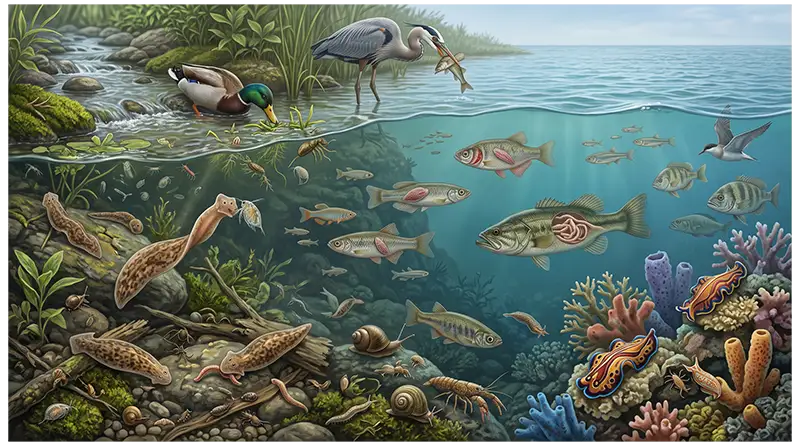
Platyhelminths play several roles in aquatic, terrestrial, and host-associated ecosystems. Free-living flatworms can act as predators and consumers of small organisms. They can influence populations of microorganisms and other small animals in aquatic food webs.
They may also serve as food for larger animals. Parasitic flatworms have another important ecological role. Parasites are part of natural food webs and can influence the health, behavior, reproduction, and population sizes of their hosts. Because some flatworms use multiple hosts, their life cycles can connect different parts of an ecosystem.
For example, a parasite may depend on an aquatic snail, a fish, and a bird or mammal at different stages. Changes in the population of one host can therefore affect the parasite's entire life cycle.
Flatworms are also useful indicators of ecological relationships because their presence and abundance can reflect interactions among hosts, parasites, predators, and environmental conditions.
How Did Platyhelminthes Evolve?
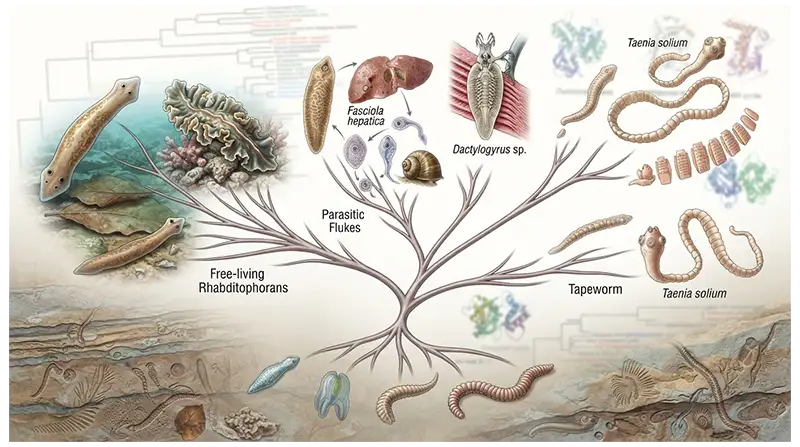
The evolutionary history of Platyhelminthes is complex and continues to be studied using fossils, anatomy, development, and molecular evidence. Flatworms belong to the broader group Bilateria, animals with bilateral symmetry. Their body organization includes tissues derived from three embryonic germ layers and a more organized head-to-tail body plan.
The fossil record of soft-bodied flatworms is limited because their bodies are easily destroyed before fossilization. As a result, scientists rely heavily on molecular data and comparisons of living species to understand their early evolution. Parasitic flatworms evolved specialized relationships with other animals. Over evolutionary time, these relationships produced complex life cycles, attachment structures, reproductive adaptations, and specialized body surfaces.
The evolution of flatworms is therefore not simply a story of increasing complexity. Different lineages followed different paths depending on whether they became free-living predators, scavengers, or parasites. Modern genetic studies continue to change our understanding of relationships among the major flatworm groups. This is why current classifications can differ from older textbook systems.
Why Are Platyhelminthes Important?
Platyhelminthes are important in biology, ecology, medicine, and evolutionary research.
In ecology, free-living flatworms participate in aquatic food webs, while parasitic species influence interactions between hosts and their environments.
In medicine and veterinary science, some parasitic flatworms cause important diseases in humans and other animals. Tapeworms and several groups of flukes are medically significant parasites.
In evolutionary research, flatworms help scientists study the development of bilateral animals, tissue organization, parasitism, and changes in body structure.
In regeneration research, planarians are especially valuable because some species can rebuild large portions of their bodies after injury. Scientists study their stem cells and regeneration processes to better understand how tissues develop and repair themselves.
In education, flatworms provide a useful example of how animal body plans can support both free-living and highly specialized parasitic lifestyles.
Their importance therefore extends well beyond their small size. They are connected to major questions about animal evolution, ecosystems, disease, and biological regeneration.
Conclusion
Platyhelminthes are a diverse group of soft-bodied animals commonly known as flatworms. Their simple-looking bodies support a wide range of lifestyles, from free-living aquatic predators to highly specialized parasites.
Their main features include bilateral symmetry, a flattened body, three embryonic germ layers, simple organ systems, and specialized structures for feeding, movement, reproduction, and waste removal. Different groups have developed very different body forms and survival strategies.
Free-living flatworms contribute to aquatic food webs, while parasitic species have important relationships with their hosts. Planarians have also become valuable research organisms because of their remarkable ability to regenerate.
Although their fossil record is limited, anatomical and molecular evidence provides important information about their evolutionary history. Studying Platyhelminthes therefore helps scientists understand animal evolution, parasitism, regeneration, ecology, and the development of complex body plans.
No. Many flatworms are free-living and occur in freshwater, marine environments, and moist habitats. Parasitic groups include flukes, tapeworms, and monogeneans.
Their bodies are generally flattened from top to bottom, giving them a flat appearance.
Many free-living flatworms have a digestive system with a mouth and branching digestive cavity. Tapeworms are highly specialized parasites and lack a conventional digestive tract.
No. They generally lack a specialized circulatory system. Their flattened bodies and branching internal structures help distribute nutrients and gases.
They occur in marine and freshwater environments, moist terrestrial habitats, and the bodies or surfaces of many animals.