
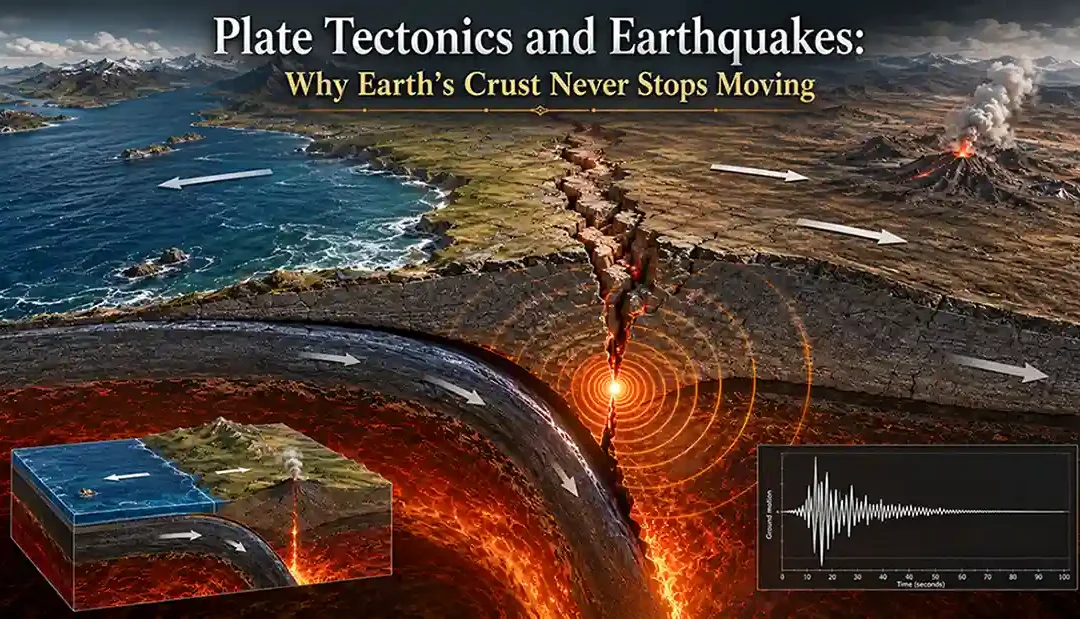
Most earthquakes happen because Earth’s tectonic plates are constantly moving.
Deep beneath the surface:
- giant slabs of Earth’s crust slowly shift
- plates collide, separate, or slide past each other
- stress builds along faults
Eventually, the pressure becomes too great. The rocks suddenly break or slip, releasing energy as an earthquake. Plate tectonics is the main reason earthquakes occur around the world.
If you’re new to earthquakes, begin here → what is an earthquake
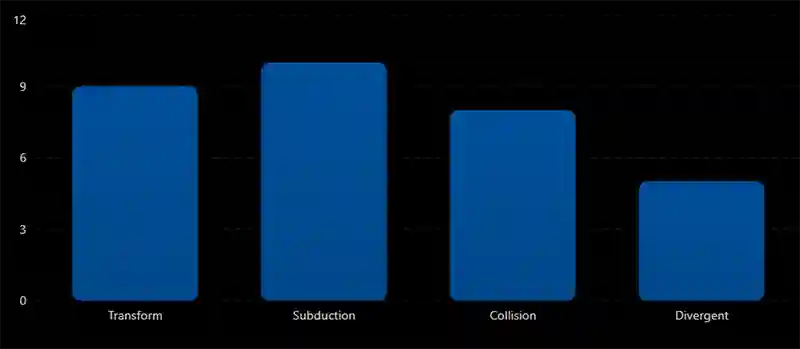
Earthquake Activity at Plate Boundaries
Earthquake Activity by Plate Boundary Type
Different tectonic boundaries produce different levels of earthquake activity.
What Are Tectonic Plates?
Earth’s outer shell is broken into giant sections called tectonic plates. These plates float slowly on hotter, softer layers beneath Earth’s crust.
Major tectonic plates include:
- Pacific Plate
- North American Plate
- Eurasian Plate
- African Plate
- Indo-Australian Plate
- South American Plate
Plate movement is usually only a few centimeters per year.
Why Plate Movement Causes Earthquakes
As tectonic plates move:
- rocks become compressed
- faults lock together
- stress builds underground
Eventually:
The rocks suddenly slip or break.
This rapid movement releases:
- seismic waves
- ground shaking
- earthquake energy
Learn more → earthquake energy release explained
The Three Main Plate Boundary Types
Most earthquakes occur along tectonic plate boundaries.
1. Transform Boundaries
At transform boundaries, plates slide sideways past each other.
Famous Example
- San Andreas Fault (California)
Common Features
- shallow earthquakes
- sudden fault rupture
- strong surface shaking
Learn more → earthquakes Southern California
2. Subduction Zones
Subduction zones form when one tectonic plate dives beneath another.
These regions create:
- giant megathrust earthquakes
- tsunamis
- volcanic activity
Famous Regions
- Japan
- Chile
- Indonesia
- Alaska
Many of Earth’s strongest earthquakes occur here.
3. Continental Collision Zones
Collision zones occur when continental plates crash into each other.
Results Include
- mountain building
- crust deformation
- large earthquakes
Famous Example
- Himalayan region
Learn more → earthquakes Pakistan
Divergent Boundaries and Earthquakes
Divergent boundaries occur where plates move apart.
These regions often produce:
- smaller earthquakes
- volcanic activity
- crust formation
Famous Example
- Mid-Atlantic Ridge
- Iceland
Learn more → earthquakes Iceland
Why Most Earthquakes Happen Near Plate Boundaries
| Plate Boundary Type | Typical Earthquake Activity |
|---|---|
| Transform | Frequent shallow earthquakes |
| Subduction | Giant megathrust earthquakes |
| Collision | Strong crustal earthquakes |
| Divergent | Smaller spreading earthquakes |
Plate boundaries are Earth’s main seismic zones.
The Pacific Ring of Fire
The Pacific Ring of Fire is the world’s most active earthquake region.
It surrounds much of the Pacific Ocean and contains:
- subduction zones
- volcanoes
- major fault systems
Countries Inside the Ring of Fire
- Japan
- Chile
- Indonesia
- New Zealand
- United States west coast
Most of Earth’s largest earthquakes occur here.
Can Earthquakes Happen Away From Plate Boundaries?
Yes.
Some earthquakes occur:
- inside tectonic plates
- along ancient faults
- in stable continental regions
These are called intraplate earthquakes. Although less common, they can still be damaging.
Famous Earthquakes Caused by Plate Tectonics
| Earthquake | Plate Interaction |
|---|---|
| 2011 Japan Tohoku | Subduction zone |
| 1960 Chile | Subduction zone |
| 1906 San Francisco | Transform fault |
| 2005 Kashmir | Continental collision |
Different plate movements create different earthquake styles.
How Scientists Study Plate Tectonics
Scientists use:
- GPS monitoring
- seismic sensors
- satellite imaging
- fault mapping
These tools help track:
- plate movement
- stress buildup
- earthquake risk zones
Learn more → earthquake monitoring technology
Plate Tectonics and Tsunami Risk
Subduction zone earthquakes can suddenly move the seafloor. This displacement may create tsunamis. That’s why coastal regions near subduction zones face especially high earthquake and tsunami risk.
Why Plate Tectonics Matter
Plate tectonics explains:
- earthquakes
- volcanoes
- mountain formation
- ocean trenches
- continental movement
It is one of the most important theories in Earth science.
Could Plate Movements Stop Someday?
Tectonic plates have been moving for hundreds of millions of years. Scientists believe plate tectonics will likely continue far into Earth’s future as long as internal planetary heat remains active.
Movement of tectonic plates along faults.
Near tectonic plate boundaries.
Subduction zones often produce the largest earthquakes.
Yes — intraplate earthquakes can occur inside tectonic plates.
Final Thoughts
Plate tectonics is the driving force behind most earthquakes on Earth. As tectonic plates slowly move, collide, and slide past one another, stress builds deep underground until faults suddenly rupture and release seismic energy.
Understanding plate tectonics helps explain why earthquakes happen, where seismic risk is highest, and how Earth’s surface constantly changes over time.