
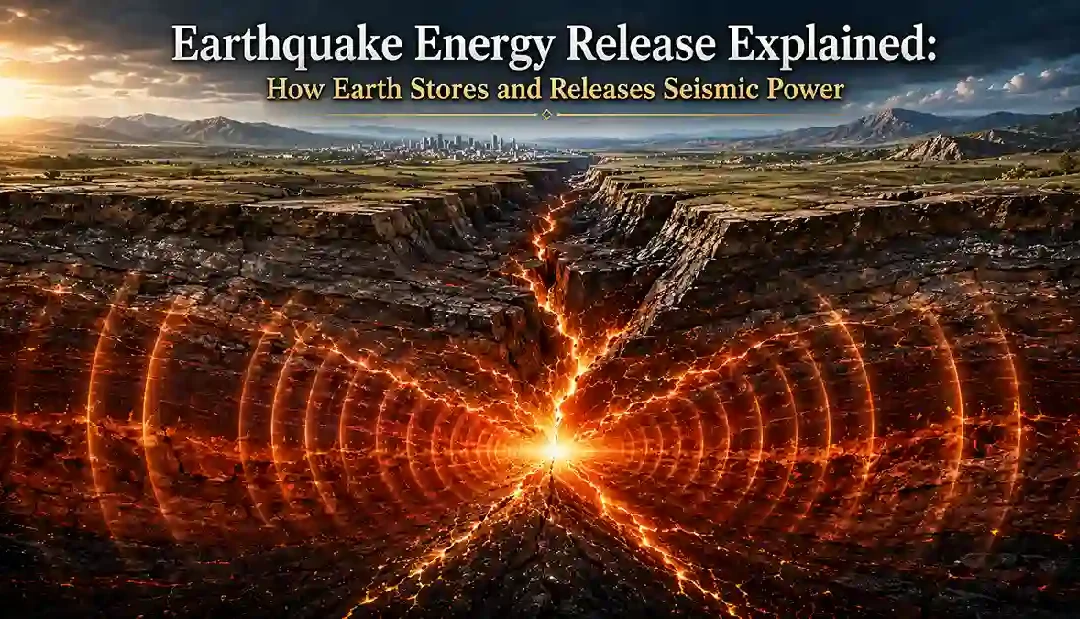
Earthquakes are giant releases of stored energy deep underground. For years — sometimes centuries — tectonic plates slowly push, pull, or grind against each other.
During this time:
- rocks bend
- faults lock
- stress builds underground
Eventually, the rocks can no longer hold the pressure. The fault suddenly slips, releasing enormous seismic energy. That released energy travels through Earth as seismic waves.
If you’re new to earthquakes, begin here → what is an earthquake
How Earthquake Energy Release Works
The earthquake process follows a simple pattern:
| Step | What Happens |
|---|---|
| 1 | Tectonic stress builds |
| 2 | Fault becomes locked |
| 3 | Rocks deform under pressure |
| 4 | Fault suddenly ruptures |
| 5 | Energy spreads as seismic waves |
Most earthquake energy is released within seconds.
Where Does Earthquake Energy Come From?
Earthquake energy ultimately comes from tectonic plate movement. Earth’s tectonic plates constantly move because of heat-driven processes inside the planet.
These movements create:
- compression
- tension
- friction
- shear stress
When stress becomes too large, rocks break, or faults slip suddenly.
Learn more → fault lines
Seismic Waves Carry Earthquake Energy
When a fault ruptures, energy spreads outward in waves. These are called seismic waves.
Main wave types include:
- P waves
- S waves
- surface waves
Surface waves usually cause the strongest damage near Earth’s surface.
Learn more → seismic waves
Earthquake Magnitude vs Energy Release
One of the most important facts in earthquake science is that earthquake magnitude is logarithmic. That means a slightly larger magnitude earthquake releases vastly more energy.
Relative Earthquake Energy Release:
Approximate relative energy released compared to a magnitude 5 earthquake.
| Magnitude | Energy |
|---|---|
| M5 | 1 |
| M6 | 32 |
| M7 | 1000 |
| M8 | 32000 |
| M9 | 1000000 |
Each full magnitude increase releases roughly 32 times more energy.
Why Giant Earthquakes Release So Much Energy
Large earthquakes rupture:
- longer fault sections
- wider underground areas
- deeper tectonic zones
This creates enormous seismic energy release.
Megathrust earthquakes can rupture faults hundreds of kilometers long. These are the strongest earthquakes on Earth.
Learn more → strongest earthquakes in history
Fault Rupture and Energy Transfer
During rupture:
- rocks snap or slide
- stress transfers along the fault
- seismic waves spread outward
Energy moves through:
- Earth’s crust
- mantle layers
- surface regions
Some energy may travel thousands of kilometers.
Why Some Earthquakes Feel More Powerful
Energy release is only part of the story.
Earthquake impact also depends on:
- depth
- distance
- local geology
- building quality
- wave amplification
A shallow moderate earthquake may feel stronger than a deeper larger one.
Learn more → shallow vs deep earthquakes
Comparing Earthquake Energy
| Magnitude | Relative Energy |
|---|---|
| M5 | Baseline |
| M6 | ~32× stronger |
| M7 | ~1,000× stronger |
| M8 | ~32,000× stronger |
| M9 | ~1,000,000× stronger |
Giant earthquakes release astonishing amounts of energy.
Earthquake Energy and Tsunamis
When offshore earthquakes release huge energy:
- the seafloor may suddenly shift
- ocean water is displaced
- tsunami waves form
Most major tsunamis come from shallow megathrust earthquakes.
Famous Earthquakes With Extreme Energy Release
1. 1960 Chile Earthquake (M9.5)
The strongest recorded earthquake released extraordinary tectonic energy.
Explore → earthquakes Santiago Chile
2. 2011 Japan Tohoku Earthquake
This earthquake released massive energy beneath the Pacific Ocean.
It generated one of history’s most destructive tsunamis.
3. 1964 Alaska Earthquake
The Alaska earthquake caused:
- huge crustal movement
- widespread seismic waves
- major tsunami generation
Can Scientists Measure Earthquake Energy?
Yes.
Scientists estimate energy using:
- magnitude scales
- seismic wave measurements
- fault rupture analysis
The most commonly used modern scale is:
The Moment Magnitude Scale (Mw).
Why Earthquake Energy Matters
Understanding seismic energy helps scientists:
- estimate earthquake strength
- compare earthquakes globally
- model tsunami risk
- improve hazard forecasting
Energy release is one of the most important concepts in seismology.
Could Earth Release Even More Energy?
Scientists believe Earth’s tectonic system is capable of extremely powerful earthquakes, especially along giant subduction zones.
Potential future megathrust regions include:
- Chile
- Japan
- Cascadia
- Indonesia
Learn more → earthquake risk zones worldwide
Stress buildup and sudden fault rupture underground.
About 32 times more energetic.
Seismic waves.
No — energy varies greatly depending on magnitude and rupture size.
Final Thoughts
Earthquakes occur when the Earth suddenly releases enormous amounts of stored tectonic energy. This energy spreads outward as seismic waves, causing the shaking people feel during earthquakes.
Understanding earthquake energy release helps explain why giant earthquakes can reshape coastlines, generate tsunamis, and release more power than most other natural events on Earth.