
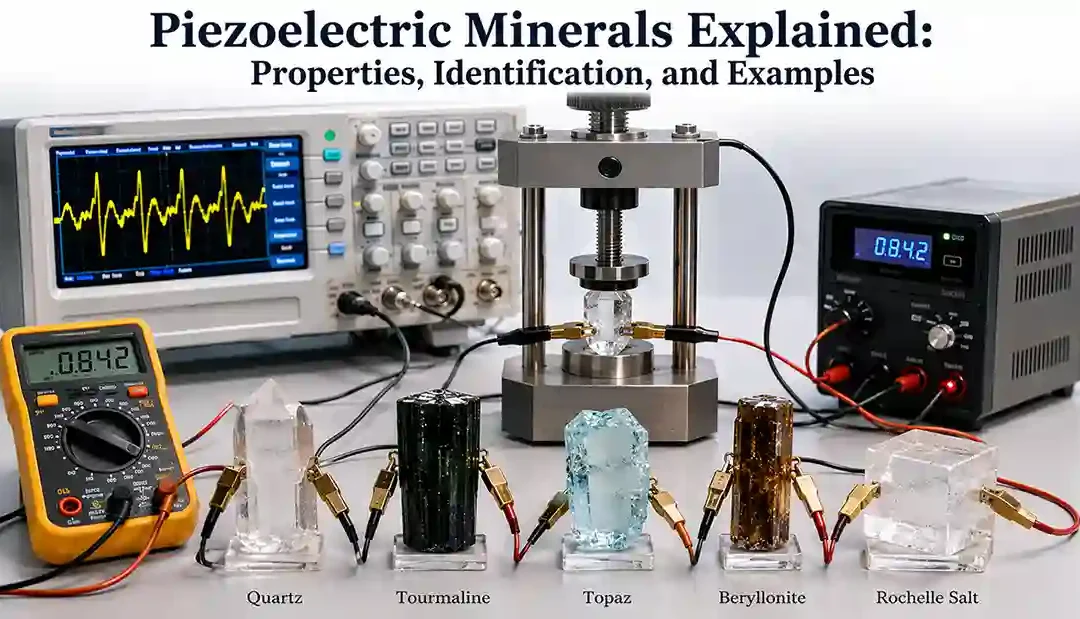
Piezoelectricity is one of the most fascinating electrical properties found in certain minerals. When mechanical pressure is applied to specific crystals, they generate a small electrical charge. Conversely, when an electric field is applied, these crystals can change shape slightly. This phenomenon is known as the piezoelectric effect.
Quartz is the best-known piezoelectric mineral and is widely used in watches, pressure sensors, medical ultrasound equipment, microphones, GPS devices, radios, and electronic oscillators. Although only a limited number of minerals exhibit piezoelectricity, this property has become one of the most important links between mineralogy and modern technology.
For mineral identification, piezoelectricity complements other physical and optical properties such as conductivity, hardness, density, crystal structure, and optical behavior.
If you are studying mineral physics, this topic is best learned together with Mineral Conductivity, Optical Properties of Minerals, and How to Identify Minerals.
What Are Piezoelectric Minerals?
Piezoelectric minerals are crystals that generate an electrical charge when subjected to mechanical stress such as:
- Compression
- Tension
- Bending
- Twisting
- Vibration
The electrical charge appears because the crystal structure lacks a center of symmetry, allowing positive and negative charges to become separated under stress.
What Is the Piezoelectric Effect?
The piezoelectric effect is the direct conversion of mechanical energy into electrical energy.
It also works in reverse.
When electricity is applied:
- The crystal expands slightly.
- The crystal contracts slightly.
- The crystal vibrates at a predictable frequency.
This reverse effect is widely used in precision electronic devices.
Why Does Piezoelectricity Occur?
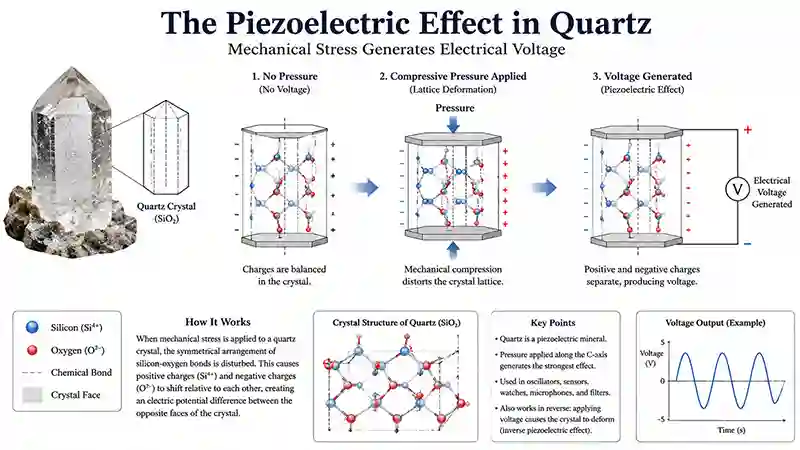
Piezoelectricity occurs because certain crystal structures are non-centrosymmetric, meaning their atoms are not arranged symmetrically around a central point.
When pressure is applied:
- Positive ions shift.
- Negative ions shift.
- Electric polarization develops.
- A measurable voltage appears across the crystal.
Crystal symmetry determines whether a mineral can be piezoelectric.
Common Piezoelectric Minerals
Several naturally occurring minerals display piezoelectric behavior.
| Mineral | Formula | Piezoelectric Strength |
|---|---|---|
| Quartz | SiO₂ | Excellent |
| Tourmaline | Complex Borosilicate | High |
| Topaz | Al₂SiO₄(F,OH)₂ | Moderate |
| Berlinite | AlPO₄ | Moderate |
| Rochelle Salt* | KNaC₄H₄O₆·4H₂O | Very High |
*Rochelle salt is a synthetic or laboratory-grown crystal commonly used in demonstrations and electronic applications rather than a naturally occurring mineral.
Quartz is by far the most important natural piezoelectric mineral.
Minerals That Are Not Piezoelectric
Many common minerals do not exhibit piezoelectricity because their crystal structures are symmetrical.
Examples include:
- Calcite
- Halite
- Magnetite
- Fluorite
- Galena
- Pyrite
These minerals may possess other electrical or magnetic properties but do not generate electricity under mechanical stress.
Crystal Systems and Piezoelectricity
Piezoelectricity depends on crystal symmetry.
Crystal systems that commonly contain piezoelectric minerals include:
- Trigonal
- Hexagonal
- Orthorhombic
- Monoclinic
- Tetragonal
Minerals in the cubic crystal system generally do not exhibit piezoelectricity because of their symmetry.
Learn more in Crystal Systems Explained.
How Is Piezoelectricity Measured?
Scientists measure the piezoelectric effect using specialized laboratory equipment.
Common instruments include:
- Oscilloscope
- Electrometer
- Piezoelectric testing apparatus
- Digital multimeter
- Signal amplifier
Mechanical pressure is applied while the generated electrical voltage is recorded.
Quartz: The Most Important Piezoelectric Mineral
Quartz is the world's most widely used natural piezoelectric crystal.
Its advantages include:
- High stability
- Predictable vibration frequency
- Excellent durability
- Low cost
- Natural abundance
Quartz crystals are used in:
- Wristwatches
- Computers
- Radios
- GPS receivers
- Oscillators
- Telecommunications
Even today, quartz remains essential in many precision timing devices.
Industrial Applications
Piezoelectric minerals and synthetic piezoelectric crystals are used in:
- Quartz watches
- Pressure sensors
- Accelerometers
- Medical ultrasound
- Sonar equipment
- Inkjet printers
- Electronic oscillators
- Microphones
- Speakers
- Frequency filters
Their ability to convert mechanical and electrical energy makes them indispensable in modern technology.
Piezoelectric Minerals in Geology
Although piezoelectricity is not commonly used as a routine field identification test, it is important in:
- Mineral physics
- Crystal chemistry
- Rock mechanics
- Earthquake research
- Laboratory mineral analysis
Some researchers study piezoelectric effects in stressed quartz-bearing rocks to better understand electrical signals generated during fault movement.
Advantages of Piezoelectric Minerals
Piezoelectric minerals offer several advantages:
- Stable electrical output
- High precision
- Long operational life
- Reliable frequency control
- Non-destructive energy conversion
Quartz is particularly valued because of its exceptional stability over long periods.
Limitations
Piezoelectricity should not be used alone for mineral identification because:
- Only a few minerals exhibit the effect.
- Specialized instruments are required.
- Electrical output is often very small.
- Crystal orientation influences measurements.
For reliable mineral identification, combine piezoelectric properties with:
- Mineral Conductivity
- Optical Properties of Minerals
- Refractive Index in Minerals
- Double Refraction Explained
- Mineral Density Test
- Mineral Hardness Test
- Crystal Systems Explained
Comparison Table
| Property | Piezoelectric Minerals |
| Energy Conversion | Mechanical ↔ Electrical |
| Best Example | Quartz |
| Main Equipment | Oscilloscope, Electrometer |
| Common Applications | Electronics, Sensors, Watches |
| Identification Value | Moderate |
Summary Table
| Feature | Piezoelectric Minerals |
| Main Property | Generate Electricity Under Pressure |
| Most Important Mineral | Quartz |
| Other Minerals | Tourmaline, Topaz, Berlinite |
| Industrial Uses | Sensors, Oscillators, Ultrasound |
| Scientific Importance | Crystal Physics & Mineralogy |
Piezoelectric minerals are crystals that generate an electrical charge when mechanical pressure is applied and can also deform slightly when exposed to an electric field.
Quartz (SiO₂) is the most important and widely used natural piezoelectric mineral.
Only minerals with non-centrosymmetric crystal structures can develop electrical polarization when stressed.
It is used in quartz watches, pressure sensors, ultrasound equipment, microphones, GPS devices, electronic oscillators, and many other electronic systems.
Yes, but it is mainly a laboratory property. It is usually combined with optical, physical, and crystallographic tests rather than used alone.
Final Thoughts
Piezoelectric minerals demonstrate one of the most remarkable relationships between crystal structure and electricity. Their ability to convert mechanical stress into electrical energy has transformed fields ranging from electronics and telecommunications to medicine and scientific research. Quartz, the most important piezoelectric mineral, continues to play a vital role in precision timing, sensing, and communication technologies.
Although piezoelectricity is not commonly used as a routine field identification test, understanding this property provides valuable insight into mineral physics and crystal chemistry. Combined with conductivity, optical properties, density, hardness, and crystal structure, it offers a deeper understanding of how minerals behave and why they are essential to both Earth science and modern technology.
Continue Learning
Expand your knowledge with these related guides: