
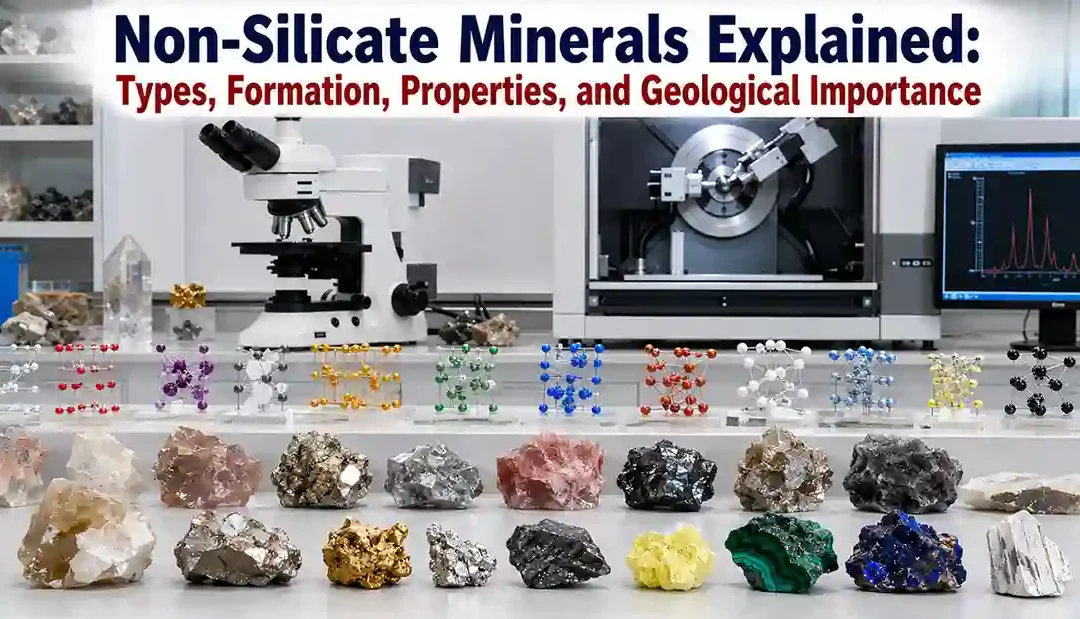
Non-silicate minerals are all minerals that do not contain the silicon-oxygen tetrahedron (SiO₄⁴⁻) as their primary structural unit. Although they make up only about 10% of Earth's crust, they include many of the world's most economically valuable minerals, supplying metals such as gold, silver, copper, lead, zinc, iron, uranium, and aluminum, as well as industrial materials like gypsum, halite, fluorite, barite, and phosphate.
Unlike silicate minerals, which dominate most rocks, non-silicate minerals commonly form through chemical precipitation, hydrothermal activity, evaporation, metamorphism, biological processes, and weathering. They occur in sedimentary basins, hydrothermal veins, ore deposits, caves, evaporite basins, and metamorphic rocks.
Understanding non-silicate minerals is essential for mineralogy, economic geology, mining, environmental geology, geochemistry, and Earth science.
This topic should be studied together with Silicate Minerals, Carbonate Minerals, Evaporite Minerals, and Hydrothermal Minerals.
What Are Non-Silicate Minerals?
Non-silicate minerals are minerals that lack the silicon-oxygen tetrahedral structure.
Instead, they are classified according to their dominant anion or elemental composition.
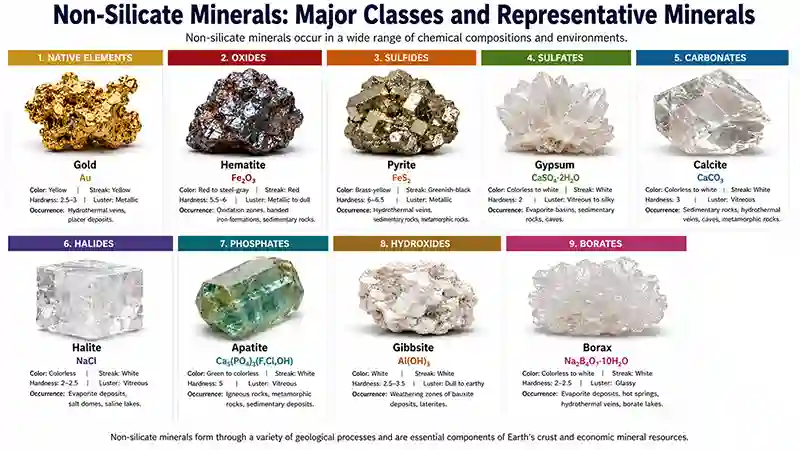
Major groups include:
- Native Elements
- Oxides
- Sulfides
- Sulfates
- Carbonates
- Halides
- Phosphates
- Hydroxides
- Nitrates
- Borates
These groups contain thousands of mineral species.
How Non-Silicate Minerals Form
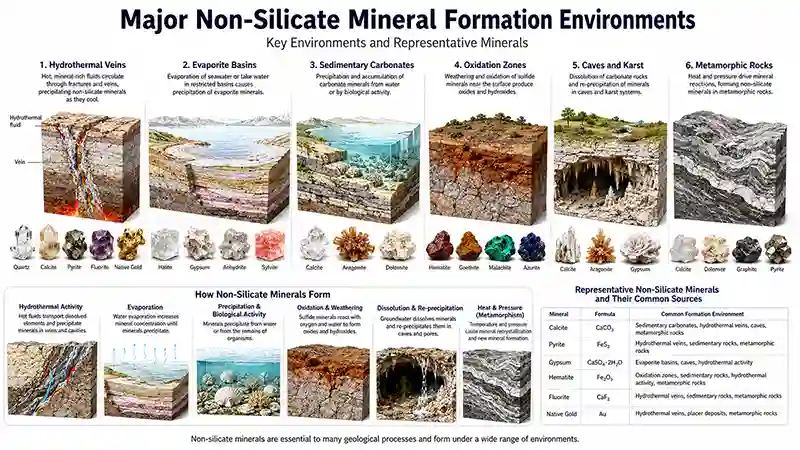
Non-silicate minerals develop through many geological processes.
Common formation mechanisms include:
- Hydrothermal mineralization
- Chemical precipitation
- Evaporation
- Weathering
- Metamorphism
- Magmatic crystallization
- Biological activity
Different geological environments produce different mineral groups.
Major Groups of Non-Silicate Minerals
Native Elements
Native elements consist of a single chemical element.
Common examples:
- Gold
- Silver
- Copper
- Platinum
- Sulfur
- Graphite
- Diamond
These minerals commonly occur in hydrothermal veins and placer deposits.
Oxide Minerals
Oxides contain oxygen bonded to one or more metal elements.
Common minerals:
- Hematite
- Magnetite
- Corundum
- Rutile
- Chromite
Economic importance:
- Iron ore
- Titanium ore
- Chromium ore
- Gemstones
Sulfide Minerals
Sulfides contain sulfur combined with metals.
Common minerals:
- Pyrite
- Chalcopyrite
- Galena
- Sphalerite
- Bornite
- Molybdenite
Economic importance:
Most metallic ores are sulfide minerals.
Sulfate Minerals
Sulfates contain the sulfate ion (SO₄²⁻).
Common minerals:
- Gypsum
- Anhydrite
- Barite
- Celestite
Major uses:
- Cement
- Construction
- Drilling fluids
- Chemical industry
Carbonate Minerals
Carbonates contain the carbonate ion (CO₃²⁻).
Common minerals:
- Calcite
- Dolomite
- Aragonite
- Magnesite
- Siderite
- Rhodochrosite
They are the primary components of limestone and marble.
Halide Minerals
Halides contain halogen elements.
Common minerals:
- Halite
- Sylvite
- Fluorite
Major uses:
- Salt
- Fertilizers
- Chemical manufacturing
- Metallurgy
Phosphate Minerals
Phosphates contain the phosphate ion (PO₄³⁻).
Common minerals:
- Apatite
- Monazite
- Turquoise
Uses:
- Fertilizers
- Rare earth elements
- Gemstones
Hydroxide Minerals
Hydroxides contain hydroxyl (OH⁻).
Examples:
- Gibbsite
- Goethite
- Brucite
They commonly form during weathering.
Borate Minerals
Borates commonly form in evaporite environments.
Examples:
- Borax
- Colemanite
- Ulexite
Uses:
- Glass
- Ceramics
- Detergents
Nitrate Minerals
Nitrates are relatively rare.
Examples:
- Nitratine
- Niter
These minerals commonly form in extremely arid climates.
Physical Properties
Non-silicate minerals display a wide range of properties.
Examples include:
- Hardness from 1 (graphite) to 10 (diamond)
- Metallic or non-metallic luster
- Variable density
- Excellent cleavage in some minerals
- Strong acid reaction in carbonates
- Magnetism in magnetite
- High solubility in halides
Their properties depend on their chemical composition and crystal structure.
Non-Silicate Minerals in Different Geological Environments
| Geological Environment | Common Non-Silicate Minerals |
|---|---|
| Hydrothermal Veins | Pyrite, Galena, Chalcopyrite |
| Marine Sediments | Calcite, Dolomite |
| Evaporite Basins | Halite, Gypsum, Sylvite |
| Weathering Zones | Goethite, Gibbsite |
| Igneous Rocks | Magnetite, Chromite |
| Metamorphic Rocks | Graphite, Corundum |
Each environment produces characteristic mineral assemblages.
Economic Importance
Non-silicate minerals are among the world's most valuable mineral resources.
Major applications include:
- Iron production
- Copper production
- Gold mining
- Zinc extraction
- Lead production
- Fertilizer manufacturing
- Cement production
- Glass manufacturing
- Chemical industry
- Jewelry
Many strategic and critical minerals belong to non-silicate groups.
Laboratory Identification
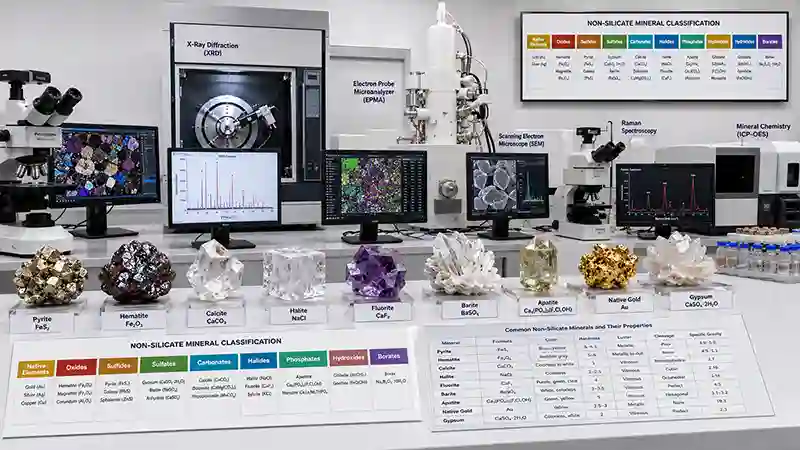
Non-silicate minerals are commonly identified using:
- Hand specimen examination
- Acid reaction tests
- Petrographic Microscopy
- X-Ray Diffraction (XRD)
- Electron Microprobe Analysis (EPMA)
- Scanning Electron Microscopy (SEM)
- Raman Spectroscopy
- X-Ray Fluorescence (XRF)
These methods determine mineral chemistry, crystal structure, and trace element composition.
Importance of Non-Silicate Minerals
Studying non-silicate minerals helps geologists:
- Identify ore deposits
- Understand hydrothermal systems
- Reconstruct sedimentary environments
- Investigate weathering processes
- Explore industrial mineral resources
- Study Earth's geochemical cycles
They are fundamental to both geology and mining.
Applications
Non-silicate mineral studies are important in:
- Mineralogy
- Economic Geology
- Mining Geology
- Environmental Geology
- Geochemistry
- Hydrogeology
- Materials Science
- Industrial Mineral Processing
Advantages of Studying Non-Silicate Minerals
Studying non-silicate minerals allows scientists to:
- Locate economically valuable ore deposits
- Understand chemical sedimentation
- Reconstruct hydrothermal systems
- Improve mineral exploration
- Investigate environmental contamination
- Develop industrial mineral resources
Limitations
Studying non-silicate minerals may be challenging because:
- Many mineral groups have similar appearances.
- Weathering can significantly alter primary ore minerals.
- Fine-grained minerals often require laboratory analysis.
- Some minerals occur only under highly specialized geological conditions.
For comprehensive interpretation, combine non-silicate mineral studies with:
- Silicate Minerals
- Carbonate Minerals
- Evaporite Minerals
- Hydrothermal Minerals
- Petrographic Microscopy
- X-Ray Diffraction in Mineralogy
- Mineral Chemistry Analysis
Comparison Table
| Mineral Group | Representative Minerals | Major Uses |
| Native Elements | Gold, Silver, Copper | Precious Metals |
| Oxides | Hematite, Magnetite, Corundum | Iron, Abrasives |
| Sulfides | Pyrite, Galena, Chalcopyrite | Metal Ores |
| Sulfates | Gypsum, Barite | Cement, Drilling |
| Carbonates | Calcite, Dolomite | Construction, Lime |
| Halides | Halite, Fluorite, Sylvite | Salt, Fertilizer |
| Phosphates | Apatite | Fertilizer |
| Hydroxides | Gibbsite, Goethite | Aluminum, Iron |
| Borates | Borax | Glass, Ceramics |
Summary Table
| Feature | Non-Silicate Minerals |
| Main Structural Feature | No Silicon-Oxygen Tetrahedron |
| Major Groups | Carbonates, Oxides, Sulfides, Halides, Sulfates, Phosphates |
| Main Formation Processes | Hydrothermal, Sedimentary, Weathering, Evaporation |
| Common Identification Methods | Acid Test, XRD, SEM, EPMA |
| Geological Importance | Ore Deposits, Industrial Minerals, Chemical Sedimentation |
Non-silicate minerals are minerals that do not contain silicon-oxygen tetrahedra as their primary structural units. They include carbonates, oxides, sulfides, sulfates, halides, phosphates, native elements, and several other mineral groups.
Silicate minerals are built from silicon-oxygen tetrahedra and dominate Earth's crust, whereas non-silicate minerals lack this structure and are classified by other chemical groups such as carbonates, sulfides, or oxides.
Many economically important minerals are non-silicates, including hematite, magnetite, pyrite, chalcopyrite, galena, sphalerite, calcite, gypsum, halite, fluorite, apatite, native gold, and native silver.
They occur in hydrothermal veins, sedimentary basins, evaporite deposits, weathering zones, igneous rocks, metamorphic rocks, caves, and placer deposits.
Geologists identify them using hand specimen examination, acid reaction tests, petrographic microscopy, X-ray diffraction (XRD), electron microprobe analysis (EPMA), scanning electron microscopy (SEM), Raman spectroscopy, and X-ray fluorescence (XRF).
Final Thoughts
Non-silicate minerals may represent a smaller proportion of Earth's crust than silicate minerals, but they are among the most economically and scientifically significant mineral groups. They supply the metals that support modern industry, form important sedimentary and hydrothermal deposits, regulate chemical cycles, and preserve evidence of Earth's changing environments.
From native gold and sulfide ores to carbonate rocks and evaporite deposits, non-silicate minerals reveal the diversity of geological processes operating within Earth's crust. By combining field observations with petrographic microscopy, X-ray diffraction, mineral chemistry, and geochemical analyses, geologists can classify these minerals, interpret their origins, and explore valuable natural resources.
Continue Learning
Continue exploring mineral classification with these related guides: