
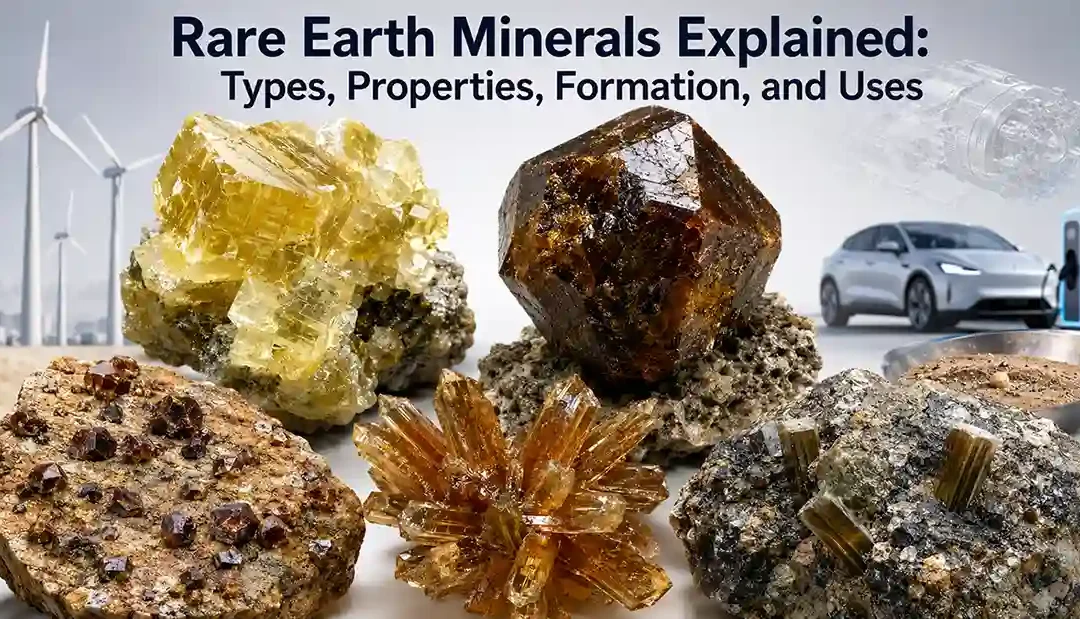
Rare earth minerals are among the most strategically important mineral resources in the modern world. Although the name suggests they are scarce, many rare earth elements are relatively abundant in Earth's crust. The challenge is that they rarely occur in economically concentrated deposits.
Rare earth minerals are essential for:
- electric vehicles
- wind turbines
- smartphones
- computer chips
- defense technologies
- renewable energy systems
Because of their importance to modern technology, rare earth minerals are often classified as critical minerals.
Learn more → mineral classification system
What Are Rare Earth Minerals?
Rare earth minerals are minerals that contain significant concentrations of rare earth elements (REEs).
These elements include:
- lanthanum
- cerium
- neodymium
- praseodymium
- samarium
- europium
- yttrium
- dysprosium
Most rare earth elements belong to the lanthanide series on the periodic table.
Rare Earth Element Symbols
The most economically important rare earth elements include:
| Element | Symbol |
|---|---|
| Lanthanum | La |
| Cerium | Ce |
| Praseodymium | Pr |
| Neodymium | Nd |
| Samarium | Sm |
| Europium | Eu |
| Gadolinium | Gd |
| Dysprosium | Dy |
| Yttrium | Y |
These elements are extracted from specialized rare earth minerals.
Major Rare Earth Minerals
| Mineral | Formula | Importance |
|---|---|---|
| Bastnäsite | (Ce,La)(CO₃)F | Primary REE Ore |
| Monazite | (Ce,La,Nd,Th)PO₄ | Major REE Ore |
| Xenotime | YPO₄ | Heavy REE Source |
| Loparite | (Na,Ce,Ca)(Ti,Nb)O₃ | REE Ore |
| Allanite | Complex Silicate | REE Source |
Bastnäsite – The Most Important Rare Earth Mineral
Bastnäsite is one of the world's most important rare earth minerals.
Its generalized formula is: (Ce,La)(CO₃)F
Characteristics include:
- carbonate composition
- fluorine content
- light rare earth enrichment
- economic significance
Many modern rare earth mines primarily exploit bastnäsite deposits.
Monazite
Monazite is one of the most widespread rare earth minerals.
Its generalized formula is: (Ce,La,Nd,Th)PO₄
Features include:
- phosphate composition
- high rare earth content
- thorium enrichment
- placer deposit occurrence
Monazite is an important source of cerium, lanthanum, and neodymium.
Xenotime
Xenotime is an important source of heavy rare earth elements.
Its formula is: YPO4
Characteristics include:
- yttrium-rich composition
- heavy REE enrichment
- phosphate mineral structure
It is particularly important for high-tech applications.
Loparite
Loparite is a complex oxide mineral.
Its generalized formula is: (Na,Ce,Ca)(Ti,Nb)O₃
It commonly contains:
- cerium
- niobium
- titanium
and serves as an important rare earth resource in some deposits.
Allanite
Allanite is a rare earth-bearing silicate mineral.
Its generalized formula is: A2M3Si3O12[OH]
It occurs in:
- granites
- pegmatites
- metamorphic rocks
and contributes to rare earth resources in certain regions.
Formation of Rare Earth Deposits
Carbonatite Magmatism
One of the most important sources of rare earth minerals.
Alkaline Igneous Rocks
Common REE-bearing environments.
Pegmatites
Can host specialized rare earth minerals.
Placer Deposits
Concentrate resistant minerals such as monazite.
Carbonatite Rare Earth Deposits
Many of the world's largest rare earth deposits occur in:
- carbonatites
- alkaline complexes
- igneous intrusive systems
These geological environments provide ideal conditions for REE concentration.
Rare Earth Minerals and Modern Technology
Rare earth elements are critical components of:
Electric Vehicles
High-performance magnets.
Wind Turbines
Permanent magnet generators.
Smartphones
Miniaturized electronics.
Computer Hard Drives
Data storage technologies.
Defense Systems
Advanced guidance technologies.
Major Uses of Rare Earth Elements
| Industry | Application |
|---|---|
| Renewable Energy | Wind Turbines |
| Transportation | Electric Vehicles |
| Electronics | Smartphones |
| Computing | Hard Drives |
| Defense | Advanced Systems |
Rare Earth Elements Used in Magnets
The strongest permanent magnets often contain:
- neodymium (Nd)
- praseodymium (Pr)
- dysprosium (Dy)
These magnets are critical for:
- EV motors
- robotics
- industrial machinery
- renewable energy systems
Major Rare Earth-Producing Countries
Important producers include:
- China
- Australia
- United States
- Myanmar
- Russia
- India
These countries host many of the world's largest rare earth deposits.
How Geologists Identify Rare Earth Minerals
Bastnäsite
- carbonate mineral
- yellow-brown coloration
- REE enrichment
Monazite
- dense phosphate mineral
- reddish-brown grains
Xenotime
- heavy mineral
- yttrium-rich composition
Allanite
- dark silicate mineral
- metamorphic associations
Modern exploration commonly uses geochemical and mineralogical analysis.
Learn more → mineral identification guide
Rare Earth Minerals Summary
| Mineral | Formula | Main Use |
|---|---|---|
| Bastnäsite | (Ce,La)(CO₃)F | REE Ore |
| Monazite | (Ce,La,Nd,Th)PO₄ | REE Ore |
| Xenotime | YPO₄ | Heavy REE Source |
| Loparite | (Na,Ce,Ca)(Ti,Nb)O₃ | REE Ore |
| Allanite | Complex Silicate | REE Source |
Rare earth minerals are minerals that contain economically important rare earth elements such as cerium, lanthanum, neodymium, and yttrium.
Bastnäsite is one of the world's most important rare earth ore minerals.
Many rare earth elements are relatively abundant, but economically concentrated deposits are uncommon.
They are used in electric vehicles, wind turbines, smartphones, computer hardware, and advanced technologies.
China is currently one of the world's leading rare earth producers.
Final Thoughts
Rare earth minerals have become some of the most strategically important mineral resources of the 21st century. Minerals such as bastnäsite, monazite, and xenotime provide the rare earth elements needed for renewable energy, electronics, transportation, and advanced technologies.
As demand for electric vehicles, wind power, and high-tech manufacturing continues to grow, rare earth minerals will remain essential to the future of global industry and sustainable technology.